To avoid these ads, REGISTER NOW!

Show us your sewing projects!

kerrynzl

Well-known member
Joined
Nov 8, 2013
Messages
5,054
Location
Tauranga, New Zealand
Nice job Kerry and also, that's a really nice galvanized trailer (looks fresh) but don't lose that cover, as that might cost you another paint job to match : )

Thanks! I was smart enough to make 2 covers from the same pattern [it only took an extra 15 minutes for the 2nd one when done at the same time]
In NZ our UV is that strong that PVC doesn't last long.
 
Last edited:
To avoid these ads, REGISTER NOW!

F-22

Well-known member
Joined
Jan 23, 2022
Messages
1,830
I bought this cool old leather jacket. No brand, it's tailor made locally. At a flea market, I got it for 30€! I immediately jumped at it, because I have a practically identical jacket (with winter lining, this used one is thinner and more for spring/autumn...) which I bought a couple years ago for 600€ directly from the tailor (and it's probably even more pricey today).

PReETuv.jpeg

Does anyone know of a good way to cover up the BMW and Honda emroidery? Tbf I have both BMW and Honda bikes, but I want to wear it more casually and not stand out anywhere with it (well, it's a cool leather jacket so it'll always stand out, but I always associate guys with such BMW jacket patches with old people). Kind of sad because it's really top notch work, I hoped it's a patch but it's not.

YP59XlW.jpeg

I just don't want to wear any kind of branding... It's a shame to ruin such a jacket, but then again I did get it practically for free.
 

kerrynzl

Well-known member
Joined
Nov 8, 2013
Messages
5,054
Location
Tauranga, New Zealand
I bought this cool old leather jacket. No brand, it's tailor made locally. At a flea market, I got it for 30€! I immediately jumped at it, because I have a practically identical jacket (with winter lining, this used one is thinner and more for spring/autumn...) which I bought a couple years ago for 600€ directly from the tailor (and it's probably even more pricey today).

PReETuv.jpeg

Does anyone know of a good way to cover up the BMW and Honda emroidery? Tbf I have both BMW and Honda bikes, but I want to wear it more casually and not stand out anywhere with it (well, it's a cool leather jacket so it'll always stand out, but I always associate guys with such BMW jacket patches with old people). Kind of sad because it's really top notch work, I hoped it's a patch but it's not.

YP59XlW.jpeg

I just don't want to wear any kind of branding... It's a shame to ruin such a jacket, but then again I did get it practically for free.

Try and find some matching grain leather.. Then sew Faux pockets over the real ones.

I did this on embossed leather a few years ago, [also glued it flat and sewed it around the edges]
Usually you need to do a bit of unpicking of the lining.

Another tip when sewing leather.
Use sellotape to prevent stretching ,then tear it off like perforated paper after sewing.
 
Last edited:

bugnut

ALLIANCE MEMBER
Joined
Jul 14, 2012
Messages
3,853
Location
Central Ohio
Make/buy/create a couple pockets or logos you like and then a few bits of metal with magnets on the inside of the jacket will hold them in place.
Name tags are held on this way on various pieces of clothing, etc.

https://www.amazon.com/Name-Tag-Badge-Blanks-Magnetic


I bought this cool old leather jacket. No brand, it's tailor made locally. At a flea market, I got it for 30€! I immediately jumped at it, because I have a practically identical jacket (with winter lining, this used one is thinner and more for spring/autumn...) which I bought a couple years ago for 600€ directly from the tailor (and it's probably even more pricey today).

PReETuv.jpeg

Does anyone know of a good way to cover up the BMW and Honda emroidery? Tbf I have both BMW and Honda bikes, but I want to wear it more casually and not stand out anywhere with it (well, it's a cool leather jacket so it'll always stand out, but I always associate guys with such BMW jacket patches with old people). Kind of sad because it's really top notch work, I hoped it's a patch but it's not.

YP59XlW.jpeg

I just don't want to wear any kind of branding... It's a shame to ruin such a jacket, but then again I did get it practically for free.
 

F-22

Well-known member
Joined
Jan 23, 2022
Messages
1,830
Uh I don't know how I haven't thought about extra pockets, but it does seem like by far the best way around it! Thanks.
 

Outlawmws

Well-known member
Joined
Aug 9, 2011
Messages
39,130
Location
The Badlands
Talk to your Taylor guy about small scraps...

I like shoulder pockets yo have side zippers, (just to really make it a pain... :evil: )
 

Outlawmws

Well-known member
Joined
Aug 9, 2011
Messages
39,130
Location
The Badlands
Wow, individual 2" squares too? I'd have pulled the wood workers trick of cutting strips gluing (sewing) the alternating pieces, then cutting "across the grain, then gluing (sewing) again.
 

kerrynzl

Well-known member
Joined
Nov 8, 2013
Messages
5,054
Location
Tauranga, New Zealand
Just spruced up my harbor freight rolling toolbox/stool.

Well done...... What machine are you using?
My weapon of choice is an Adler walking foot [but I sold mine, and sometimes borrow my friends adler]

I bought a little "home sewer" and an overlocker so my wife can learn to sew.
This backfired on me........ I end up doing all the tailoring on her clothes etc [I dislike sewing clothing]

Here I am lengthening some sleeves on a coat.

Sewing Sleeves.jpg

I ended up making all the curtains in our house, plus some roman blinds etc. This saved me over $12 K for a few days work.
The majority of this work was with a staple gun and fitting [similar to seats etc]
 
Last edited:

vpd66

Well-known member
Joined
Mar 1, 2010
Messages
709
Location
Central Wisconsin
Well done...... What machine are you using?
My weapon of choice is an Adler walking foot [but I sold mine, and sometimes borrow my friends adler]

I bought a little "home sewer" and an overlocker so my wife can learn to sew.
This backfired on me........ I end up doing all the tailoring on her clothes etc [I dislike sewing clothing]

Here I am lengthening some sleeves on a coat.

Sewing Sleeves.jpg

I ended up making all the curtain valances in our house, plus some roman blinds etc. This saved me over $12 K for a few days work.
The majority of this work was with a staple gun and fitting [similar to seats etc]
I have a Nakajima 280L and a Singer 111w155 back up machine. I bought the Singer about 10 years ago and was my primary machine until last winter when I bought the Nakajima. I bought the Nakajima to up my production has I've been getting and taking on more upholstery work.
 

macgee

Well-known member
Joined
Jan 11, 2014
Messages
2,834
Location
Sepulveda Pass, CA
Well done...... What machine are you using?
My weapon of choice is an Adler walking foot [but I sold mine, and sometimes borrow my friends adler]
I'm going to guess it was an Adler 67 GK? If so, they're amazing highly coveted German made machines. A true workhorse and thats not too big.
 

kerrynzl

Well-known member
Joined
Nov 8, 2013
Messages
5,054
Location
Tauranga, New Zealand
I'm going to guess it was an Adler 67 GK? If so, they're amazing highly coveted German made machines. A true workhorse and thats not too big.
If anybody is considering doing a bit of upholstery , I highly recommend being a "caretaker" of one of these bulletproof little wonders.
When you're over it all........You'll always get you $$$ back.

The one I had would be 50 years old now. I first used it back in 1977 and it was 2nd hand then. [I purchased it off a former employer]
That employer's son [who is a close friend of mine now] purchased it back from me, on the proviso that I still can use it whenever I needed to.

These are dead simple to repair/maintain [all the timing hooks and feed dogs etc are adjustable and replaceable]

It is the most positive "feeling" machine I have ever used. [fabrics don't slip etc]
When I made all the curtain valances in my home, I used the smallest needle possible and adjusted the hooks over a bit. [this was a one-off job, normally I leave the machine alone]

I made these "Roman Blinds" for my kitchen [my wife pinned the flowers on for that "women's touch"]
20190914_171219.jpg

In my bedroom "walk in wardrobe" the sun always shined in and faded clothes so I cut down some "Venetian blinds" and made this valance to go with them.
[Just after I fitted it to the frame I made]
20190914_153801.jpg

Installed in my wardrobe. [excuse the poor lighting]
20190914_171152.jpg

Curtains are "**** easy" to make! .........It is all about "drape" [how it falls and hangs]
I simply cut these out with a Hot knife to stop them fraying , then top sewed some web with tassels [I purchased from a haberdashery shop]
The real skill was using the staple gun to fit them.

I've done my whole house in this similar theme [after being quoted $16K , I decided to DIY it]
 
Last edited:

macgee

Well-known member
Joined
Jan 11, 2014
Messages
2,834
Location
Sepulveda Pass, CA
Nice, I couldn't think of a better deal, sell the Adler and get to use it whenever you want to.

Unless you need a sewing machine often, then why have it take up precious space when you can have someone else pay you cold hard cash to store it for you when you don't need it : )
 

kerrynzl

Well-known member
Joined
Nov 8, 2013
Messages
5,054
Location
Tauranga, New Zealand
Nice, I couldn't think of a better deal, sell the Adler and get to use it whenever you want to.

Unless you need a sewing machine often, then why have it take up precious space when you can have someone else pay you cold hard cash to store it for you when you don't need it : )

That was the problem, the poor thing got stuck in my garage collecting dust and ****. It always needed a major clean-up just for a simple sewing job [or your fabric got filthy with over spray etc]
Paul [the present caretaker] built a nice cutting bench around it, which made it better to use than what I had.

We both joke about the other inheriting it when one of us "falls off our perch"


Here is some more curtains I did [back in 2018] The fabric on the valances is actually a mismatched pattern to the actual curtains, but looked way better this way.
I lacked motivation to do the walk-in wardrobe [which I completed in 2020] but by then I had run out of webbing and tassels/beads, and couldn't find any to match.
This is why the walk-in wardrobe has different tassels [it was one room only that normally stays closed]

All these valances throughout the house were pre-cut from a template I made ,then overlocked , webbed as individual pieces and sewn together later.
It was a measuring nightmare as not all were the same size [and I tried standardizing them throughout]

I later made "shields" to hide the horizontal pleats [which were simply top sewn] and then corner "drapes" which were an after thought [after my wife gave me the idea]

New Carpet TV Room.jpg

New Carpet Living  Room..jpg


The curtain fabric had a large lace pattern, whereas the valance pattern was totally different [only the colors were similar]
The ropes used to tie back the curtains were purchased off Ali-express


All GJers need understand the motivation behind this "we're all scared of our wives" :LOL: (y) [I'd be quite happy sitting on wooden boxes]
 
Last edited:

WILD-BILL

Well-known member
Joined
Dec 10, 2011
Messages
872
Location
Brook Park Oh
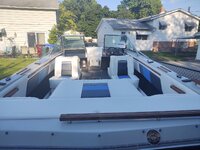
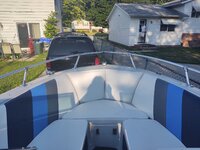
So, Back near the end of 2018, I bought a boat. Nothing fancy. A 19' Rinker V 190 bow rider with a OMC 4cyl. Only paid $700 for it with the trailer as the starter was locked up and as it had been sitting for a while I new the fuel system would need gone through. I really low balled him and was ready to walk away but he took it with out hesitation so here we are.

After finally getting it on the water for a full season last year (my daughters racing kept me busy prior) it seems the interior was more worse for wear then I originally thought.

Ironically, the interior was one of the things I really like about it. Well the color scheme and design anyways.

The boat....

IMAG0001.JPG

As I wasn't really planning on making a before and after post I never took pics of the before so these are the only shots we could snag from a video my kid took showing what the interior was looking like
image0.pngimage1.png


To start off, let me first say that I haven't touched a sewing machine since 1986 or so (Jr High) let alone ever done any upholstery work.

That said, here goes....

I did my best to keep it as close to factory original as I could.


IMG_20220719_184733005.jpgIMG_20220719_185043506.jpgIMAG0002.JPGIMG_20220719_184814929.jpgIMAG0003.JPGIMAG0004.JPGIMG_20220719_184920612.jpg
 
To avoid these ads, REGISTER NOW!

kerrynzl

Well-known member
Joined
Nov 8, 2013
Messages
5,054
Location
Tauranga, New Zealand
A simple project this Time.
My Trailer has Tie-down loops on the Tongue [because this pulls my Race Car forward preventing movement back and forth]
Also by being on the tongue if I have a latch failure on the tilt deck, the Tie-downs will prevent the deck tilting.

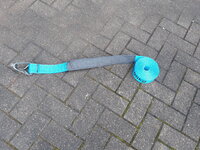
So I got my trusty old hot knife and cut/shortened the webbing straps to the correct length for my race car .
Then I top sewed some sleeves onto the webbing straps so they are in the correct position for when they wrap over the A-Arms of my race car. This saves me trying to reach under and position them.

I now have 2 x purpose built tie-downs for that car/trailer combo.

Tie Down Sleeve 1.jpg

Tie Down Sleeve 3.jpg

Now I have some webbing offcuts leftover from 2 Tie-Downs.
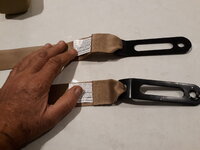
So I purchased 4 x "keepers" and cut one of the offcuts to the correct length to make 2 straps with keepers at each end.

Strap 2.jpg

The sleeves on these 2 "float"
Strap 1.jpg

When my car and trailer is in storage, I detach the tongue, and roll it under the trailer [away from thieving eyes in a domestic garage]
The problem was the front tie-downs needed to be released to do this. So I welded another lashing loop to the trailer frame to hold the race car to prevent it rolling off the back [down the dovetail]
Strap 4.jpg

You can see my winch cover underneath !
Strap 5.jpg

Here is the car and trailer in storage , balanced on axle stands [I can easily shut the garage door with this combo]
In Storage 2.jpg


In case you're wondering about my reversing a trailer skills [which are pretty good] The 57 Chevy beside it is actually sitting on wheel dollies [No paint was harmed making these photos]
 
Last edited:

kerrynzl

Well-known member
Joined
Nov 8, 2013
Messages
5,054
Location
Tauranga, New Zealand
The reason I made 2 x short straps [to retain the car on my trailer] was also to re-purpose them as a tie-down loop through wheels on cars with no tie-down points [usually at the rear]
Strap 3.jpg

With the leftover offcut webbing from the other Tie-down. I sewed a spare "Hook and Keeper" to it [in case I need a longer Ratchet Tie-down]
New Hook and Keeper 1.jpg

New Hook and Keeper 2.jpg

The sleeve on this floats as well.
The black line across the webbing I did with a sharpie. This is the closest I could sew to. [If I went over this line I couldn't slide the hook out from under the keeper]

If anybody is considering sewing tie-downs / seat belts / or load bearing straps ! There is a bit of a science to it ! I was OSH registered to sew these in NZ back in the late 70's [Now a redundant skill due to programmable "Bar Tack Sewing Machines"]

Here is some basic rules from the playbook. [showing relative tension strength of stitching]
stitches.JPG
 

WoodsTruck

Well-known member
Joined
Jan 12, 2013
Messages
1,019
On the attached image of stitching patterns, is there a rule of thumb for the length of stitching in relation to the width of the strap (left 2 examples)?

I have done some of that style before but didn't know what the ratio of strap width and thickness related to length of sewn overlap. I tend to overkill when possible. On smaller 1" strap I tend to make the boxed X pattern as it looks more commercially done.
 

Outlawmws

Well-known member
Joined
Aug 9, 2011
Messages
39,130
Location
The Badlands
Interesting that the Lowest% pattern is what I see on Seat Belts, (even racing seat belts) all the time.

Saved that Pic...
 

kerrynzl

Well-known member
Joined
Nov 8, 2013
Messages
5,054
Location
Tauranga, New Zealand
On the attached image of stitching patterns, is there a rule of thumb for the length of stitching in relation to the width of the strap (left 2 examples)?

I have done some of that style before but didn't know what the ratio of strap width and thickness related to length of sewn overlap. I tend to overkill when possible. On smaller 1" strap I tend to make the boxed X pattern as it looks more commercially done.

The "Rule of thumb" was 300% length/width ratio so if you had 2" wide belts ,you needed 6" of stitching length [not including the fold]
I have tested down to 200% but it required a lot more up/down stitch seams.

You need a decent polyester thread [and the smallest needle possible for the thread] And you really need to play with upper and lower thread tension so it loops in the centre and not seen on either side.

We tested them in a hydraulic tension tester. This measures stretch of the webbing for a given amount of tension

You can easily get over 100% relative strength on tests by simply lengthening the overlap and adding a few more seams [the double thickness acts as one] so there is less stretch.
But going over 100% can cause the stretching to abruptly dissipate at the edge of the seam.
 
Last edited:

kerrynzl

Well-known member
Joined
Nov 8, 2013
Messages
5,054
Location
Tauranga, New Zealand
Interesting that the Lowest% pattern is what I see on Seat Belts, (even racing seat belts) all the time.

Saved that Pic...
The retro colour matched seatbelts in my 57 Chevy had one of the straps sewn on upside-down. [normally I would flip it around in the inertia reel but the safety label would still be on the wrong side]
These were expensive and USA made.

So I simply unpicked them an re-stitched them, so you couldn't tell it was done.
What annoyed me was I had to replicate their original poor/dangerous methods.

They were sewn east/west and only had 100% [2"] seam overlap.
If I corrected this , I would have to argue with our "Road Compliance Nazis"

straps reversed.jpg

The 30% relative strength pattern you are referring to is called a "Gate Stitch" [looks like a farm gate]
This pattern has poor tension strength but is very good at "peel" strength [it resists being peeled off]

This pattern is very common on tents and tarpaulins with buckles and straps.[which try to peel off]
We had a gate stitch bar tack machine that could do this in about 6-10 secs. This was used making tents for military contracts [replicating outdated 1948 British army designs]

But the problem with the industry is "Monkey see....Monkey do" because of deregulation. [or that looks strong enough]
When I see this type of stitching on a tie-down or seat belt, I know damn well the manufacturer has merely plagiarized someone else's mistake.
[then they baffle you with ********]


These longitudinal vs lateral seams etc etc can also be applied [if you're smart] to welding.
Sometimes a stitch weld is stronger than a full weld etc, and you try to avoid welding across something subjected to bending loads
 

WoodsTruck

Well-known member
Joined
Jan 12, 2013
Messages
1,019
I find it interesting you related this to welding. I have played around with thin metal welding where a single run of MIG welding would produce a relatively smooth bead when done, but the heat pattern on the reverse side would be minimal. On the other hand, I would stack spot welds to mimic the stacked dimes of TIG welding, once I released the trigger and let the puddle cool to an orange color then move over and zap the next coin I would actually show a continuous pattern of penetration on the reverse side. If I think I need better penetration on a piece, I will choose this higher concentration of heat energy in the On-Off-On pulse welding technique.
 

kerrynzl

Well-known member
Joined
Nov 8, 2013
Messages
5,054
Location
Tauranga, New Zealand
I find it interesting you related this to welding. I have played around with thin metal welding where a single run of MIG welding would produce a relatively smooth bead when done, but the heat pattern on the reverse side would be minimal. On the other hand, I would stack spot welds to mimic the stacked dimes of TIG welding, once I released the trigger and let the puddle cool to an orange color then move over and zap the next coin I would actually show a continuous pattern of penetration on the reverse side. If I think I need better penetration on a piece, I will choose this higher concentration of heat energy in the On-Off-On pulse welding technique.
when you play around with fabrics you will develop a very good grasp of tensions and spreading loads and also shapes etc [the only thing different with steel is compression loads]
Sometimes when I help my wife make the bed in the morning , I simply give the blankets a simple "tug" and all the wrinkles disappear [my 2 seconds of contribution to household chores :LOL:]


The largest "tension structure" I was involved in was a 50,000 sq ft PVC "cable supported" Marquee.[all H/F welded]
I've also applied this knowledge to "monocoque" designs in race cars etc.

Anyway , when you look at a weld or a seam they are both stronger under shear loads [direction of these joins to the loads is important as the chart above states]

Here is an example on a utility trailer I built 10 years ago. Where the A-frame Tongue is welded to the main frame.
The tension loads are "pulling" at the coupler and "resisting" at the frame [red arrows] creating shear at the welds [blue lines]
Stopping with an un-braked trailer would create compression loads [arrows being opposite] but there is still shear at the welds.

tension loads.PNG

here is an example of the welds.
Tension welds.PNG

Here is the tongue welds from the top . you can see the ends appearing like spot welds [circled]
Tension welds topside.PNG

I do not weld laterally across the front [or rear] of these welds.
There is bending loads applied down the tongue [constant elasticity] and a lateral weld creates a stress point and will fracture.
[on this trailer it got filled with hot-dipped zinc]

on a trailer that requires an "equalizer hitch" this problem is even worse, Any porpoising [up/down movement] will cause stress fractures.
So if you see this area not welded on a trailer, it is not cheap workmanship but somebody who knows about this.


When we weld "foot plates" for a roll-cage in FIA sanctioned vehicles , The cage tubing must be fully welded to the plate. But the foot plates are only permitted to be stitch welded to the unibody floor.
When a car is seam welded, it is stronger with stitch welds [fully welding creates a breakable/brittle stress point]

My race car has a claimed 2100 stitch welds in the main unibody [they are everywhere] Ford did this when they were a "Body in white" for their racing programme.
sample here, but they're all over [including the trunk and cross-members under the floor.]
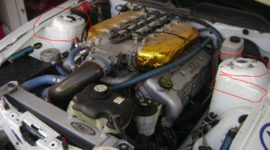
seam welded.PNG

When playing around with the tig, try a method called "back stepping" to minimalise heat warpage.
I get more success from the Hammer welding technique [to counteract the welds "pinching" when they cool]
 

Bob Heine

ALLIANCE MEMBER
Joined
Oct 24, 2009
Messages
10,703
Location
Boca Raton, Florida
@kerrynzl, you should add the welding information in your post to the Show us your welding projects thread:

In the old days (circa 1976) the conventional wisdom was to fully [arc] weld the stitch-welded chassis. It made sense to me back then, when hot rodders boxed all those c-channel frames but your explanation of the benefits of stitch welding makes sense as well.
 

kerrynzl

Well-known member
Joined
Nov 8, 2013
Messages
5,054
Location
Tauranga, New Zealand
@kerrynzl, you should add the welding information in your post to the Show us your welding projects thread:

In the old days (circa 1976) the conventional wisdom was to fully [arc] weld the stitch-welded chassis. It made sense to me back then, when hot rodders boxed all those c-channel frames but your explanation of the benefits of stitch welding makes sense as well.


My dad was a very competent welder [by trade] who often bragged that his welds were stronger than the parent material.
His welds never break it was always the material beside his welds.

Then I showed my dad results of "brinell testing" [hardness] after welding.
He never realized that welding was actually annealing the parent material so that a hard weld adjacent to a softened material would create a weakness [concentrated stress point]

Heat treating the steel usually restores this , but when this isn't possible then stitch/spot welding is more advisable.

------------------------------------------------------------------------------------------------------------------------------------------------------------------------------------
Back to the Sewing

One thing I learned from Fabrics and Textiles is how to dissipate loads over a greater area. A good lesson/example is comparing a 10ft tow rope to a 30ft tow rope. The shorter one is more violent even though the weight of both vehicles is the same.

Back to the chart [post #303]comparing longitudinal and lateral seams . We did the same test with High frequency welded 2" strips of "Ripstop" PVC [used on truck Tarpaulins] [These were straight cut on the "Warp and Weft" for strength]

On the hydraulic tension machine we measured both force and distance [stretch]
Then we overlapped and joined 2 pieces together with a H/F weld.
All the PVC strips snapped right on the edge of the overlap weld [It was the same force but less stretch distance] and the bigger the overlap the shorter the stretch distance before they snapped]
Not one of the PVC welds de-laminated at the welds.

This ^^^ is a classic example of a "chain only being as strong as it's weakest link"
On the !00% example on the Chart, the weakest point is 4 & 5 x stitches at the very ends [the area of the individual stitches is minimal compared to the area/cross section of the webbing

I see this all the time with steel. The engineer/welder keeps adding more and more steel for added strength [but also adds more weight which needs to be overcome by strength as well]
What they usually end up doing is shifting all the compliance to a concentrated stress point.
 
Last edited:

Modern Garage

Well-known member
Joined
Mar 26, 2015
Messages
583
Location
Southern Minnesota
I'm on to another project car and along with some upholstery repairs I'll need to put in new carpets. Some of the carpet edges will be exposed and need to be bound and my vintage White won't have any trouble sewing carpet, but I don't know if I can buy a binding foot that will accept material as thick as carpeting. It's a pretty tough home machine that uses common low-shank accessories like an older Singer. Does anyone know if there is a binder foot available for home machines that will accept thick fabric - maybe one made for thick wool coat material for instance?
Joe
 

kerrynzl

Well-known member
Joined
Nov 8, 2013
Messages
5,054
Location
Tauranga, New Zealand
I'm on to another project car and along with some upholstery repairs I'll need to put in new carpets. Some of the carpet edges will be exposed and need to be bound and my vintage White won't have any trouble sewing carpet, but I don't know if I can buy a binding foot that will accept material as thick as carpeting. It's a pretty tough home machine that uses common low-shank accessories like an older Singer. Does anyone know if there is a binder foot available for home machines that will accept thick fabric - maybe one made for thick wool coat material for instance?
Joe
Is your Vintage White a walking foot? [with a presser foot and inner needle foot that walks]

Example here:

If not....I would highly advise you to get one now [and sell your old one if needed to]
With a walking foot machine you dont need a "Binder foot" a flat presser foot is OK!
All you need is a flat presser foot, and one cut on the R/H side for piping and sewing against bulk ropes etc [for awning tracks]

What binding are you using? Vinyl or a Cloth webbing? [polyester webbing]

If you use vinyl binding you need "bias" binding not straight binding. I've cut my own binding on a diagonal "bias" so it can stretch on corners


I've followed a few of your previous posts, and you're certainly getting confident [and competent] to tackle bigger projects.
You really should step up an get a walking foot machine [if you don't already have one]

A cheap old industrial walking foot can cost less than a touch-up respray on the hood of your car.
And in my case.........I've done many "Contra Deals" in exchange for paint work.

And get a good pair of upholsterers scissors [these scissors always cut straighter]

Mine are over 40 years old
20220803_102048.jpg
 
Last edited:

WILD-BILL

Well-known member
Joined
Dec 10, 2011
Messages
872
Location
Brook Park Oh
I will second the walking foot machine if you are doing upholstery work. FWIW, I got a Consew 255 RB with the table and already upgraded with a Sailrite servo motor and slow speed pulley set for $700. The thing is a beast and will go through 10 layers of marine grade vinyl (all I could fit under the foot) as easily as it will just one.
 

Modern Garage

Well-known member
Joined
Mar 26, 2015
Messages
583
Location
Southern Minnesota
I'd love a walking foot machine but it's not in my immediate future.
Yet!
I'm using a 60's era White brand home machine. It's tough as nails and had no problem punching thru three and four layers of "marine" vinyl upholstery. A walking foot would make life easier but I'm getting by on a hobby level. I sewed the piping for my shift boot in the MG with the flat foot but it was only 3/16" cord inside the same vinyl as the seats. I could see where a narrower piping foot would be handy to get the seam closer and I may get (or modify) one.

I thought a binder foot that folds binding tape evenly would give a cleaner finish, but I suppose if I press a crease into the binding and roll it over the carpet edge by hand it will work. I forget that the underside will never be seen.
I haven't purchased any carpet or tape yet, but expected to use a polyester binding to look close to the original. (I'm not making a show car, just trying to make it look "right".) I knew the binding needed to be cut on a 'bias' but didn't know why. It makes sense that it will be easier to curve with bias binding. Thinking about it now I realize that the warp and weft threads on binding are never in line with the carpet edge. I'd never noticed it before. I also have seen upholstery scissors but didn't realize the long length makes it easier to keep a straight line. Makes sense again.

Thank you for your advice. I have a few little scraps of carpet from another project so I guess I'll rustle up some polyester and cut some tape and try it out.

Joe
 

WILD-BILL

Well-known member
Joined
Dec 10, 2011
Messages
872
Location
Brook Park Oh
These are the scissors I bought for my boat project.


They cut like a dream and it looks like they're now even cheaper then what I paid.

For basting tape I used Sailrites Seamstick for canvas. I used a mix of 1/4 and 3/8 depending on the seam I was doing.


I'm not sure if it would hold on carpet though
 

Outlawmws

Well-known member
Joined
Aug 9, 2011
Messages
39,130
Location
The Badlands
I've seen an attachment for a no-walking foot Singer that claims to make it a walking foot?

Has anyone used one of the attachments? Are they good for anything at all?

Once I find a bobbin case for the 221, I might go for one if they work at all... That and a zigzag attachment would probably be all I'd ever need. Possibly a buttonholer :dunno:
 

kerrynzl

Well-known member
Joined
Nov 8, 2013
Messages
5,054
Location
Tauranga, New Zealand
I've seen an attachment for a no-walking foot Singer that claims to make it a walking foot?

Has anyone used one of the attachments? Are they good for anything at all?

Once I find a bobbin case for the 221, I might go for one if they work at all... That and a zigzag attachment would probably be all I'd ever need. Possibly a buttonholer :dunno:

Having also learned to get inside sewing machines and fix them myself, I can reassure you that their claims are snake oil.
The presser foot would need "timed cams" to lift it up and down, to walk it.

The standard sewing machine only has a presser foot that presses against the feed dogs underneath .

There is also another type of machine with an inner needle foot that is timed to the feed dogs and a standard presser foot [sometimes called "needle feed"]


You can overcome a lack of a walking foot with some skills and trickery.
With PVC and Vinyls , use some food grade silicone spray as a top lubricant.

But the best method is improved sewing skills! Learn to hold the fabric with 2 hands [one in front and one behind the machine] and move the fabric and your hands together like using a "Hacksaw"
You need a bit of practice with this [tension and machine speed] and it is really useful when sewing one fabric cut on a bias to another that is straight cut.
If sewing 2 soft stretchy fabrics together..........use sellotape to stop it stretching [then pull it off later like perforated paper]
This ^^^^ is the best way to sew sheepskins.
 
Last edited:

kerrynzl

Well-known member
Joined
Nov 8, 2013
Messages
5,054
Location
Tauranga, New Zealand
I thought a binder foot that folds binding tape evenly would give a cleaner finish, but I suppose if I press a crease into the binding and roll it over the carpet edge by hand it will work. I forget that the underside will never be seen.
I haven't purchased any carpet or tape yet, but expected to use a polyester binding to look close to the original. (I'm not making a show car, just trying to make it look "right".) I knew the binding needed to be cut on a 'bias' but didn't know why. It makes sense that it will be easier to curve with bias binding. Thinking about it now I realize that the warp and weft threads on binding are never in line with the carpet edge. I'd never noticed it before. I also have seen upholstery scissors but didn't realize the long length makes it easier to keep a straight line. Makes sense again.

Thank you for your advice. I have a few little scraps of carpet from another project so I guess I'll rustle up some polyester and cut some tape and try it out.

Joe

Joe , for a really nice job with binding carpets [and if you machine can handle it]
You need to sew it twice!

Cut you own out of vinyl [at a 30° angle across the roll]

Then you sew it on upside down and inside out [# 1 in the drawing attached]

Then you go around it again and top sew it ,with the binding folded around and pulled underneath [# 2 in the drawing attached]
Try and top sew this slightly over from the original seam [and straight]

Then trim off the excess [welcome to the wonderful world of off-cuts on the floor]

sewing binding.jpg

If you have rounded corners, try and "push" the binding on the corners doing the 1st seam.

Note: the top example is the conventional method of sewing commercial cut bias binding with a walking foot machine.
I've done lots of this, sewing scalloped valances on awnings.

Some machinists use a "folder" but I personally dislike using them.
 

Modern Garage

Well-known member
Joined
Mar 26, 2015
Messages
583
Location
Southern Minnesota
Thanks Kerry, that's how I did half the seams on my seats, a top sewn felled seam I think it's called? I don't think I'll have any trouble with that thickness, especially with polyester fabric instead of vinyl for binding tape.
When you suggest I "push" the binding on corners I'm guessing you mean to compress it so as to have a little extra material to stretch around the extended radius when I fold it over the outside of the corner, right?
Joe
 
To avoid these ads, REGISTER NOW!
Top Bottom