To avoid these ads, REGISTER NOW!

Show us your VFD conversions/installations

Techie1961

Well-known member
Joined
Feb 18, 2014
Messages
1,520
Location
Pickering Ontario Canada
I'm a pretty techie person and love this stuff. I have worked with VFDs in my customers machines for many years but never took the time to understand them enough to do my own installs. For some reason, I thought that they were a lot more involved in the configuration aspect. Now that I have dug in a bit I want to put them on EVERYTHING!:D

So in light of this, let's see your VFD installations and conversions. I have been working on an old Rockwell sander and this is the first to get one. I don't want to just stick a box on it but rather something nice and kind of looking original but modern. Retro meets technology.

24787102382_564f01654e_c.jpg

24766232081_8a58e1cb96_c.jpg
 
To avoid these ads, REGISTER NOW!

Willie Makeit

Well-known member
Joined
Dec 30, 2013
Messages
907
couple videos showing my VFD running a 1948 Bridgeport knee-mill.

first vid - initial power up:


second vid - remote variable speed


zmotorsports

ALLIANCE MEMBER
Joined
Oct 20, 2009
Messages
21,348
Location
Northern Utah
Thanks Mike, looks great. Did you put the variable speed on the lathe or leave it on the VFD?

Thanks. I remote mounted my potentiometer on the original control panel of the lathe. I just used the remote input option for all of the lathe controls to send the inputs to the VFD. I also went one step further and put a FWD/REV toggle and jog feature which are also tied into the remote inputs all from the lathe's front control panel. Jog function works great that way.

Mike.
 

Packard V8

Well-known member
Joined
Mar 16, 2009
Messages
7,380
Location
Spokane, WA
Since this idea has been around forever, does anyone now offer a turnkey kit with printed instructions?

I remote mounted my potentiometer on the original control panel of the lathe. I just used the remote input option for all of the lathe controls to send the inputs to the VFD. I also went one step further and put a FWD/REV toggle and jog feature which are also tied into the remote inputs all from the lathe's front control panel.

Yes, the techno types make them up from readily available parts, using only their left hand, done before coffee break and say "easy-peasy", but for the rest of us, seems as if there's be a huge market for a plug-and-play kit for each motor horsepower range.

jack vines
 
OP
T

Techie1961

Well-known member
Joined
Feb 18, 2014
Messages
1,520
Location
Pickering Ontario Canada
Since this idea has been around forever, does anyone now offer a turnkey kit with printed instructions?


Yes, the techno types make them up from readily available parts, using only their left hand, done before coffee break and say "easy-peasy", but for the rest of us, seems as if there's be a huge market for a plug-and-play kit for each motor horsepower range.

jack vines

I really don't know but you're right about both a need for them as well as the understanding gap.
 

yaidunno

Well-known member
Joined
Feb 10, 2011
Messages
1,336
Location
WI
Here's the setup I put together for the mill I have. Note the large resistor mounted on the side. Works great for .5 sec decel times and rapid speed adjustments via the CVT on the head.


I tried to come up with a "period correct" enclosure for my Delta DP. The machine came with the back half of the housing, but was missing the cover. I made one that sort of fits the bill.

 
OP
T

Techie1961

Well-known member
Joined
Feb 18, 2014
Messages
1,520
Location
Pickering Ontario Canada
Here's the setup I put together for the mill I have. Note the large resistor mounted on the side. Works great for .5 sec decel times and rapid speed adjustments via the CVT on the head.

I tried to come up with a "period correct" enclosure for my Delta DP. The machine came with the back half of the housing, but was missing the cover. I made one that sort of fits the bill.

So, not knowing enough about VFDs at this point, I'm guessing you're using the resistor as a brake? I've seen those settings in the parameters and the terminals. Just wasn't aware that it's as simple as a resistive load.

The drill press installation looks nice. Any close up shots you can share?
 
Last edited:

yaidunno

Well-known member
Joined
Feb 10, 2011
Messages
1,336
Location
WI
So, not knowing enough about VFDs at this point, I'm guessing you're using the resistor as a brake? I've see those settings in the parameters and the terminals. Just wasn't aware that it's as simple as a resistive load.

The drill press installation looks nice. Any close up shots you can share?

Exactly, resistance braking. The Teco FM50 series does have internal braking, but I’ve found that it’s not up to the task of rapid deceleration. The resistor works fantastically well, and completely eliminates the nuisance over current trips. For your belt sander application, you likely wouldn’t need to brake at all. However, I think that the internal braking circuit would be able to easily handle a 2-5 second, should you decide to enable that feature.

At my previous employer, we had taken a 20,000 piece job for valve spring retainers. The Haas lathe was not equipped to handle the rapid start/stops for 10 hours per day and shut itself down. We ended up buying 3 oven burner elements and wired them up to absorb the braking energy. If memory serves me right, it had a 20 HP motor, so they got quite hot.

I will get some shots of the drill press setup this weekend. I never really documented it during the process.
 
OP
T

Techie1961

Well-known member
Joined
Feb 18, 2014
Messages
1,520
Location
Pickering Ontario Canada
Exactly, resistance braking. The Teco FM50 series does have internal braking, but I’ve found that it’s not up to the task of rapid deceleration. The resistor works fantastically well, and completely eliminates the nuisance over current trips. For your belt sander application, you likely wouldn’t need to brake at all. However, I think that the internal braking circuit would be able to easily handle a 2-5 second, should you decide to enable that feature.

At my previous employer, we had taken a 20,000 piece job for valve spring retainers. The Haas lathe was not equipped to handle the rapid start/stops for 10 hours per day and shut itself down. We ended up buying 3 oven burner elements and wired them up to absorb the braking energy. If memory serves me right, it had a 20 HP motor, so they got quite hot.

I will get some shots of the drill press setup this weekend. I never really documented it during the process.

Cool, errr Hot! Yeah, I didn't think that I would need any braking on the sander but the lathe will be soon so that might end up having one. Thanks!
 

jallyn

Well-known member
Joined
Jun 29, 2015
Messages
448
Location
Fort Wayne, Indiana
Very cool guys. I will look more in to using VFDs at home.

I have experience with them in industry and had training and labs during my university years.

A little theory on VFD braking... When a VFD is performing braking it gets mechanical energy back into the DC bus (motor acts as a generator and the energy has to go somewhere). The DC bus voltage rises and the VFD sends braking energy back into the AC line (AC line voltage rises slightly and some appliance in your house or your neighbors house gets some of its energy for "free" while the VFD is braking). During this process the VFD protects itself by monitoring the DC bus voltage and making sure to only brake as much as the electronics can handle. So it is limited to a certain braking rate. To achieve higher braking rates a braking resistor is added to take energy off the DC bus during heavy braking without which the VFD electronics would have burnt up.
 

E.rodz

Well-known member
Joined
Nov 11, 2009
Messages
2,434
Location
st.paul MN.
here is a old craftsman band saw that i bought with no motor and a broken step pulley a friend told me about vfd. drives and i was hooked! no step pulleys needed just adjust the speed on the vfd.


also added on to my old Craftsman vertical 18" bandsaw so i could slow it down enough to cut steel with it.
 

Steve from Socal

Well-known member
Joined
Jan 27, 2009
Messages
3,491
Location
Hutchinson Ks.
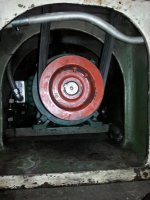
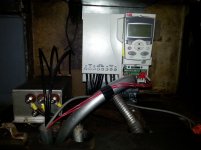
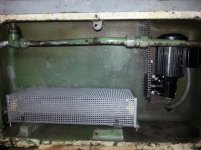
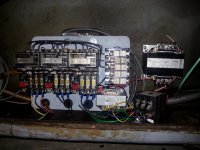
Here are some pictures of my Monarch 13EE re-power. This lathe originally came with a 20 HP DC motor and drive that were missing when I found it.

The spindle motor is a 15 HP inverter rated motor, ABB 11KW inverter drive, 1500W brake resistor, incoming line reactor, output filter, aux control panel for hydraulics, coolant, rapid travel motor and low voltage controls. Pancake fan for inverter housing, the inverter is in a enclosed area. Control pendant; the open hole is for a constant surface speed switch that I have not sorted out yet.

Steve
 

Attachments

  • 20150109_172458.jpg
    20150109_172458.jpg
    133.4 KB · Views: 481
  • 20150131_134112.jpg
    20150131_134112.jpg
    136 KB · Views: 516
  • 20150118_174704.jpg
    20150118_174704.jpg
    143.3 KB · Views: 477
  • 20150118_174636.jpg
    20150118_174636.jpg
    145.5 KB · Views: 498
  • 20150118_174617.jpg
    20150118_174617.jpg
    143.3 KB · Views: 518
  • 20150201_172203.jpg
    20150201_172203.jpg
    137.9 KB · Views: 537

Thumper68

Well-known member
Joined
May 16, 2013
Messages
5,134
Location
Duluth MN
Mine are very simple by comparison.

Clausing Drill press.


Rockwell/Delta 20" bandsaw. Since this picture was taken I bought the remote cord and mounted the controls in the face of the bandsaw to make it easier to use.
 
To avoid these ads, REGISTER NOW!
OP
T

Techie1961

Well-known member
Joined
Feb 18, 2014
Messages
1,520
Location
Pickering Ontario Canada
I like how some installations are simple and some are in-depth. The beauty of these seems to be that you can take them as far as you want or need. In the machines that I have worked on, they are always in an enclosure with air filters or at least some very good protection from the environment. For my sander conversion, this is what I'm struggling with the most.

I'm thinking that I'll build an enclosure around it and put a small fan on it or well, I don't really know yet. Have any of you had them fail due to metal dust or bad ventilation?
 

MBeaty

Well-known member
Joined
Feb 1, 2010
Messages
237
Location
Middle Tennessee
In the machines that I have worked on, they are always in an enclosure with air filters or at least some very good protection from the environment. For my sander conversion, this is what I'm struggling with the most.

There are some rules of thumb regarding enclosure volume and material vs the VFD size. With mine mounted in a steel enclosure with 4 times the volume of the VFD should be close to being able to cool on its own without fans. My installation is "sealed" and so far I have had no issues, but I would check the manual of your specific model to see what the cooling recommendations are.


Here is my installation on an older Delta drill press. I wanted to be able to see the screen on the VFD, but wanted all remote buttons and potentiometer to prevent the built in potentiometer from wearing out. The buttons are set up as a standard 3 wire control scheme.

The "door" on the enclosure allows me to access the hard buttons and terminals on the VFD due to the odd sideways installation. The door is sealed with a foam gasket and held down with a strong magnet. So far it has done well at keeping debris out of the enclosure.

Full%20View.JPG


Access%20Opening.JPG


Inside%20Box.JPG
 
Last edited:
OP
T

Techie1961

Well-known member
Joined
Feb 18, 2014
Messages
1,520
Location
Pickering Ontario Canada
There are some rules of thumb regarding enclosure volume and material vs the VFD size. With mine mounted in a steel enclosure with 4 times the volume of the VFD should be close to being able to cool on its own without fans. My installation is "sealed" and so far I have had no issues, but I would check the manual of your specific model to see what the cooling recommendations are.


Here is my installation on an older Delta drill press. I wanted to be able to see the screen on the VFD, but wanted all remote buttons and potentiometer to prevent the built in potentiometer from wearing out. The buttons are set up as a standard 3 wire control scheme.

The "door" on the enclosure allows me to access the hard buttons and terminals on the VFD due to the odd sideways installation. The door is sealed with a foam gasket and held down with a strong magnet. So far it has done well at keeping debris out of the enclosure.

Very nice! I like the sideways mount of the VFD. I also noticed what appears to be an incoming filter. How important do you think those are?

This is what I was contemplating for my sander. There is a large area under the sander where the motor goes. Since the motor is pulling in air at the shaft end and pushing it out the back, I was thinking I could leave the back of the motor exposed through the side. I would mount the VFD on the inside of the back which would be a large aluminum plate. The sides would be sheet metal and therefore fully closed in. I am then going to make a small box on a support that I can run it from.
24787102382_564f01654e_c.jpg
 

jallyn

Well-known member
Joined
Jun 29, 2015
Messages
448
Location
Fort Wayne, Indiana
Here are some pictures of my Monarch 13EE re-power. This lathe originally came with a 20 HP DC motor and drive that were missing when I found it.

The spindle motor is a 15 HP inverter rated motor, ABB 11KW inverter drive, 1500W brake resistor, incoming line reactor, output filter, aux control panel for hydraulics, coolant, rapid travel motor and low voltage controls. Pancake fan for inverter housing, the inverter is in a enclosed area. Control pendant; the open hole is for a constant surface speed switch that I have not sorted out yet.

Steve

Awesome equipment there. Love it all especially the NEMA contactors. :thumbup:
 

goingtoarizona

Well-known member
Joined
Apr 5, 2015
Messages
761
Location
Central Valley California
All of these are really cool. Where do I get more information on VFD'S ? Where are you all buying your VFD's ? The workshop/garage is a great place for these. I own a laundromat and my large washers have these, but sometimes they get water logged and it ruins my whole week. This gets me thinking about mounting some water proof containers and relocating the VFDs in the machine to protect them from water intrusion.
 
OP
T

Techie1961

Well-known member
Joined
Feb 18, 2014
Messages
1,520
Location
Pickering Ontario Canada
All of these are really cool. Where do I get more information on VFD'S ? Where are you all buying your VFD's ? The workshop/garage is a great place for these. I own a laundromat and my large washers have these, but sometimes they get water logged and it ruins my whole week. This gets me thinking about mounting some water proof containers and relocating the VFDs in the machine to protect them from water intrusion.

I usually get them from the OEM of the machines that I sell and service which just so happens to be laundry machines and dry cleaning machines as well as presses. I don't do laundromat machines but the larger ones that you might have I work on a bit. No residential stuff.

For the washers, you definitely want to keep the VFD (or as we call them in the industry which isn't totally correct, inverters) protected. Even just some plastic to protect them from splashing will save you a ton of money.
 
Last edited:

MBeaty

Well-known member
Joined
Feb 1, 2010
Messages
237
Location
Middle Tennessee
Very nice! I like the sideways mount of the VFD. I also noticed what appears to be an incoming filter. How important do you think those are?

That line filter was a last ditch effort to try to prevent the setup from tripping the GFCI, unfortunately it did not work, but I never got around to removing it from the system. The only way I found to keep the GFCI from tripping was to run a circuit to the drill press without a GFCI.
 

BCreekDave

Well-known member
Joined
Dec 17, 2015
Messages
206
Location
Dayton, OH
I used to deal with VFD's quite often in my previous life as an engineer. Whenever we spec'd a machine with a VFD we were also careful to spec a "VFD rated motor". Basically it was a 3 phase motor with a 110 percent service factor. It looks like most of the applications here are ignoring this? Is anyone having reliability issues with motors overheating? Probably for short usage it may not be an issue. Also, many of the older motor son some of this style of equipment were really overbuilt and can sustain the heat.

Here is a good explanation of what I am referring to:
http://motors.automationdirect.com/Information/compare.html

Also,as noted by the issue with GFCI problems, these things can throw a ton of noise on the AC lines in operation. In an industrial setting this is not too much of an issue. In a home setting beware of future problems with power supplies in TV's and computers and especially with home automation devices that communicate over the AC lines such as Insteon of X10. This may vary greatly with the manufacturer of the drive. Again, these things were designed for an industrial environment.


Sent from using Tapatalk
 
Last edited:
OP
T

Techie1961

Well-known member
Joined
Feb 18, 2014
Messages
1,520
Location
Pickering Ontario Canada
I used to deal with VFD's quite often in my previous life as an engineer. Whenever we spec'd a machine with a VFD we were also careful to spec a "VFD rated motor". Basically it was a 3 phase motor with a 110 percent service factor. It looks like most of the applications here are ignoring this? Is anyone having reliability issues with motors overheating? Probably for short usage it may not be an issue. Also, many of the older motor son some of this style of equipment were really overbuilt and can sustain the heat.

Here is a good explanation of what I am referring to:
http://motors.automationdirect.com/Information/compare.html

Also,as noted by the issue with GFCI problems, these things can throw a ton of noise on the AC lines in operation. In an industrial setting this is not too much of an issue. In a home setting beware of future problems with power supplies in TV's and computers and especially with home automation devices that communicate over the AC lines such as Insteon of X10. This may vary greatly with the manufacturer of the drive. Again, these things were designed for an industrial environment.


Sent from using Tapatalk

That's some really good advise and thanks for sharing. Since I'm kind of on a VFD craze right now and thirsty for knowledge, I was reading up on the difference between the cheapo Chinese stuff and the real pieces. Apparently the cheap stuff can be quite bad for noise and tougher on motors.

I suspect that there aren't many issues in the home environment due to the short time usage and lighter work loads seen. The big thing for me is the lack of 3 phase power here and even though I have a very big roto-phase, I don't like to have it powered up constantly since it draws almost 20 amps just at idle.
 

jdwilson44

Well-known member
Joined
May 7, 2005
Messages
128
Location
Chelmsford, Massachusetts
I've been adding machines to my shop with the intent of building up to a small metalworking business. It's running in the barn behind my house (residential neighborhood) - so there's no 3 phase power available. I recently bought a Precision Matthews PM-932 milling machine - with the variable speed option. It does that using a VFD and a 3 phase motor.

One of the other pieces of equipment I would like to add - is an Ironworker. A lot of the larger ones seem to come only in 3 phase - or possibly with a single phase motor, but it's an expensive option. Reading up a little on what my options would be for using a 3 phase motor in a single phase environment, I ran across the "old" solution of using a phase convertor. But from what I've been reading - using a phase convertor can cut the available HP from the motor by quite a bit.

Do VFD's have the same issues? I'm a complete electrical ignoramus when it comes to understanding the underlying engineering of how this works. Is there a VFD's for dummies out there ?

Now I'm wondering if I shouldn't be looking into running a VFD on things like my compressor and other things that have large electrical motors on them to save some power.
 

jdwilson44

Well-known member
Joined
May 7, 2005
Messages
128
Location
Chelmsford, Massachusetts
I used to deal with VFD's quite often in my previous life as an engineer. Whenever we spec'd a machine with a VFD we were also careful to spec a "VFD rated motor". Basically it was a 3 phase motor with a 110 percent service factor. It looks like most of the applications here are ignoring this? Is anyone having reliability issues with motors overheating? Probably for short usage it may not be an issue. Also, many of the older motor son some of this style of equipment were really overbuilt and can sustain the heat.

Here is a good explanation of what I am referring to:
http://motors.automationdirect.com/Information/compare.html

Also,as noted by the issue with GFCI problems, these things can throw a ton of noise on the AC lines in operation. In an industrial setting this is not too much of an issue. In a home setting beware of future problems with power supplies in TV's and computers and especially with home automation devices that communicate over the AC lines such as Insteon of X10. This may vary greatly with the manufacturer of the drive. Again, these things were designed for an industrial environment.


Sent from using Tapatalk

Is there any way to reduce or get rid of that noise? I'm building out my shop - but I still haven't had the final electrical installed in my barn to support everything. I wondering if there is some way I could get the electician to design in some protection for the things like TV sets and computers if I have a device or two running a VFD in my shop.
 

Kevin54

MEMBER EMERITUS
Joined
Jan 12, 2005
Messages
29,341
Location
Urbana, Ohio
Interesting thread and I have it bookmarked for later. I have a Lagun that I am going to put a VFD on sometime this year so I don't have to run the rotary phase converter to run my mill.

And for everyone that has posted up pics of their machines, I must say...."Great looking machines"

Techie, I love the blue and orange together. I like to see color in a shop
 

J king

Well-known member
Joined
Jun 1, 2013
Messages
786
Location
Ne oh
I have 4 drives. I run one on my 10 hp lathe with single phase.Its wired into the three phase panel. If I am taking heavy cuts I just turn on the rotary converter and it gives me 3 phase and full power. Best of both worlds. My smaller lathe is wired the same but I never trip the drive on it.
 
OP
T

Techie1961

Well-known member
Joined
Feb 18, 2014
Messages
1,520
Location
Pickering Ontario Canada
...Do VFD's have the same issues? I'm a complete electrical ignoramus when it comes to understanding the underlying engineering of how this works. Is there a VFD's for dummies out there ?

Now I'm wondering if I shouldn't be looking into running a VFD on things like my compressor and other things that have large electrical motors on them to save some power.

I hadn't heard that about phase converters derating motors and have a few customers that are running them with industrial machinery. No issues.

For the VFD thing you will find that there are units with single phase input and three phase input. You can run most 3p input VFDs with only two wires but you derate the drive. I think it's to about 60-70% of it's rated output. So a 3p VFD can be connected to 2 wires but that 3HP rating will be about 2HP.

I'm seriously thinking that a VFD will end up on my air compressor too. The roto-phase is just too inefficient.
 

manwithtools

ALLIANCE MEMBER
Joined
Aug 24, 2015
Messages
13,705
Location
Lebanon, TN
I suspect that there aren't many issues in the home environment due to the short time usage and lighter work loads seen.

That's exactly correct. The short duty cycles of home use allow these setups to work quite well and are much more flexible than rotary converters.
 

J king

Well-known member
Joined
Jun 1, 2013
Messages
786
Location
Ne oh
Also I have one on my Bridgeport. Having ran BPs for years I am so use to using factory style forward and reverse switch setup. I wired my ac drive thru the switch so when tapping ect.. it is no different.love that.
I cut the crossovers in the switch and just use it as a low voltage dc switch. Highly recommended!
 

manwithtools

ALLIANCE MEMBER
Joined
Aug 24, 2015
Messages
13,705
Location
Lebanon, TN
I used to deal with VFD's quite often in my previous life as an engineer. Whenever we spec'd a machine with a VFD we were also careful to spec a "VFD rated motor". Basically it was a 3 phase motor with a 110 percent service factor. It looks like most of the applications here are ignoring this? Is anyone having reliability issues with motors overheating? Probably for short usage it may not be an issue. Also, many of the older motor son some of this style of equipment were really overbuilt and can sustain the heat.

Here is a good explanation of what I am referring to:
http://motors.automationdirect.com/Information/compare.html

Also,as noted by the issue with GFCI problems, these things can throw a ton of noise on the AC lines in operation. In an industrial setting this is not too much of an issue. In a home setting beware of future problems with power supplies in TV's and computers and especially with home automation devices that communicate over the AC lines such as Insteon of X10. This may vary greatly with the manufacturer of the drive. Again, these things were designed for an industrial environment.


Sent from using Tapatalk

Inverter rated motors are best applied in lower speed, long run time applications. They have better insulation and can tolerate the lack of air flow at lower speeds - 30hz and below for example. You are correct that some of the older motors are just simply built heavier and due to the low duty cycle of home use they will likely never be a problem.

The newer inverters are much better about noise generation especially in the smaller hp typical of home use.
 

BCreekDave

Well-known member
Joined
Dec 17, 2015
Messages
206
Location
Dayton, OH
Is there any way to reduce or get rid of that noise? I'm building out my shop - but I still haven't had the final electrical installed in my barn to support everything. I wondering if there is some way I could get the electician to design in some protection for the things like TV sets and computers if I have a device or two running a VFD in my shop.


Not sure on a large scale like a whole shop. I'm sure there is a filtering setup possible.
When I had noise issues due to VFD's where I used to work, I would on the device that was experiencing the problem (not the device with the VFD) install one of these:

http://www.tripplite.com/products/power-conditioners~23

That really worked good to solve the problem, but was a point of use device.


Sent from using Tapatalk
 
Last edited:
To avoid these ads, REGISTER NOW!
Top Bottom