

You are using an out of date browser. It may not display this or other websites correctly.
You should upgrade or use an alternative browser.
You should upgrade or use an alternative browser.
Show us your VFD conversions/installations
- Thread starter Techie1961
- Start date
laser3kw
Well-known member
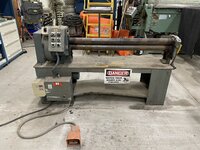
Is that Yaskawa?We put a VFD on this PEXTO roller which you can see on the lower left of the machine. Works awesome.
Dang you know your vfd's! Yes it is a Yaskawa. Have you had good or bad experiences with this brand?Is that Yaskawa?
slodat
ALLIANCE MEMBER
Yaskawa is top tier.
slodat
ALLIANCE MEMBER
I've been researching and the Hobby Machinist Forum has lots of information. Mark Jacobs (mksj) there has developed some very nice setups for Precision Matthews lathes. The PM lathes are somewhat similar to mine, except they are gear drive spindles, and mine is a belt drive.
My lathe is essentially identical to a Jet BDB-1340 (not the BDB-1340A, which has a different style of quick change gearbox) the the extent that many of the part numbers in the manual match the Jet numbers of the BDB-1340A! It has a D1-4 chuck mount and a 1-1/2" spindle bore. It was made in 2004, but hardly used before the motor burned up. It is one of many Asian lathes of that period that seem identical except for the name on the headstock!
I ended up buying a Hitachi WJ-200-015LF because of Mark's extensive wiring diagrams. They make it straightforward to do the installation, wiring, and programming. I'm going to use a 2 HP, 1725 RPM, 3 phase motor with a 145T frame size. This should give me a great range of spindle speeds, and I can change the belts if I need to slow it way down, and engage the back gears if I need to. I'm putting a magnetic tachometer on the spindle so I won't have to do calculations.
Here are a couple of photos of the machine after some clean up. It was covered with dirt, oil, and swarf. It looked really ratty when I inspected it, but it turns out that most of the dirt layer was actually the cosmoline from the factory! The face plate and 4-jaw chuck still had paper wrapping, and the mounting pins had never been installed in the 4-jaw. It came with the stand, steady and follower rests, turret tool post, two dead centers, headstock Morse Taper reducer, tool kit, and a keyless drill chuck for the tailstock.

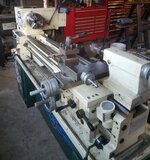
I just got an Acra 16x40 lathe. I will be building one of Mark's systems for it. Parts are starting to arrive.
Provincial
Well-known member
I have almost all my parts now, but won't be able to attack the project for at least a month. Too much going on right now. I did get a chance to set up the parts in the enclosure, and my lay-out looks like it will work well. I'll report back here when I get started.
laser3kw
Well-known member
Dang you know your vfd's! Yes it is a Yaskawa. Have you had good or bad experiences with this brand?
Yaskawa is top tier.
Agree - top tier!
I designed machines for 14 years, some having as many as 4 Yaskawa vfds. They were required to do some pretty unique things, cycling at multiple times per second . The Yaskawa drives never had any problems in years of service in those environments. The newer drives are getting smaller in size but still have a great set of features.
I am searching for a 10hp vfd 220v 1 phase input 3 phase output. I literally have looked at hundreds and hundreds of vfd's and the only ones I can find that are 1 phase in 3 phase out are 5hp or less. I have scoured ebay as well as many other websites on the internet. I cannot find one new or used. Let me clarify. On ebay there are some brand name is Huanyang brand new for $244. I am very leary on buying that. So what I mean to say is I cannot find what I think would be a decent brand with those specs. Does anyone know where I can find one?
slodat
ALLIANCE MEMBER
You can use a 20hp Hitachi SJ-P1 to power a typical 10hp from single phase. I’m doing it and it works well. It’s rated to do it.
What is the 10hp motor connected to?
What is the 10hp motor connected to?
It is a 5hp motor attached to a tubing roller. Ive always been told to double the vfd's size for single phase input hence why I was looking for a 10hp vfd. It seems like every vfd I see is rated for 3 phase input to 3 phase output at least those in the 10 hp range, or even 7.5 hp range for that matter. Having alot of trouble finding one rated for 1 phase input to 3 phase output that is 10hp.You can use a 20hp Hitachi SJ-P1 to power a typical 10hp from single phase. I’m doing it and it works well. It’s rated to do it.
What is the 10hp motor connected to?
slodat
ALLIANCE MEMBER
Look at your motors full load amps (FLA). The attached document shows you each drives rated output with single phase supply. It's the motor current that matters, not HP. I am using this drive, supplied by single phase 240, on two CNC machines with great success. They are great drives. I buy them from https://www.driveswarehouse.com
Attachments
slodat
ALLIANCE MEMBER
New control panel for the lathe mocked up in MDF to check figment and see how it looks. This is going to be nice.

Thanks for the info and the website address!Look at your motors full load amps (FLA). The attached document shows you each drives rated output with single phase supply. It's the motor current that matters, not HP. I am using this drive, supplied by single phase 240, on two CNC machines with great success. They are great drives. I buy them from https://www.driveswarehouse.com
that looks awesomeNew control panel for the lathe mocked up in MDF to check figment and see how it looks. This is going to be nice.
I just bought a 30hp SJ-P1 to replace a dying A500. it actually came with a printed addendum for single phase use.Look at your motors full load amps (FLA). The attached document shows you each drives rated output with single phase supply. It's the motor current that matters, not HP. I am using this drive, supplied by single phase 240, on two CNC machines with great success. They are great drives. I buy them from https://www.driveswarehouse.com
slodat
ALLIANCE MEMBER
I just bought a 30hp SJ-P1 to replace a dying A500. it actually came with a printed addendum for single phase use.
Would you be willing to scan and share the addendum? I haven't seen it and I use these drives in my machinery builds often.
I am somewhat confused, which is easily done mind you. I thought a VFD was built to either have single phase input or three phase input. One or the other but not both. I know some are converters for the output but the input is either single phase, or it is 3 phase, they are not able to have both a 3 phase or a 1 phase input depending on what the installer has wired in their shop correct? Reading some comments it almost seems as though a vfd can run on single or three phase input on the same unit but I thought it was just one or the other.I just bought a 30hp SJ-P1 to replace a dying A500. it actually came with a printed addendum for single phase use.
the more you know about how VFDs are built, the more sense it makes.I am somewhat confused, which is easily done mind you. I thought a VFD was built to either have single phase input or three phase input. One or the other but not both. I know some are converters for the output but the input is either single phase, or it is 3 phase, they are not able to have both a 3 phase or a 1 phase input depending on what the installer has wired in their shop correct? Reading some comments it almost seems as though a vfd can run on single or three phase input on the same unit but I thought it was just one or the other.
a regular VFD is three parts. the input stage, the DC bus and the output stage.
here's a drawing I stole from VFDs.org

the output stage is the same for 1ø or 3ø. it's 6 switches on the output, controlled by the computer.
the DC bus capacitors may or may not be the same. if it's NOT the same, it's larger for single phase use because ripple will be higher.
the input stage may or may not be the same. if it's truly a purpose built single phase unit, it will have a rectifier that looks like this:

(fun fact, this is actually the same drawing as above if you leave out the L3 diodes, just arranged differently for drawing efficiency. )
and a capacitor sized for the intended load.
otherwise if it's a unit rated for both uses, they will simply de-rate the output so that the input rectifiers are happy at full load (because you didn't connect two of the diodes and are leaving the other 4 to do their work), and ripple on the DC bus is acceptable.
10A @ 240V 3ø = 17.3A @ 240V 1ø. so while they may have oversized a bit for safety, they may not have oversized by 75%, thus the need to de-rate the unit. (my bet, this leaves you with theoretically higher transient overload/torque capacities since most VFDs are limited by the current they can put OUT, not what they can take IN. based on the 3ø rating).
sometimes they just slap a single phase label on a 3ø unit and tell you the single phase data, leaving out the fact that it's literally the same unit they're selling as the 3ø unit. this makes sense from an economies of scale perspective. I'd bet high horsepower single phase units move a tiny percentage of the volume the 3ø units move.
most VFDs have phase loss detection, and some run the electronics off of a single phase. so you have to power those two input legs (or the electronics won't light up) some run the electronics off the DC bus and a buck converter, so they can control the motor in the event of an input power failure.
all you have to do is look at the de-rating curve from the manufacturer, and disable phase loss detection on the drive in software. bam! you've got a single phase drive.
Last edited:
slodat
ALLIANCE MEMBER
Components for the lathe controls arrived. I screwed up reading the dimensions on the drive somehow. Enclosure is a lot deeper than needed. Guess it will have plenty of airspace for cooling! The thing on the left is the braking resistor. Very cool flat setup.


That look a bit tighter than the recommended 10cm/4" top clearance but otherwise I like what I see.Components for the lathe controls arrived. I screwed up reading the dimensions on the drive somehow. Enclosure is a lot deeper than needed. Guess it will have plenty of airspace for cooling! The thing on the left is the braking resistor. Very cool flat setup.
slodat
ALLIANCE MEMBER
I'm not sweating that piece at all.That look a bit tighter than the recommended 10cm/4" top clearance but otherwise I like what I see.
MKSJ
Active member
Most modern 3 phase input VFD's, can be run off of single phase in a derated mode, many smaller factory VFD lathes and mills allow single phase or 3 phase input. In essence a single phase VFD is just an oversized 3 phase model, and the most common single phase VFD's are 3 Hp and under, a few have 5 Hp models. Beyond that it is not practical for VFD makers to offer models specifically for single phase use, but many provide a derating for single phase input. The typical derating for single phase was a factor of ~1.7, but it can vary widely based on the application and VFD model. It is not enough to match up the Hp rating, you need to look at the VFD output in amps for the particular load. Newer VFD's that I have seen come to market have much more significant deratings for single phase use. Example below is for the DURApulse GS20 & GS20X Drive 230V Class – 3-Phase Model-Specific Specifications the factor is 2. Older VFD did detect phase loss for inputs, on some it could be disabled, others it could not. Newer VFD's measure input THD, which is increased with single phase input, Yaskawa drives indicate that the phase loss is not to be deactivated for single phase use, it can cause damage and void the warranty.
Both my mill and lathe which have 3 Hp motors use 3 phase input VFD's and are setup to run off of either single phase or 3 phase power. I have done a number of VFD installs with smaller machines up to 10 Hp using 3 phase input VFDs running off of single phase in a derated mode. Never had any issues. A 3 phase input VFD can also be run off of a RPC, the degree of derating is reduced but is not a factor of 1, so I usually up-size the VFD to the next larger model. It is also recommend to use a DC buss choke on derated VFD's running single phase which help reduce the THD/ripple. Example below is my mill with a factory installed VFD, I extensively modified the control system and added a DC buss choke.


Both my mill and lathe which have 3 Hp motors use 3 phase input VFD's and are setup to run off of either single phase or 3 phase power. I have done a number of VFD installs with smaller machines up to 10 Hp using 3 phase input VFDs running off of single phase in a derated mode. Never had any issues. A 3 phase input VFD can also be run off of a RPC, the degree of derating is reduced but is not a factor of 1, so I usually up-size the VFD to the next larger model. It is also recommend to use a DC buss choke on derated VFD's running single phase which help reduce the THD/ripple. Example below is my mill with a factory installed VFD, I extensively modified the control system and added a DC buss choke.
Great info thank you very much for clarifying.Most modern 3 phase input VFD's, can be run off of single phase in a derated mode, many smaller factory VFD lathes and mills allow single phase or 3 phase input. In essence a single phase VFD is just an oversized 3 phase model, and the most common single phase VFD's are 3 Hp and under, a few have 5 Hp models. Beyond that it is not practical for VFD makers to offer models specifically for single phase use, but many provide a derating for single phase input. The typical derating for single phase was a factor of ~1.7, but it can vary widely based on the application and VFD model. It is not enough to match up the Hp rating, you need to look at the VFD output in amps for the particular load. Newer VFD's that I have seen come to market have much more significant deratings for single phase use. Example below is for the DURApulse GS20 & GS20X Drive 230V Class – 3-Phase Model-Specific Specifications the factor is 2. Older VFD did detect phase loss for inputs, on some it could be disabled, others it could not. Newer VFD's measure input THD, which is increased with single phase input, Yaskawa drives indicate that the phase loss is not to be deactivated for single phase use, it can cause damage and void the warranty.
Both my mill and lathe which have 3 Hp motors use 3 phase input VFD's and are setup to run off of either single phase or 3 phase power. I have done a number of VFD installs with smaller machines up to 10 Hp using 3 phase input VFDs running off of single phase in a derated mode. Never had any issues. A 3 phase input VFD can also be run off of a RPC, the degree of derating is reduced but is not a factor of 1, so I usually up-size the VFD to the next larger model. It is also recommend to use a DC buss choke on derated VFD's running single phase which help reduce the THD/ripple. Example below is my mill with a factory installed VFD, I extensively modified the control system and added a DC buss choke.
DuluthMachineWorks
Well-known member
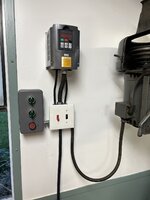
Here’s my setup for my Rockwell 20” drill press. It’s a 3HP Huanyang VFD, with controls broken out for forward, reverse, and a jog button for power tapping. I also have the second selector switch set up to switch between two pre-programmed high and low speeds, or allow speed control via the potentiometer on the VFD. Run and stop is controlled by the push buttons on the drill press, and the switch is a DPST 30A disconnect. The goal here was to make it so I never really have to mess with the VFD during the course of normal operation.
Still needs labeling and a metal cover plate, but it’s all working.
Still needs labeling and a metal cover plate, but it’s all working.
83VillageRepair
Well-known member
That is a very clean looking install.Here’s my setup for my Rockwell 20” drill press. It’s a 3HP Huanyang VFD, with controls broken out for forward, reverse, and a jog button for power tapping. I also have the second selector switch set up to switch between two pre-programmed high and low speeds, or allow speed control via the potentiometer on the VFD. Run and stop is controlled by the push buttons on the drill press, and the switch is a DPST 30A disconnect. The goal here was to make it so I never really have to mess with the VFD during the course of normal operation.
Still needs labeling and a metal cover plate, but it’s all working.
laser3kw
Well-known member
Very nice terminal feature use! That's the true beauty of VFD usage.with controls broken out for forward, reverse, and a jog button for power tapping. I also have the second selector switch set up to switch between two pre-programmed high and low speeds, or allow speed control via the potentiometer on the VFD. Run and stop is controlled by the push buttons on the drill press,
DuluthMachineWorks
Well-known member
Thanks!
It was actually hard to find an inexpensive (cheap import) VFD that had plenty of output terminals. It seemed like most only had the standard run and stop, but this one has five programmable inputs. Just enough to do what I wanted it to.
It was actually hard to find an inexpensive (cheap import) VFD that had plenty of output terminals. It seemed like most only had the standard run and stop, but this one has five programmable inputs. Just enough to do what I wanted it to.
Here is my Powermatic 1200 drill press I finished the other day. I used a Teco L510 that will run off 120V and puts out 208/220 volt 3PH. I found a plastic box on Amazon that the VFD fit inside, added an air intake filter and a small "computer" fan that is on when ever there is power to the VFD. Forward Reverse switch, speed pt, and "Oh ****" button mounted where the original on/off switch was mounted.
I am ditching the black work light as it is too limp to stay in place. I found a 12" long LED I plan on mounting back by the column, under the head of the drill press.
I am ditching the black work light as it is too limp to stay in place. I found a 12" long LED I plan on mounting back by the column, under the head of the drill press.
Attachments


laser3kw
Well-known member
Lol! Got to love the brutal honesty!"Oh ****" button mounted where the original on/off switch was mounted.

nice layout!
Here's my very modest contri: A KBDF-27D from KB Electronics, powering a 1.5 HP motor on my 1982 vintage Taiwanese lathe.
Pretty bare-bones, but the one thing I did that's noteworthy is I added an LED tachmometer readout to the front of it.
https://flic.kr/p/2mYR2fr Click the pic to go to Flickr, then Right arrow to see more pics in that album, like the steps required to fit the tach inside the VFD. Normally these tachs require a 12V DC power adapter (wall-wart) but my VFD has the 12V DC transformer inside it already, to run the cooling fan. I just tapped into that to run the tach. Hopefully the transformer can handle the fan and the tach at the same time long-term, but I'm cautiously optimistic. Works so far (couple months) and the power draw from the tach is minuscule.
The tach is cheap chinese, maybe $20 (I forget). Hall-effect sensor with a magnet attached to the lathe spindle. I avoid chinesium in my shop but I can live with that.
Oops I see the pic shows the door ajar, but that's just me being too lazy to re-take the pic. The door does close all the way.
I know a VFD like this should be in an enclosure, but I'm going to risk it like this. Like I said I'm lazy. Git 'er done!
Here's a pic of the lathe:

For my belt-grinder, I used another KB VFD, model KBDA-27D, which is "wash down" sealed so no enclosure needed. That one has a programmable display, and I have it set to read out the SFPM of the belt rather than hertz or RPMs. It was also a lot more expensive than the one on the lathe. I figgered the sealed enclosure is a lot more important on a grinder. All my "dirty" machines/processes are in an outbuilding, no air exchanged with the room with the lathe.
Cheers
Mark B
Pretty bare-bones, but the one thing I did that's noteworthy is I added an LED tachmometer readout to the front of it.
https://flic.kr/p/2mYR2fr Click the pic to go to Flickr, then Right arrow to see more pics in that album, like the steps required to fit the tach inside the VFD. Normally these tachs require a 12V DC power adapter (wall-wart) but my VFD has the 12V DC transformer inside it already, to run the cooling fan. I just tapped into that to run the tach. Hopefully the transformer can handle the fan and the tach at the same time long-term, but I'm cautiously optimistic. Works so far (couple months) and the power draw from the tach is minuscule.
The tach is cheap chinese, maybe $20 (I forget). Hall-effect sensor with a magnet attached to the lathe spindle. I avoid chinesium in my shop but I can live with that.
Oops I see the pic shows the door ajar, but that's just me being too lazy to re-take the pic. The door does close all the way.
I know a VFD like this should be in an enclosure, but I'm going to risk it like this. Like I said I'm lazy. Git 'er done!
Here's a pic of the lathe:
For my belt-grinder, I used another KB VFD, model KBDA-27D, which is "wash down" sealed so no enclosure needed. That one has a programmable display, and I have it set to read out the SFPM of the belt rather than hertz or RPMs. It was also a lot more expensive than the one on the lathe. I figgered the sealed enclosure is a lot more important on a grinder. All my "dirty" machines/processes are in an outbuilding, no air exchanged with the room with the lathe.
Cheers
Mark B
Last edited:
I would be concerned of getting metal chips, or other shop debris getting into that VFD. In any type of shop environment I would not mount a VFD in the open, unless it had a sealed enclosure.Here's my very modest contri: A KBDF-27D from KB Electronics, powering a 1.5 HP motor on my 1982 vintage Taiwanese lathe.
Cheers
Mark B
The post above yours ins my Teco VFD on my PM 1200 drill press. Again, an open VFD, but i put it inside a plastic box with a muffin fan for ventilation.
Kpaige
Well-known member
Not really a conversion but just finished building my belt grinder with vfd
Last edited:
Great looking machine! Is that the Revolution design from Housemade? Was it fun to build, and would you do anything different if you had to do it over? I'm asking because I have a BG build on the back burner. I have a functional BG already but I want something more rigid and powerful.Not really a conversion but just finished building my belt grinder with vfd
Did you put a fan inside your enclosure, and if so is it filtered? I've heard reports of some enclosures next to a beltgrinder acting like vacuum cleaners, sucking in the dust and depositing it inside the enclosure, unless they had a filter over the fan. If filtered, I assume you have to clean the filter now and then or it'll get clogged, correct? No experience of that myself, it's just hearsay. Wondering what your experience is, or is it too early to say?
Anyway, nice sano* build.
*sano= '60s hot rod slang, short for sanitary, meaning clean and bitchin'.
Thanks for sharing
Mark B
Kpaige
Well-known member
Great looking machine! Is that the Revolution design from Housemade? Was it fun to build, and would you do anything different if you had to do it over? I'm asking because I have a BG build on the back burner. I have a functional BG already but I want something more rigid and powerful.
Did you put a fan inside your enclosure, and if so is it filtered? I've heard reports of some enclosures next to a beltgrinder acting like vacuum cleaners, sucking in the dust and depositing it inside the enclosure, unless they had a filter over the fan. If filtered, I assume you have to clean the filter now and then or it'll get clogged, correct? No experience of that myself, it's just hearsay. Wondering what your experience is, or is it too early to say?
Anyway, nice sano* build.
*sano= '60s hot rod slang, short for sanitary, meaning clean and bitchin'.
Thanks for sharing
Mark B
Yes it is the Housemade Revolution newest generation. It was fun to build. If I had to do it again I would have ordered the cut metal from him simply because it is actually cheaper compared to steel prices around here. I am also working on a diffrent tracking mechanism compared to his original, I woyld probably buy his he sells otherwise as the little one in the plans just was too touchy ( pics attached of my tracking) I am either going to mill a slot for my tracking adjustment screws to keep them from walking up when the top bolt is loosened for adjustment or put thrust bearings so it can pivot freely while being firmly secured.
As far as the vfd I used the $89 dollar one off Amazon he used it for a year with no issie so why not try it. I did remove it from its case and put it in the sealed case, there is no fan but I have the heat sink directly attached to the box and its not a tool that runs for an hour at a time so heat should not be an issue. House used the unsealed version for the first year mounted down and away as it has a remote screen and yes it was caked with **** but still worked he recently blew it clean and mounted it in a sealed box. Vfd as anything electric combined with metal dust = bad idea. Make sure any outlets in the area are taped over also.
Only used it a little but so far so good. I biught a starter belt kit from combat abbrasives comes with 32, 80, 120 etc and the 32 will eat material with out even blinking.
My motor is a 2 hp 3600 rpm tefc 3 phase 220 ebay motor for $150 but it will run up to 3800 if I let the vfd take it there but really even 3600 is rediculously fast.
Funny thing is I could really have used the BG to build the BG :/.
If you do not have a mill buy his mounts and d plate with the tilting curves as I can not imagine drilling and filling them. I have anbextra d plate slightly smaller if someone wants it.


Also to remove the inside weld on the tube a nice heavy file and 10 minutes does the trick.
laser3kw
Well-known member
that's how the industrial revolution started. Build machines that enabled you to build better machines - then we went to the moon!Funny thing is I could really have used the BG to build the BG :/.
Funny thing is I could really have used the BG to build the BG :/.
Have you watched Jeremy Schmidt build his? I think it was on the video where he was making an optional add-on for it when he started shaping something with an angle grinder and then said "oh wait, I almost forgot, I have a belt grinder now"
Also notable (but not for you making your BG, that ship has sailed), check out Fireball Tool's YT channel for a pretty cool way to remove the inside weld from square tubing. He made a slug with a HSS cutting bit like a lathe tool, then dragged that through the tube with a piece of all-thread. The cutting step went fast, but he probably spent more time making the cutter than you did to just hand-file it. And the tool, once made, might not even work on your next square tube because they don't put the weld in the same place relative to the square corners. Still, I thought it was clever. Might be useful someday if you ever need to do it on a tube that's too long to hand-file, can't reach the center.
Kpaige
Well-known member
Not sure if I seen the first that you mentioned I watch alot of you tube lol.Have you watched Jeremy Schmidt build his? I think it was on the video where he was making an optional add-on for it when he started shaping something with an angle grinder and then said "oh wait, I almost forgot, I have a belt grinder now"
Also notable (but not for you making your BG, that ship has sailed), check out Fireball Tool's YT channel for a pretty cool way to remove the inside weld from square tubing. He made a slug with a HSS cutting bit like a lathe tool, then dragged that through the tube with a piece of all-thread. The cutting step went fast, but he probably spent more time making the cutter than you did to just hand-file it. And the tool, once made, might not even work on your next square tube because they don't put the weld in the same place relative to the square corners. Still, I thought it was clever. Might be useful someday if you ever need to do it on a tube that's too long to hand-file, can't reach the center.
Yes Fieball tool I watch alot and seen that one. There is a diffrent one I was going to do that uses a square block that fits in the tube with an offset debur bit on a drill extension. Just grinds right through but ultimately to do a 9" piece and a 2" piece was quicker and easier to just file it.
ToolmanGary
Well-known member
Will I be able to run a 3 phase 460v motor with a VFD?
I'm not sure on the HP of the motor because I didn't pick it up yet but it's an Iron Worker. If it's possible I'll probably need some more advise on which VFD to buy. TIA
I'm not sure on the HP of the motor because I didn't pick it up yet but it's an Iron Worker. If it's possible I'll probably need some more advise on which VFD to buy. TIA
Last edited:
MKSJ
Active member
So you need to look at the schematic for the Ironworker, some can be wired for 230/460V, so you may be able to rewire it for the lower voltage. Also how it operates, I did look at Piranha P65 as an example, the control system operates off of a single phase transformer, so you could pass through the single phase for it to operate. The main hydraulic motor is operated by a contactor, you could rewire or switch it out for a relay to operate the VFD run command. The VFD could be powered up with the machines main power. The problem is that you would need a step transformer to get from 230 to 460 and then feed that into 480V rated VFD. Since they are only available in 3 phase input, you would need to upsize the VFD by at least a factor of 2. So if you had a 10 Hp motor on the iron worker you would need 20Hp VFD, so something like the Fuji Electric FRN0030C2S-4U, Hiatchi WJ200-150HF, or similar. You would want to also use a DC choke which will decrease the input current pulses/fusing requirements. You also need a sizable step up transformer, although you may be able to find one used. I would fist see if it can be rewired for a 230V operation, otherwise you are looking at probably 2-3K. Alternative would be an RPC with a step-up transformer for the iron worker, and 230VAC 3 phase for other machines. Example below, it should be plug and play for the iron worker. Depending on the size you need for the ironworker motor, you may need a substantial single phase service. VFD should be more efficient, of note the step-up transformer can draw high short term current when initially energized.

 www.phoenixphaseconverters.com
Phoenix Phase Converters | Phase Converters | Phase Shifter
Rotary phase converters built in the USA with a lifetime warranty. 50+ years of engineering excellence. Single to 3-phase power, 2-100HP. Free sizing help.
www.phoenixphaseconverters.com
Hey I have a 3kw lathe and am considering mounting a VFD on it. I have a couple questions:
What VFD would I need that would be capable of showing the RPM? I don't mind if I have to measure the RPM and the enter the max value or sth like that, but I would really need that function.
A very neat thing would be if it is possible to have the VFD output the RPM to such a gauge. Says it works on 24V DC too, so it'd be great.
Alternatively I'd mount the sensor and some magnet on the spindle at the rear...
I'd also want an external potentiometer to adjust the speed, but I assume all allow for that.
What VFD would I need that would be capable of showing the RPM? I don't mind if I have to measure the RPM and the enter the max value or sth like that, but I would really need that function.
A very neat thing would be if it is possible to have the VFD output the RPM to such a gauge. Says it works on 24V DC too, so it'd be great.
Alternatively I'd mount the sensor and some magnet on the spindle at the rear...
I'd also want an external potentiometer to adjust the speed, but I assume all allow for that.