I'm playing catch-up on this forum, as I've posted some of my projects to other forums in the past, and here's another welding project that I put together a couple of years ago:
I fabricated this welding cart to hold a new Everlast PowerTIG 210 EXT AC/DC IGBT inverter-technology welder that I had ordered.
I already had about 60 feet of mild-steel angle that was originally intended for a project that never materialized, plus a bunch of swivel casters left over from when I constructed a boat dock several years earlier, so my out-of-pocket expenses didn't break the bank.
Most of the cart is constructed from 1.5 in x 1.5 in x .125 in steel angle, with some smaller angle here and there. Each side rail of the top shelf consists of a double set of steel angles that extend unbroken to the post at the back of the cart. I installed two 3/8" all-thread "suspension" rods to add more rigidity to the top shelf. The middle shelf is for accessories and won't be carrying much weight, and its one-piece side rails extend to the rear post. It would have been easier (and faster) to fabricate the cart from square tube, but I saved some cash by using what I had on hand.
When the welder arrived, I found that the new model was longer than the previous year’s model, so I had to lengthen the top shelf a bit.
I mounted a handle on the front of the cart, plus a pair of handles on the back that act like handlebars to make it easy to maneuver.

The shelf bottoms (see below) are 1/8" steel and removeable to make future modifications easier (i.e., if I discover that I did something stupid, it’s easier to fix). For now, I’m reserving the bottom shelf for a TIG cooler unit that I 'might' eventually build or buy if/when the treasury has been adequately replenished. I like the open-shelf design, as I think it allows for a variety of configuration options. Admittedly, the cable hooks on the sides may interfere with side access to the middle shelf to some degree, but if they prove to be a problem, it’s easy enough to reposition a hook by drilling a mounting hole in a different location. So far, no problem. I was tempted to mount the hooks on the back of the cart, but I wanted to avoid having a “long cart in a short workshop."

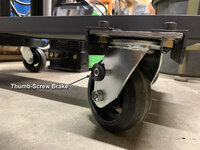
My little workshop is pretty crowded, so I needed as much maneuverability as possible, and four swivel casters make the cart very nimble. The shop floor is nice and flat, but I added thumb-screw brakes to the front casters anyway, just in case I ever need to keep the cart from rolling away, such as when used out in my driveway, which has a slight slope to it. I plan to add brakes to the rear casters as well.
The argon cylinder is secured with a large U-bolt with a piece of high-pressure air hose on it for padding, and the cylinder is pulled snugly against a V-shaped pair of angles welded to the frame, with a chunk of conveyor belt for padding. The cylinder doesn't contact the screw that holds the padding on the frame, as I designed it to leave a gap in the middle. I don’t like cylinders to clank around when moving a cart (it’s just a “thing” of mine), and this setup holds the cylinder securely...and quietly. I also added some pieces of conveyor belt as spacers/bumpers to fit the welder snugly into the top shelf, so that it can't slide around, plus a strap to further secure the welder.
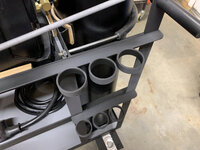
I made a set of low-cost filler-rod tubes from schedule 40 PVC electrical conduit. The tubes have male and female thread adapters where the top and bottom sections connect, and by using a thick O-ring, the tops screw on easily and stop against the O-ring before the threads get screwed on far enough to start binding. I had to sand off the raised letters on the edge of the female adapter to allow a tight seal against the O-ring. I fashioned internal plugs for the top and bottom ends out of slices of solid PVC rod, sanded them a bit to fit snugly, and solvent-glued them in. The tops might look open in the photos, but that's only because the plugs are darker than the conduit. The plugs eliminated the need for PVC fittings at the top and bottom, which allows me to slide the tubes in and out of the steel rings that I welded onto the sides of the cart. Here are a few views of the cart:



Future modifications might include mounting a short metal tube somewhere on the cart to hold short pieces of filler rod, and maybe a built-in rest for a TIG torch. I might also try to figure out some sort of drawer or bin for the accessories. The only consumables that I carry on the cart are filler rods. My workshop is small enough that the other TIG consumables are just a few steps away.
My standard disclaimer: I do not guarantee the safety, efficacy, or applicability of any of my designs or ideas that I have described here in this thread. Any use of my designs or ideas is entirely at your own risk.

 . Work alone 90+ % of time.