Outlawmws
Well-known member
A USC will dislodge "stuff" I would go with a de-greaser first, then - maybe - Evaporust if a bare steel finish. then hopefully anything left can still get rinsed out or get carried to non working areas in the lube.


On which part of what I said?^ Sorry you lost me there...
??!! If they were putting the tool set labels in the bottom of their boxes, and backwards, instead of the lid, by design, as a deliberate practice, against all common sense and industry practices, for reasons I cannot begin to fathom, of course they would have to pose the box upside down - with the tools placed in the lid, and the bottom folded up as if it was the lid - if they wanted to display the set for marketing photos and brochures and catalogs etc in a way that showed the tools and the label at the same time. But I would call that necessary, not good, and a comedy of errors....but I can understand why they thought it was a good idea (for the purposes of displaying the tool set.)
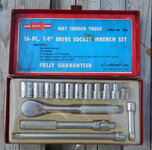
Thanks, 4.c. In addition to the same reaction that Don and 3bay had, I do find this helpful.Came across this label earlier this evening.

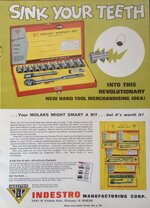
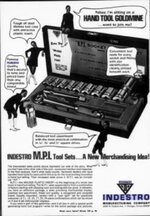

You keep saying that and I am very eager to see the reason explained. Again, I understand why it would be necessary to display them for retail upside down if they were putting the labels in the tools compartment, and backwards. But that's not a reason for putting the labels there to begin with. That's tautological.There was a reason they did that for purposes of displaying the set for retail sale.
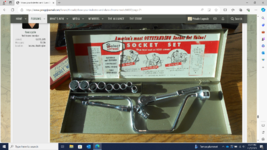
Was it only for a certain period? Certain tool-sets?Yes, they were very deliberately affixed to the working part of the box (NOT the lid) and the box was displayed upside-down for retail sale.
I am not sure why you're showing boxes from the MPI era, or why you think a box with an MPI would have a hidden divider. I guess perhaps in some transition period when they were using up surplus boxes? It wouldn't make much sense after they ditched dividers and moved into the MPI era full bore. But what is needed to make me a believer that Indestro was putting labels in the bottoms of divider era boxes intentionally, as a matter of policy and practice, is a number of examples showing that and/or period ads and brochures showing that.The product illustrations (photos staged for the purposes of marketing) won't show that because... they were pitching the M.P.I. (Molded Plastic Insert) which covered up and hid that spot-welded partition.
Post linked here.I'm surprised that the labels are in such good condition. Because of the design of the box, the tools rested upon them. I would have thought that they would have been attached to the lid.
I found them. I still don't understand WHY or HOW. But it was a factory practice. Something related to what they called "skin packing" to prevent pilferage. Stand by..., I need a few minutes to recuperate!I will have to check as I pull the sets out... I was planning on working through the Indestro LAST, as it's the largest pile.


Private Lugnutz said:Stand by..., I need a few minutes to recuperate!

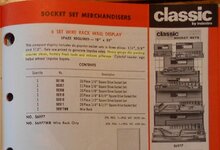

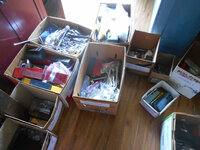
Nope. I know you have a tons of tools, and in the pictures in my head, it's a hoarder's house with only narrow passages to walk from room to room between boxes and towering stacks of stuff. No, I needed to recuperate from Indestro Upside Down Land. It's one of the craziest things I have ever seen.If that has anything to do with the volume of material in that photo,
Now that I have proved YOUR case for you, you're going to give up?!And I hope you're done asking me to make sense of something which never made a bit of sense to me (or anyone else.)
Private Lugnutz said:it's a hoarder's house with only narrow passages to walk from room to room between boxes and towering stacks of stuff.
Private Lugnutz said:"... such weird steps with the display and labeling ..."
^ The term "skin pack" as used above in their advertising and catalog is actually a misnomer - at least from what I understand about plastic packaging. "Skin pack" would indicate (to ME, as a BUYER) that the items were sealed in a clear plastic which had been heated to cause the plastic to mold around the object being contained.
That's not how those Indestro sets were packaged. They were packaged just like this Japan-made set, which (for the record) does NOT have a spot-welded divider in the bottom part of the box.
That vacuum-molded clear plastic cover was not attached to anything. Had it been attached - by means of a staple, for example - the customer would likely have destroyed the "M.P.I." molded plastic insert trying to get it apart. The clear plastic piece just sat on top, exactly as is shown here on this "Mark I" set:


That burrito thing is hilarious^ Packaging went through some radical changes during the 1960s and 1970s.
When we were little kids, my younger sister and I would play with the Hawaiian kissing dolls and the Cal Custom chrome air cleaner scoops (intended for the tops of Stromberg 97's.)
Those items - as well as pretty much everything else my old man sold - came in cardboard boxes. Cal Custom used a yellow box, like Indestro.
Later stuff started coming in "Poly bag with header" - the item was contained in a plastic bag onto which was stapled a folded piece of cardboard with graphics on it, with a hole punched in it, all ready to display on a pegboard wall.
After that we got "blister pack" or "bubble pack" and the aforementioned "shrink wrap", all of which had advantages and disadvantages.
Car Freshner Corporation (Watertown, NY) was an industry leader on "bubble pack" - their little "skunk" air freshener was a top seller, and it sold even better inside a clear plastic ball.
"Shrink wrap" was a favorite for manufacturers who put stuff in "display boxes", like "Sparkomatic" shift kits.
Workers at the assembly plants used the shrink-wrap machines to heat up their lunches. When we toured the Fenton plant in Gardena, California (1969) we were walking down the assembly line just as the lunch bell rang.
Almost every working in the plant stopped what they were doing, and lined up with an aluminum-foil wrapped package at the shrink-wrap part of the line. They'd lay their aluminum-foil wrapped lunch on the conveyor belt and run it through the machine to heat up their lunch.
(There were no "break rooms" or "microwaves" in the Fenton plant that year.)
(I only told you that story because a couple years later my older brother was unwrapping a Fenton shift kit for a customer on the front counter down at 38th Street and somebody's very old and very nasty burrito had been put inside the package at the plant. )
Only much later did they come up with "clamshell" packaging, which is ubiquitous today (particularly at Costco.)
Those Indestro socket sets you're looking at weren't "shrink wrapped" - at least not the ones we were getting. All they did was put a clear, vacuum-molded piece on top of the tools, which was not attached to anything - that served only to slow the thieves down a couple seconds.
I think I have a Japanese set that still has the plastic thingie on top ... I'll see if I can dig it out.
And I hope you're done asking me to make sense of something which never made a bit of sense to me (or anyone else.)
 !
!Yep. And not the first story I’ve heard like that…That burrito thing is hilarious
d42jeep said:Here is a Kraeuter set that came with a molded plastic cover.
Cruzan80 said:"... with staples ... {/quote]
now that's curious... maybe my memory is failing me or the retailer put those staples in there... I do not believe I own an M.P.I. set in which the insert is intact. I was looking at one recently but the insert was cut in half by a previous owner.


All they did was put a clear, vacuum-molded piece on top of the tools, which was not attached to anything -
That vacuum-molded clear plastic cover was not attached to anything. Had it been attached - by means of a staple, for example -
I have a black plastic mouldedcase set of Indestro 3/8 metric, WITH STAPLES to hold down the skin wrap. The plastic skin wrap is intact, with two small pieces ripped out around the staples.
But they are in the "bottom" of the case, so not sure it is directly relevant to the upside down part.
Whether it was stapled or secured by some other means, I am more convinced than ever that the "skin wrap" is the culprit for the labeling and for the socket tray notice. The socket tray notice seems a little less captain obvious if you think about the set being sold with the tools "skin packed" inside the lid instead of where they normally belong. I have requests in with Google Books to open up several 'snippet only' views in trade mags. Hopefully in a matter of days to a week I will have more info for us on this whacky issue.four.cycle said:...maybe my memory is failing me...

Excellent job of stating the obvious. I wonder what marketing genius thought of that?
-Don
Got a new wrinkle in my brain!That's tautological.
Latent HS debate club experience and mid-life literary forums heavy with exegesis!Got a new wrinkle in my brain!
Thanks for chiming in, OR. I concur. That's what I was getting at here...they were designed simply to display each tool in the set to best advantage without being obscured by the interior divisions or structure of the "traditional" bottom of the case.
Which would necessitate the label placement. And since they were skin packed on the lid, which sounds permanent to begin with, and implies even more permanence with the stated anti-pilfering purpose, it would help explain the socket tray notice. In other words, in case you're confused by our crazy upside down and backwards merchandising set-up, this part with the socket divider is not actually the lid!I'm guessing they thought the tools were more attractive if they were assembled in a more open way on the lid, not how they were stowed in the compartment and the socket tray.


literary forums heavy with exegesis


Out of four (4) requests, Google Books could legally only make one (1) available for full viewing, a 1967 Hardware Age.I have requests in with Google Books to open up several 'snippet only' views in trade mags. Hopefully in a matter of days to a week I will have more info for us on this whacky issue.