
You are using an out of date browser. It may not display this or other websites correctly.
You should upgrade or use an alternative browser.
You should upgrade or use an alternative browser.
Show Your Structural (SPUD) Wrench
- Thread starter MisterEd
- Start date


Private Lugnutz
Well-known member
Yes. And, like many other wrenches made by many other mfgrs, it was adopted from J.H. Williams. That is their model numbering system. Not everyone followed it. Armstrong definitely did. In the 1930's Billings was still marking wrenches with their own numbers, but they would list the Williams number next to their number in a separate column called "Trade No." in the catalog. By the 1940's even Billings had given up and were using the Williams/Trade number as the standard. But there were holdouts. I have Plomb structural wrenches with their 26xx size numbering scheme.Is there a standard for Structural Wrench sizes?
Slightly off-topic . . .Not everyone followed it.
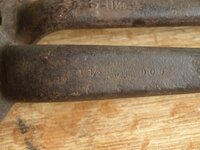
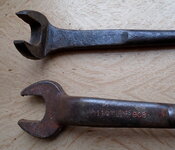
Does this look like a hand-forged Wrench?
Attachments


rustyjames
Well-known member
Every steel framed project that I worked on only had two size bolts 3/4" & 7/8". I forget the actual hex sizes but I'd guess they were 1-1/16" & 1-1/2" as shown above.
Private Lugnutz
Well-known member
Definitely!Does this look like a hand-forged Wrench?
Walkers
Well-known member
What he said.Every steel framed project that I worked on only had two size bolts 3/4" & 7/8". I forget the actual hex sizes but I'd guess they were 1-1/16" & 1-1/2" as shown above.
wrenchguy
Well-known member
After "Einsteining" 3rd photo, looks to be made from a file or rasp. I'd say the flat part is handforged. Super wrench.
It's one of my Significant Other's favorite finds.Super wrench.
Private Lugnutz
Well-known member
Every steel framed project that I worked on only had two size bolts 3/4" & 7/8". I forget the actual hex sizes but I'd guess they were 1-1/16" & 1-1/2" as shown above.
Just in case you or anyone else was wondering, vintage structural (colloquially "spud") wrenches ranged from 7/16" to 2" openings. I have several different sizes in that range, all from the 30's or 40's. I'll try to remember to post a photo later.What he said.
KnurledNut
Well-known member
7/8 for 1/2 heavyEvery steel framed project that I worked on only had two size bolts 3/4" & 7/8". I forget the actual hex sizes but I'd guess they were 1-1/16" & 1-1/2" as shown above.
1-1/16 for 5/8 heavy
1-1/4 for 3/4 heavy
1-7/16 for 7/8 heavy
1-5/8 for 1 heavy
3/4 for 1/2 reg
15/16 for 5/8 reg
1-1/8 for 3/4 reg
1-5/16 for 7/8 reg
1-1/2 for 1 reg
That's an oldie. I'm not a blacksmith but I recently bought a propane forge and have been learning about the craft. I'm guessing how it was made here.Slightly off-topic . . .
Does this look like a hand-forged Wrench?
Typically either flat bar stock or round stock was selected to bash into something useful. Here it looks like it was a piece of round stock as you can see on the last half of the wrench. It was pounded flat for the front half where the claw is. To get the extra material for the claw you can pound the end of the metal into itself from the end (thereby increasing it's thickness) or what I think was done is the last 2" of the flattened end was folded over onto itself and forge welded together where it overlapped. This may be why you can see a slight raised square step just past the claw on one side. This double thick section would then be flattened back to the original thickness but worked so it spread width wise forming the paddle shape. Finally the opening was shaped probably by slicing through the center of the paddle from the end with a chisel and then pounding another piece of round stock that had been flattened on 2 sides (to the appropriate dimension) into the chiseled fork and hammering the near molten sides tight to the sized round stock and finishing with a file. The taper at the other end was simply hammered down to shape.
Unfortunately it doesn't look like it was heat treated or hardened. Today specific alloys can be bought with exact hardening and tempering protocols that can be followed for superb results but when this tool was made it likely wasn't spelled out so well. Furthermore it may have been made from some scrap object of unknown origin. Back in the early days blacksmiths' shops were often built on skids and were skidded into mine sites or pulled onto rafts and floated to mine, logging camps etc. and you used whatever metal you could find.
This is how I imagine it may have been made after watching a ton of youtube videos and banging a bit of metal myself. If this wrench could talk it would have some hardtimes to tell of.
Like most people using this Forum, we enjoy preserving bits and pieces of tool history.If this wrench could talk it would have some hardtimes to tell of.
Thanks for the hand-forging information. My father spent 50 years shipping drop-forged pieces so I have rust in my DNA, but none of the steel splinters he often brought home in his fingers.
The Wrench pleases my Wife and on the most important level that's what matters!
Private Lugnutz
Well-known member
Good idea!Huh! Seems like it's become "Show your SPUD".
While spud wrenches have been shown and discussed before, it's always been scattered here and there in other threads or a Whatzit? thread, and very short-lived. If you'd oblige in editing your title into something less interrogative, and more declarative or nominate, and less temporary, more permanent (e.g., 'Show your structural ("spud") wrenches!' or something more creative of your choice) I would put it in the Sticky Index. Don't worry about your first post being a query. The thread has already outgrown that and people who find it later will get the idea.
Private Lugnutz
Well-known member
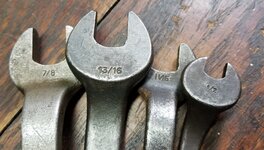
Here are a few of mine, all smaller than the Model 909 and 907 sizes shown and discussed above. A Williams 905 (7/8"), a Proto 905A (13/16"), a Williams 903 (11/16"), and a Fairmount 901 (1/2").


Private Lugnutz
Well-known member
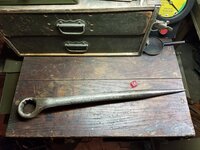
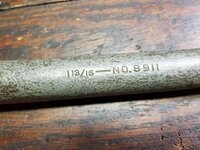
I also have this giant box end structural wrench. It is a wartime Alloy Steel Williams Superrench, leoparded with cadmium plating remains, 26" OAL, with a 1-13/16" 12-point opening.
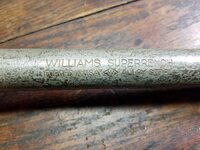
Done.If you'd oblige in editing your title into something less interrogative, and more declarative or nominate, and less temporary, more permanent


wrenchguy
Well-known member
Good solid BS marking, For those who might not know, Post any other marking/stampings the tool may have. It'll prolly indicate company the tool was "borrowed" from. I think ones marked "AB" are the most collected.
d42jeep
Well-known member
Here are some Spuds I’ve run across. The last one I left behind for some reason.
-Don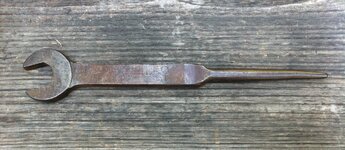
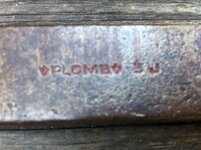
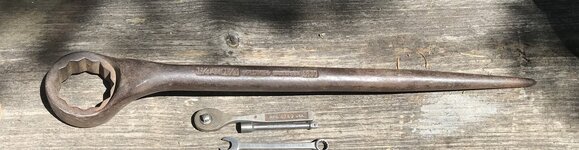


-Don
Here are mine, mostly 1 1/4" except the bottom one which is 15/16" and then the Proto Ratchet.
WILLIAMS 208 1 1/4"
ARMSTRONG 32-640 ARMALOY 1 1/4"
Unmarked 908 with a cast "T" and USA on the back side.
Snap-on SOE-140 1 1/4"
Gray Canada 906 15/16"
Proto Ratchet

WILLIAMS 208 1 1/4"
ARMSTRONG 32-640 ARMALOY 1 1/4"
Unmarked 908 with a cast "T" and USA on the back side.
Snap-on SOE-140 1 1/4"
Gray Canada 906 15/16"
Proto Ratchet
The Bean
Well-known member
Wow. That looks like it was left on a railroad rail.Slightly off-topic . . .
Does this look like a hand-forged Wrench?
Private Lugnutz
Well-known member
@2oolhound
The Williams 208 is a construction wrench. No offset. Bonney, Billings, Armstrong and several other mfgrs made that distinction. The wrenches with the offset were called structural wrenches, wrenches with no offset were called construction wrenches.
I'm pretty sure your 908 is a Williams, by the way.
The Williams 208 is a construction wrench. No offset. Bonney, Billings, Armstrong and several other mfgrs made that distinction. The wrenches with the offset were called structural wrenches, wrenches with no offset were called construction wrenches.
I'm pretty sure your 908 is a Williams, by the way.

Private Lugnutz
Well-known member
You're probably in the best position to determine that, but for one data point, I have never seen a crowfoot angle on a spud wrench before, and for another data point, that model number (907) is for a structural wrench, and again, they had a shallow offset, with a 1-1/6" opening. IF, and again it's a big if, Williams made a crowfoot spud, my hunch is they would've given it a model number like 907-S (for Special) or something like that, and if they were an entire line, maybe a whole new series number. Lastly, it sure looks like they took the offset out of the shank to help them make that bend. Just my $.02.(is this original, or user modified ?)
Thanks for the info Lugs, by the way your 1 13/16 box end is a show stopper! I want it but you don't want to know why.
Kwigly, I'm going to guess your right angle is user modified. I've never seen another one and the design doesn't seem very practical for wide spread use. Obviously someone needed one though.
Kwigly, I'm going to guess your right angle is user modified. I've never seen another one and the design doesn't seem very practical for wide spread use. Obviously someone needed one though.
Private Lugnutz
Well-known member
Well, now that you said I don't want to know why, of course it has made me even more curious! If not mechanical, I am guessing it has something to do with bludgeoning!I want it but you don't want to know why.

wrenchguy
Well-known member
"user modified?"
For close quarters use, or long reach backup. Prolly modified at the rivet forge as needed.
Photos from a 1914 complete line book i have.
Photos should enlarge.


For close quarters use, or long reach backup. Prolly modified at the rivet forge as needed.
Photos from a 1914 complete line book i have.
Photos should enlarge.
Private Lugnutz
Well-known member
The Williams catalogs are very informative on the subject. One of the 30s or perhaps it was the 1941 discusses the openings being milled a hair over to accommodate bunged up nuts and bolts, how the step-up from the flat shank to the round shank serves as a natural stop for hanging it through a belt loop, and how the tangs of certain sizes were shorter for oil derrick work.
You're on the right track. I recently bought a forge to dabble in blacksmithing but the forge is only 1/2 the equation. The other 1/2 of the blacksmithing equation is the anvil and I don't have one. I'm using an old counter weight which I've put a hardy hole in and it's doing the job, sort of. You'll never miss the horn on an anvil until you need to hammer some curves and your anvil doesn't have one (my case). So now I find myself looking at everything that I could utilize as an anvil horn. Lately I've been entranced by the idea of making a bick for my hardy hole which would provide me with a curved surface to compensate for my hornless anvil.Well, now that you said I don't want to know why, of course it has made me even more curious! If not mechanical, I am guessing it has something to do with bludgeoning!
Enter the "BICK"

Do you see where I'm going with this? I've been eyeballing my spud wrenches but they're too small.
Private Lugnutz
Well-known member
Haha, yes, I do. The problem with anvils is they're just too dang expensive!
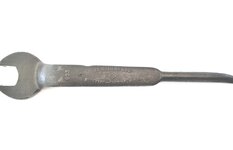
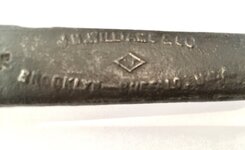
My contribution to the spud thread is this J.H. Williams 903 (3/4” opening). Typically I’ve seen early Williams tools as either Brooklyn or Buffalo, with the diamond W logo. This one is marked “Brooklyn - Buffalo U.S.A.”
Attachments
Joemctag
Well-known member
Those sizes are correct. Was an iron worker and still know them.7/8 for 1/2 heavy
1-1/16 for 5/8 heavy
1-1/4 for 3/4 heavy
1-7/16 for 7/8 heavy
1-5/8 for 1 heavy
3/4 for 1/2 reg
15/16 for 5/8 reg
1-1/8 for 3/4 reg
1-5/16 for 7/8 reg
1-1/2 for 1 reg

Cleave
Well-known member
A bit of spud wrench trivia from the AISC Steel Construction Manual,
There are a few different tightness conditions for bolted joints. The simplest and most often used is called "Snug Tight."
Here is the wordy definition,
Compacting the joint to the snug tight condition shall progress systematically from the most rigid part of the joint. Snug tight is the condition that exists when all of the plies in a connection have been pulled into firm contact by the bolts in the joint and all of the bolts in the joint have been tightened sufficiently to prevent the removal of the nuts without the use of a wrench… The snug tightened condition is typically achieved with a few impacts of an impact wrench, application of an electric torque wrench until the wrench begins to slow, or the full effort of a worker on an ordinary spud wrench. More than one cycle through the bolt pattern may be required to achieve the snug tightened joint.
I have a feeling that when wrench standard lengths were being developed, they made some measurements about the force an ordinary worker could pull on a wrench, and determined the approximate torque they wanted in each size bolt, then it is simple math to determine the necessary wrench length. These lengths then became standard.
There are a few different tightness conditions for bolted joints. The simplest and most often used is called "Snug Tight."
Here is the wordy definition,
Compacting the joint to the snug tight condition shall progress systematically from the most rigid part of the joint. Snug tight is the condition that exists when all of the plies in a connection have been pulled into firm contact by the bolts in the joint and all of the bolts in the joint have been tightened sufficiently to prevent the removal of the nuts without the use of a wrench… The snug tightened condition is typically achieved with a few impacts of an impact wrench, application of an electric torque wrench until the wrench begins to slow, or the full effort of a worker on an ordinary spud wrench. More than one cycle through the bolt pattern may be required to achieve the snug tightened joint.
I have a feeling that when wrench standard lengths were being developed, they made some measurements about the force an ordinary worker could pull on a wrench, and determined the approximate torque they wanted in each size bolt, then it is simple math to determine the necessary wrench length. These lengths then became standard.
Here's a bouquet of 903 structural variants (she was not impressed). All of these wrenches were found at the Steelton PA steel mill (Pennsylvania Steel Co, Bethlehem Steel, Steelton, etc.), which dates to 1867. In the early days, the mill was mostly self-contained, including the ability to hand-forge wrenches and other tools with many of the earliest steam hammers. These are not the smallest structurals, but I'm amazed that they are sill intact. Now.....to wire-wheel, or not to wire-wheel?
- The first is a stunning hand-forged wrench (JH who?)
- The next is a Lakeside 903
- The next is a Bonney, stamped with a "480". I assume this was before falling in line with JH Williams convention
- The next two are also Bonneys, but look closely: The "480" appears to have been hammered away, and replaced with a 903 stamping
- The next two are JH Williams Brooklyn, with "3/8" stamped under the 903
- The next is a JH Williams Brooklyn-Buffalo, with the "3/8" appearing on the head. The Buffalo era 903 is definitely more refined, and has a thicker head
- The last is a JH Williams 903A, and I assume that this "longer version 903" was made later that the previous three
Attachments


Last edited:
Private Lugnutz
Well-known member
Snerk.(she was not impressed).
I'm going to assume this was a rhetorical get yer goat question, but if genuine, my vote is NEVER!Now.....to wire-wheel, or not to wire-wheel?
Nice collection.
If I haven't said this before on any of your other threads or posts, I find your niche to be one of the more unique and interesting approaches to participation here on GJ. Most of us are fairly broad and diverse. Some of us have a few favorite brands and deep dive on them. Some of us have a few favorite types and deep dive on them. A few of us have a few favorite eras and deep dive in those. Nobody else to my awareness is so singularly inspired - from your username to the tools you are pulling out of "the mill" to your passion in researching its history - in one company, in one geographic place. The fact that it is still in operation and that you work there is the coolest part! In any other context, it might seem narrow. But in this case it is the composition that the entire industry relies on. The making of steel, and the tools that were used in a mill making steel, also made of steel. It's just neat to see what you turn up next and picture you traipsing around finding them.
Lugz, Thanks...I really appreciate it. A career at an old steel mill has been strange, terrible, fascinating, challenging, fantastic, and terrifying all rolled up into one. I wish it hadn't taken so long for me (sparked by GJ only a couple of years ago, especially by members such as yourself and WrenchGuy), to finally embrace the history of the place (old tools especially!), and then to stop history from literally heading back to steelmaking for re-melt or into the dumpster. A breathtaking amount of old tools of every sort, obsolete equipment, drawings, and other relics from the "second industrial revolution" has been lost forever, and now I'm scrambling to save whatever I can. WrenchGuy in particular has really helped with what is significant (and not), and to understand old-school forging & blacksmithing.
I totally agree with you regarding the "composition that the whole industry relies on". In case any don't really realize, do a quick search on Sir Henry Bessemer. He could well be the most significant figure regarding practically everything on GJ.
Again, thanks for the comments. Every day is a treasure hunt, and I look forward to sharing more.
I totally agree with you regarding the "composition that the whole industry relies on". In case any don't really realize, do a quick search on Sir Henry Bessemer. He could well be the most significant figure regarding practically everything on GJ.
Again, thanks for the comments. Every day is a treasure hunt, and I look forward to sharing more.
Ricky Joe
Well-known member
Last edited:
WNYflyer
Well-known member
AB stands for "American Bridge" initially a division of the United States Steel Corp. They did a lot of the engineering, fabricating and erecting of steel for the construction of USS mills back in the day. They also handled fabricating and erection of a lot of the steel for structures and bridges like the George Washington Bridge, Mackinac Bridge amongst many others. And yes spud wrenches stamped AB seem to draw the most interest, I am assuming because of the tie in with American Bridge/USS.Good solid BS marking, For those who might not know, Post any other marking/stampings the tool may have. It'll prolly indicate company the tool was "borrowed" from. I think ones marked "AB" are the most collected.
Last edited: