To avoid these ads, REGISTER NOW!

Simple Radiant floor heat

70pcuda

Well-known member
Joined
Jan 15, 2006
Messages
76
Location
OHIO
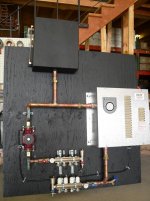
Here's a system I went to look at before I setup my system.

well insulated 3600 sq ft building with at least a 20' ceiling. It had 13 - 1/2" PEX loops. It was a very simple system, consisted of an electric boiler ( I think it was 120K BTU), one temperature gauge, a homemade PVC tank, thermostat, and a single pump.

The PVC tank had fluid in it and was open to the atmosphere.

Anyone ever seen a system like this before? He'd been running it for two years now, and loved it. He kept the thermostat set at 56*

If it's this simple, why does everyone add all the valves,gauges, pressure tank, etc?
 

Attachments

  • 0783.jpg
    0783.jpg
    58.3 KB · Views: 474
  • 0784.jpg
    0784.jpg
    60.3 KB · Views: 406
To avoid these ads, REGISTER NOW!

Eggman

Well-known member
Joined
Dec 29, 2010
Messages
82
Location
St. Louis
Looks simple enough. The plastic "tank" that he is using looks to be replacing the actual expansion tank. The reason for the expansion tank is there is a diaphragm inside that is pressurized with air and allows the water to expand without breaking anything. Remember, a hydronic heating system is basically a closed system. There has to be some room for the expanding water as it heats up. If there isn't any room for it to expand, something has to give. Most of the hydronic systems used in garages and homes are low pressure systems. Operating around 17-18 psi and about 130 degrees.

Personally, I wouldn't want a pressurized pvc pipe on my system. An Expansion tank is around $35.

HTH,

Eggman
 
OP
7

70pcuda

Well-known member
Joined
Jan 15, 2006
Messages
76
Location
OHIO
The PVC is not pressurized. There is a small 1/4" hole in the top. and the lid is not screwed on tight.
 

Weedwaka

Well-known member
Joined
Mar 28, 2008
Messages
737
All the gauges and valves help you control and service, maintain and diagnose issues with the system.

How many gpm is flowing per loop
Supply and return temps
Air removal and top up fluid
Expansion as mentioned

If that system ever starts to under perform, how would you begin to diagnose it ? How do you know its really working optimally from the start ? He may be down 2 loops and not even know it.
 

Fastback

Well-known member
Joined
Oct 5, 2010
Messages
518
Location
Indy
Also sounds like this system would be full of air !

I cant see your logic? Air cannot go under the fluid in that tube and the concept is about perfect. The system is just a bit over full and if it cools down the PVC tube still has reserve. The only issue is evaporation, but you gotta admit that it would be easy to add more fluid, even while running.
 

Weedwaka

Well-known member
Joined
Mar 28, 2008
Messages
737
What pressure is this system running at with the expansion tank being open to the atmosphere ?
 

787B

Well-known member
Joined
Sep 16, 2010
Messages
294
Location
Baltimore, MD
Sounds like an even better reason to use an expansion tank.

That doesn't make any sense to me. What's wrong with the unpressurized PVC expansion tank?

Also sounds like this system would be full of air !

That doesn't make any sense either. The expansion tank is the highest point in the system, so it would naturally purge any air.

All the gauges and valves help you control and service, maintain and diagnose issues with the system.
[...]
If that system ever starts to under perform, how would you begin to diagnose it ? How do you know its really working optimally from the start ? He may be down 2 loops and not even know it.

None of the other systems listed on the big "show us pictures of your radiant heat setup" had individual gauges on the loops, barring some zoned systems with thermostats. At most they had supply and return temp/pressure gauges, which makes sense. And how hard is it to shoot an IR temp gauge at the slab to tell whether a loop is working or not?

And it looks like he's got plenty of valves -- two on each loop. Does look like he could use a drain valve under the heater. But without a pressurized system and very short loop to the pump and manifold, why would he need or want a bunch of extra valves?


Cuda, nobody has answered your questions yet, and I can't either. It does seem like a simple, unpressurized system would be much easier to install, maintain, and service. Only reason I can come up with for using a pressurized system is that it significantly increases the boiling point of the water/ethylene glycol mix.

A 50/50 mix has a 225° boiling point. Put it under 15 PSI pressure and that becomes about 265°. The compact, high-power on-demand water heaters like this guy is using might need that extra headroom to prevent hot spots from boiling voids that could burn out the heater. That would make sense as 100% water at typical 45 PSI household pressure boils at about 275°.
 
OP
7

70pcuda

Well-known member
Joined
Jan 15, 2006
Messages
76
Location
OHIO
thanks 787b. I think you see my point on this simple system. I don't think boiling point is even an issue, the owner said the output side of the boiler never gets too hot to grab with your hand.
 

Fastback

Well-known member
Joined
Oct 5, 2010
Messages
518
Location
Indy
I think a lot of guys use boilers and cant see the benefits of just using hot water in a system like that.
 

Eggman

Well-known member
Joined
Dec 29, 2010
Messages
82
Location
St. Louis
You can build it however you want to. However, 100's of the boiler/hydronic heating systems that I have worked on are all low pressure systems.

The efficiency of a pressurized system is higher than one with an "open" expansion tank. When the system is sealed and pressurized, the movement of the fluid and the heat is better than having a system that is open to the air. With the ability of the pump to cavitate and create more air in an open, unpressurized system the "open" pvc tube is probably required to remove the large amounts of air. When the system is closed and pressurized, once the air has been purged from the tubing/system, the heated water will travel in a more efficient manner being pushed through by the pump instead of relying on gravity to feed the pump and or tubing.

This system you are looking at being simple is a simple system. One thing the guy isn't telling you is how much its costing him to run it, truthfully. From all the systems I have seen, bills I have seen, I would be willing to bet he could save 35-40% by spending a bit more money to finish his system correctly.

The reasoning behind adding a glycol substance is not to raise the boiling point, but to keep the lines from freezing if/when the boiler/heat source goes down in the winter or the home owner doesn't start it up soon enough.

YMMV...my advice and experience and $5 will get you a happy meal at McDonalds.

Eggman
 
Last edited:

Eggman

Well-known member
Joined
Dec 29, 2010
Messages
82
Location
St. Louis
thanks 787b. I think you see my point on this simple system. I don't think boiling point is even an issue, the owner said the output side of the boiler never gets too hot to grab with your hand.

This information coupled with 3600 sq ft, 20 foot ceilings, 13 pex loops, and an electric 120K water heater keeping it at 56*.......Sorry, 70pcuda, but I have to call BS.

Just the load on the water heater keeping the 3600 sq ft concrete pad is way more than 120K. I will do a load calc on it tomorrow at work and see what it really requires and the amount of btu's required for the slab.

Eggman
(Flame suit on)
 
OP
7

70pcuda

Well-known member
Joined
Jan 15, 2006
Messages
76
Location
OHIO
You can call BS on that, but I was there and the pipe was not to hot to hold onto.

I am going by memory on the 120K boiler, I read the label on it, but don't remember exacty what it was, it might have been less.

I am trying to remember the conversation, and I kinda recall him mentioning $350/month for electric, but I don't know if that was total electric bill or just for the heating. He also had a separate 2-loop system running off a 50 gal electric water heater in the office portion of the building.

I went there to look at his system to get an idea on how to complete my own system in my 3456 sq ft shop. I have 3/4" pex in my floor, and am leaning towards adding the temp and pressure gauges, the fill/pruge valves, pressure tank, ect.. Mine will be using a Natural gas heater (leaning towards an on demand water heater like the Takagi TK-3)

I 'm trying to determine the pump size. (Thinking Taco 011-F4)

Not sure if I need a two pump system like I see with some of the systems on here.

Thanks
 

sneezer41

Well-known member
Joined
Oct 8, 2007
Messages
407
Location
People's Republic of Mass
There is no reason the system would not work, remember the pad is a huge storage area, not a load. if the building and slab are insulated, I don't see a problem

Most heating systems at some point have to go 'up' so would not work without pressure. This one doesn't so it [obviously] does.

Pressure tanks are cheap tho.....
 

larry_g

Well-known member
Joined
Apr 28, 2007
Messages
16,874
Location
oregon
You can build it however you want to. However, 100's of the boiler/hydronic heating systems that I have worked on are all low pressure systems.

The efficiency of a pressurized system is higher than one with an "open" expansion tank.

This system you are looking at being simple is a simple system. One thing the guy isn't telling you is how much its costing him to run it, truthfully. From all the systems I have seen, bills I have seen, I would be willing to bet he could save 35-40% by spending a bit more money to finish his system correctly.


YMMV...my advice and experience and $5 will get you a happy meal at McDonalds.

Eggman

Can you cite where you are getting the 30-40% savings on an open vs a closed and pressureized system?

lg
no neat sig line
 

Clik

Well-known member
Joined
Jan 1, 2011
Messages
430
Location
Highest Mountain in Western, MD
Judging by the heighth of the open top or vented PVC resevoir in the picture, which I estimate to be around six feet, the head pressure would be around three PSI. Boiling never enters the equation because, as he stated, it is kept at 56 degrees.

I plan to do my next garage with radiant solar and a 3000 gallon tank burried under the drive way apron. I'd put it under the garage but if it ever needed repair I'd rather dig up the driveway outside.
 

787B

Well-known member
Joined
Sep 16, 2010
Messages
294
Location
Baltimore, MD
The efficiency of a pressurized system is higher than one with an "open" expansion tank. When the system is sealed and pressurized, the movement of the fluid and the heat is better than having a system that is open to the air. With the ability of the pump to cavitate and create more air in an open, unpressurized system the "open" pvc tube is probably required to remove the large amounts of air.

OK hold it a sec. Cavitation does not "create air". It creates water vapor. Cavitation is caused when the action of the pump makes the pressure in areas of the impeller drop below the vapor pressure of the fluid being pumped. Then the fluid actually boils, creating a pocket of steam (cold steam!).

Cavitation reduces the efficiency of a pump and this may be enough argument for a pressurized system if the pump is cavitating. Severe or prolonged cavitation can damage a pump, but unlikely to cause anything more than cosmetic damage in this application. (My car redlines at 9000 RPM, and is often driven in that vicinity to keep it healthy. The water pump is known for cavitation at those speeds and leaves a rough surface in the pump housing.)

But even extreme cavitation is not going to generate anything to go out the vented expansion tank. Once the vapor leaves the immediate area causing the low pressure the steam pocket collapses, leaving nothing behind but noise.

Anyway, I sincerely doubt cavitation is a problem here. But I do wonder if the heater's efficiency isn't increased by pressure by keeping those little boiling hot spots to a minimum?


When the system is closed and pressurized, once the air has been purged from the tubing/system, the heated water will travel in a more efficient manner being pushed through by the pump instead of relying on gravity to feed the pump and or tubing.

You're saying a closed loop is more efficient because of higher pressure at the pump inlet?
That doesn't make a darn bit of difference if the pump isn't sucking air or cavitating.
And there's no guarantee the pump will see higher relative inlet pressure in a closed system.


The reasoning behind adding a glycol substance is not to raise the boiling point, but to keep the lines from freezing if/when the boiler/heat source goes down in the winter or the home owner doesn't start it up soon enough.

That makes sense. And no doubt to keep green goo from making a home in the plumbing too.

YMMV...my advice and experience and $5 will get you a happy meal at McDonalds.

Same here, except my advice and experience and $5 will get you a cup of coffee at Starbroke's! :beer:
 
To avoid these ads, REGISTER NOW!

787B

Well-known member
Joined
Sep 16, 2010
Messages
294
Location
Baltimore, MD
Most heating systems at some point have to go 'up' so would not work without pressure. This one doesn't so it [obviously] does.

That's the best explanation I've heard yet for why it would have to be pressurized.

Pressure tanks are cheap tho.....

But not as cheap as not having one. :bounce:

My money for the ultimate answer (aside from going uphill) is still on improving the efficiency of the high-energy-density water heaters. I suppose I should go RFTM for one of them. ;)

Edit: Just found a possible good explanation: Oxygen. Open systems will get more oxygen in them which will rot iron pumps and water heaters. You can even buy "oxygen barrier" radiant tubing for higher-temperature (>140°) systems.
 
Last edited:

Weedwaka

Well-known member
Joined
Mar 28, 2008
Messages
737
None of the other systems listed on the big "show us pictures of your radiant heat setup" had individual gauges on the loops, barring some zoned systems with thermostats. At most they had supply and return temp/pressure gauges, which makes sense. And how hard is it to shoot an IR temp gauge at the slab to tell whether a loop is working or not?

And it looks like he's got plenty of valves -- two on each loop. Does look like he could use a drain valve under the heater. But without a pressurized system and very short loop to the pump and manifold, why would he need or want a bunch of extra valves?


Most complete manifolds have gpm flow gauges and adjustment on the supply / return of each loop. This allows you to see exactly how much each loop is flowing and balance as necessary. These are built into the manifolds so you don't need a bunch of extra valves.
 

Weedwaka

Well-known member
Joined
Mar 28, 2008
Messages
737
You can call BS on that, but I was there and the pipe was not to hot to hold onto.

I am going by memory on the 120K boiler, I read the label on it, but don't remember exacty what it was, it might have been less.

I am trying to remember the conversation, and I kinda recall him mentioning $350/month for electric, but I don't know if that was total electric bill or just for the heating. He also had a separate 2-loop system running off a 50 gal electric water heater in the office portion of the building.

I went there to look at his system to get an idea on how to complete my own system in my 3456 sq ft shop. I have 3/4" pex in my floor, and am leaning towards adding the temp and pressure gauges, the fill/pruge valves, pressure tank, ect.. Mine will be using a Natural gas heater (leaning towards an on demand water heater like the Takagi TK-3)

I 'm trying to determine the pump size. (Thinking Taco 011-F4)

Not sure if I need a two pump system like I see with some of the systems on here.

Thanks

Sounds like your on the right track. Cant wait to see the finished system.

Ive mentioned it before, but for about 70 bucks, an auto fill valve that monitors your pressure and tops up as necessary is really handy for the first few days ( and any time after you may have to open the system for service ) .

like this ;

http://www.pexuniverse.com/store/product/taco-334-t3-boiler-feed-valve
 

Jackfre

Well-known member
Joined
Dec 26, 2010
Messages
4,408
Location
N CA
Do you think there may be a bacteria/algae problem with an open loop? The temps are perfect for the formation of it and oxygen is a prime component of it. Your open loop system will certainly work, but may require quite a bit of monitoring. I'll be interested in how it works out for you

I have a Japanese boiler that has all the radiant controls and 6 zone manifold built into the boiler. It is an odd duck though in that it too is an open loop boiler. I'm thinking of throwing it into my place in CA this fall when I get out there and run a combination of radiant and panel rads...but I am having a hard time getting my head wrapped around the open loop part. I'm also having a hard time reading the Japanese....:headscrat
 

Fastback

Well-known member
Joined
Oct 5, 2010
Messages
518
Location
Indy
So the thinking is that with that 6" tube being open at the top (With a pin hole vent) lets oxygen into the system? So you are thinking that the surface area of that 6" diameter tube is moving and exchanging? I doubt it. I would be curious if it had any type of slime on the top from lack of movement.
 

Weedwaka

Well-known member
Joined
Mar 28, 2008
Messages
737
Where would you put the autofill valve in a closed system?

Here you go. It monitors system pressure. You set the fill pressure ( factory is on or about 14 psi which is usually fine ) . It auto fills / tops up to this psi and blows off at 30 psi on the system side. Blow off is 100 psi on the fill side. Any time air is removed, it tops up the system.

http://www.pexuniverse.com/docs/pdf/102-006.pdf
 

Weedwaka

Well-known member
Joined
Mar 28, 2008
Messages
737
So the thinking is that with that 6" tube being open at the top (With a pin hole vent) lets oxygen into the system? So you are thinking that the surface area of that 6" diameter tube is moving and exchanging? I doubt it. I would be curious if it had any type of slime on the top from lack of movement.

Thats an iron taco pump. Simply check the fluid / pump for excessive rust.
 

Truax13

New member
Joined
Jan 13, 2011
Messages
2
I cant see your logic? Air cannot go under the fluid in that tube and the concept is about perfect. The system is just a bit over full and if it cools down the PVC tube still has reserve. The only issue is evaporation, but you gotta admit that it would be easy to add more fluid, even while running.

Water is full of oxygen. Oxygen rusts out any iron components in the system. An open loop system always has 'air' in it. Pumps operae by creating a pressure differential between the inlet and outlet side. In inlet pressure will be below atmosperic thus drawing more air in. Fresh water also means more oxygen. Pump has to be stainless steel or kiss it good bye in a year or two.
Question. Why did u waste your money on 3/4" tubing in your floor?
 

Truax13

New member
Joined
Jan 13, 2011
Messages
2
You should have a vent, preferably a spirovent (as air vents on manifolds, etc are largely unaffective). On the Spirovent there is a female thread on the bottom where you would mount an expansion tank. The autofill should mount between the vent and the expansion tank. Then, of course, the system pump has to be downstream of the air vent.
this in response to question "Where would you put the autofill valve in a closed system?"
 
Last edited:

yevangelis

Well-known member
Joined
Jan 4, 2011
Messages
409
Location
PHX
You should have a vent, preferably a spirovent (as air vents on manifolds, etc are largely unaffective). On the Spirovent there is a female thread on the bottom where you would mount an expansion tank. The autofill should mount between the vent and the expansion tank. Then, of course, the system pump has to be downstream of the air vent.

never heard of the fill valve being between the vent and exp tank, but it seems like a good idea, and you could look up the Amtrol fill-trol which comes will a fill valve
 

neutral

Well-known member
Joined
Apr 17, 2011
Messages
50
so here's a second attempt. maybe this time i won't time out before pressing post....


I have an open system as well and infact i'm hoping to install it tomorrow. My reservoir is however alot bigger than the pvc one in a previous post. My is about 3 gallon cap and has a clear side hose to monitor fluid levels.

the reason that i was sold an open system is simply put because i do not have water in the gargage thus not allowing me to have an auto fill valve/supply to the system. Without it you could have a significant amount of diffusion or evaporation in the system leaving it with not enough fluid to maintain proper operation. or perhaps allowing air in the system.

my only kwams with this are that the whole reason for putting in oxy barrier pipe in was to reduce the level of oxygen in there. If the tank vents to atmosphere then you could get oxygen in the system. However as we all know water is in large part made of oxygen so does it really make that much difference???

the symplicity of the open system is great but will it be as efficient. I don't really see why it wouldnt be symply because water is for all intents and purposes non comressable so if the pump pushes this end then it moves at the other.

it seems that there are alot of varying opinions on this so this should be interesting. perhaps since this is an old thread that there may be some updated reports on the system mentioned above.
 

neutral

Well-known member
Joined
Apr 17, 2011
Messages
50
here is a picture that my sales guy sent me. this is almost identical to what i am doing. Merely a couple pipe differences. i'm having my manifolds oriented the same way rather that superimposed. so my copper will go from the boiler to a t then down to the pump then to the right side of the hot manifold rather than the left. thats all
 

Attachments

  • hydronic.jpg
    hydronic.jpg
    143.7 KB · Views: 97

pstnbly

Well-known member
Joined
Jul 20, 2010
Messages
766
Location
So. Vermont
Open systems will work well, most outdoor boilers are open, but as a previous poster said the pumps should be bronze or stainless, problems will arise later with a cast pump ( premature pump failure, potential loop clogs,ect.)

Cost of a bronze pump upgrade would more than pay for an ex tank and fill valve.

Also I don't see a LWCO (low water cut off) which in my opinion should be placed just under the plastic tank thingy. This system in not stand alone and must be monitored for water level, turn your back on it and ignore it for to long and one day you may come home to a charred crater in your yard.

Water does not need to boil to evaporate, all you need to do is lower its vapor pressure by adding energy to it (heat it in a boiler) to make it evaporate. Closed systems minimize this but you must still proved make up water to them.
 

jlckmj

Well-known member
Joined
Dec 7, 2009
Messages
732
Location
SE Wiscosin
OK, I am in no way an expert on these systems, in fact I am reading all I can so I can get mine hooked up for next winter. (I won't move into the house until next spring)

I am old enough to remember going up to the attic with my father as a little kid to turn the water valve on and fill the galvanized tank that hung up in the rafters. This tank was part of an old 1890's farm house radiator system, and if I am not mistaken, I can remember my father reaching over the top of the tank to feel for water to make sure there was enough in the tank. That tank was about the size of an old round 5 gallon gas can with an open top if I recall correctly.

SO, why would this system not work with the PVC tank open to the atmosphere? gravity kept the system in the old house filled with water, I am sure it is doing the same thing in this example, but with slightly less pressure due to the height of the tank.

Just thinking out loud here, am I wrong?

Jim
 

randydupree

Well-known member
Joined
Jun 3, 2006
Messages
235
Location
archer fl
I have a 4000sf house thats heated with solar,its an open type system,no pressure and i have a 400 gal tank thats used for storage.
The water is pumped from the tank to the collectors and then through the floor and back to the tank.
All heat is from 4 solar panels on the roof.
It works like a charm,simple.
simple is good.
 

Sureshot

ALLIANCE MEMBER
Joined
Jan 3, 2011
Messages
3,134
Location
Bridge Creek, OK
I have a 4000sf house thats heated with solar,its an open type system,no pressure and i have a 400 gal tank thats used for storage.
The water is pumped from the tank to the collectors and then through the floor and back to the tank.
All heat is from 4 solar panels on the roof.
It works like a charm,simple.
simple is good.

:beer: I just smile when I see posts from FL regarding heating. Reminds me of a few years ago when we were in So Cal and the first week we were there the temp was 100F difference between home and there and the locals were squawking about how cold and miserable it was. I would go down to 60 at night and home was -40 and about a 15F rise in both places during the day.

I am looking to add solar panels to my pressureized system but the rep thinks my pad will be large enough to not even need a tank. The water in the system will turn black over time as the oxygen goes out.

Very nice simple system and I think the heart of it is the low temp heat supply and constant circulation. Easy to add solar if you ever wanted as well.
 

randydupree

Well-known member
Joined
Jun 3, 2006
Messages
235
Location
archer fl
:beer: I just smile when I see posts from FL regarding heating. Reminds me of a few years ago when we were in So Cal and the first week we were there the temp was 100F difference between home and there and the locals were squawking about how cold and miserable it was. I would go down to 60 at night and home was -40 and about a 15F rise in both places during the day.

I am looking to add solar panels to my pressureized system but the rep thinks my pad will be large enough to not even need a tank. The water in the system will turn black over time as the oxygen goes out.

Very nice simple system and I think the heart of it is the low temp heat supply and constant circulation. Easy to add solar if you ever wanted as well.

Well,this house is in Ga.
While still way down south we do get some cold,and heat always cost's money.
I love free heat.
Us southern guys always smile when you northern guys come down in the summer,100 degrees and 100% humidity,ahhh,we love it!
 

Sureshot

ALLIANCE MEMBER
Joined
Jan 3, 2011
Messages
3,134
Location
Bridge Creek, OK
Well,this house is in Ga.
While still way down south we do get some cold,and heat always cost's money.
I love free heat.
Us southern guys always smile when you northern guys come down in the summer,100 degrees and 100% humidity,ahhh,we love it!

I hear ya on that LMAO. I become nocturnal if I have to be south in those months.
 
To avoid these ads, REGISTER NOW!
Top Bottom