To avoid these ads, REGISTER NOW!

Single zone Mini split for 40x48 barn

rosshurlow1

Active member
Joined
Mar 20, 2019
Messages
25
Location
Clinton, IN
I'm trying to finalize the HVAC plan for my 40x48x16 Barn, Just insulated with R50 in ceiling and R9 from blankets in the walls.

I really need help with the AC. originally I was going to pursue a 2.5 ton AC unit and air handler like this post

But the more I look at it I think maybe the Mini split route would be better. In summer I will mainly be using the left hand side of the barn and the right portion is just storage. So I'm not terribly concerned about uneven distribution. Intial thought for the unit is a 2 zone 24kbtu below. Any advice for pointers on the system?


The Heat will come from a radiant heat panel. Concrete is insulated as well and located in Indiana.
1704318765186.jpeg
1704318709447.png
 
To avoid these ads, REGISTER NOW!

theoldwizard1

Well-known member
Joined
Feb 22, 2011
Messages
43,106
Location
SE MI
An openspacd like that can NEVER be properly heated/cooled without ducting or multiple air handlers.

If I was going to heat/cool with mini-split, I would have 2 full systems with 2 air handlers each, total of 4.
 

65’Comet5.0

Active member
Joined
Oct 14, 2023
Messages
42
With a building that size I would lean towards atleast a three zone or even better a single four zone system (or two two zone systems). I’d do two wall mounts of the back wall and center a wall mount on each side wall. My building is a 20x40 with a two zone 2.5 ton system and so far with it 27 degrees out I’ve had no issues with it pretty evenly maintaining 70 inside.
 

racecougar

Well-known member
Joined
Jan 26, 2021
Messages
4,991
Location
Missouri
I'll interject my setup here. 30' x 60' x 13' building with a single 24K mini-split head mounted in the middle of the rear 60' wall. Temperature distribution measured with calibrated thermo/hygrometers placed around the shop was within 2.4 degrees F this Summer and has been within 2.2 degrees F thus far this Winter. Seeing as that it's a shop, not a house, that is just fine for me. Many mini-split heads have motorized louvers that can cycle back and forth to assist in even distribution, or if you're just working in one area, you can set it to point the air flow in that direction.
 

theoldwizard1

Well-known member
Joined
Feb 22, 2011
Messages
43,106
Location
SE MI
I'll interject my setup here. 30' x 60' x 13' building with a single 24K mini-split head mounted in the middle of the rear 60' wall. Temperature distribution measured with calibrated thermo/hygrometers placed around the shop was within 2.4 degrees F this Summer and has been within 2.2 degrees F thus far this Winter. Seeing as that it's a shop, not a house, that is just fine for me. Many mini-split heads have motorized louvers that can cycle back and forth to assist in even distribution, or if you're just working in one area, you can set it to point the air flow in that direction.
Can't argue with hard data !

Motorized louvers are a great idea !
 

pcmeiners

Well-known member
Joined
Aug 13, 2009
Messages
7,853
Location
In the only town in Pennsylvania, Bloomsburg.
Have (1) 12 Fujitsu doing a 30x36 garage, 2 garage doors , 2 windows.

I would use (3) single zone 12k low temp units along the 60 ft wall. Single zone units as they have greater efficiency than a multi-head units. My 12k unit can easily send heated air over 30ft, 40ft should be no issue. (3) units will supply an even heat distribution, and having separate single zone units gives you redundancy, if one of the units fails, with a non emergency situation if one does fail.

In your diagram, you have the heads too close. Also the air streams and heat sensors, in the units, will interfere with each other.
 
OP
R

rosshurlow1

Active member
Joined
Mar 20, 2019
Messages
25
Location
Clinton, IN
Stand corrected, thanks.

Still would go (3) units, same size. 6 ft off the ends for 2 inside unit, other dead center of 48 ft wall.
Really appreciate all the good info from everyone, what BTU you have in mind for the 3 independent units? I was also going to try to get a AC only model instead of heat pump if that may extend the life?
 

WildBill

ALLIANCE MEMBER
Joined
Aug 20, 2021
Messages
1,987
Location
PNW
With that good of insulation I wouldn't go too crazy, my 24k unit has no issue heating and cooling a mostly uninsulated (just radiant barrier) 24x36' metal building in the PNW, we see anything from -20 to 110F here. I would think a double headed 24k or a 36k if you got it cheap would be fine. I'd probably go for the 36K if it wasn't a huge price increase, or two 18k setups, sometimes that's cheaper and then you have redundancy.
 

pcmeiners

Well-known member
Joined
Aug 13, 2009
Messages
7,853
Location
In the only town in Pennsylvania, Bloomsburg.
", what BTU you have in mind for the 3 independent units?"

12k. Two 12k units as per the link below would likely do, the reason for the third is fast, even heat distribution. The recommended minisplits are more expensive due to the low temp heat rating, and the very high efficiency will make up for the initial cost . Again the very high efficiency only comes in single zone units.


racecougar

Well-known member
Joined
Jan 26, 2021
Messages
4,991
Location
Missouri
Right, just the mini-splits alone would be ~$6k for that setup. For a 40'x48' barn. I could see it if we're talking about living in the building, but for a moderately sized barn?
 

rockcrawler

Well-known member
Joined
Jan 11, 2013
Messages
930
Location
Dallas, TX
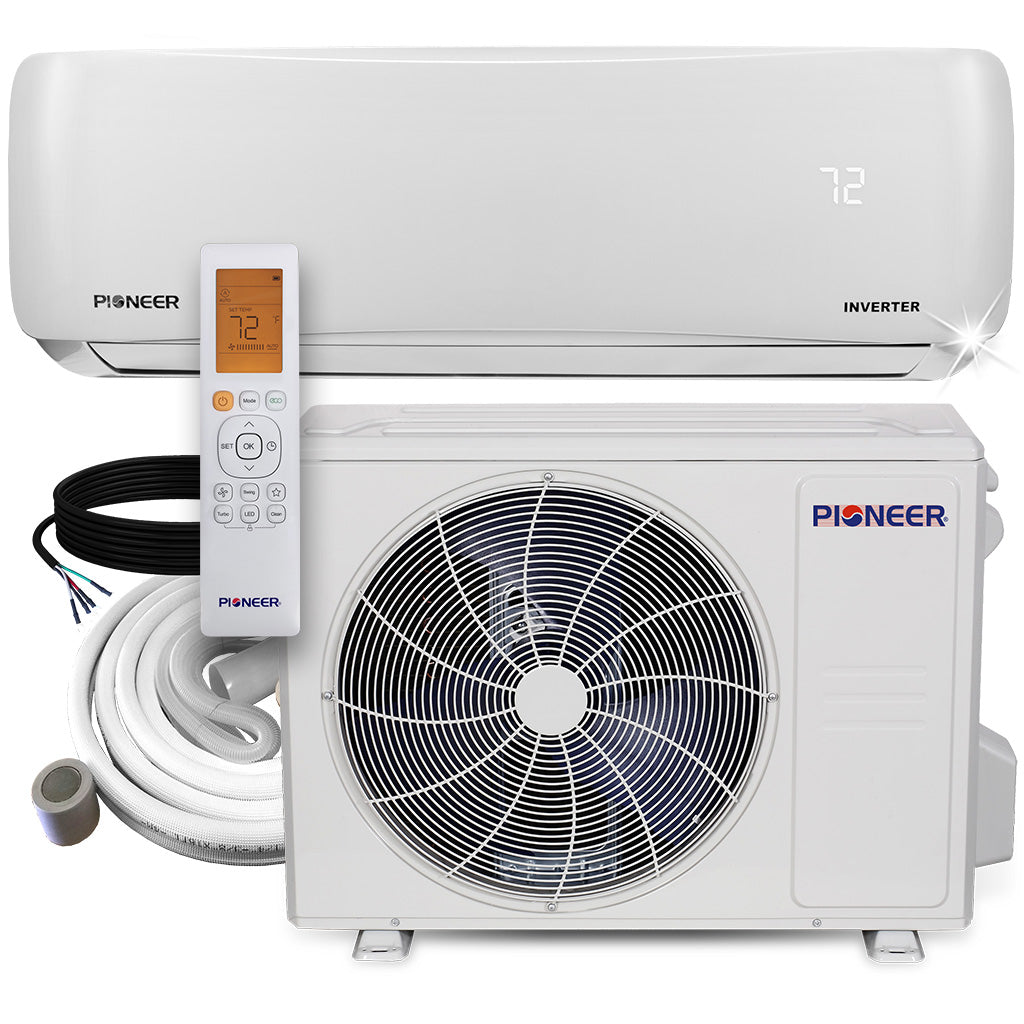
I’m in a similar situation. I have a 45 x 35 x 14 with two insulated man doors, two 10 x 12 insulated garage doors and spray foam insulation. The BTU calculator I used said that I needed about 48K. So, I’m in the process of installing two 24K Pioneer mini-splits (about $3,500). I would assume you would need the same BTU’s, or maybe a little more for your place. I read a thread on here in the past where a guy in Texas had a shop larger than yours and he said two 24K units had been working well for him. I wish mine were complete so I could provide you with some real feedback.

These are the units I purchased. They came with 10’ line sets, but they offer up to 50’ line sets.

 
Last edited:
OP
R

rosshurlow1

Active member
Joined
Mar 20, 2019
Messages
25
Location
Clinton, IN
I’m in a similar situation. I have a 45 x 35 x 14 with two insulated man doors, two 10 x 12 insulated garage doors and spray foam insulation. The BTU calculator I used said that I needed about 48K. So, I’m in the process of installing two 24K Pioneer mini-splits (about $3,500). I would assume you would need the same BTU’s, or maybe a little more for your place. I read a thread on here in the past where a guy in Texas had a shop larger than yours and he said two 24K units had been working well for him. I wish mine were complete so I could provide you with some real feedback.

These are the units I purchased. They came with 10’ line sets, but they offer up to 50’ line sets.

after thinking, it seems like this pioneer unit may be the one. I travel constantly for work and the barn will only be cooled as needed when I'm periodically home. So I could install a pad for 2 outside condensers like this, but only install the first 24k unit and see how it works. if the barn only got down to 75 I would be ok with that, and could add the second unit if need be. That would be 48k btu of cooling total with a SEER of 21. I would put the first unit 12' off the side wall and the second right in the middle at 24'. I imagine 12' would be a good height?
 

Black Oak

Well-known member
Joined
Aug 6, 2013
Messages
161
Location
black oak arkansas
Quote
after thinking, it seems like this pioneer unit may be the one. I travel constantly for work and the barn will only be cooled as needed when I'm periodically home. So I could install a pad for 2 outside condensers like this, but only install the first 24k unit and see how it works. if the barn only got down to 75 I would be ok with that, and could add the second unit if need be. That would be 48k btu of cooling total with a SEER of 21. I would put the first unit 12' off the side wall and the second right in the middle at 24'. I imagine 12' would be a good height?
Folks have pointed out to me which brands are made by the same manufacturer , and most believe Pioneer ,Blueridge .and Senville to be close to the same units . Rebadged but all pretty much the same . IF true , Senville will be the lowest cost , based on what is included or not - based on current pricing . My first unit was a Pioneer , second was a Senville . Both have been trouble free .
 

rockcrawler

Well-known member
Joined
Jan 11, 2013
Messages
930
Location
Dallas, TX
after thinking, it seems like this pioneer unit may be the one. I travel constantly for work and the barn will only be cooled as needed when I'm periodically home. So I could install a pad for 2 outside condensers like this, but only install the first 24k unit and see how it works. if the barn only got down to 75 I would be ok with that, and could add the second unit if need be. That would be 48k btu of cooling total with a SEER of 21. I would put the first unit 12' off the side wall and the second right in the middle at 24'. I imagine 12' would be a good height?

12’ (144”) is too high, according to the manufacturer. Instructions state that optimal height is 6.5’ to 8.3’ (80” to 100”). This has something to do with thermal stratification. But, I wonder if the recommended height is affected by ceiling height. So, if your ceiling is 10’ or 18’, will the recommended mounting height be the same? Mine is mounted at about 97”.
 
To avoid these ads, REGISTER NOW!

rockcrawler

Well-known member
Joined
Jan 11, 2013
Messages
930
Location
Dallas, TX
Quote

Folks have pointed out to me which brands are made by the same manufacturer , and most believe Pioneer ,Blueridge .and Senville to be close to the same units . Rebadged but all pretty much the same . IF true , Senville will be the lowest cost , based on what is included or not - based on current pricing . My first unit was a Pioneer , second was a Senville . Both have been trouble free.

I do agree that several brands look identical, so it would not surprise me one bit if multiple “brands” were built by the same manufacturer. The biggest difference for me was the DIY friendly warranty. Pioneer seemed to have a good reputation when it comes to that.
 
Last edited:

theoldwizard1

Well-known member
Joined
Feb 22, 2011
Messages
43,106
Location
SE MI
I would use (3) single zone 12k low temp units along the 60 ft wall. Single zone units as they have greater efficiency than a multi-head units. My 12k unit can easily send heated air over 30ft, 40ft should be no issue. (3) units will supply an even heat distribution, and having separate single zone units gives you redundancy, if one of the units fails, with a non emergency situation if one does fail.
Very true ! The issue is dollars vs comfort !. The higher efficiency is great, but it will take a long time to recoup the cost.
 

TimeOrMoney

Member
Joined
Feb 8, 2021
Messages
11
Location
Nevada
Very true ! The issue is dollars vs comfort !. The higher efficiency is great, but it will take a long time to recoup the cost.
I did a spreadsheet projecting increased energy costs over 25 years when I designed(I’m an engineer) and built my house. Because of my projections and then current costs, I went with a less efficient system. Guess what? My projections were wrong. Energy costs went up faster than the in the 25 year spreadsheet.

My point is that energy costs will exceed what you think. So saving a few bucks now may not be the best decision. YMMV.

It is difficult for a garage, as the issue is how often one is in there. Mini-splits should NOT be oversized for best efficiency. They should be running all the time, adjusting the output to meet demand. The downside is they don’t come up to temperature quickly unless oversized, which lowers efficiency.

A typical furnace or air conditioning system turns on and off with a simple thermostat. It’s on or off. They are typically oversized, and need more vents as the air is not constantly circulated.
 

theoldwizard1

Well-known member
Joined
Feb 22, 2011
Messages
43,106
Location
SE MI
It is difficult for a garage, as the issue is how often one is in there. Mini-splits should NOT be oversized for best efficiency. They should be running all the time, adjusting the output to meet demand. The downside is they don’t come up to temperature quickly unless oversized, which lowers efficiency.

A typical furnace or air conditioning system turns on and off with a simple thermostat. It’s on or off. They are typically oversized, and need more vents as the air is not constantly circulated.
That is a bonus of most (all?) mini-split systems. They use inverter driven compressors and can vary their speed to just what is required.
 

pcmeiners

Well-known member
Joined
Aug 13, 2009
Messages
7,853
Location
In the only town in Pennsylvania, Bloomsburg.
"The downside is they don’t come up to temperature quickly unless oversized, which lowers efficiency."

They will not raise the temperature of a garage as fast as a grossly over sized gas heater but if your willing to pay for a decent unit (with research) they can warmup a garage quickly. Have a 12k unit heating a 1080sft garage, if the garage is pre heated to 55 degrees, bringing temps to 70 degrees or backup when a garage door is closed does not take long.
 

Youngandfree

Well-known member
Joined
Dec 29, 2020
Messages
877
Location
VA
12’ (144”) is too high, according to the manufacturer. Instructions state that optimal height is 6.5’ to 8.3’ (80” to 100”). This has something to do with thermal stratification. But, I wonder if the recommended height is affected by ceiling height. So, if your ceiling is 10’ or 18’, will the recommended mounting height be the same? Mine is mounted at about 97”.
He didn't say 12ft HIGH. He said 12ft from the end of the wall.
 

racecougar

Well-known member
Joined
Jan 26, 2021
Messages
4,991
Location
Missouri
He didn't say 12ft HIGH. He said 12ft from the end of the wall.

He did though:

after thinking, it seems like this pioneer unit may be the one. I travel constantly for work and the barn will only be cooled as needed when I'm periodically home. So I could install a pad for 2 outside condensers like this, but only install the first 24k unit and see how it works. if the barn only got down to 75 I would be ok with that, and could add the second unit if need be. That would be 48k btu of cooling total with a SEER of 21. I would put the first unit 12' off the side wall and the second right in the middle at 24'. I imagine 12' would be a good height?
 

TimeOrMoney

Member
Joined
Feb 8, 2021
Messages
11
Location
Nevada
That is a bonus of most (all?) mini-split systems. They use inverter driven compressors and can vary their speed to just what is required.
I spent a bunch of time at ASHP.NEEP.ORG which is THE place for evaluating heating performance. Most of the lower cost ones do not have a very good turn down ratio. This means the minimum at 47 degrees may be too many BTUs compared to what you size the system for at 5 degrees. For example, you get 10K BTU max at 5 degrees but only down to 5K BTU at 47. Means it turns on and off a lot once up to temp in mild weather.
 

theoldwizard1

Well-known member
Joined
Feb 22, 2011
Messages
43,106
Location
SE MI
"The downside is they don’t come up to temperature quickly unless oversized, which lowers efficiency."

They will not raise the temperature of a garage as fast as a grossly over sized gas heater but if your willing to pay for a decent unit (with research) they can warmup a garage quickly.
Or buy a propane tank top dual burner heater. It will knock the chill out quick.

Do not run for long as the produce CO, CO2 and a LOT of moisture !
 
Last edited:

pcmeiners

Well-known member
Joined
Aug 13, 2009
Messages
7,853
Location
In the only town in Pennsylvania, Bloomsburg.
"I spent a bunch of time at ASHP.NEEP.ORG which is THE place for evaluating heating performance."

The organization support the HVAC industry, no one else. The certificate information is supplied by the manufacturers, it is not checked by NEEP, nor by the government. Couple months back I kept finding false info, upon questioning my finding I found NEEP has questioned (1) submitted device, out of thousands, over years. Found a number of false data entries, and a number of certification which have NO useful data to support advertising claims. Eg. Carrier "Infinity" purports a Seer 42 , couple months back I looked up the certificate. It contained NO data . Basically nothing other than the model and SEER42 ...just ********.
Yes some manufacturers are honest for the most part, other are not. Seriously, if you allow manufacturers to supply info without any checking, it is allowing the fox to guard the hen house. Again some of the info is honest and useful, take any certificate info with healthy skepticism.


Carrier's stated 42 Seer unit is a Medea unit as below. The link below is the AHRI certificate having NO useful data, Carrier's cert is the same ********. The certificate has no data as they know the data can not backup the claims.


Compared to a certificate with pertinent data....


"Or buy a propane tank top dual burner heater. It will knock the chill out quick."

There is no need, if a buyer gets a decent minisplit, it will warm up a garage within roughly 20 minutes from 50 degrees. If they want to pay for the cheapest unit, they better have a line to someone who does heat/cooling miracles.
 
Last edited:

Hank11

Well-known member
Joined
Aug 19, 2019
Messages
1,139
Location
Tennessee
I’d forget the radiant heat panel and put in two 24K units and a ceiling fan in the middle of the ceiling running slowly 24/7. If it was me, I’d leave the room set to about 60 in the winter and 80 in the summer. When you go out there you can move either to 70 in not too long. Your stuff will stay rust free with low to moderate humidity. The room will be nicer to be in.

Note that there are federal tax credits (30% of the total up to $2,000 per year) for the units and install labor that probably apply to your situation. Also check with your local electric utility — they may have some rebates available.
 

pcmeiners

Well-known member
Joined
Aug 13, 2009
Messages
7,853
Location
In the only town in Pennsylvania, Bloomsburg.
Aside from the $2000 tax credit on minisplits, heat pump hot water heats can add another $1200 to this , and insulation, windows and other energy savings can give $3200 in tax credits plus a few hundred for insulation/windows/weatherization. For 2023 I get $3600 for energy saving tax credits and $2400 in utility rebates for 5 minisplits and the water heater.
 

pcmeiners

Well-known member
Joined
Aug 13, 2009
Messages
7,853
Location
In the only town in Pennsylvania, Bloomsburg.
This needs a branch box and the indoor units. Branch box >$500, you need two different tubing sizes (total 3 sets), will need added refrigerant due to the branch box, not sure but the last time I checked pan heaters were an add on option, it will need it. Having two inside heads, on this unit are not going to be as efficient as two single zone units, and it does not give you redundancy.

Now the Fujitsu XLTH units below give you higher efficiency, a much lower >100% heat output, extra low temp unit come standard with a pan heater . Not BSing you, they are better than the Mitsubishi units, comparing equal units, Mitsubishi is more expensive, ever slightly less noise. Again two 12k units will do it


SBAG

Well-known member
Joined
Aug 27, 2022
Messages
208
Here is mine:


Note that I also have radiant heat, but will keep that low and top off with the Hi2 Mitsubishis and use them in "shoulder months" for heating.

I used the Blueridge advanced calculator (based on Manuel J) to calculate it, and the HVAC guy that I eventually used agreed with the calculation. I was going to buy and install myself due to the ****** HVAC guys we have around here, even bought the tools (except a nitrogen setup, that was on the list).

But I found a good HVAC dude and didn't have the time to fck with it. Glad I did. He knew what he was doing and it still took him 3 1/2 days to install six units.

I was looking at Fujitsu but there were reports of them developing pin holes with foam insulation. They probably have that issue fixed by now.
 
Last edited:

pcmeiners

Well-known member
Joined
Aug 13, 2009
Messages
7,853
Location
In the only town in Pennsylvania, Bloomsburg.
"I was looking at Fujitsu but there were reports of them developing pin holes with foam insulation. They probably have that issue fixed by now."

That is the issue of formicary corrosion of linesets, nothing to do with Fujitsu. Caused by poor quality copper and or the poor forming of tubing where minuscule cracks form in the tubing. Once this occurs, acid possibly from the lineset manufacture, foam deterioration, or the ambient environmental air causes pin holes to form. This not common with quality tubing, as in US manufacturing or European manufacturing conforming to standards unlike the tubing coming from the far east.
Yes I read the google results about Fujitsu and supposed formicary corrosion, there were comments about foam and building materials causing an issue, that is not a Fujitsu issue, but an environment issue, as to the pictures I saw, there was steel corrosion, no proof of formicary corrosion.
 
To avoid these ads, REGISTER NOW!
Top Bottom