To avoid these ads, REGISTER NOW!

Slab Design - Critique please

grkmec

Well-known member
Joined
Oct 19, 2015
Messages
63
Location
Stamford, CT
So I just got the 1st set of plans for my new detached garage project from my architect and was underwhelmed by the slab he specified:

6" gravel + 4" cement with 6x6 10/10 WWM

I am not impressed....

By way of background, this is going to be a 30'x56' garage, detached, and insulated space in CT. I will also have a 4 post lift in the garage + maybe a 2nd lift down the road (maybe 2 post). Also the back of the garage will be a gym with weight lifting platforms. I am into power lifting / strongman so expect to be dropping 500#+ bars (with bumpers) regularly.

So I did some research, and this is what I was thinking for slab design:

- 12" 3/4" crushed stone compacted by machine
- 15 MIL Stego Wrap Vapor Barrier
- 2" Foamular 250 XPS Foam
- #4 Rebar 18" OC
- 2" x 2" concrete dobies
- 6" 4,500 PSI cement with Fiber

Thoughts? Am I crazy? Overkill? Perfect?
 
To avoid these ads, REGISTER NOW!

matt_i

Well-known member
Joined
Mar 14, 2008
Messages
10,726
Location
SE Michigan
I think your architect is fine, insulation is your call really. Compacting the disturbed part of the subgrade properly is important. I like washed crushed limestone (no fines) of 3/4" nominal size unless you have a long time (~1 year) to let it get wet and naturally compact the fines in crusher run. And the stone should be plate compacted also. I like the vapor barrier. How will you cure it to achieve design strength? 28 day water flood or curing sealer?
 

GMCGarage

Well-known member
Joined
Jan 31, 2017
Messages
1,264
The #[email protected]. will do nothing for you. The idea of reinforcing in a slab is to control any cracking, and not have it open up. The WWM he spec's is good, 6" spacing, smaller bars. Have it in the top 1/3 of the slab.

Subbase is what gives a slab on grade strength. If you want 12", tell him. 6" is usually more than enough if grade is compacted. Make sure all organics are removed.

Foam is a waste of money everywhere unless in floor heating, you could do perimeter if you want.

The rest is your call. 4" is good for car traffic, 6" if you have heavier vehicles.

Vapor barrier in my mind is waste of money, unless having a wood floor or finished room.

Concrete strength is not alone in slab serviceability. A nice mix design with lower strength could perform better than a plain higher strength.

What you propose is more than likely 3x what he is proposing. If you have the money, go for it for your peace of mind.
 

Stuart in MN

Well-known member
Joined
Sep 8, 2005
Messages
23,106
Location
Minneapolis
Have you talked to the architect about your concerns? He should be able to explain what he specified and why.


I'm not a civil engineer but I do get involved with concrete slabs in a limited way, and what he specified sounds pretty strong to me.
 

6768rogues

Banned
Joined
Nov 28, 2007
Messages
4,524
Location
Western NY
Concrete is strong in compression and weak in tension. Steel is strong in tension and weak in compression. When you place a heavy load in a small area, the top of the concrete is under compression and the bottom is under tension. Therefore, you want whatever steel you put in the floor to be in the bottom third or fourth of the concrete. The only time you put steel in the top of concrete is where it passes over a beam or to a cantilever, where the top of the slab is in tension.
I used 10" of #1 crusher run, compacted at 5" and 10". Then I put in 5" of 4000# concrete with fiber mesh and #4 bars every 2 feet in both directions, in the bottom third of the slab. The fiber mesh keeps shrinkage cracks tight and the bars give it strength for heavy concentrated loads. I have a lift and I have driven my son's loaded 25 ton dumpster truck on it with no damage. In the 25 years since it went it, it has performed perfectly.
Your architect's design is just over what is typically done in our area for a regular attached two car garage. I like to have large outbuildings upgraded.
 
Last edited:

trinaussie

Member
Joined
Dec 7, 2011
Messages
5
Concrete is strong in compression and weak in tension. Steel is strong in tension and weak in compression. When you place a heavy load in a small area, the top of the concrete is under compression and the bottom is under tension. Therefore, you want whatever steel you put in the floor to be in the bottom third or fourth of the concrete. The only time you put steel in the top of concrete is where it passes over a beam or to a cantilever, where the top of the slab is in tension.
I used 10" of #1 crusher run, compacted at 5" and 10". Then I put in 5" of 4000# concrete with fiber mesh and #4 bars every 2 feet in both directions, in the bottom third of the slab. The fiber mesh keeps shrinkage cracks tight and the bars give it strength for heavy concentrated loads. I have a lift and I have driven my son's loaded 25 ton dumpster truck on it with no damage. In the 25 years since it went it, it has performed perfectly.
Your architect's design is just over what is typically done in our area for a regular attached two car garage. I like to have large outbuildings upgraded.

This response is not correct for a slab on grade where the slab is fully supported by the compacted fill. The wire mesh must be in the top third as a previous poster noted. What you are talking about above is correct for a suspended slab with beams where the main rebar is in the bottom and as the slab passes over a beam additional rebar is added in the top as the moment is +ve whereas it is negative in the middle third (approx) of the slab.

Trinaussie BEng PEng
 

Leaflessshadetree

Well-known member
Joined
Aug 1, 2013
Messages
7,154
Location
Don't ask.
His spec sounds good to me but I'd include a vapor barrier (not a big cost adder).

Including insulation and pex for radiant heating aren't cheap but if you may want it in the future now is the time to put it in.
 

ssdave

Banned
Joined
Apr 11, 2015
Messages
2,913
Location
Eastern Oregon
I like your design slightly better than the Architects, but either will work. The pluses of yours are more base, vapor barrier. The overkill is the foam and the fibermesh reinforcement. The 6 inch is maybe good or maybe overkill, but depends on what your lift is and the requirements for it. It's not much overkill, though, just a bit better for more cost.

I'll not give a definitive opinion on the mesh vs bar and top or bottom 3rd. I tend to prefer mesh, but it's hard to get it placed where you want it and make it stay there uniformly. The good thing about bar and dobies is you know where it is. Where you place the reinforcement to be most useful depends on what failure mode you are trying to prevent. In the top 1/3'rd, it helps prevent surface cracks. In the bottom third, it helps prevent rutting/settlement under heavy loading. Take your pick, both have their usefulness. If I couldn't decide, I'd make the slab 6" thick and put it in the middle! :) I usually use both mesh and bar, use the bar to precisely place the mesh, which I wire to the bar. Now, you could legitimately say that is overkill for a shop slab, for a warehouse it probably wouldn't be. But, the bar design and mix design would be a lot more rigorous, too.
 

6768rogues

Banned
Joined
Nov 28, 2007
Messages
4,524
Location
Western NY
This response is not correct for a slab on grade where the slab is fully supported by the compacted fill. The wire mesh must be in the top third as a previous poster noted. What you are talking about above is correct for a suspended slab with beams where the main rebar is in the bottom and as the slab passes over a beam additional rebar is added in the top as the moment is +ve whereas it is negative in the middle third (approx) of the slab.

Trinaussie BEng PEng[/QUOTE

Let me clarify as I did not state my case clearly. I should have said steel for strength, not all steel. If you are only concerned with keeping cracks from separating, mesh can be used near the top. If you are concerned with strength, rebar is used in the lower part of the concrete keeping it up enough for adequate concrete coverage. Even if you compact the base to 95% compaction, it is not 100% and a large concentrated load can compress the base. Rebar will spread the load and reduce or spread compaction by making the slab more resistant to deflection. That is how a reinforced slab is designed. Is the OP interested in crack control or strength? I assumed strength based on his design suggestion. He specified fiber for crack control so his rebar would logically be for strength.
 
Last edited:

matt_i

Well-known member
Joined
Mar 14, 2008
Messages
10,726
Location
SE Michigan
I believe the rebar helps strength in high load situations, here's why:

The Young's modulus or stiffness of the concrete is 2-6 x 10^6 psi. That's an elastic slope under load.

However the same value for steel is pretty much centered on 30 x 10^6 psi.

It says to me that per unit area the steel is considerably more resistant to deflection. And so I do think it adds strength to the slab in bending...not so much in vertical shear. But this aligns with the thought process that a slab intended for heavy loading gets more rebar.

If you think about an overload where something like a heavily loaded forklift tire is sitting on the concrete, the shape of the deflection is something akin to a large "dimple". Max tensile stress is going to be farthest away from the neutral axis which is at the bottom surface of the slab.

I built my slab with the above in mind, and so far we haven't tested it like that yet :) Still working on other details before I move in the machines...
 

ConCretin

Well-known member
Joined
Jan 20, 2011
Messages
3,378
Location
Central Maine
Since somebody was kind enough to post my guide to floor slabs, I’ll Just offer the following thoughts on positioning of rebar. As a general rule, I recommend placing bar or mesh in the middle third for one simple reason. For an average 4” slab, by the time you allow for cover above and below the reinforcing, you are in the middle third by default.

Positioning reinforcing higher in the slab, would theoretically minimize the width of cracks at the surface but the difference would be negligible. It would be better to prevent or control these cracks anyway. Slab thickness would have to be increased significantly before positioning rebar in the bottom would have any structural benefit.

To the original question, the upgrades of vapor barrier and under slab insulation will provide minimal value unless you have in-floor radiant heat or plan to apply an adhered floor covering. On the other hand, you only get one chance to install them. If it were me, i’d probably do both.

With regard to the other elements, your architects specifications are certainly adequate for your application if executed properly. Most of us however are prone to overkill, myself included. If you have the cash and want the added piece of mind, your upgrades are fine.

One final thought regarding your strange desire to lift very heavy objects and drop them on your floor, I’d probably thicken the concrete in your gym area to 8” or so and add a mat of #4 bars at 12” each way. While not a true structural slab, it would help distribute the load.

Btw, if my advice doesn’t work out and you get angry, I think LLWillysfan changed his name and moved to Oregon.
 
Last edited:

ConCretin

Well-known member
Joined
Jan 20, 2011
Messages
3,378
Location
Central Maine
I believe the rebar helps strength in high load situations, here's why:

The Young's modulus or stiffness of the concrete is 2-6 x 10^6 psi. That's an elastic slope under load.

However the same value for steel is pretty much centered on 30 x 10^6 psi.

It says to me that per unit area the steel is considerably more resistant to deflection. And so I do think it adds strength to the slab in bending...not so much in vertical shear. But this aligns with the thought process that a slab intended for heavy loading gets more rebar.

If you think about an overload where something like a heavily loaded forklift tire is sitting on the concrete, the shape of the deflection is something akin to a large "dimple". Max tensile stress is going to be farthest away from the neutral axis which is at the bottom surface of the slab.

I built my slab with the above in mind, and so far we haven't tested it like that yet :) Still working on other details before I move in the machines...

I don’t disagree with a thing you say matt_i. You laid it out very well. A slab is undoubtedly stronger with rebar. The only question is how much and whether it’s any real benefit to the average garage floor. In my experience, most structural cracks occur around the edges, where the top of the slab is in tension rather than the dimple model you refer to in the middle. I believe the typical garage owner should focus on a strong base and think of reinforcing in terms of crack control rather than prevention. Then again, most of us aren’t typical I guess and overkill will continue to rule the day. :)
 
Last edited:

GMCGarage

Well-known member
Joined
Jan 31, 2017
Messages
1,264
I believe the rebar helps strength in high load situations, here's why:

The Young's modulus or stiffness of the concrete is 2-6 x 10^6 psi. That's an elastic slope under load.

However the same value for steel is pretty much centered on 30 x 10^6 psi.

It says to me that per unit area the steel is considerably more resistant to deflection. And so I do think it adds strength to the slab in bending...not so much in vertical shear. But this aligns with the thought process that a slab intended for heavy loading gets more rebar.

If you think about an overload where something like a heavily loaded forklift tire is sitting on the concrete, the shape of the deflection is something akin to a large "dimple". Max tensile stress is going to be farthest away from the neutral axis which is at the bottom surface of the slab.

I built my slab with the above in mind, and so far we haven't tested it like that yet :) Still working on other details before I move in the machines...

If you have one wheel, then you have two, what about the stress in the top of the concrete between the two wheels?

If the OP wants a structural slab, he should get it designed. If he wants a slab that wont crack as much, he should go with the mesh.

The slab strength is 90% going to be achieved from a good sub base. Get that right, and you wont really need any reinforcing.

Millions and Millions of square feet of warehouse slab is poured all the time without reinforcing. The sub base is done properly. If the slab cant deflect, it cant really have stress.
 
To avoid these ads, REGISTER NOW!

Homerr

Well-known member
Joined
Mar 16, 2012
Messages
379
Location
Seattle, WA
Did you talk with your architect about what the use(s) were in the garage? Looks like they went with a totally typical construction detail. Other than thickened areas at potential lift locations it looks ok.
 

alexb2000

Well-known member
Joined
Feb 7, 2010
Messages
664
Location
Fort Worth, TX
Slab design is great, but most of the problems I see are done during installation/finishing. Dobies/chairs are often pulled after inspection so they can walk on the steel while pouring and they just never get replaced, but don't worry they lift it while pouring (yeah right). Curing the slab is a huge issue and expecting a contractor to wet cure doesn't happen unless you have it specified in the contract, so consider having them spray on a curing sealer after finishing. Vapor barriers also help keep the water in for curing the slab so there is more than one benefit, but plenty of contractors don't like to lay it out so they don't. Also, whatever mix you pay for won't mean **** if they just add a bunch of water onsite (never let them do this). Same with spraying the top with water to make finishing easier. Point is you or someone qualified should be onsite to make sure they are following the spec or it is useless.
 

aka Larry

Well-known member
Joined
May 2, 2012
Messages
8,043
Location
Eastern, NC
Did I miss the part about the perimeter footing? My 40'x40' shop has a 12" x 12" perimeter footing (local code) in addition to the slab requirements.
 

nolimits76

Well-known member
Joined
Jul 11, 2013
Messages
959
Location
Oklahoma
I don’t disagree with a thing you say matt_i. You laid it out very well. A slab is undoubtedly stronger with rebar. The only question is how much and whether it’s any real benefit to the average garage floor. In my experience, most structural cracks occur around the edges, where the top of the slab is in tension rather than the dimple model you refer to in the middle. I believe the typical garage owner should focus on a strong base and think of reinforcing in terms of crack control rather than prevention. Then again, most of us aren’t typical I guess and overkill will continue to rule the day. :)

What!? Overkill around this forum? :lol::lol::lol:

But I'm just as guilty. For the small cost involved to reinforce the slab, I think it's a no brainer personally.

If the OP goes with one layer of #4's on 18" centers both directions, then it's only 2,260' or 1,500lbs of steel. Granted bridge construction is a little different than home slab construction, but nuts in material, accessories (chairs, tie wire, etc), labor & equipment is running about $1.10 per pound on average.

So for about $2,000 he can have a steel reinforced slab. That's before he counts the discount back from the mesh.


Slab design is great, but most of the problems I see are done during installation/finishing. Dobies/chairs are often pulled after inspection so they can walk on the steel while pouring and they just never get replaced, but don't worry they lift it while pouring (yeah right). Curing the slab is a huge issue and expecting a contractor to wet cure doesn't happen unless you have it specified in the contract, so consider having them spray on a curing sealer after finishing. Vapor barriers also help keep the water in for curing the slab so there is more than one benefit, but plenty of contractors don't like to lay it out so they don't. Also, whatever mix you pay for won't mean **** if they just add a bunch of water onsite (never let them do this). Same with spraying the top with water to make finishing easier. Point is you or someone qualified should be onsite to make sure they are following the spec or it is useless.

Lots of good info in this response.

Personally I'd be on-site for the pour, and make it clear before hand that chairs or bricks won't be kicked out of the way. With 18" spacing, there is plenty of room to walk and not be a b*tch.

To avoid adding water on-site, discuss with the contractor the use of a mid range so he can keep slump and workability. If they are using a pump they may need it anyway. It's about $3-5 per CY around here.

If the OP doesn't know how to calc CY's..... L x W x D / 27 (make sure all measurements are in FEET). So 30' x 56' x .334' (or 4") / 27 = 21cy + 10% waste = 23cy x $5 = $115

I'm not sure what type of flooring/finishing you plan on adding in the shop (if any) but keep in mind curing agents can be a problem. If you know the flooring type, find the cure agent and review with the flooring rep so there aren't issues.

Did I miss the part about the perimeter footing? My 40'x40' shop has a 12" x 12" perimeter footing (local code) in addition to the slab requirements.

My thoughts too. Although in other states I've seen some designs where they create a true floating slab with no footings which I found very odd. I'd probably consider some intermediate footings (slab beams) as well.

And if doing a lift I'd really beef that area up.
 

ConCretin

Well-known member
Joined
Jan 20, 2011
Messages
3,378
Location
Central Maine
Did I miss the part about the perimeter footing? My 40'x40' shop has a 12" x 12" perimeter footing (local code) in addition to the slab requirements.

My thoughts too. Although in other states I've seen some designs where they create a true floating slab with no footings which I found very odd. I'd probably consider some intermediate footings (slab beams) as well.

Up here in frost country most of our footings are 4' or more below the slab. :D
 

lakeroadster

Well-known member
Joined
Jan 19, 2015
Messages
5,166
Location
Central Colorado
I'll not give a definitive opinion on the mesh vs bar and top or bottom 3rd. I tend to prefer mesh, but it's hard to get it placed where you want it and make it stay there uniformly. The good thing about bar and dobies is you know where it is.

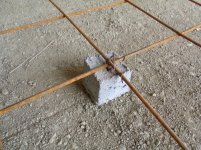
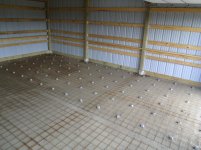
Dave.. have you ever used concrete dobies and wire mesh? I used them spaced 24" on my barn slab along with 6 x 6-W2.9 x W2.9 mesh sheets, overlapped and wired. The mesh deflects when walked on and then bounces back into position.

attachment.php


attachment.php


attachment.php
 

Attachments

  • Dobie 001.jpg
    Dobie 001.jpg
    104.6 KB · Views: 190
  • Dobie 002.jpg
    Dobie 002.jpg
    152.9 KB · Views: 185
  • GEDC1666.jpg
    GEDC1666.jpg
    150 KB · Views: 188

ssdave

Banned
Joined
Apr 11, 2015
Messages
2,913
Location
Eastern Oregon
Can't argue too much with that, John, as long as it will spring back up through the concrete after the workers step off it. Almost 500 dobies on a 36x48 floor. 130 for a 4' pattern for rebar. Pays for a bit of the material or labor on the rebar.
 
OP
G

grkmec

Well-known member
Joined
Oct 19, 2015
Messages
63
Location
Stamford, CT
Just to close the loop on this. The plans that my architect had sent me were an early version with standard slab specs. When I touched based a few days later he had changed the slab specs to 6" with #4 rebar 12' OC.

Just curious on people's view for thickness of crushed stone base. Is there a big advantage going more than 6" ??
 

ssdave

Banned
Joined
Apr 11, 2015
Messages
2,913
Location
Eastern Oregon
The advantage of deeper crushed rock base is that it spreads out point loads at about a 45 degree angle. So, if you put 2000 pounds on a 1 foot square piece of concrete floor, the concrete spreads that out to about 2 feet by 2 feet if it's 6 inches thick. (maybe even more than that). Then, the 6 inches of gravel spreads that out another 6 inches, or 3' x 3'. so, you have 2000 pounds per square foot load on the floor that is now over 9 square feet, or about 225 pounds per square foot. Even fairly poor soil will support that. (I'm ignoring a non-linear distribution of weight, and the weight of the concrete and gravel, which will at least double that 225). But, the point is that the more depth of gravel and concrete you have, the more floor loads are spread out, and the less they are likely to make the underlying soil settle.
 

matt_i

Well-known member
Joined
Mar 14, 2008
Messages
10,726
Location
SE Michigan
I think I'd do welded wire over rebar 12 feet apart.....its just a gut feel but that hardly seems like its even worthwhile putting that little in for as much overkill as is already spec'd.
 

GMCGarage

Well-known member
Joined
Jan 31, 2017
Messages
1,264
I think I'd do welded wire over rebar 12 feet apart.....its just a gut feel but that hardly seems like its even worthwhile putting that little in for as much overkill as is already spec'd.

I think its a feel good thing. Folks want rebar over a properly designed slab with mesh.
 

WNYflyer

Well-known member
Joined
Sep 13, 2009
Messages
2,119
Location
Lockport, NY
I think I'd do welded wire over rebar 12 feet apart.....its just a gut feel but that hardly seems like its even worthwhile putting that little in for as much overkill as is already spec'd.

12' makes no sense, probably a typo, probably 12" o.c.
 
To avoid these ads, REGISTER NOW!
Top Bottom