To avoid these ads, REGISTER NOW!

Slab Insulation questions?

tricountytrail

Well-known member
Joined
Jan 26, 2015
Messages
212
Location
Pendelton, NY
Questions?

Vapor barrier under foam or over foam under mesh and pex?

Pex stapled to foam with mesh over top or zip tied on Top of mesh?

bottom foam or side foam installed first?

Thanks in advance!
 
To avoid these ads, REGISTER NOW!

sstec

Well-known member
Joined
Jul 31, 2014
Messages
45
I did side foam down 4' first, vapor barrier, foam, rebar on chairs then tide pex under rebar.
I'm happy with results.
sstec
 

chaosracing

Well-known member
Joined
Nov 14, 2015
Messages
585
Location
Kutztown, Pa
If you tape the seams of the insulation, there really is no need for a vapor barrier as the insulation will act as one.
 

wssix99

Well-known member
Joined
Mar 2, 2011
Messages
5,156
Location
Chicago, IL
If you put your vapor barrier under the foam, it won't be punctured if you ever drill through the slab.


Pex stapled to foam with mesh over top or zip tied on Top of mesh?

I recommend putting a layer of (non-structural) mesh sheets down (not the rolled stuff that wants to curl or that is tough to straighten) flat on the foam. Zip tie the PEX to that. This will keep the pex flat on the foam and keep it from popping up during the pour. Then, you can follow whatever slab reinforcing scheme you want on top of that.
 

ConCretin

Well-known member
Joined
Jan 20, 2011
Messages
3,378
Location
Central Maine
I prefer to put the vapor barrier down first to protect it from damage, followed by the rigid insulation. Stapling the pex to the insulation is quick, effective and keeps it well below your saw cuts. Place your reinforcing at mid slab. There are a lot of theories on this but I think this works best from a practicality standpoint.
 

crook038

Well-known member
Joined
Nov 3, 2010
Messages
113
Location
South Eastern MA
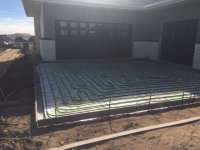
Vertical insulation down the sides, then vapor barrier. I then used Crete Heat panels that allowed the Pex to lay into the knob area. Then tied wire mesh on chairs. It’s been a little over 1 year with no cracking👍👍
Sean
 

Attachments

  • 6CABB1C3-DFDE-4A75-95F2-58354A121785.jpg
    6CABB1C3-DFDE-4A75-95F2-58354A121785.jpg
    113.5 KB · Views: 125
  • 991B5915-B64B-475A-923A-048975747010.jpg
    991B5915-B64B-475A-923A-048975747010.jpg
    162.9 KB · Views: 129
OP
T

tricountytrail

Well-known member
Joined
Jan 26, 2015
Messages
212
Location
Pendelton, NY
What was your source for the Crete Heat panels Ampex Pex panel are another brand I've heard about? Do you have what model you used? and the cost per panel? I reached out to company but haven't heard back yet.
 

crook038

Well-known member
Joined
Nov 3, 2010
Messages
113
Location
South Eastern MA
What was your source for the Crete Heat panels Ampex Pex panel are another brand I've heard about? Do you have what model you used? and the cost per panel? I reached out to company but haven't heard back yet.

I purchased the panels at FW Webb. When I purchased them I was able to use my brother in-law’s discount as an employee. I don’t recall my exact price, suffice to say, they aren’t cheap. I used the 2” panels which have an overall thickness of 2 7/8”. It is cheaper to use regular flat panels but for a single person installation, this is the easiest product to use. I am 100% happy with the outcome of the slab and the underpayment. If I were to do it again, I would do it the same way. There is more info in this thread.
https://www.garagejournal.com/forum/showthread.php?t=377368
Sean
 
To avoid these ads, REGISTER NOW!

seanc_mt

Well-known member
Joined
Jul 20, 2015
Messages
285
I dont think I will ever understand the foam under the slab.... I did the simple foil/bubble wrap under the slab, then rebar, then 1/2" pex. Heat rises... Always. The most loss is out the sides of the slab.
 

PNWguy

Well-known member
Joined
Jan 3, 2018
Messages
494
Location
Near Grants Pass, OR
I dont think I will ever understand the foam under the slab.... I did the simple foil/bubble wrap under the slab, then rebar, then 1/2" pex. Heat rises... Always. The most loss is out the sides of the slab.

There are multiple ways for heat to redistribute, and not all of them depend on gravity. If the ground is cooler than your slab, some heat will transfer to the ground. If heat only rises, why did you insulate the sides of the slab?
 

Innovate1

Well-known member
Joined
Jul 28, 2014
Messages
4,281
Location
Illinois near St. Louis, Missouri
I really doubt the long term effectiveness of foil/bubble wrap and I doubt the short term effectiveness too. The bubbles will leak eventually and the foil is a radiant barrier. Radiant barriers only work on radiation, not conduction. If the foil is touching anything but air it does not work as a heat barrier.

If heat only/always rises why even do that? When welding or soldering does heat always rise? Of course not - the metal below the heating gets hot too. This is conduction. Hot AIR rises (convection) but in solid materials it travels in all directions.

As I see it the real question is how much insulation do I need, if any, and how much resistance to heat flow does the ground/dirt provide.

The slab edge is a significant loss that is often overlooked. My area is very strict on insulation, ratings of windows, etc but seems to totally ignore the slab edge.
 

FANTM58

Well-known member
Joined
Feb 21, 2015
Messages
575
Location
Brighton, Co
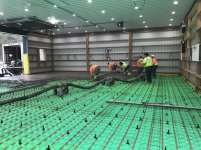
I installed the vapor barrier first, then 2” foam followed by
Mesh . Then I zip ties my radiant tubes to that . Then rebar on chairs.
The rebar acts as protection when cutting a expansion cuts
Also the double system , mesh and rebar really secure my slab.
 

FANTM58

Well-known member
Joined
Feb 21, 2015
Messages
575
Location
Brighton, Co
A few pictures of the install process.
 

Attachments

  • 7D2A379E-D989-4FC3-9EC2-CE9623D32D7F.jpg
    7D2A379E-D989-4FC3-9EC2-CE9623D32D7F.jpg
    154.8 KB · Views: 84
  • 4BF6F209-D013-4FB9-9ADF-8155245A1CE4.jpg
    4BF6F209-D013-4FB9-9ADF-8155245A1CE4.jpg
    148.7 KB · Views: 77
  • 79094496-FE21-4EF9-AD19-811DEA46795E.jpg
    79094496-FE21-4EF9-AD19-811DEA46795E.jpg
    150 KB · Views: 77

pv74

Active member
Joined
Jan 1, 2015
Messages
41
Location
Boise, ID
What kind of tape do you use for the vapor barrier and for the foam?

Also, for those who have the radiant tube elevated into the slab as opposed to laying on the bottom, can I use wire remesh suspended on castle chairs or dobie bricks, or will the concrete guys smoosh it all down anyways when they are working the slab? Also, when elevating the tube, how do you deal with the saw cuts..I have read that they only need to be an inch or so and can be hand troweled in?

Building a 24 X 36 shop myself and am putting in a radiant slab over foam very very soon...
 
Last edited:
OP
T

tricountytrail

Well-known member
Joined
Jan 26, 2015
Messages
212
Location
Pendelton, NY
What kind of tape do you use for the vapor barrier and for the foam?

Also, for those who have the radiant tube elevated into the slab as opposed to laying on the bottom, can I use wire remesh suspended on castle chairs or dobie bricks, or will the concrete guys smoosh it all down anyways when they are working the slab? Also, when elevating the tube, how do you deal with the saw cuts..I have read that they only need to be an inch or so and can be hand troweled in?

Building a 24 X 36 shop myself and am putting in a radiant slab over foam very very soon...
I have the same Questions staple pex to foam (won't I lose some heat transfer from NOT being in concrete)
Zip tie to wire mesh with pex on top and lose reinforcement in concrete.
Or add wire mesh on top also and concrete guys will destroy it all anyways.
 

Bclinehand

Well-known member
Joined
Oct 17, 2017
Messages
70
Location
Clearwater BC Canada
Don’t over think it......compacted fill, Vapour barrier (seams taped or overlapped by 2’) foam insulation then staple your pex to the foam for a slab up to 3.5” and then your reinforcing of choice supported to middle of slab. For thicker slabs you want the pex in the center of the slab so put your reinforcing of choice down suspend it in center of slab and then attach pex to reinforcing. In my install I chose to insulate the outside of stem wall so the edges of my vapour barrier were sealed to stem wall with AcoustiSeal . I overlapped all seams and only used TuckTape around plumbing etc


Sent from my iPad using The Garage Journal mobile app
 

ConCretin

Well-known member
Joined
Jan 20, 2011
Messages
3,378
Location
Central Maine
If you buy a specialized vapor barrier such as Stegowrap, you can purchase tape from the mfg. If you are using poly, duct tape or something similar will work. Taping rigid insulation will act as a vapor barrier but it won't be as effective as Stego. If you have a separate vapor barrier, there is no need to tape the foam.

Placing the pex at mid depth exposes it to potential damage from saw cuts. Control joints should be 1/4 of the slab depth and can be saw cut or tooled in. A skilled finisher can do a nice job with tooled joints, which would be a better option in this case.
 

wssix99

Well-known member
Joined
Mar 2, 2011
Messages
5,156
Location
Chicago, IL
I have the same Questions staple pex to foam (won't I lose some heat transfer from NOT being in concrete)

No. Heat follows the path of least resistance. With the PEX on the bottom, the heat can go two ways: down through the insulation, or up through the concrete. The concrete is a much better conductor (that's way insulation is insulation) and the concrete will literally **** up and radiate most of the heat.

Some of your heat will eventually make it's way through the insulation to the ground, but it makes no material difference if the pex is in the middle of the slab or on the bottom. Heat is heat and it doesn't matter where it enters the slab. (middle or bottom)


Zip tie to wire mesh with pex on top and lose reinforcement in concrete.

Zip tying pex over mesh on the bottom works like a less expensive and higher performing (you get the full insulation thickness everywhere) version of those fancy stamped insulation panels. If you want reinforcing in the slab, you'd have to add another layer of mesh or rebar, floating above the pex.

Stapling (IMO) is not a reliable way to fix this stuff. Sections can pop up during the pour or cure and you end up getting the issues Doug talks about above with saw cuts - except worse! (You don't know where the tubes have popped up.)

BTW - You should also be sure to plan your saw cuts before your pour and read your pex/radiant instructions. You should have special sleeves where your pex crosses control joints and the slab is expected to crack, etc.


Or add wire mesh on top also and concrete guys will destroy it all anyways.

The concrete finishers will stomp whatever you put down. Having the pex on the bottom is more resilient for what will come, here.

I'm a big fan of putting reinforcing bar on top (instead of another layer of mesh). The larger squares should be much easier for the crews to work around and get on proper chairs.
 

Radix2

Well-known member
Joined
May 28, 2014
Messages
1,853
Location
the thumb!, MI
Put your mesh over the stapled pex. Easy, no way anything is coming up. And mesh is up off the bottom where it can do a little.
 
To avoid these ads, REGISTER NOW!
Top Bottom