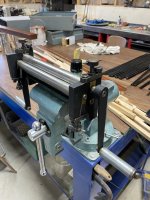
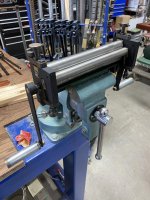
Normally, the 2 infeed rolls (the ones stacked vertically) are geared together to turn in opposite directions such that they feed the metal in while the third roll freewheels and does the actual forming.
Cranking a single roll would require the infeed rolls be adjusted tight enough that the other roll is driven by friction. The problem with that is the sheet will feed perpendicular to the point of tangency between the upper and lower rolls and essentially just **** into the third roll. Depending on the adjusted position of the third roll, the sheet may climb the third roll and begin to form, or it may just stop.
With both rolls driven, or cranked in the case of the OP, friction drives the sheet from both top and bottom sides, and the rolls can be adjusted more loosely. When the sheet contacts the third roll, the looser clearance between the upper and lower rolls allows the sheet to more easily deflect and begin to climb the third roll. As this happens, the sheet is pushed more tightly against both infeed rolls this increasing the available friction for driving the sheet.
As is, cranking one handle would likely be adequate for rolling light material like 24 or 26 ga, but rolling something like 16 or 18 ga probably require cranking both handles. Not an ideal setup as the handles have to be cranked in opposite directions. Adding a set of gears to the infeed rolls would make the device multiple times more useful for one man operation.