To avoid these ads, REGISTER NOW!

Slow down a drill press

Kenster

Member
Joined
Nov 30, 2023
Messages
5
I have an old Delta Rockwell radial arm drill press; looks like this one https://www.garagejournal.com/forum/threads/rockwell-delta-radial-arm-drill-press.439153/

But even at its slowest, it runs too fast for some jobs. Is there a mod I can make to slow down the motor? It currently has a Dayton Electric 3/4 HP motor, 1750 RPM, 115V 10.8A. No telling if that's original. I was looking at variable frequency drives, and 3-phase motors, which might be overkill? This is for my hobby shop, so no business budget. Any thoughts?
 
To avoid these ads, REGISTER NOW!

oldmachinenut

Well-known member
Joined
Apr 3, 2009
Messages
2,519
Location
Missing, presumed dead in central Pa.
I put a Dayton 3/4hp pmdc motor and a KBMG-212 dc drive on my Wilton drill press and it works very well. A friend of mine made the same conversion using the same drive and an import pmdc motor from eBay. He was initially skeptical but is very impressed with the performance and ease of conversion.
 

wssix99

Well-known member
Joined
Mar 2, 2011
Messages
5,159
Location
Chicago, IL
My old Delta Rockwell had two motor options. A 1750 and, a more expensive, 1140 RPM motor. The decal by the belt pullies has speed tables translating both options to RPM at the bit.

If you get a copy of the instructions for your model, you can confirm the spec's you need for the motor. I expect that yours is intended for a 1140 also.

I originally had a 1140 RPM motor on my unit and went to a 1750 RPM motor when I rebuilt it. ... I'm not happy. The lowest speed is a little too fast for my liking, particularly when drilling metal.
 
OP
K

Kenster

Member
Joined
Nov 30, 2023
Messages
5
The pulleys look like the ones in the link above. So I assume they are original.
I haven't been able to find a model number or name yet. An 1140 RPM motor would probably work. I don't know an exact speed I'd want, just that the slowest it can go seems too fast for some jobs, like drilling metal, or using 2-3" hole saws.

I'll go see if I can find the Dayton 3/4hp pmdc motor and a KBMG-212 dc drive oldmachinenut suggested.
 

nadogail

Well-known member
Joined
Jan 23, 2009
Messages
31,942
Location
Coronado, CA
At my last employer we wanted a Variable Speed Mag Based Drill for a “One Time”job. No room in the budget.

Went to Harbor Freight and bought the $50 special and an 11” pulley at the hardware store.
That job made more than enough to make pay for the “Ultra Light” drill press and also turn a good profit.
 

cgrutt

Well-known member
Joined
Mar 4, 2016
Messages
8,225
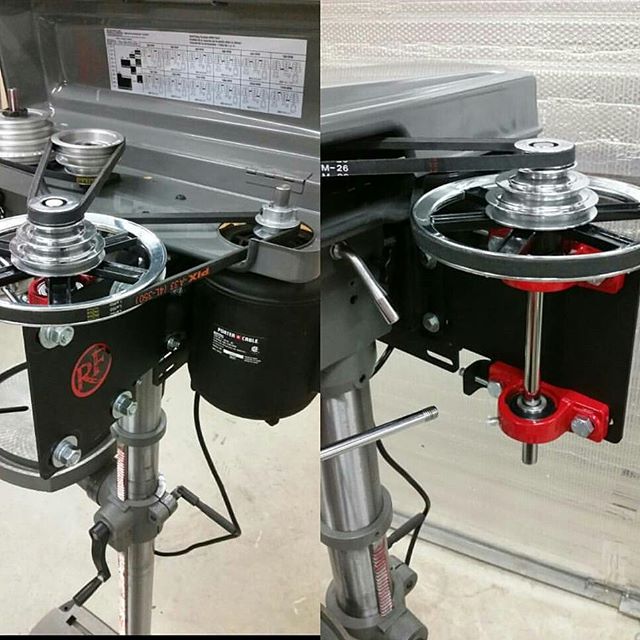
They sell aftermarket speed reduction kits such as this on (no affiliation or experience with vendor)


Can also convert to DC motor from treadmill etc.
 

Norcal

Well-known member
Joined
Mar 16, 2008
Messages
13,754
Some have installed 3 phase motors & a VFD, Variable Frequency Drive to control it, there are downfalls to it, torque is reduced at lower speeds, I have it on a Rockwell DP, but it was done because I could not find the single phase motor I wanted so used a Teco NEMA 4X drive for it.
 

75gmck25

Well-known member
Joined
Jul 21, 2014
Messages
1,320
Location
Alexandria, VA
I don't know much about the design of your drill, but will the speed go down if you feed it lower voltage? I have a variable auto transformer (VARIAC), rated at 12 amps, that will reduce 120 volt AC down to as low as 10 volts.

I use it for working on old tube radios, where its useful to be able to vary the voltage when checking out components to see how they are working.
 
OP
K

Kenster

Member
Joined
Nov 30, 2023
Messages
5
It looks like the options were 1) DC motor and VFD, 2) AC VFD, 3) slower motor (1140 RPM). The first two generally would cot more than just buying a new drill press. I considered that, but kind of like the old beast. So I asked the Chat at Grainger for a 1140 RPM equivalent of the ancient 5K694-G I have. She suggested the DAYTON, 4YY55. So that's on order.
 
To avoid these ads, REGISTER NOW!

BillK

Well-known member
Joined
Aug 24, 2006
Messages
9,320
Location
Beautiful Southern Maryland
The pulleys look like the ones in the link above. So I assume they are original.
I haven't been able to find a model number or name yet. An 1140 RPM motor would probably work. I don't know an exact speed I'd want, just that the slowest it can go seems too fast for some jobs, like drilling metal, or using 2-3" hole saws.

I'll go see if I can find the Dayton 3/4hp pmdc motor and a KBMG-212 dc drive oldmachinenut suggested.
Can you measure the diameter of the small pulley on the motor and the large pulley on the drill spindle ? That will tell you what the rpm will be for each motor rpm.

Just eyeball I would say 2" and 6" which would give you 380 rpm with the 1140 rpm motor. Probably still too fast for a hole saw depending on what material you are cutting ?
 
OP
K

Kenster

Member
Joined
Nov 30, 2023
Messages
5
I looked at cgrutt's drill press reduction kit, which adds a middle pulley. And it's kind of elegant in directly addressing the problem mechanically. But aside from the circular "radial arm" shaft on the DP, there is nothing to attach a third pulley to aside from the expanded metal lath keeping wandering fingers from the belt drive. It seemed simple, though more expensive, to get a slower motor. I'll have to get back to you on the pulley diameters.
 

dave*99

Well-known member
Joined
May 5, 2009
Messages
4,263
Location
Coastal NJ
I don't know much about the design of your drill, but will the speed go down if you feed it lower voltage? I have a variable auto transformer (VARIAC), rated at 12 amps, that will reduce 120 volt AC down to as low as 10 volts.

I use it for working on old tube radios, where its useful to be able to vary the voltage when checking out components to see how they are working.

I believe this approach greatly reduces the torque available from the motor. Since the OP needs a lower speed to drive 2"-3" hole saws, he probably wants more torque rather than less.
 

wssix99

Well-known member
Joined
Mar 2, 2011
Messages
5,159
Location
Chicago, IL
Is this your drill press? https://ozarktoolmanuals.com/machin...ft-radial-drill-press-operators-parts-manual/

It looks like that model may have only come with a 1725 RPM motor with a 700 RPM spindle speed. Here's a similar model and a copy of its speed plate on page 2: https://www.ehs.iastate.edu/forms/Rockwell-DeltaDrillPress_DataSheet.pdf

For reference, I have a larger 15" floor model drill press. The lowest speed with the 1725 RPM motor is 425 RPM at the spindle (too fast for me) and the 1140 RPM motor option slows that down to 280 RPM at the spindle.

^ So, I don't think that only slowing the motor down is going to give you what you want.
 

nadogail

Well-known member
Joined
Jan 23, 2009
Messages
31,942
Location
Coronado, CA
There is no commandment that prohibits the changing of Drillpress Pulley sizes to get the speed you need.

To reduce Spindle speed either use a smaller motor pulley or a larger spindle pulley, occasionally you will find it desirable to do both.
 

dave*99

Well-known member
Joined
May 5, 2009
Messages
4,263
Location
Coastal NJ
There is no commandment that prohibits the changing of Drillpress Pulley sizes to get the speed you need.

To reduce Spindle speed either use a smaller motor pulley or a larger spindle pulley, occasionally you will find it desirable to do both.
That would certainly reduce speed. But a pair of stepped pulleys would be needed to maintain the capability to change speeds by moving the belt. There is plenty of room on the motor end but the belt guard on the spindle end would need to be removed to fit a larger pulley. There are practical limits too. The smallest pulley must have sufficient diameter to grip a belt.
 

Firebrick43

Well-known member
Joined
May 12, 2015
Messages
14,024
Location
West central Indiana
Some have installed 3 phase motors & a VFD, Variable Frequency Drive to control it, there are downfalls to it, torque is reduced at lower speeds, I have it on a Rockwell DP, but it was done because I could not find the single phase motor I wanted so used a Teco NEMA 4X drive for it.
Um, no. Hp is reduced because of the time factor but torque is maintained at low speeds with AC motor + VFD. .

Torque isn’t reduced until one over speeds the motor with a vfd.


VFD-tourque-HP.jpg
 
OP
K

Kenster

Member
Joined
Nov 30, 2023
Messages
5
wssix99, my DP looks a lot like the first link you have there. But it has an expanded metal cage around the belt, with a sheet metal top. So the belt is fully enclosed. I'd guess it was a later model, when someone got interested in workplace safety. And yes, the belt/pulley enclosure would make enlarging the pulley kind of hard. Most modern DPs get around that by having a third stack of pulleys.
BTW, where do you measure a pulley for calculating reduction ratios? The crest or valley of the pulley? I imagine it would be the crest, where the belt has reinforcement, so doesn't change dimension as it goes around the pulley.
Small pulley: valley = 1-1/8" crest = 2-1/8
Large pulley: valley = 4-3/8 crest = 5-3/16
 

dave*99

Well-known member
Joined
May 5, 2009
Messages
4,263
Location
Coastal NJ
wssix99, my DP looks a lot like the first link you have there. But it has an expanded metal cage around the belt, with a sheet metal top. So the belt is fully enclosed. I'd guess it was a later model, when someone got interested in workplace safety. And yes, the belt/pulley enclosure would make enlarging the pulley kind of hard. Most modern DPs get around that by having a third stack of pulleys.
BTW, where do you measure a pulley for calculating reduction ratios? The crest or valley of the pulley? I imagine it would be the crest, where the belt has reinforcement, so doesn't change dimension as it goes around the pulley.
Small pulley: valley = 1-1/8" crest = 2-1/8
Large pulley: valley = 4-3/8 crest = 5-3/16
The ratio of the pulley sizes is what matters. Just measure both pulleys at the easiest spot. Do the same for both.

Edit: Larry is correct in the next post. The pitch diameter will give the most accurate results.
 
Last edited:

larry_g

Well-known member
Joined
Apr 28, 2007
Messages
16,877
Location
oregon
wssix99, my DP looks a lot like the first link you have there. But it has an expanded metal cage around the belt, with a sheet metal top. So the belt is fully enclosed. I'd guess it was a later model, when someone got interested in workplace safety. And yes, the belt/pulley enclosure would make enlarging the pulley kind of hard. Most modern DPs get around that by having a third stack of pulleys.
BTW, where do you measure a pulley for calculating reduction ratios? The crest or valley of the pulley? I imagine it would be the crest, where the belt has reinforcement, so doesn't change dimension as it goes around the pulley.
Small pulley: valley = 1-1/8" crest = 2-1/8
Large pulley: valley = 4-3/8 crest = 5-3/16
I do believe that you need to figure out the pitch diameter of each pulley if your going to be accurate in figuring the ratio of the two. That said for close just figure the diameter using the diameter 1/2 way 'tween the numbers you posted for min/max dia.

lg
 
To avoid these ads, REGISTER NOW!
Top Bottom