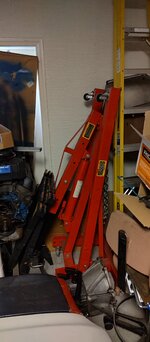
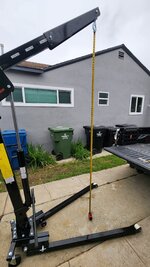
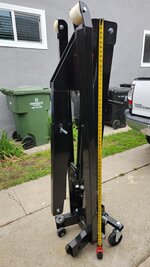
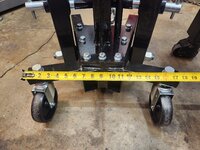
Okay, okay. Figured I at least had time to come out and snap a few pictures before things got going but that's what I get for living on the west coast.
To address some commets:
- Yes, the small* difference in floor area does make a difference in my very small shop. I hope to someday have a much larger shop where these things won't make a difference but today is not that day.
* 18" x 18" is about 2.25 sq. ft. Based on dimensions I found for the HF 2 ton model (for example) at 31.5" x 25" (5.5 sq. ft.) this is almost exactly half the footprint. But more importantly, my overhead cabinets are just over 16 inches deep so this will tuck in almost perfectly underneath.
- I realize comparing capacity must take in to consideration the extension of the boom, but all of those numbers are published for all the models being discussed here. For example, I mentioned the HF 1 ton model was rated at 500 lbs at full extension, and full extension is listed as 45-7/8" vs 1,450 lbs at 47-1/2" for the black widow. And that brings me to my next point...
-How can it maintain such a high capacity rating at full extension compared to (for example) the Harbor Freight hoist? I'm no engineer, but I think there are a few obvious differences between the designs that might account for the difference. First of all, the HF uses square tubing for both the upright and the boom. Meanwhile, the BW uses 2x4 x .125 wall rectangular tubing for the upright, and a combination of 2x4 tube and plate for the boom. The plate that makes up the pivot portion is 8mm thick (5/16") and the folded portion that makes up the boom extension is 5mm (.197"). I think it's just much much stiffer in the dimension being loaded.
Also, the attachment of the upright to the base is really beefy. I assume the HF uses the stabilizer bits to compensate for the fact that the main upright is held on by just two bolts and a small plate to the cross member. Meanwhile, the BW upright is welded to a 1/2" thick plate. That plate is bolted to the base using 7 x 12mm bolts. The base itself is another 1/2" plate welded along the entire perimeter to 2 x 4 tubes that are connected in the front and back by more 8mm plate.
All of this explains why the thing weighs over 50% more than the 1 ton HF hoist. I don't believe it was designed particularly efficiently. Rather, everything was just sort of arbitrarily super sized. I guess steel is cheap in China?
Anyway, that brings me to my last point:
- All of these weight capacities must be taken with a grain of salt. Who knows what kind of testing or certification these things go through (if any). Like all my other jacks, hoists, trolleys, slings etc. I evaluate them the best I can and decide how comfortable I am using them at or close to their published specs. In this case, my instinct tells me this is a more stout hoist than the HF, but I'll know even more the first time I load it up and see how it behaves.
I didn't necessarily purchase this for loading things in to and out of my truck (lifted tacoma short bed) as I have a Spitz Lift for that. Anything that would exceed the Spitz Lift's capacity and require this engine hoist would likely exceed the payload capacity of my truck anyway. But, I was curious how effectively it could be used after a certain skeptic above brought it up.
With the load nearly centered in the bed, I have about 60" between the bed and the hook. With rigging and all, I'm not going to be loading a vertical compressor, but a generator, toolbox, etc. would work. At max height, I have 68 inches of vertical clearance and the load is centered about 32" in from the lip of the tailgate.



 www.discountramps.com