Caveat: For automotive
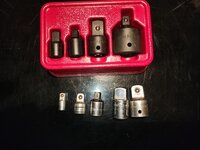
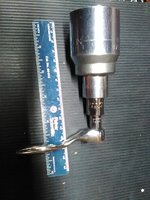
2 different scenarios, adapting up eg 1/4” ratchet to 3/8” socket, and adapting down, eg 1/2” ratchet to 3/8” socket.
Adapting up allows you to drive a socket sized for a fastener that requires a torque that exceeds the driving tool you are using. Not sure why anyone would do this when midget ratchets and every length of extension are available in every drive size.
Adapting down offers the opportunity to use a drive tool larger (really heavier) than required for a socket/bolt of that size.
In both cases, the advantage seems to be to have more options for what ratchet, extension you use for any given fastener.
In reality, the addition of the adapter takes up value space, adds another joint in your drive line, and offers the opportunity to break something. I own, but never use an impact step down. Maybe not dangerous, but certainly more risky since you don’t really get great torque feedback from an impact….takes experience to sense what they are doing.
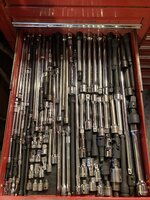
The solution is to procure ratchets and extensions in a range of sizes for each drive size. My advice is to island hop the std length models and choose instead the ends of the range. Start with long flex heads, and stubbies. (Don’t need 1/4” drive stubby). That mid length ratchet should be chosen for low ratchet angle (fine tooth count) and low back drag, not necessarily highest strength. Ditto the stubby. (I personally find nearly no use for std length 1/2” ratchets. I go from my flex stubby, to my 26” flex head. I have a worn out F80 that I love.)
I have all dual80s. Fantastic in the long handled versions, but unnecessary in the shorter lengths. Other ratchets may be better optimized for lower back drag, sacrificing some max torque strength, which you don’t need/won’t use if you have better, longer options.
Adapters exist principally because, in the old days, ratchet gears/pawls were the weak point in the drive line. Ratchet manufacturers didn’t generally make long ratchets because folks could pretty easily shear teeth. We used breaker bars. And to get the handle where we wanted it, some of us used 12 pt sockets. A step down adapter allowed you to increase the effective length of a ratchet that once upon a time didn’t exist. Adapters gave us the opportunity to drive a 3/8” socket with a longer 1/2” drive ratchet. Ditto, stubbies weren’t popular and strong ratchets meant low tooth counts and high back drag, which really limited the functionality of the ratchet. So step ups gave us lower back drag, lighter, faster ratchets.
Today, the gears/pawls are stronger than the square drive, so most all modern ratchets are as strong as breaker bars, which has rendered breakers obsolete. Pawls engaging multiple ratchet gear teeth have allowed fine teeth to be used, which has substantially improved back drag with no loss in strength.