Sr. WiNdTeCh
Well-known member
- Joined
- Apr 15, 2011
- Messages
- 241
More info on the batterys and inverteer setup
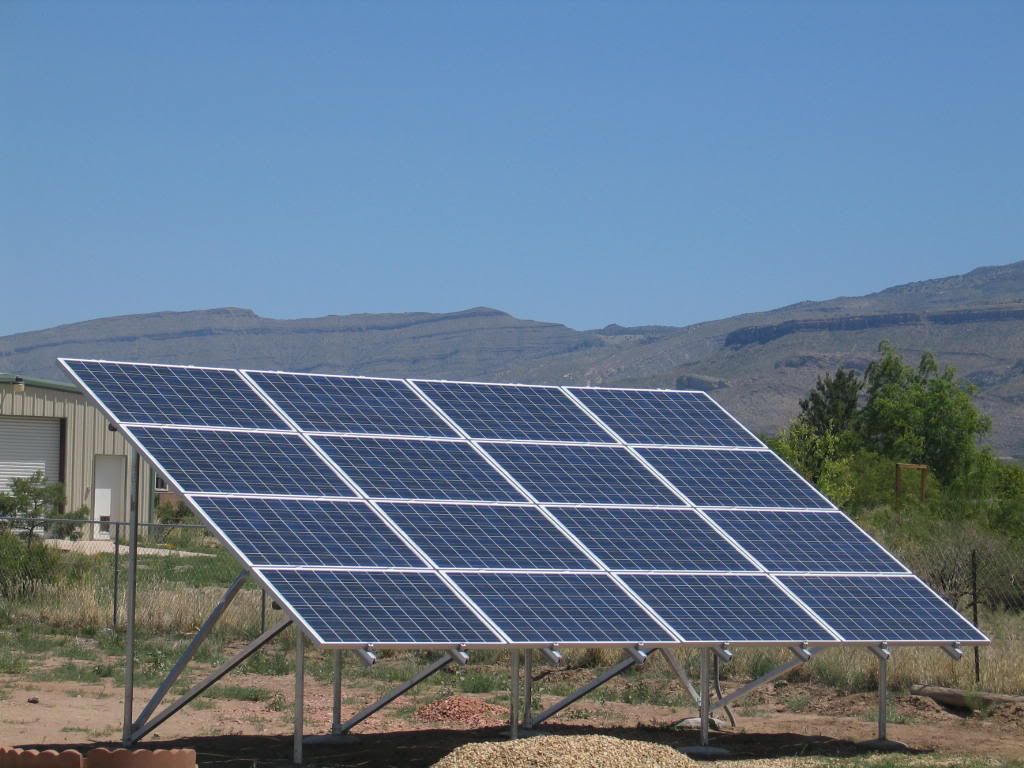
Yup. Here's my set up. 3.6KW takes care of my house, garage, workshop, everything. 16 225w panels, plus16 Enphase micro-inverters.
![]()
One day I shall be there, one day! 
I want solar so bad... just that I have no clue where to start looking and what the cost per kw should be
10. If you live in the USA be aware that the federal incentive program may be nearing its end so you better get on the boat.
Teken . . .
I want solar so bad... just that I have no clue where to start looking and what the cost per kw should be
...
4. Does ROI (Return On Investment) matter to you?
5. How many solar hours are in your region / area / season?
6. Do you want a grid tied, off grid system/
These should probably be 1, 2, 3 !
If ROI is important, it rules out most (inhabited) parts of the US.
Men don't have to make sense, or have solid reasons for doing anything!
I don't have a running total, probably cry if I did. Prices have also come down since I bought my first components.
A 140W Kyocera panel is ~$250.
A Xantrex Prowatt SW2000 inverter ~$325
Each 6V 220AH battery (I have 8) are ~$80 each
Each charge controller is ~$175
Xantrex Linkpro ~$240
30A transfer switch ~$60
Fuses, wire, connectors, switches, relays, yada yada, maybe $1k or so
I have thousands into my setup, and NOT looking to make money back. I will be putting some items, such as house lighting, on this setup exclusively. When the power goes out, my lights never will. I had it setup at my last house this way, and still am working on getting the system setup at the new house.
Here's how it worked at my last place.

I'm in hurricane prone FL. Last major outage was 18 days here. After that, I invested in solar panels.
I would be curious to see how well the panels hold up against high wind and debris flying around !
I really enjoyed your build thread you created.Also, I am of like mind with respect to the solar ROI.
I do try to balance what I am spending opposed to what I get. But, I am in it for the long haul and in Canada there is no such things as rebates etc from the Government like you guys do.
So, with that in my mind I simply build the best I can within the budget I can and enjoy the daily savings that God shines down each day!
Teken . . .

from what I have read so far. I'd like a system I can grow. thinking of starting off slow, one panel at a time...add inverters when I expand. want to start by putting my refrigerator, air conditioning system on solar to run during the day, and on grid when solar is not available. I live in Abilene, tx, I get about 6 hours of light avg.
http://directory.leadmaverick.com/Axium-Solar/DallasFort-WorthArlington/TX/10/8805/index.aspx
I live on 5+ acres, the house sits on about 2 that is cleared and has full sun. roof ridge is a little off from north/ south. so may need to set a little weird on roof.
the may reason would be to offset cost and maybe make a little money from grid. So if this just feeds the power grid that would be fine.
I also hope to convert my electric heat/ water heater to instantaneous using propane.
my area is GREAT for wind turbine set up also. would be pretty constant also. looking at pros and cons for both
my last electric bill was about $200 thru WTU ( will be switching to Reliant soon) this was with very little use from aircondioning. House is about 2000sq foot.

If you want to be able to grow the system than you can't go wrong with using Enphase micro inverters. They will allow you to install from one panel up to what ever you can afford to install.
^^^^^^^^^^^^ This.
However, there seem to be a few contraints: you are limited to 17 Enphase on each 20A branch circuit, and seemingly limited to a maximum of 20% of the service entrance rating for back feeding. From what I can tell, the intent of NEC 690.64(B)2 was to keep you from drawing more than 120% of the maximum panel rated current.
Example: If you had a 150A service entrance, and you were drawing every bit of that 150A, AND you had a 50A solar back feed on a cool crisp spring day, then you potentially have 200A available in your panel for consumption. (133% of bus bar ratings) I'm not sure I completely agree with the "theory" behind the rule. John Wiles attempts to explain it in a paper here:
http://www.nmsu.edu/~tdi/pdf-resources/cc89.pdf
If I wasn't tripping the 150A main breaker before the PV array was installed, I'm not sure how I'd be capable of consuming 200A afterwards? Anyone who did their homework should have cut their consumption before they added a PV array. The NEC seems to presume you added the PV array as a bandaid to cover your overconsumption.
It seems rather crazy to me that I can have a 60A breaker for electric heat strips in my 150A panel, but I cannot have more than a 30A back feed from my solar array. I'd really like to know if having the house on a separate sub-panel from the service entrance/meter panel would alleviate this restriction? If the house sub-panel uses a 150A main breaker to keep the loads inside the sub-panel under control, then why can't I have a 60A or 100A back-feed into my service entrance panel?


...Because I will never be able to produce enough KWH's in this region due to orientation, weather, and the number of panels I will ultimately have deployed. Now, don't get me wrong once all of the panels arrive and are installed my home will be above net neutral!
Right now I have more time than money.
Teken . . .