To avoid these ads, REGISTER NOW!

Solar Swimming Pool Heat DIY with Hubitat / Webcore Automation

mike93lx

ALLIANCE MEMBER
Joined
Dec 9, 2013
Messages
37,321
Location
Richmond, VA
The issue is night...those 50F (typical nights) means there are 300K BTU to catch up on each day, before adding any heat. That said, the water has been staying 78-82 F quite consistently with peaks over if we get two days of sun etc. Getting to 88F is great, but of course the night delta ends up being large, so you just lose more at night.
My nights are much warmer than that right now and I am hoping the thick concrete walls and autocover will retain a lot of heat.

Unfortunately my heat pump doesn't have run time tracking, so I cant see what it's needing to do to maintain that temp right now
 
To avoid these ads, REGISTER NOW!
OP
D

Denwood

Well-known member
Joined
Sep 22, 2014
Messages
4,179
Location
Thunder Bay, Ontario, Canada
If you are interested in that usage number, this is what I use on our inductive cook top to trigger the exhaust fan system for around $100 USD. It will measure power use and automate any 240V device up to 40 amps.


I don't use it to switch the 240V cooktop at all...I just use the power meter functions to trigger an ECM kitchen exhaust fan. This is the post on how I set that system up. Basically, if you fire up the induction cook top the exhaust fan will turn on, and then off when power use is below 5 watts...regardless of the fan switch position.


250

Well-known member
Joined
Oct 16, 2014
Messages
537
Location
West of the Sierras
Thanks Denwood. All your data has been very helpful.

I stumbled across some 2x20 panels at a pretty good price, so I have 4 of those on the way so now the project is off the ground. Have some thermo ordered up so I can see in flow vs out flow and hopefully tune the system as we go.
 
OP
D

Denwood

Well-known member
Joined
Sep 22, 2014
Messages
4,179
Location
Thunder Bay, Ontario, Canada
Thanks Denwood. All your data has been very helpful.

I stumbled across some 2x20 panels at a pretty good price, so I have 4 of those on the way so now the project is off the ground. Have some thermo ordered up so I can see in flow vs out flow and hopefully tune the system as we go.
Good luck with your project :) My two tips based on a lot of testing over the last five years:

1. If the 2x20' panels are set up for cross flow (water flows up 12" on one side to the end of panel, then returns down the other 12"), just knock out the restrictor on the intake side (would be placed midway on the intake manifold pipe) so water flow is fully parallel. Water should all enter the supply side of your four panels, and all of it should exit via the return, otherwise you'll have too much restriction to get efficient flow...or your pump may not be able to overcome the high head a cross flow setup creates.

2. Aim for 4 GPM to each panel, 16 GPM total, 960 GPH. A pool pump like the Intex (designed for an 18' pool and 12" to 16" sand filter) which used 2 amps@120V should be fine. You'll be able to get 45-50K BTU max from that setup, but it may be just fine for your situation. I just time a five gallon bucket filling at the pool return to calculate flow.
 
  • Like
Reactions: 250

rayra

Well-known member
Joined
Dec 1, 2014
Messages
4,724
Location
Escaped from Los Angeles
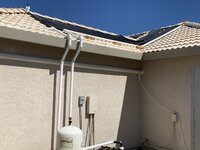
That's a good setup but I strongly suggest the OP and anyone else using regular PVC exposed like this should paint it. Not so much of an issue with Sched40 and above, but the more UV you keep off it the less brittle it gets.
 

250

Well-known member
Joined
Oct 16, 2014
Messages
537
Location
West of the Sierras
Good luck with your project :) My two tips based on a lot of testing over the last five years:

1. If the 2x20' panels are set up for cross flow (water flows up 12" on one side to the end of panel, then returns down the other 12"), just knock out the restrictor on the intake side (would be placed midway on the intake manifold pipe) so water flow is fully parallel. Water should all enter the supply side of your four panels, and all of it should exit via the return, otherwise you'll have too much restriction to get efficient flow...or your pump may not be able to overcome the high head a cross flow setup creates.

2. Aim for 4 GPM to each panel, 16 GPM total, 960 GPH. A pool pump like the Intex (designed for an 18' pool and 12" to 16" sand filter) which used 2 amps@120V should be fine. You'll be able to get 45-50K BTU max from that setup, but it may be just fine for your situation. I just time a five gallon bucket filling at the pool return to calculate flow.
How did you ‘core’ out the restrictor that the factory put in?
 
OP
D

Denwood

Well-known member
Joined
Sep 22, 2014
Messages
4,179
Location
Thunder Bay, Ontario, Canada
@rayra ,further to your comment, ABS is cheaper...and just fine given the low pressure of the system. Not sure if ABS is less or more resistant to UV vs sched 40 PVC, but doing this again, I'd just use the cheaper pipe.

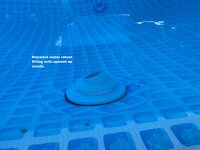
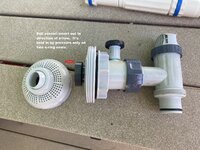
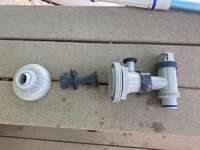
@250 You can unscrew the the nozzle housing (on the pool side of return) and then firmly pull out the plastic venturi piece (towards pool water) . Air injection (aeration) won't work after that, however it's not something we need...more of a marketing thing IMHO.

I installed a Hayward skimmer which came a new pool inlet so I just completely replaced the Intex water return with that fitting. I also opened up the Hayward nozzle about .25". Replacing the pool return with the Hayward bits was worth about 25 GPH...not a huge difference but it does reduce the system head for sure.

Intex "aerator" water return fitting:
IMG_8218.jpg

With venturi core removed. Doing this disables aeration, but the fitting won't leak. The water "jet" effect into your pool would be reduced but flow will be higher.
IMG_8219.jpg

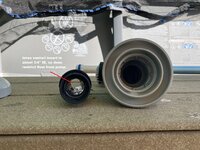
Note the small size of the venturi ID...it is well designed, but will cost you some GPH.
IMG_8221.jpg

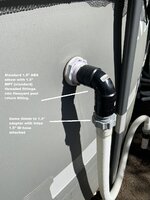
Hayward water return fitting swapped in. It comes with their above ground pool skimmer kit and has 1 1/2" MPT threads. This setup improved flow from 1765 (with the Intex return in place) to 1800 GPH for an improvement of 35 GPH. The "jet" effect to induce some swirl into the pool water is very good with this mod'd Hayward pool return...definitely better than the Intex setup. This swirl allows the skimmer in turn to work more efficiently.

Remember that our target is 4 GPM per 2'x20' solar collector, so any flow improvement translates directly to higher efficiency on the panels. We're sitting about 3.75 GPM per panel right now which is pretty close to ideal.
IMG_8216.jpg

IMG_8217.jpg

With a few days of mostly sunny skies and temps in the 75 F range, the pool water is pretty toasty at 86F. Output is still in the 36K BTU range as we push to 6pm.
IMG_8222.png
 
Last edited:

250

Well-known member
Joined
Oct 16, 2014
Messages
537
Location
West of the Sierras
@250 You can unscrew the the nozzle housing (on the pool side of return) and then firmly pull out the plastic venturi piece (towards pool water) . Air injection (aeration) won't work after that, however it's not something we need...more of a marketing thing IMHO.

Hmm. Must be a design change along the way somewhere. There appears to be a molded in restrictor in the middle of the supply side manifold tube. My plan was to have water some in from one side and go through all 4 supply sides in parallel, but now I'm wondering if those little restrictors are going to be a problem.
 
OP
D

Denwood

Well-known member
Joined
Sep 22, 2014
Messages
4,179
Location
Thunder Bay, Ontario, Canada
If the restrictions are in the supply side manifold on the solar panels,...just knock them out. I had the same issue and they were very easy to just tap out. I had ordered a 24" drill bit, but you don't need one…the insert material will break free with a few taps leaving no restrictions to flow…and letting you do the more efficient full parallel flow setup.
 
Last edited:

250

Well-known member
Joined
Oct 16, 2014
Messages
537
Location
West of the Sierras
Thanks denwood. I was able to break them out with a long screwdriver.

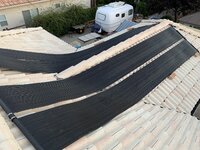
Flowing water through the setup for the first time this afternoon. I don't love how the panels lay over the change in roof pitch. I think our pump is going to flow too much water for the 4 2x20's. Might have to figure out a shunt of some sort. If I can get them working well, I'll forgive the slight eye sore for the moment.
 
OP
D

Denwood

Well-known member
Joined
Sep 22, 2014
Messages
4,179
Location
Thunder Bay, Ontario, Canada
@250, good show on the restrictors :) My lower 4 panels do drape over the roof peak (but hidden from view 100%) and there have been no issues. Just measure your output (at pool return) using a 5 gallon pail with solar in the loop. Time it.

You want .1 GPM per square foot of panel. For 160 square feet, that's 16 GPM, or 960 GPH. Flowing more won't hurt at all, but once you exceed 960 GPH, you won't see a big increase in efficiency. In other words, you'll likely see about 50K BTU in full July sun at 960 GPH. Increasing flow beyond that will only increase that BTU output a small amount. If you go much below that magical .1 GPM/sq/ft though you'll see a very significant drop in performance.

BTU is just your GPH x Temp difference between input/output x 8.33. If your GPH is 1000 (US gallons), and the temp delta is 6 F (in vs out) then:

1000 GPH x 6 F x 8.33 = 49 980 BTU.

You can take your pool volume in gallons and multiply that by 8.33 to figure out how many BTU it would take to raise your pool water 1 F. In my case (7000 US gallons), that's 58 310 BTU to raise the pool water 1 F. Sure enough, if the system is humming along at 90 000 BTU, the pool water temp increases about 1.3 F /hour. Ambient air temps are almost always lower than the pool temps by 10F during the day here, so we're also losing heat all the time! Our pool is pretty much 100% shaded, however a pool like mine in full sun would gain about 1 F per hour just by virtue of direct solar heating.
 
Last edited:

metalmagpie

Well-known member
Joined
Nov 1, 2011
Messages
796
Location
Seattle
Before I start, I do solemnly swear that the following story is true as it really happened.

Two friends of mine built a wood-fired hot tub once. They were good carpenters but designed the firebox by the seat of the pants. When it was done, they waited until Super Bowl Sunday to test it. Before the game, they went out and built a fire in the firebox. Then they went in and watched the game. At halftime they were curious to see if it was getting warm yet. They went out and were astonished to see it *boiling".

Nobody ever got to use that hot tub. It had absolutely no heat control. Way too cold or way too hot. They tore it out and built a sauna in its place.

Moral of the story is think a little about thermodynamics before you get going.

metalmagpie
 
OP
D

Denwood

Well-known member
Joined
Sep 22, 2014
Messages
4,179
Location
Thunder Bay, Ontario, Canada
@metalmagpie ,they could have resolved that with a bit of automation ..ha :)

Our issue is that other than a few days of 86-88F, the pool stays around 78-82F with our challenges of climate and shade. Another 4F would be about perfect.
 

250

Well-known member
Joined
Oct 16, 2014
Messages
537
Location
West of the Sierras
Alright, time for a little followup to the solar panel installation.

I've had it running a little over 2 weeks now. There was a little trial and error to get the pool pump set in a way that it was happy. I think we're at 40gpm at the moment. That seems to be a reasonable compromise between filtering capacity, heat input, and system pressure. Popped off a coupler, blew off the hose to the pool vacuum in the process, but seems to have settled down. One thing I've haven't figured out where the system is sucking in some air, maybe the air bleeder valve.

The system seems to be adding about 5 degrees to roughly 15,000 gal during the day. An example from last week, the water temp started at 85.5 when the system kicked on at 1000, and 90.7 at 5:30 when it kicked off. I have a thermometer on the pool water coming in and going out of the solar array and I seem to see a 4-5 degree temp delta while running. Its interesting to see how much heat is lost during the night with no cover. Right before I finished the system, the pool temp was hovering around 80-82 degrees.

So, what have I learned? More panels would be better. Not for more heat, but just more volume to filter. Its a little challenging to determine if the pool is a little dirtier because the through put of the filter is less, or maybe its been a little windier or the bush near the pool is shedding spent flowers. If I was starting from scratch and putting a pool in, might plump for the solar heaters to have their own circuit to completely seperate it from pool cleaning. Also, setting the system up by myself on a cement tile roof was a little tricky. Once the pool season is over, I might sacrifice a few dollars in piping and get some help to try and set the system up neater on the roof.
 

Attachments

  • 68187919143__01F207A3-52EB-4F3A-A9CC-7CB46003EBB8.jpeg
    68187919143__01F207A3-52EB-4F3A-A9CC-7CB46003EBB8.jpeg
    528.3 KB · Views: 17
  • 68236356083__87692A17-49F4-48F9-BD9B-2B80FBE6C470.jpeg
    68236356083__87692A17-49F4-48F9-BD9B-2B80FBE6C470.jpeg
    373.1 KB · Views: 16
OP
D

Denwood

Well-known member
Joined
Sep 22, 2014
Messages
4,179
Location
Thunder Bay, Ontario, Canada
Yep, double the panel count and 40 GPM will be right on target for flow :) For now, you can just set your bypass valve so that not all flow goes to the panels? I think you'll want about 16-20 GPM for four panels.

The vacuum breaker valve, you'll want on the high pressure (supply side) as it will for sure allow air in if on the return side. Mine needed to be at the beginning of the panels (so sees higher pressure) to remain closed during solar operation...otherwise it did let air into the system. That setup (vacuum breaker on the supply side) seems typical as gravity on the return generates negative pressure. If the negative pressure on return side of the panels opens the vacuum breaker, then the pump too has to do a lot more work (and flow will drop off a lot) as it is not getting any help from gravity on return.
 
OP
D

Denwood

Well-known member
Joined
Sep 22, 2014
Messages
4,179
Location
Thunder Bay, Ontario, Canada
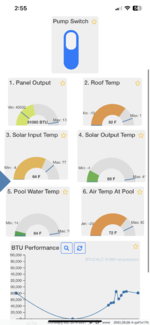
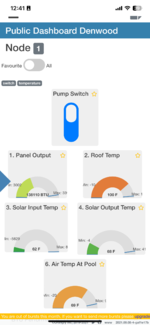
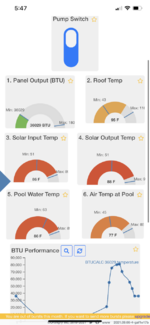
2023 and a late start to the pool setup. Other than about 5 leaks in an upper rooftop heating panel (some water likely froze in a small area of “droop” over winter) setup went fairly quickly this year. All the automation bits are ported over to Hubitat now and working very well. It’s cool and hazy outside today, but we still managed 3-4 hours of output from solar in the 90K BTU range. This is the output just before 3pm. Roof and air temps are pretty low today due to a cool east wind coming in off Lake Superior (water temps, 44 F !)

IMG_9243.png

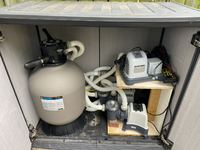
The dual pump system (one plumbed in before, and the 2nd just after the upgraded sand filter) is working great and moving over 1700 GPM through the eight panels.

1687460565839.png
 
Last edited:
OP
D

Denwood

Well-known member
Joined
Sep 22, 2014
Messages
4,179
Location
Thunder Bay, Ontario, Canada
Pool opening was again quite late in the season (as in yesterday). Good news is that the system fired right up with no issues other than a few solar panel leaks. The pool solar output today definitely set a new record…138K BTU.


IMG_0593.png
IMG_0596.jpeg
 
Last edited:
To avoid these ads, REGISTER NOW!

jar944

Well-known member
Joined
Jul 26, 2010
Messages
5,890
Location
Northern VA
Pool opening was again quite late in the season (as in yesterday). Good news is that the system fired right up with no issues other than a few solar panel leaks. The pool solar output today definitely set a new record…138K BTU.


IMG_0593.png
IMG_0596.jpeg

Any plans for a pool chiller?

I could stand to remove 138k btu, rather than add it..lol.
 
OP
D

Denwood

Well-known member
Joined
Sep 22, 2014
Messages
4,179
Location
Thunder Bay, Ontario, Canada
Two warm days and the pool picked up 20F, from 66F to 76F. That’s 1.2 million BTU…crazy. It’s pretty much fully shaded so all of that is from the rooftop solar.

I’ll have to pop some sensors up in the attic to see how much the rooftop “cooling” impacts attic temperature and therefore AC load on the house.
 

jonshonda

Well-known member
Joined
Jul 17, 2017
Messages
4,731
Location
Wisconsin
Well I've got a platform built in a primo sun spot in the yard, and two of the solar heater panels mounted. I've got the output run from the panels to the pool finished, just working on the inlet side. I do need to source another Intex pump flex hose to run from the pump to the new pvc, and hoping to find something soon as the summer is going by fast. haha
 
OP
D

Denwood

Well-known member
Joined
Sep 22, 2014
Messages
4,179
Location
Thunder Bay, Ontario, Canada
Well I've got a platform built in a primo sun spot in the yard, and two of the solar heater panels mounted. I've got the output run from the panels to the pool finished, just working on the inlet side. I do need to source another Intex pump flex hose to run from the pump to the new pvc, and hoping to find something soon as the summer is going by fast. haha
Make sure you get the Intex or same sized hoses. I found some of the “generic” hoses had a smaller ID which will restrict flow. I must have bought a dozen extra hoses for my setup…
 
OP
D

Denwood

Well-known member
Joined
Sep 22, 2014
Messages
4,179
Location
Thunder Bay, Ontario, Canada
Very informative- newer pool user. I am thinking of a solar heater and as usual the devil is in the details.
It’s all about square feet. The smaller “expensive!!” plastic dome type heaters from Amazon are a complete waste of money. What you likely need is the flat plastic heaters 2x10, 2x20 or 4x10, 4x20. Start with square feet at 1/2 or more to your pool surface area. With a shaded pool and cool climate it took 320 square feet of heaters to keep an 18ft (52” deep) pool warm. An 18 foot pool is about 230 square feet.
 

jonshonda

Well-known member
Joined
Jul 17, 2017
Messages
4,731
Location
Wisconsin
Make sure you get the Intex or same sized hoses. I found some of the “generic” hoses had a smaller ID which will restrict flow. I must have bought a dozen extra hoses for my setup…

I'll need to examine the hoses more later, but for now it's up and running. I use the valves to balance the restriction caused by the solar heaters, and so far so good. I have two solar heaters in parallel and with the valve to the pool closed (meaning all water from the pump is going through the heaters) there is a noticeable jump in pressure/restriction. I will need to read up more on the acceptable range for the pump, but for now we will try to limit the additional strain by diverting some of the water directly back into the pool.
 
OP
D

Denwood

Well-known member
Joined
Sep 22, 2014
Messages
4,179
Location
Thunder Bay, Ontario, Canada
I'll need to examine the hoses more later, but for now it's up and running. I use the valves to balance the restriction caused by the solar heaters, and so far so good. I have two solar heaters in parallel and with the valve to the pool closed (meaning all water from the pump is going through the heaters) there is a noticeable jump in pressure/restriction. I will need to read up more on the acceptable range for the pump, but for now we will try to limit the additional strain by diverting some of the water directly back into the pool.
If the solar heaters are set up for crossflow (they will have a diverter molded inside the supply and return manifolds, halfway in) you can break out the diverter so they are properly parallel. All of my 2x20 foot panels were set up this way OEM, and were terribly restrictive as by default that end up in series. I seem to recall about 4 panels was the magic trick with the higher output Intex pumps.

By default a 2x20 heater (at least the ones I bought) will send flow up 1 foot of the collector, then back through the other 1 foot so you can install supply and return on one end of the heater. This is a terrible setup for restriction. If you break out the internal diverter, then all of the flow will enter one end of the collector, and then exit the other end. Also, once modified, you can just connect all of the panels at one end for supply, and do return at the other end of the collectors for truly parallel flow. This makes a massive difference in restriction and only takes a few seconds for the modification.
 

jonshonda

Well-known member
Joined
Jul 17, 2017
Messages
4,731
Location
Wisconsin
Well against your instructions @Denwood I followed the manufacturers guide to plumbing the panels and left the restrictor plates in place. I assume the goal is to raise the temp as much as possible by passing the water through the panels in stages to bring the temps up as the water moves down the line. At full exposure yesterday, 83* temps using two panels I measured the output increase of only 6-7 degrees, which isn't what I was hoping for.
 
Last edited:

ripperd

Well-known member
Joined
Jul 2, 2014
Messages
2,041
Location
Twin Cities, MN
Well against your instructions @Denwood I followed the manufacturers guide to plumbing the panels and left the restrictor plates in place. I assume the goal is to raise the temp as much as possible by passing the water through the panels in stages to bring the temps up as the water moves down the line. At full exposure yesterday, 83* temps using two panels I measured the output increase of only 6-7 degrees, which isn't what I was hoping for.

I think thermodynamically you want the opposite. Faster flow through the collectors, for minimum heat rise of the water going through the collectors. It may be counter intuitive but the larger the temperature delta the more heat transfer happens.

Total BTUs going into heating the pool is a combination of temperature rise and water volume obtaining that rise. 6-7 degrees at 1gpm is less BTU wise (3000 btu/hr) than something like 2 degrees at 5gpm (5,000 BTU/hr).
 

jonshonda

Well-known member
Joined
Jul 17, 2017
Messages
4,731
Location
Wisconsin
I think thermodynamically you want the opposite. Faster flow through the collectors, for minimum heat rise of the water going through the collectors. It may be counter intuitive but the larger the temperature delta the more heat transfer happens.

Total BTUs going into heating the pool is a combination of temperature rise and water volume obtaining that rise. 6-7 degrees at 1gpm is less BTU wise (3000 btu/hr) than something like 2 degrees at 5gpm (5,000 BTU/hr).

Yeah that does make sense, but I'm curious why the manufacturer would setup the panels in a way that promotes this type of configuration. It clearly shows that they want the water to run through the panels as many times as possible, and it's not like we are using these panels for something outside their design intent.
 

mike93lx

ALLIANCE MEMBER
Joined
Dec 9, 2013
Messages
37,321
Location
Richmond, VA
Yeah that does make sense, but I'm curious why the manufacturer would setup the panels in a way that promotes this type of configuration. It clearly shows that they want the water to run through the panels as many times as possible, and it's not like we are using these panels for something outside their design intent.
I bet they get less complaints when the water leaving the panels feels hotter
 
OP
D

Denwood

Well-known member
Joined
Sep 22, 2014
Messages
4,179
Location
Thunder Bay, Ontario, Canada
I think thermodynamically you want the opposite. Faster flow through the collectors, for minimum heat rise of the water going through the collectors. It may be counter intuitive but the larger the temperature delta the more heat transfer happens.

Total BTUs going into heating the pool is a combination of temperature rise and water volume obtaining that rise. 6-7 degrees at 1gpm is less BTU wise (3000 btu/hr) than something like 2 degrees at 5gpm (5,000 BTU/hr).

Correct, the best efficiency is with a delta of 4-5 degrees between intake and output. If you have more panels, you typically dial up the flow so you have about 3-5 GPM per panel. With say four panels (all connected in parallel !!) your system flow flow should be somewhere around 12 to 20 GPM total. You can check flow by just timing the fill time for a 5 gallon pail. Then figure out your Gallons Per Minute (GPM) from that. You can also just measure the temp delta in full sun between supply and return. If it's more than 7-8 F, then increase flow.

EDIT: found some efficiency data from an older test, on a fairly cold day. We got 25% higher output going from 2.14 GPM/panel to 3.57 GPM/panel.

At 2.14 GPM/panel, the best we did was 75K BTU, with a 10 F difference between input/output temps.

At 3.57 GPM, output jumped to 100K BTU, although temperature rise (input vs output) dropped, as you'd expect with higher flow, to about 7F. This pretty much demonstrates the fact that you don't want high temps in the panels, as they lose a lot of efficiency when you exceed ambient temps (the panels start losing heat to radiation).


Yeah that does make sense, but I'm curious why the manufacturer would setup the panels in a way that promotes this type of configuration. It clearly shows that they want the water to run through the panels as many times as possible, and it's not like we are using these panels for something outside their design intent.
I think they do it so you can connect supply and return at one end. It's not efficient at all though. Hotter panels lose more heat to ambient, so this is why you want them actually running cooler than what they are seeing ambient. Efficiency goes up as you increase flow, however beyond 5 GPM per panel, the curve gets pretty steep and you're just wasting pump power. I ran a ton of tests and because my system does measure BTU live, I found that 3-4 GPM per panel works the best for 2'x20' panels. You just adjust that number based on how many panels you're running. Another upside of correct parallel flow is that you don't need a bypass for the heater system and you can use the inexpensive Intex pumps as well. I just run fully filtered water through the panels in our setup.

If you do connect solar pool heaters configured as "crossflow" in series, you'll never get even close to 4 GPM per panel as the restrictions are massive. There are a pile of videos out there showing how hot the water is coming off 10 DIY coils, but they never provide the flow (GPM). You need a lot of BTU's to warm up a pool. An 18 foot pool, 52" deep runs around 7000 gallons. You need 8.33 BTU per gallon, per degree F. So raising the pool's 7000 gallons by 1 degree F is: 7000 gallons x 8.33 x 1 F = 58 310 BTU to raise it 1 degree F. In full sun, my system provides somewhere around 120 000 BTU using eight 2'x20' panels. With four panels it was about half that.

@jonshonda , what size and how many panels do you have? If you do the 5 gallon pail test, how long to fill it?

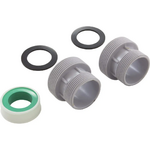
Btw, these bits are super handy to go from the 40mm Intex hoses to 1.5" PVC for solar: https://www.amazon.ca/4560-Conversion-Intex-Bestway-Pools/dp/B004TYBCEG

1753749163790.png
 
Last edited:
To avoid these ads, REGISTER NOW!
Top Bottom