To avoid these ads, REGISTER NOW!

solar

OP
F

FredWanaker

Well-known member
Joined
Mar 27, 2021
Messages
1,470
Location
NorCal
Battery chemistry is about 250 years old at this point. The technology is well established, and has been since just after WWII. I don't see future big gains in batteries unless someone figures out the unified field formula. Maybe then we will be able to store more power in smaller spaces. But that is my opinion. Electric cars are well over 120 years old. They are still bumping up against weight vs charge and recharge issues. If the battery weighs more then it takes more energy to move it. My guess is that in urban settings it will do fine, where the commute is less than 50 miles each way. But when it comes to long distance, it will be a long time before EV is a solution. The other issue is where to charge. If someone commutes to work then their car isn't at home to charge off their solar during the day. In that case the charging solar needs to be at work. In the capital of the EV state in the world,where I worked, in the garage that serves CalEPA and ARB, there were limited charging stations. They worked well when only 6 or 8 people of the 1300 who worked there had EV cars they drove to work. Once it got up to 20 - 30 EV cars then the city had to limit the number of hours each car could be parked in a charging spot. Hey, sorry but I have to leave the meeting with the Governor - I need to move my car so someone else can charge their car. A good friend was recently telling me how the world should change to EV. Then he mentioned he was going to drive from SoCal to Oregon to see his mom and family. I asked, how long a drive is that? He said, "maybe 20 hours." Then he paused, and said, "I guess if I get an EV 3 to 4 days each way... that won't work will it?"

All we want is to have solar if it can be made cost effective over a 10 - 12 year period, and so far unless I can roll time backwards to where I can scamper on the roof as a young man again and DIY, that won't work. 71 year olds with bad backs, and bad knees that do funny things, don't belong on roofs.
 
To avoid these ads, REGISTER NOW!

Sumboodie

Well-known member
Joined
Mar 20, 2021
Messages
10,660
Location
AK
At 15 cents for power, getting an installed system will likely never pay back.

DIY could be a different story and getting rid of batteries would greatly reduce the cost, but probably only makes sense if you have enough daytime load to use what the array can generate
Grid fed will balance out between load and use...
 

dcg9381

Well-known member
Joined
Jun 20, 2018
Messages
11,627
Location
Austin, TX
With all of the investment in battery tech anything purchased today will be outdated soon. No sense in buying the powerwall other than to say you have a powerwall.
I'm really not a Tesla fanboy, but they're just the product that I know best as I've done some consulting for a friends project. I know that generac was buying battery tech companies and it would not surprise me at all that there are better options than Tesla at a much better price point. Some of their stuff, IE "the solar roof" - to me it's somewhat laughable at the price point and the "Tesla math" that they use as an example is pretty ludicrious.

Tesla CAN integrate solar and a generator with a battery in a scenario where the grid is down, so that's been fairly unique until recently. Most people don't understand that grid tie solar goes down and stays down until the grid is back.

The "battery" advantage is that available power can span that gap between when grid power goes down and your generator comes on. I imagine there are cases where that "matters" for critical systems. I have a few critical things here and we handle it by racked UPS batteries (a bunch) and power-over-ethernet. Unplug our house, turn propane off at the generator, all of our network, camera, and security systems, my office, and internet, all stay up for a period of time...
 

dcg9381

Well-known member
Joined
Jun 20, 2018
Messages
11,627
Location
Austin, TX
Battery chemistry is about 250 years old at this point. The technology is well established, and has been since just after WWII. I don't see future big gains in batteries unless someone figures out the unified field formula. Maybe then we will be able to store more power in smaller spaces. But that is my opinion. Electric cars are well over 120 years old.

All we want is to have solar if it can be made cost effective over a 10 - 12 year period, and so far unless I can roll time backwards to where I can scamper on the roof as a young man again and DIY, that won't work. 71 year olds with bad backs, and bad knees that do funny things, don't belong on roofs.

I'm not entirely sure that I'd agree that batteries haven't changed much. I'm not arguing the point on battery chemistry, you statements may very much be spot on. I flew RC planes for more than 40 years. We used to power them with gasoline motors. We dealt with rebuilds, nitro based fuel, glow plugs, exhaust discharge, burns, constant tuning, and I'm sure that many fingers were lost in the process.

Now we have LiPo batteries that weigh less than 1/2 a pound and can reliably put down continuous (not burst) 100A at 12V.. And that's probably a mid-range performance battery. Cost? about $25.00. Brushless electric motors - I've never had any hassle with one and they put down crazy power for their size. I'm sure this tech has other applications - and there are limitations, like not being able to discharge too low and battery limited life, etc... But as tech, you don't see many dino powered RC airplanes anymore. We've even got a few "personal transport" experiments like Lift Aircraft that use this tech. And even in less experimental aviation - I've seen battery powered full sized self-launch sailplanes (general aviation stuff)...

I'd like solar prices to come down too. But to me it seems that it's more likely that inflation on power costs will go up before solar tech comes down. Making it easier to self-install would help. I don't like roof arrays either, I tend to build them into ground arrays.
 

gpiggaz

Well-known member
Joined
Mar 14, 2010
Messages
2,548
Location
Tucson, AZ & Edmonds, WA
FWIW- I spent 10 years thinking about adding solar to our house in Tucson. Finally last year the numbers worked out well enough after the Fed tax credit our payback period is about 6.5 years. Not the best, but not shabby- We did 100% of the installation ourselves and didn't cheap out on anything, US made panels and a higher end inverter - Plus ground mounted which actually added about 25% to the cost or our payback would have been far shorter than the 6.5 years it's pencilling out to be.

The best news for our system - we used a couple of simulations to predict it's performance, and so far after 11 months, we are right on the predictions for power produced. We do get to "Sell" our excess power to the local utility for about 2/3 of what we'd pay for it if we were buying it. But with our Electric cars, we try to charge during the day ( I know that seems counter intuitive) We figure why not use the power in real time vs buying it at a higher rate than we can sell it for- So we actually do things like laundry in the middle of the day instead of a night. I hope the hardware holds out for at least as long as we plan to live there- Its rated to last 20 years, but I'd be surprised if the inverter lasts that long. it's got a 12 year warranty though, so that would be good if it makes it that far.

By far the worse part of our installation was the digging of the piers for the ground mount, followed believe it or not- the permitting process which involved both the local municipality and the power company- But being a retired engineering, I was able to navigate both with only a few sleepless nights. The digging took more of a toll on my physically though- My hands hurt for months-after I used a jack hammer to dig he holes in the AZ "soil" if yo can call it that.

We actually increased the panel count late last year because after running the system over the summer we could see that we could add 20% more panels and only briefly saturate the inverter around 12PM ea day and only a few months of the year. The inverter is designed to tolerate that saturation, so we should be good. We'll start to see the saturation in about another 8-10 weeks and that will last through mid summer based upon my calculations.

Our system is 9.2KW DC and 7.6KW AC- no batteries as they would never pay for themselves in our estimation and our power has been reliable for the 35 years we've lived here.
 

WisJim

Well-known member
Joined
Dec 20, 2010
Messages
2,264
Location
Menomonie, WI
Walrus, we run 2 Fujitsu 15k minisplits which usually take care of all heat through November, then a little wood heat through February if we don't want to buy electricity to run minisplits. Otherwise our surplus energy that we've accumulated over the summer runs everything until the first of the year, when the utility zeros out our energy surplus, pays us a fraction of what they charge us, and start us over on our surplus energy.
We've using solar and wind generated electricity since 1977 so I do have a bit of experience, including professional training and certification in siting small wind systems and solar electric systems, and I find it amusing to see what all the "experts" have to say about the feasibility of PV systems.
I also should mention that I have used a set of new lead acid batteries, similar to fork lift cells, and have gotten 20 years out of a set. My oldest panels are 40 years old and still work as they should, my first inverter is over 20 years old with no problem, and 28 of my panels have individual microinverters which have a 25 year warranty and some have been in service for 10 years or more with absolutely no problems.
 
Last edited:

givemethewillys

Well-known member
Joined
Sep 21, 2009
Messages
173
Location
New Kent, VA
I have 34 panels on my roof, and have been very happy with my system. While it doesn't cover all of my usage, the monthly solar payment seems to about equal the savings on my electric bill (although I haven't looked super closely).

My panels have a 20 year warranty, so if one goes bad, it will be replaced under manufacturer warranty. I'm not too worried about it.

I feel like if I can do a little part to make the world cleaner through renewables, I will. I'd like to throw another 20+ panels on my detached garage when I build it (5 year plan).
 

Sumboodie

Well-known member
Joined
Mar 20, 2021
Messages
10,660
Location
AK
Walrus, we run 2 Fujitsu 15k minisplits which usually take care of all heat through November, then a little wood heat through February if we don't want to buy electricity to run minisplits. Otherwise our surplus energy that we've accumulated over the summer runs everything until the first of the year, when the utility zeros out our energy surplus, pays us a fraction of what they charge us, and start us over on our surplus energy.
We've using solar and wind generated electricity since 1977 so I do have a bit of experience, including professional training and certification in siting small wind systems and solar electric systems, and I find it amusing to see what all the "experts" have to say about the feasibility of PV systems.
I also should mention that I have used a set of new lead acid batteries, similar to fork lift cells, and have gotten 20 years out of a set. My oldest panels are 40 years old and still work as they should, my first inverter is over 20 years old with no problem, and 28 of my panels have individual microinverters which have a 25 year warranty and some have been in service for 10 years or more with absolutely no problems.
Enphase?
That's what my setup has.
 

Ole Slewfoot

Well-known member
Joined
Feb 22, 2016
Messages
5,098
Location
Freedom, CA
My friends house is a few million bucks distant from the grid, so he's built a system entirely from idiots giving up their panels because they are old. About 14 of them on a meadow, and some gold cart batteries. He has generators, but I've never seen him run one for residential purposes. Welders and sawmill get the generator. How you chose to spend your power is most of the equation and Americans can typically afford to be really stupid about it.
 

walrus

Well-known member
Joined
Nov 12, 2008
Messages
11,674
Location
Maine
I'm running a 7.7 SMA inverter, mounted under my ground mount racking. Q cell 430 watt panels. Iron Ridge racking which I beefed up because of the winds on the coast of Maine, added another rail in the middle of panel. I scrounged 2" galv pipe for some of the mount. The ground mount added another 3 grand to the project but this allows me to keep panels clear of snow which I knew would drive me crazy if they were on the roof. :) This is my first install, took NABCEP training class a few years ago thinking I would get into the solar business but decided I was too old to crawl on roofs. NEC has made it harder to do these installs.
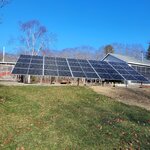
If you look to the right of ground mount you see the back of my shop and a homemade collector I use to heat the radiant floor in my shop. Keeps the shop from freezing and generally around 50 degrees with no other heat source running. To warm it up from there I use wood.
 

Attachments

  • 20211205_111113.jpg
    20211205_111113.jpg
    860.2 KB · Views: 79
  • 20220201_122646.jpg
    20220201_122646.jpg
    258 KB · Views: 75
Last edited:
OP
F

FredWanaker

Well-known member
Joined
Mar 27, 2021
Messages
1,470
Location
NorCal
we don't have the land to mount racks of solar at an optimum angle or install a solar flower, or whatever they are called. I mentioned in the beginning that the size of the install would be limited to about 375 sq feet, which is appx 1/2 of a two car garage roof facing SSW. Also we'd look for a cash price due to no desire to finance a solar system over 20 years that has a 12 year warranty, from a company that has been around 3 - 4 years, and a salesman who was a car lot salesman 3 months earlier, whose boss is wanted in 3 states by their contracting board, and installed by a crew who is so new to town they can't even tell me where the local McDonalds is, or how to get to the freeway. :)
 
OP
F

FredWanaker

Well-known member
Joined
Mar 27, 2021
Messages
1,470
Location
NorCal
I ran the calculator on the utility site. Basically after rebates $15,000 and 20 year break even. And the calculator fudges a 15% improvement by using LEDs, new insulation etc., which things are already done. So basically it is a wasted effort still to consider it. I'll plant more sages in the backyard for the humming birds and butterflies, and feel that I have saved the planet more. As to financing it, I spent too many years in consumer finance. Someone takes out 20 year financing on an item with a 15 year warranty. It fails at 10 years and the company is gone to warranty it. Your attorney talks with the bank who agrees to forgive payments and interest until it is repaired which it never is. You go to buy a car and are told that the bank charged off a loss. You pay your attorney again and the bank removes the charge off reporting. Then you go to sell or refinance the house and are told that there is still a large lien on it. The bank refuses to release it and says sue us. The sale of the house falls thru unless you pay them off, so you pay them on a settlement amount your attorney negotiates with them. Then you get a notice your credit has changed again. Bank is reporting a charge off again and they refuse to remove it. Back to the attorney who tells you it will cost more to fight it than pay it. You pay the balance and swear you'll never finance another home improvement like that.
 

brianh

Well-known member
Joined
Apr 6, 2010
Messages
1,299
Location
grahamsville NY
I'm running a 7.7 SMA inverter, mounted under my ground mount racking. Q cell 430 watt panels. Iron Ridge racking which I beefed up because of the winds on the coast of Maine, added another rail in the middle of panel. I scrounged 2" galv pipe for some of the mount. The ground mount added another 3 grand to the project but this allows me to keep panels clear of snow which I knew would drive me crazy if they were on the roof. :) This is my first install, took NABCEP training class a few years ago thinking I would get into the solar business but decided I was too old to crawl on roofs. NEC has made it harder to do these installs.

If you look to the right of ground mount you see the back of my shop and a homemade collector I use to heat the radiant floor in my shop. Keeps the shop from freezing and generally around 50 degrees with no other heat source running. To warm it up from there I use wood.
That is great love the hot water floor system I did the same 6 years ago 20'x8' homemade panel heats the floor to 50 55 degrees pumps are brushless running off pv panels. Rest of my heat comes from a wood stove and a pellet stove modified to burn my waste saw dust.

A 9 kw grid tie system is on the shop roof paId off in 7 years
 

reader2580

Well-known member
Joined
Dec 31, 2014
Messages
14,516
Location
Minneapolis, MN
I spent about $10,000 after tax credits for a mostly DIY 9,300 watts system. I figure a 10 year payback. I actually get a check for about $400 every year from the power company.

There is no reason to believe my system will fail at 10 years. Panels are warrantied for 25 years.
 
OP
F

FredWanaker

Well-known member
Joined
Mar 27, 2021
Messages
1,470
Location
NorCal
I spent about $10,000 after tax credits for a mostly DIY 9,300 watts system. I figure a 10 year payback. I actually get a check for about $400 every year from the power company.

There is no reason to believe my system will fail at 10 years. Panels are warrantied for 25 years.
thanks
 

dcg9381

Well-known member
Joined
Jun 20, 2018
Messages
11,627
Location
Austin, TX
There is no reason to believe my system will fail at 10 years. Panels are warrantied for 25 years.
I've never had a panel failure and I've probably installed 80 panels.

If you read the "fine print" on panel warranty, they are typically guaranteed % output for a number of years. Panel efficiency does decrease over time, but if we're still getting 80% out of it at 15 years, that's OK with me.

I do see people selling "B" quality panels - or panels that are non-optimum, maybe a cracked cell etc. They could be used in "budget" DIY cases.

I have very little faith in any sort of "25 year" warranty. Will the company be in business? Most of this stuff is made overseas. Will the "newer" panels be of the same dimensions, wattage, and configuration as the warranty-replace panels? If you didn't DIY, does the warranty cover install costs?
 

HamAndEggs

Well-known member
Joined
Nov 16, 2020
Messages
932
Location
Houston, TX
Best thing I've done is get solar panels. Cost about 1/2 the price of paying for electric, and if they raise rates, I just get more money back. That plus its a fixed cost per month for the loan, and its 0.5% Interest, so its essentially free money, as inflation is well over 0.5%. The 26% tax credit was just icing on the cake, helped pay for most of my generator install

The only catch is that if they end net metering, I'm bamboozled. But hopefully by that time batteries will be more compelling
 

Attachments

  • 2021-09-05 09.12.41.JPG
    2021-09-05 09.12.41.JPG
    563.5 KB · Views: 52
To avoid these ads, REGISTER NOW!
OP
F

FredWanaker

Well-known member
Joined
Mar 27, 2021
Messages
1,470
Location
NorCal
here the blended cost of power to this household last year was 15.7 cents a kWh although we are on time of day so it is actually higher if we use it in the evening to cool the house, which we don't. Beginning next week the utility company is lowering the buy back rate on net metering (net metering 3.0*) to 7.4 cents per kWh, so net metering won't even be close to a one to one relationship. I priced batteries and they don't pencil out here. The way I see it, it is a 15 - 20 year payback for solar because they don't want you competing with them. They want to be the ones to install solar farms in the desert etc., and do solar that way instead of roof top. I am 71 so this is probably the last time we will look at it. I love the planet but frankly I am not impressed at all with how government treats its citizens of late. I already pay ample taxes with taxes, fees, inflation, and whatever else they concoct. Buying solar right now for us would end up just being another form of tax because of the time it would take to pay for itself, especially if it needed any maintenance. I had hoped that a bunch of folks here would show me how to do this in a 5 - 10 year payback if we paid upfront, but it just isn't so right now. The cost is too great.

*even if someone is on contract at a better buyback rate, any changes such as a replacement inverter, replacement solar panel, batteries or any changes to the service panel will void the old contract and put it on the new net metering plan according to local news sources, and interviews with the local utility Co. If you need it serviced the power Co will be involved in the permitting, and then the plan changes to net metering 3.0. So who knows what net metering 4.0 will look like in 5 or 6 years.
 

HamAndEggs

Well-known member
Joined
Nov 16, 2020
Messages
932
Location
Houston, TX
On the tax credit front, it also HEAVILY benefits the more well off. Since its a tax credit, you have to actually pay that tax in the first place to get it back.

If you make minimum wage and want to get solar, you'll probably never get the tax credit back, as the program will have ended before you could roll it over enough times to get the money back. So if you are poor (Or have any other reason to not pay much federal tax), you have a 26% tax hike on solar panels
 

Git

Well-known member
Joined
May 18, 2008
Messages
6,894
Location
S Cal
here the blended cost of power to this household last year was 15.7 cents a kWh although we are on time of day so it is actually higher if we use it in the evening to cool the house, which we don't. Beginning next week the utility company is lowering the buy back rate on net metering (net metering 3.0*) to 7.4 cents per kWh, so net metering won't even be close to a one to one relationship. I priced batteries and they don't pencil out here. The way I see it, it is a 15 - 20 year payback for solar because they don't want you competing with them. They want to be the ones to install solar farms in the desert etc., and do solar that way instead of roof top. I am 71 so this is probably the last time we will look at it. I love the planet but frankly I am not impressed at all with how government treats its citizens of late. I already pay ample taxes with taxes, fees, inflation, and whatever else they concoct. Buying solar right now for us would end up just being another form of tax because of the time it would take to pay for itself, especially if it needed any maintenance. I had hoped that a bunch of folks here would show me how to do this in a 5 - 10 year payback if we paid upfront, but it just isn't so right now. The cost is too great.

*even if someone is on contract at a better buyback rate, any changes such as a replacement inverter, replacement solar panel, batteries or any changes to the service panel will void the old contract and put it on the new net metering plan according to local news sources, and interviews with the local utility Co. If you need it serviced the power Co will be involved in the permitting, and then the plan changes to net metering 3.0. So who knows what net metering 4.0 will look like in 5 or 6 years.
You pretty much hit the nail on the head. Without a 1:1 net metering agreement, return on the out of pocket will take years. And who knows what the future will bring. I am just happy at this point I least got my money's worth.

On the tax credit front, it also HEAVILY benefits the more well off. Since its a tax credit, you have to actually pay that tax in the first place to get it back.

If you make minimum wage and want to get solar, you'll probably never get the tax credit back, as the program will have ended before you could roll it over enough times to get the money back. So if you are poor (Or have any other reason to not pay much federal tax), you have a 26% tax hike on solar panels

You can roll the tax credit over for 5 years. Average cost of solar in California is around $17k for decent sized, 6 kW system. The 26% federal tax credit which would be about $4,400. So that is about $900 a year in federal income tax. Even if you only made $10k a year which would put you in the 10% tax bracket, you would still be able to take full advantage of the tax credit.
 

mike93lx

ALLIANCE MEMBER
Joined
Dec 9, 2013
Messages
37,403
Location
Richmond, VA
You pretty much hit the nail on the head. Without a 1:1 net metering agreement, return on the out of pocket will take years. And who knows what the future will bring. I am just happy at this point I least got my money's worth.


You can roll the tax credit over for 5 years. Average cost of solar in California is around $17k for decent sized, 6 kW system. The 26% federal tax credit which would be about $4,400. So that is about $900 a year in federal income tax. Even if you only made $10k a year which would put you in the 10% tax bracket, you would still be able to take full advantage of the tax credit.
People making 10k don't pay any federal taxes, but yes, lower income earners can take the credit over time, they just can't afford the systems
 

msharley

Well-known member
Joined
Sep 20, 2021
Messages
13,986
Location
Central Pennsylvania
My electric bill last year was $1,422.19. We used 9026 kWh during the year = .157 per kWh using the average. Low month was 453 kWh and high month in summer was 1332 kWh. The area that faces southwest on the roof is about 15' x 25' or 375 sq ft.

I figure that anything that I put on the house that may require maintenance won't live more than 10 - 15 years. Several of our friends who bought into solar have been thru 2 systems in 15 years because the companies go under and the next company says they can't get parts to service the old system that has failed. So, using 10 years as a life expectancy, if I got 100% savings (not expecting that just using that number) that would be $1,422.19 x 10 years or $14,221.90 I could spend on solar, otherwise I am going backwards. Adding solar also increases my risk of a roof leak. And, with new insulation R50 in the attic, our electric bills are down about 15% this year so even with inflation, $1500 a year for electricity seems a good number to use. Can anyone get a system capable of putting out enough KW to make it worthwhile in a situation like this that includes batteries for night use? I think their life span is about 5 - 7 years before they start losing ability to charge. Last bid I got 10 years ago they wanted $35K - $40K for a system that would provide that much power based on the Sacramento area.

Has anyone installed solar lately where the cost zeroed out at 10 years? I am still thinking it is 20 - 25 years before the cost zeros out.
$120/month?

Totally reasonable.....

Solar Is going to be much more....
 
OP
F

FredWanaker

Well-known member
Joined
Mar 27, 2021
Messages
1,470
Location
NorCal
yes $1422 a year was all of last year. 9026 kWh. The issue here is that we would still use power at night, cloudy days, and net metering is about 1/3 buyback of the cost of that power used at night plus there are service fee, grid fees, and state and local utility taxes. We'd still probably pay $600 a year in an electric bill, so the actual savings would be closer to $65 a month. We'd pay cash for it. I am 71 so unlikely I'll ever get all my money back but my heirs might.
 

reader2580

Well-known member
Joined
Dec 31, 2014
Messages
14,516
Location
Minneapolis, MN
*even if someone is on contract at a better buyback rate, any changes such as a replacement inverter, replacement solar panel, batteries or any changes to the service panel will void the old contract and put it on the new net metering plan according to local news sources, and interviews with the local utility Co. If you need it serviced the power Co will be involved in the permitting, and then the plan changes to net metering 3.0. So who knows what net metering 4.0 will look like in 5 or 6 years.
How is the power company going to know if you have to replace an inverter or a solar panel?
 

dcg9381

Well-known member
Joined
Jun 20, 2018
Messages
11,627
Location
Austin, TX
*even if someone is on contract at a better buyback rate, any changes such as a replacement inverter, replacement solar panel, batteries or any changes to the service panel will void the old contract and put it on the new net metering plan according to local news sources, and interviews with the local utility Co. If you need it serviced the power Co will be involved in the permitting, and then the plan changes to net metering 3.0. So who knows what net metering 4.0 will look like in 5 or 6 years.
Horsepucky. It's likely that many jurisdictions technically require a permit to replace a breaker in your home, but there ain't no way they know that's going on.

Micro-inverter systems are designed for high availability power. Lose one? The system alerts and keeps on trucking. Replace at your leisure. Your system just has a slight drop in output.

Even single inverter systems, there is no "system monitoring" on the POC side. For all the POC knows, my lot had a peculiar set of stationary clouds over the barn for a few days. Or maybe I turned the system off because of another project. It's much more likely to work the other way around, I've informed the POC that their grid is out of spec (because my system monitors it) - apparently better than they can...

I'm poking fun a bit. But the only people that know less about solar (around here) than traditional electricians is the POC.

That being said, your augment is completely valid. The coop (POC) here just voted to cut solar buyback rates by 50%. They can set rate changes whenever they want. So I agree that it IS a risk to over produce power. What you can count on is being able to reduce your usage and count on those as "payback" dollars. If they net meter weekly, monthly, or yearly, that's a huge help. When you're trying to make solar pay back via checks, that's a lot harder as they'll never pay retail... And may not even pay wholesale.
 

HamAndEggs

Well-known member
Joined
Nov 16, 2020
Messages
932
Location
Houston, TX
If I recall, the "Sense Energy Monitor" has the ability, or claims to have the ability to detect specific devices based on their power "signature", and apparently Schneider Electric/Square D has a whole big database of those devices and what their power draw looks like from testing AFCI Breakers

I wonder if we could get a future where the power company will charge you more for "luxury" devices

Looking forward to that future /s
 

tech

Well-known member
Joined
Dec 21, 2005
Messages
67
Location
keene nh
This is a NET ZERO house I designed and built in 2018 then lived in until this past sept when I sold it for a large profit. ZERO energy bills including a small hot tub. ROI was 8 years (including tax credit) New England has expensive energy though. Solar makes a lot of sense for many already. Factor in rising energy costs and it really looks good. Also the comfort of a house like this is hard to imagine until you have lived in one.
 

Attachments

  • pdl23tp.jpg
    pdl23tp.jpg
    162.4 KB · Views: 57
OP
F

FredWanaker

Well-known member
Joined
Mar 27, 2021
Messages
1,470
Location
NorCal
On their change the articles about what the utility has passed reads:

"The policy changes will be retroactive to all existing solar users starting in 2031. The reduced credits are also triggered by adding solar panels to an existing solar system, adding a battery, or selling your home.... ."
 

Mr onetwo

Well-known member
Joined
Apr 6, 2011
Messages
2,005
Location
Coastal Maine
It all comes down to the batteries for this to make sense. I personally don't care about being tied into the grid and selling back to the utility. My electric bill is only about $50 a month any way. They will just continue to cut or eliminate net metering unless a national law is passed(fat chance of that). I worry more about a major failure of the grid and having no power for weeks or months.Because no investment is being done to strengthen and upgrade the grid this is more and more likely to happen in my lifetime.Paranoid...maybe, but I don't think so. No power means no water,food storage or heat for me. Also if my propane company can't delivery gas, then no fuel for the generator. My 2 cents for what it is worth.
 

ycgoat

Well-known member
Joined
Mar 28, 2020
Messages
971
Location
S.E. Va
It all comes down to the batteries for this to make sense. I personally don't care about being tied into the grid and selling back to the utility. My electric bill is only about $50 a month any way. They will just continue to cut or eliminate net metering unless a national law is passed(fat chance of that). I worry more about a major failure of the grid and having no power for weeks or months.Because no investment is being done to strengthen and upgrade the grid this is more and more likely to happen in my lifetime.Paranoid...maybe, but I don't think so. No power means no water,food storage or heat for me. Also if my propane company can't delivery gas, then no fuel for the generator. My 2 cents for what it is worth.
I think the fed is investing in the grid, but 2 weeks with out power is not unheard of
 

dcg9381

Well-known member
Joined
Jun 20, 2018
Messages
11,627
Location
Austin, TX
It all comes down to the batteries for this to make sense. I personally don't care about being tied into the grid and selling back to the utility. My electric bill is only about $50 a month any way. They will just continue to cut or eliminate net metering unless a national law is passed(fat chance of that). I worry more about a major failure of the grid and having no power for weeks or months.Because no investment is being done to strengthen and upgrade the grid this is more and more likely to happen in my lifetime.Paranoid...maybe, but I don't think so. No power means no water,food storage or heat for me. Also if my propane company can't delivery gas, then no fuel for the generator. My 2 cents for what it is worth.

That's exactly right. If the utility won't net meter it's impossible to "net zero" a home without having massive over-production. The obvious alternative is to store that power and pump it back into the house when the house needs it. It adds cost to the system, but guarantees that you're getting dollar for dollar return on your power production. What's the real "lifetime of a battery?" - I dunno, but that'd be a concern of mine.

Here is a look at our power production (from the utility monitoring side) for 24 hours. We over produced from about 9am - 3pm, then we were drawing power from the grid. Without "net metering" we'd be getting marginal credits for over production. In our case, solar "reduces" our bill, but does not eliminate it. This is optimum for ANY utility that net meters - meaning production up to a net meter of "zero". I'm essentially capturing the retail cost of power per KwH, which is why I we can pay back < 8 years or sooner on a DIY install.

We designed for a second "ground mount" array, but I have bigger projects (like collecting additional water - our water supply is 100% rain water). I probably need another 12KW to start to get to "zero" on net meter and need to look at how two solar inverters play together as they both "push" via additional line voltage (I'd assume).

Solar economics are also impacted by whatever the current political "tariff" is between us and China as well as the every-expiring federal tax credit.

EVs ruining our grid? I doubt it. I'd be there is a high correlation between people doing solar power production and EV ownership. EVs will eventually ruin our ability to fund road infrastructure until we find a way to tax them.

1645626299559.png
 
To avoid these ads, REGISTER NOW!
Top Bottom