To avoid these ads, REGISTER NOW!

solar

dcg9381

Well-known member
Joined
Jun 20, 2018
Messages
11,627
Location
Austin, TX
Not much I don't think, however I'm sure that number will grow. Even if it does nothing, it will make me feel like I'm sticking to the man at least :LOL:
As an "solar installer" - I straight up tell people that want solar and are attached to our power "co-op" that solar will not pay back within 30 years. Sure, we'll add more systems, but the decision for the POC to drop net metering and pay a fraction of WHOLESALE, that wiped out the economics. It did exactly what the utility board wanted: Less adoption of solar.

I'll let you know when I get these board members voted out and return things to "rational".
 
To avoid these ads, REGISTER NOW!

83VillageRepair

Well-known member
Joined
Aug 17, 2007
Messages
768
Location
Merkel, Texas
As an "solar installer" - I straight up tell people that want solar and are attached to our power "co-op" that solar will not pay back within 30 years. Sure, we'll add more systems, but the decision for the POC to drop net metering and pay a fraction of WHOLESALE, that wiped out the economics. It did exactly what the utility board wanted: Less adoption of solar.

I'll let you know when I get these board members voted out and return things to "rational".
wholesale cost of power, what the coop buys at, is around 3 cents. Is that what they are paying for excess or less than that?
 

dcg9381

Well-known member
Joined
Jun 20, 2018
Messages
11,627
Location
Austin, TX
wholesale cost of power, what the coop buys at, is around 3 cents. Is that what they are paying for excess or less than that?
Less than. Fraction of wholesale (I don't remember the %). They pay something, but not much.
Basically our co-op board looked at the issues in CA and wanted to act preemptively to make sure we don't have "CA Problems".
1.7% of co-op members have solar.
 

83VillageRepair

Well-known member
Joined
Aug 17, 2007
Messages
768
Location
Merkel, Texas
Less than. Fraction of wholesale (I don't remember the %). They pay something, but not much.
Basically our co-op board looked at the issues in CA and wanted to act preemptively to make sure we don't have "CA Problems".
1.7% of co-op members have solar.
The US needs a consistent transparent policy on renewables but unfortunately politics always gets in the way.
 

reader2580

Well-known member
Joined
Dec 31, 2014
Messages
14,516
Location
Minneapolis, MN
As an "solar installer" - I straight up tell people that want solar and are attached to our power "co-op" that solar will not pay back within 30 years. Sure, we'll add more systems, but the decision for the POC to drop net metering and pay a fraction of WHOLESALE, that wiped out the economics. It did exactly what the utility board wanted: Less adoption of solar.

I'll let you know when I get these board members voted out and return things to "rational".
CO-OP boards have to look at the cost to the members as a whole. The CO-OP can't cover the costs of distribution if they pay retail rates for solar.

In Minnesota retail net metering is still the law. There is also a newer law that allows CO-OPs to charge solar customers a monthly fee. My CO-OP charges me a solar fee of just over $21 per month for my 10KW, but I also get paid retail for excess production. I still have a credit at the end of the year that they pay me for with a check. (Regular for-profit electric utilities are not allowed to charge such a fee.)

I'm taking the risk that net metering will be phased out before my system is paid for around the 10 year mark. Several states that have phased out net metering grandfathered in current solar users for up to 20 years, but other states just terminated net metering entirely.
 

NakeDiesel

Well-known member
Joined
Sep 6, 2007
Messages
2,729
Location
oklahoma
I've been looking and planning for a bit now. Haven't pulled the trigger on anything at this point. Still making models in visio and thinking about it.

My goal isn't to sell back to the grid, I see no point in it. I'm also not just focusing on solar to supply my consumption of electric. I'm looking at everything here on the farm and seeing what I can improve or replace that would be a better outcome as we look at retirement in the next 10 to 20 years. I see us never getting rid of the poco connection, especially on my shop side, too many power hungry high amp items like welders, compressor, etc.. but if I loose power for a day or week to the shop, no biggie.

Our house is a 2400 sq ft double wide solitaire. 2x6 wall construction with good insulation in it. We have 2 - 2.5 ton HVAC systems with 80% efficiency propane furnaces. They are almost 20 years old except for one condenser/a coil unit, it's 8 years old now. I've just finished putting down a thick vapor barrier under the house in the crawl space and a dehumidifier. Next step is to close cell spray foam the sand stone rock wall I enclosed the crawl space in with. Once that's done, next year I plan on pulling all the under floor insulation out and replacing all of the water lines with new pex manifolds and lines to each end point and then close cell foaming the under side of the floor, plumbing lines and hvac ducts.

I just pulled the trigger to have all the windows replaced in the house with good windows as the ones in it now are ****. Once that's done, the whole house will have a 1/4" layer of either double bubble or closed cell foam with reflective coatings on inside and out then new metal panels and trim to wrap the whole house and better protect it from wild fires. I did the Roof years ago.

On the electric side of things, we have 400 amp service coming in to the farm. This splits out to 2 200 amp panels with feed through lugs on my pole. One 200 amp box feeds my house and water well. The run to the house is about 150'. The other panel feeds a sub panel for our patio/hot tub, overhead LED area light on the pole and on to my shop. The shop is 40x80 and spray foamed. I'm in the middle of installing a 5 ton heat pump for it.

We have power outages quite often in the winter, in the past we just lit the fireplace and ran a genny when needed to keep freezers and fridge at good temps. Dad now lives with me so I need more as he's been on O2 generators off and on so I need a standby house generator. The decision lies, if I put it out at the pole, I can power my well along with the house, but I either need a 2nd propane tank for it or I run a huge long line from my existing tank at the back of the house. If I put it at the back of the house, it's close to the tank but then I would either need to run a new power line from my well to the house sub panel or not have it included on the whole house generator.

Where I'm at so far in these decisions:

Well plans: I plan on making an off grid solution for it with solar panels, inverter, charge controller and lifepo4 batteries. I know my running amps, I know my inrush amps. I'm now needing to know my usage during an average summer day where I'm irrigating 40-50 fruit/nut trees, garden and house needs. I have a hobo data logger arriving today along with a current trigger that will help me log run times on the pump. I'll leave it on there for a week or two and then will have a good idea of average run time a day and can then spec out the solar panels and battery. The inverter I plan on using is an AIMs 4kw 120/240 split phase inverter, it's a low frequency inverter and has a 12kw surge for 20 sec capability and will work well with my 1hp well pump based on what I've measured on it.

HVAC system: Looking at replacing both units with multi speed 2.5 ton heat pump units with 96% or better efficient gas furnaces. We need the backup heat because we can get down to -15 for days at a time...

Hot water tank is currently electric, looking at different options for hot water but haven't spent much time on it as our current one isn't that old.

House: I'm planning on going with a 20 to 24kw generator. I haven't locked in brand or size yet. But will be at the back of the house where the propane tank is located. POCO feed and generator feed will go into an ATS. ATS will split into a manual transfer switch and a manual disconnect. the manual transfer switch will feed into my house panel. The manual disconnect will feed to my inverter/charger. Presently I'm looking at 1 and possibly 2 Sol Arc 15k units. I like the capabilities and features of this unit. I will plan on maxing out panels for each mppt attached to it. Each mppt is 6.8kw rated I believe. I will also have the option of adding an additional 19.5kw AC connected to the gen input of the inverter for additional power. Each 15k is limited to 65 amps through the inverter, part battery, part solar but has 200 amp pass through so I can start with 1 and add a second as I can afford. Sol Arc is also coming out with a dynamic load management panel that will juggle loads vs demand based on available power that I'm waiting for it to come out as well and would move high power loads off to it in the house. I will probably invest in an expandable lifepo4 battery bank for the house as well.

I plan on doing most of the work myself, from building my own ground mounts, trenching power lines from the panels, etc.. But will work with a local electrician to get sign off from the poco for the ATS/Generator and then Inverter and initial solar. I've done 90% of all the wiring out here on the farm myself and 100% of my shop.

Still researching and learning so the below layout may change as I figure more out:
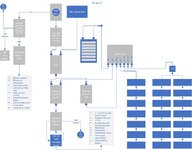
52257317021_656ed0501e_c.jpg
 

dcg9381

Well-known member
Joined
Jun 20, 2018
Messages
11,627
Location
Austin, TX
CO-OP boards have to look at the cost to the members as a whole. The CO-OP can't cover the costs of distribution if they pay retail rates for solar.


I'm taking the risk that net metering will be phased out before my system is paid for around the 10 year mark. Several states that have phased out net metering grandfathered in current solar users for up to 20 years, but other states just terminated net metering entirely.
The rate prior was "net metered". Wholesale rates for power buy back - that'd make "sense" to me, as that's what the utility pays and they can profit from the margin that is distributed by our (hey, it's a co-op) power network. Fraction of wholesale is just "we don't want solar".

The "insurance" program for dropping net metering is installing battery(s) and an inverter smart enough to discharge that power at night.
 

Jehannum

Well-known member
Joined
May 3, 2012
Messages
1,350
Location
Albuquerque, NM
I did the math back in 2016, and the installed price for the guaranteed power output from my SunPower system was $0.09/kwh. All-in (taxes included), my rates at the time were around $0.17/kwh. I'll likely do better than the 9 cents per kwh, because my guarantee was a very conservative number, and I've gotten far more out of it than that so far, judging by what the power monitoring software says.

So, I bought the solar system. I have one regret, that I didn't replace the roof at the same time, so I have to R&R it at the end of this month.

I'm on a net-metered plan, not a buyback plan, so I get a 1 for 1 credit for excess power produced - that is, the power company doesn't pay me for excess generation, but I can take out what I generate at a later time on a 1kwh for 1kwh basis.
 
Last edited:

DC73

Well-known member
Joined
Dec 27, 2014
Messages
1,627
Location
Lubbock TX
wholesale cost of power, what the coop buys at, is around 3 cents. Is that what they are paying for excess or less than that?

Less than. Fraction of wholesale (I don't remember the %). They pay something, but not much.
Basically our co-op board looked at the issues in CA and wanted to act preemptively to make sure we don't have "CA Problems".
1.7% of co-op members have solar.

The power industry uses something they call "avoided cost". That is - What cost do they avoid by receiving power from your solar installation? Their average wholesale cost or generation cost might be 3 cents but the incremental cost of producing the very next kWh might be much less than that. Once a power plant is running at, say for example, 75% of capacity, turning it up to 76% of capacity doesn't cost as much as the first 1%. Conversely, turning the power plant down from 76% to 75% of capacity when new solar power comes online doesn't save much more than just the cost of the fuel to provide the power. The fixed costs like infrastructure and labor still exist the same as before.

To pay any more than avoided cost for power received from solar installations means all the folks who don't have solar are helping to subsidize those who do. Another factor is that power producers must have power plants online and ready to respond the second solar installations reduce their output which can happen at a moments notice when a cloud blocks the sun from getting to the array. This could mean power plants are running that normally wouldn't be and that contributes to the calculation of avoided cost.

For what it's worth, the math doesn't work for me either. After factoring in the base charge for the net metering solar rate of the local Coop, my net savings are only about $40/month. Can't pay back much with those numbers.

Hopefully, solar panels will continue to get more efficient and less costly to the point that the math works without considering what the power company will pay for excess generation.

DC
 

My Old Tools

Well-known member
Joined
Jun 4, 2014
Messages
5,427
Location
Hamrick Lake, TX
Well, I'm in a home state where we hate anything green and the vast majority of our power comes from oil and gas. You know, the same industries that provide massive capital to political campaigns in the state who have authority in our power infrastructure. To be fair, oil and gas are a huge portion of our Texas' state economy, so I "get it" (politically speaking).

Then again, Tesla is here building cars (sorry, California). And more and more of Texas is becoming "tech" dependent in terms of economy.

But guess what? We still have brown-outs too. Oil and gas companies apparently didn't design or "winterize" in 2021 and the resulting lack of power - in some cases for more than a week - that got people killed. Lots of people blamed "green power" - they don't care to know that frozen natural gas valves don't work very well and that was the big problem. It's just complete misinformation and lack of public understanding.

I DO agree that there is currently a limit to how much "grid" can be "green" - because it can be unpredictable, but where I am, we are not anywhere near that limit.

Even in the summer, when demand goes "high" we have rolling brown-outs, just the same as California.

And look, I love a good American V8 (or Diesel I-6) just as much as everyone else on GJ, but when Rivian has a truck that will tow 10k lbs and beat my Corvette in the quarter mile, that technology has my attention. We produce enough solar power at home to power that EV "for free" with no additional load on the grid. It's creates a problem with road funding (as that's provided by taxes on fuel) - but I assume that can be sorted out.
Austin may have rolling brown outs, east Texas doesn't and I haven't heard of any in Dallas or Houston.
 

dcg9381

Well-known member
Joined
Jun 20, 2018
Messages
11,627
Location
Austin, TX
Austin may have rolling brown outs, east Texas doesn't and I haven't heard of any in Dallas or Houston.
Temps are down, so we're good for today (this week) - but if you monitor ERCOT, we got very close to having to trigger rolling black outs several times in the last 60 days. I assume when ERCOT can't provide capacity, it's going to impact more than central Texas.

ERCOT Monitoring
 
Last edited:

cannuck

Well-known member
Joined
Nov 30, 2021
Messages
4,595
Location
Rural SK
I work on the utility side with a mess of EE and EETs. IMHO the only way solar electric makes any sense is for completely off-grid (as some of our people do with great success). From what I can see, everything depends on the politics of your location and the ethics of your grid operator, neither of which I can trust or control.

For those reasons, I am thinking solar heat collection for space heating is a better bet because it gives me 100% control of the situation (even at our relatively Northerly location). Also looking at ground source cooling for shop and house (on farm, so lots of room to bury lines). Electricity here is extremely reliable and relatively cheap. If push came to shove I can always fire up a genset to carry over one of the exceedingly rare outages of more than a couple hours.
 

NakeDiesel

Well-known member
Joined
Sep 6, 2007
Messages
2,729
Location
oklahoma
I've been noticing a lot of flicking in our lights over this summer with PSO, remember boys and girls, you can't spell cheap without AEP. Power went out for about 10 seconds this morning. No heat wave or weather going on here at the moment, we seem to have finally gotten a break from the 100+ days we have had all summer.
 

dcg9381

Well-known member
Joined
Jun 20, 2018
Messages
11,627
Location
Austin, TX
close isn't a brown out
Actually, per ERCOT, "close" (to 0 reserves) is exactly what triggers rolling black outs as a safety valve. Seems to be reserves less than around ~1000 MW and is known as EEA3 - ERCOT sheds load. It was triggered at least once during the following years: 1989, 2011, 2019, 2021

If your point is that we haven't triggered a rolling brown out in 2022, that's a fair point. I monitor when we get warnings and I certainly would have bet otherwise for 2022.. Our reserves in the heat wave have gotten pretty tight.


I work on the utility side with a mess of EE and EETs. IMHO the only way solar electric makes any sense is for completely off-grid (as some of our people do with great success). From what I can see, everything depends on the politics of your location and the ethics of your grid operator, neither of which I can trust or control.

Curious why you think it doesn't make sense. It looks like about 22% of Texas' total grid power is solar/wind, that's a pretty decent mix.
If we can predict visibility conditions for pilots, why can't we use the same mechanisms to predict to a reasonable degree of accuracy when solar will be able to produce?

Where I do agree is there is a limit to how much we can depend on wind/solar for a state wide grid - I don't know where that point is, but I know other countries have found it.. And perhaps California!
 

u3b3rg33k

Well-known member
Joined
Dec 18, 2017
Messages
4,047
Here's a fun one:

Britain has seen huge jumps in electricity consumption during past football games, with highest ever spike of 2,800 megawatts - equivalent to 1.1 million kettles - recorded after England lost the 1990 World Cup semi-final penalty shootout against West Germany.
and it's a somewhat regular occurrence. large groups of people will "make tea" during commercials of BBC shows, etc. apparently they will have dispatchable pumped hydro on standby for these events.

note that no one is required to have a grid battery to "smooth out" their demand from making tea...
it's just expected that the grid operators will "deal with it"
 

cannuck

Well-known member
Joined
Nov 30, 2021
Messages
4,595
Location
Rural SK
I did a job down in Southern IA a couple of months ago. When it gets hot there, the only way they can meet demand, now that the nukes and coal have been shut down they have to rely on a bunch of small towns that still have their '20s technology old diesel generators and pay through the nose for power generated at diesel fuel rates.
 
To avoid these ads, REGISTER NOW!

NakeDiesel

Well-known member
Joined
Sep 6, 2007
Messages
2,729
Location
oklahoma
My first solar project here on the farm is to provide a solar solution to my water well. When I get my generator installed for the house, the well won't be on it. Eventually the house will have a sol-ark 15 or 2 on it with panels supplying it as well as a lifepo4 battery bank, but that's way further down the road.

I replaced the metal siding on the well and added trim and a new roof and removed the old batt insulation, 2 weekends ago. Installed a new 86 gallon pressure tank and new lines inside the well house this past weekend. I'm waiting on my closed cell foam kit to get here so I can insulate it.

Finally got my hobo data logger and current switch yesterday and put it on the well. It's been on there for 22 hours so far and has logged 9 minutes, 44 seconds of run time since install. Not much use in the next 2 hours, so that gives me a start baseline. I'll continue logging run times for the next 2 weeks to get a good summer average. Part of that usage is I irrigate my fruit and nut trees for 2 hours every evening, my wife's night bath in the garden tub, 2 load of dishes, etc... The irrigation won't be going on in winter so winter use will be dramatically reduced. Run time with the new 86 gallon pressure tank is 2 minutes 20 seconds from 30psi to 50psi.

So breaking down the math:

10.5 amps (running pump amps measured) * 240 volts = 2520 watts
2520 watts * .25 hours a day (rounded up to 15 minutes) = 630 watt/hours
630 watt/hours a day * 3 days backup = 1890 watt/hours
1890 watt/hours /48 vdc = 39.3 amp hours of storage needed
1890 watt/hours /24 vdc = 78.75 amp hours of storage needed.

2520 watts a day / 4 hours sun (think average is between 4.5 and 5 hours in my location) = 630 watts of panels needed minimum.
MPPT Charger size = 800 watts / 24 vdc =

I think my calculations are pretty spot on. Will collect run time data over the next 2 weeks to get an average.

But as of this info, plan is as follows:

1 - 4kw Aims 120/240 split phase inverter charger 24vdc
2 - 12v 100Ah lifepo4 batteries
1 - Aims 40 amp charge controller
800 or so watts of panels

plus wiring and disconnects, etc.

Any thoughts?

52286194061_53d0ed12ab_c.jpg

52302172834_a650fe2878_c.jpg

52304064149_f3361ab5f1_c.jpg
 
Last edited:

u3b3rg33k

Well-known member
Joined
Dec 18, 2017
Messages
4,047
oversize the panels if you can. that's only 2 400W class panels. size for a cloudy day if it's within budget.
 

Innovate1

Well-known member
Joined
Jul 28, 2014
Messages
4,279
Location
Illinois near St. Louis, Missouri
Interesting discussion... Here in Illinois only the two largest electric companies are required to do net metering and I am on a coop. They pay 3.7 cents per kilowatt for what I generate. The rules for connection seem to be that all I would generate would go through a separate meter so even if I am generating at the same time I am using my generation doesn't offset my use - I get 3.7 cents for everything I generate. I am thinking I will talk to a few of the installers but I don't see that as anywhere near a good economic decision - main reason to talk to them is see what other configurations they might suggest.

I think solar thermal often is better financially but it isn't promoted the way solar electric is. Not sure why other than it isn't the popular flavor of the day. We built with southern facing house with porch overhang all along the south side for summer shading so it's got a bit of "passive solar". We did good insulaton and air sealing and a conventional 90+ NG furnace and AC so our bills are low.

Would like to put in some small panels to run a few essentials when the grid goes down. Our grid is pretty reliable but have had a few long outages from storms and it will probably get worse. Only way to do that without doing the whole generate to the grid thing (which requires several inspections and has to be done by certified installers) is some sort of UPS like switching that can run loads from solar when it's available but not backfeed the grid. Batteries are the obvious storage solution but maintainance/replacement is a significant issue so maybe avoid those...
 

dcg9381

Well-known member
Joined
Jun 20, 2018
Messages
11,627
Location
Austin, TX
I think he's done that by calculating watt/hours. I agree with oversizing the panels.
he rules for connection seem to be that all I would generate would go through a separate meter so even if I am generating at the same time I am using my generation doesn't offset my use - I get 3.7 cents for everything I generate. I am thinking I will talk to a few of the installers but I don't see that as anywhere near a good economic decision - main reason to talk to them is see what other configurations they might suggest.

If you are using power at the same time you're generating, anything pushed back into the grid is "excess". So you're using the power you produce and that power "offsets" - it's reducing your bill at the rate you were charged for power. Let me know if that doesn't make sense.

The solution I've found to poor paybacks is to store the power and have a system that can "discharge" (for your use) during a time after the sun is down. It adds substantial cost, but the "payback rate" (it just drops your billed use).
 

Innovate1

Well-known member
Joined
Jul 28, 2014
Messages
4,279
Location
Illinois near St. Louis, Missouri
If you are using power at the same time you're generating, anything pushed back into the grid is "excess". So you're using the power you produce and that power "offsets" - it's reducing your bill at the rate you were charged for power. Let me know if that doesn't make sense.

The solution I've found to poor paybacks is to store the power and have a system that can "discharge" (for your use) during a time after the sun is down. It adds substantial cost, but the "payback rate" (it just drops your billed use).
I understand what you are saying but your explanation doesn't make sense at least not from what I have read from the utility. They put in a separate meter here for the solar generation. As I understand it ALL the solar goes through the second meter at the 3.7 cent rate and all the demand goes through the retail rate meter. So although the net from the utility is reduced the amount through the first, retail meter is not reduced by the solar. The coop has been great for most things but this looks like a really bad deal for solar.
 

dcg9381

Well-known member
Joined
Jun 20, 2018
Messages
11,627
Location
Austin, TX
Your solar array is not attached to the house load and just pushes to the solar meter? That would really **** and .037 per kWh, I can tell you that the economics of that are awful.
 

NakeDiesel

Well-known member
Joined
Sep 6, 2007
Messages
2,729
Location
oklahoma
I plan on over sizing the panels some. Been looking at batteries and trying to figure out how to handle the inrush amps needed to start the pump up. Most of the lifepo4 batteries I've looked at can't handle the startup amps needed. By my calcs that would be 455 amps on 24 volt system and 227.5 amps on a 48 volt system. I'm seeing AGM batteries are better able to handle surge watts so I may end up going with them. Still researching it.
 

Innovate1

Well-known member
Joined
Jul 28, 2014
Messages
4,279
Location
Illinois near St. Louis, Missouri
Your solar array is not attached to the house load and just pushes to the solar meter? That would really **** and .037 per kWh, I can tell you that the economics of that are awful.
That seems to be the case. Here is part of the email from them and an attachment in which the second example is of the solar providing the same Kwh as was consumed - I just used a photo of the second example. If you read this differently I would like to be wrong on this but I don't think so. They also note that it's a grid intertie system so will be unable to produce power when the grid is down and some requirements for $1,000,000 insurance policy, etc. One of the documents mentions a "bidirectional meter" and the email below mentions "dual register meter". The example bills show two lines with the same meter number but different usage numbers so apparently the meters are combined into one unit but I think largely independent. This is the second example of about 800 Kwh used and produced for a net bill of $100. It shows as negative only because there was a larger negative balance from the previous month (did they do that to make it look better? Good question...) The breakdown is shown.

Equal cogeneration example.PNG

Code:
1. The standard costs to install the meter, change the billing data, and perform the commissioning test are paid by the member. We will send an invoice for $500 to cover these fees as the project nears completion.

2. The inverter must comply with IEEE Standard 1547 and an Underwriters Laboratory (UL) 1741 listing is required.

3. Please submit a one-line diagram, including size in AC and DC, disconnect location from the meter (in ft), and location of signage for our engineering department to review and approve prior to installation. (This is usually supplied to us by solar installer.)

4. A lockable disconnect is to be provided in close proximity (within 10') of the revenue meter so we can disconnect the inverter, if necessary. The disconnect will need to be visible from the meter. The disconnect is required to have a visible open point – breaker type disconnects are not allowed. Disconnects are not allowed to be attached to SWECI transformer poles or meter poles. The disconnect should be labeled identifying it as an interconnected source of generation. If the panels are located on a building other than where our meter is located, labeling should also indicate where the disconnect is located.

5. The inverter is not to be interconnected to the utility until it has passed commissioning and a dual register meter has been installed.

6. Installation must comply with the requirements of the National Electric Code and the requirements of any other jurisdictional authority.

7. Southwestern Electric Cooperative, Inc. does not net meter. Compensation for generation flowing into the cooperative will be at our average avoided cost, which is currently 3.770ȼ per kWh. A dual register meter will record both the kWh purchased and the kWh generated onto our system – both registers are read at the beginning of the month and the kWh purchased are calculated at your current rate while the kWh generated onto our system are calculated at our avoided cost. If the dollar amount of credit is greater than the dollar amount of your energy charge, the difference will be put into your “cogen bank” to be applied in future months as needed. The bank resets on April 30th of each year. Any remaining balance will be cleared on this date.

8. Each account will pay the monthly Service Availability fee and distribution charges, regardless of the amount of kWh generated onto our system.
 

dcg9381

Well-known member
Joined
Jun 20, 2018
Messages
11,627
Location
Austin, TX
That seems to be the case.
I can't tell from the invoice. What I'd need to know is if the power from the array is connected to your main panel (there are other places it could be connected) or if it's solely connected to the solar meter. I'm leaning towards not connected to your home main as there are issues with two "main feeds" and NEC code, but I suppose it's possible by some means that I don't know about.
 

dcg9381

Well-known member
Joined
Jun 20, 2018
Messages
11,627
Location
Austin, TX
I plan on over sizing the panels some. Been looking at batteries and trying to figure out how to handle the inrush amps needed to start the pump up. Most of the lifepo4 batteries I've looked at can't handle the startup amps needed. By my calcs that would be 455 amps on 24 volt system and 227.5 amps on a 48 volt system. I'm seeing AGM batteries are better able to handle surge watts so I may end up going with them. Still researching it.

I've been watching your project. It takes a LOT of battery / inverter to power an RV air conditioner unit - the few rigs that I've seen that have this feature, the implementation was very expensive. The power required for a pump is probably in the same neighborhood.

I've done projects like this that power 12V things - gates, cameras, etc - because it's DC to DC, you can get away with a lot less. But even then, I had to account for odd weeks of 7 days or more with no or limited sun. I think powering a well 24/7/365 will be pretty expensive.

I do think you're thinking about it and planning for it the right way (didn't check the math).
 

NakeDiesel

Well-known member
Joined
Sep 6, 2007
Messages
2,729
Location
oklahoma
@dcg9381 there are inverters that blend solar/battery/grid. The inverter I'm looking at for the house eventually is the Sol-Ark 15, it can supply up to 65amps combined from DC Solar and Battery and has 200 amp pass through. It also has a lot of features on selling back to the grid if your interested in that as well or you can tell it not to at all. You can also prioritize where the power comes from I believe off the top of my head. It has 3 mppts built into it each supporting 6800 watts of DC solar and you can use it's gen input feed to supply another 19.5kw of AC solar through it or you can hook a 18kw generator to it. I plan to use an ATS with the generator hooked there and adding some AC solar at some point.

I figure the batteries are going to be close to the most expensive part of my well setup.
 

Innovate1

Well-known member
Joined
Jul 28, 2014
Messages
4,279
Location
Illinois near St. Louis, Missouri
I plan on over sizing the panels some. Been looking at batteries and trying to figure out how to handle the inrush amps needed to start the pump up. Most of the lifepo4 batteries I've looked at can't handle the startup amps needed. By my calcs that would be 455 amps on 24 volt system and 227.5 amps on a 48 volt system. I'm seeing AGM batteries are better able to handle surge watts so I may end up going with them. Still researching it.
Is it a single phase motor on the pump? You could greatly reduce startup inrush by using a 3 phase motor and inverter. Probably cheaper than sizing things for large inrush.
 

NakeDiesel

Well-known member
Joined
Sep 6, 2007
Messages
2,729
Location
oklahoma
It's a 2 year old single phase 240 volt 1hp pump and it's 150' down the hole. My wife and I had to pull the well during all the covid ****. I pulled it up and she tailed it.... was so much fun. If I replaced it, it would probably with a grundfus soft start pump.
 

Innovate1

Well-known member
Joined
Jul 28, 2014
Messages
4,279
Location
Illinois near St. Louis, Missouri
It's a 2 year old single phase 240 volt 1hp pump and it's 150' down the hole. My wife and I had to pull the well during all the covid ****. I pulled it up and she tailed it.... was so much fun. If I replaced it, it would probably with a grundfus soft start pump.
I helped my dad pull a deep jet (with double steel pipe) about that deep and put in a submersible many years ago so I know what a project that is. Understandable you don't want to do that again.
 

NakeDiesel

Well-known member
Joined
Sep 6, 2007
Messages
2,729
Location
oklahoma
When I pulled it, it had 20' joints of schedule 80 pvc in it, I replaced it with poly pipe. Much lighter and easier to handle.

Looking at what you posted above, it looks like your inverter won't be connected to your house at all, but to their return meter. Looks like a totally horrible way to do it. The way their bill works looking at it. You are billed for the energy used and refunded energy returned and then you are billed on distribution based on the same energy used, so you will pay full rate on distribution even in the amount you generated cancels out the amount you consumed.

I think you'd be better off creating a sub panel that is completely off grid with a battery backup not connected to the grid and power that panel off your solar setup. Would be more costly setting up, but you could put your critical loads on that panel and they would be covered in a power off situation. Leave your big power hungry loads on the grid connected panel like HVAC.
 

u3b3rg33k

Well-known member
Joined
Dec 18, 2017
Messages
4,047
I understand what you are saying but your explanation doesn't make sense at least not from what I have read from the utility. They put in a separate meter here for the solar generation. As I understand it ALL the solar goes through the second meter at the 3.7 cent rate and all the demand goes through the retail rate meter. So although the net from the utility is reduced the amount through the first, retail meter is not reduced by the solar. The coop has been great for most things but this looks like a really bad deal for solar.
When I pulled it, it had 20' joints of schedule 80 pvc in it, I replaced it with poly pipe. Much lighter and easier to handle.

Looking at what you posted above, it looks like your inverter won't be connected to your house at all, but to their return meter. Looks like a totally horrible way to do it. The way their bill works looking at it. You are billed for the energy used and refunded energy returned and then you are billed on distribution based on the same energy used, so you will pay full rate on distribution even in the amount you generated cancels out the amount you consumed.

I think you'd be better off creating a sub panel that is completely off grid with a battery backup not connected to the grid and power that panel off your solar setup. Would be more costly setting up, but you could put your critical loads on that panel and they would be covered in a power off situation. Leave your big power hungry loads on the grid connected panel like HVAC.
I think you're misunderstanding how the accounting is done.

mine is wired up the same way. house panel is fed from the house meter. solar goes directly into the solar meter. then they're tied together "before" the meters.

Whatever I generate and immediately use, is "netted out" from the bill. aka net metering.
The time buckets are what matter. I'm on TOU, so I have two time buckets. on-peak, and off peak.

So whatever I generate on-peak, for the month, is deleted from my bill. only if I generate more than I use does it get "sold" at the wholesale rate.

the other option is flat rate, one big bucket. that bucket is the length of the billing cycle.

the only way what you two are saying makes sense is if the 'owner' of the solar generation meter is not the same account as the house bill. then I could see that happening.
 

Innovate1

Well-known member
Joined
Jul 28, 2014
Messages
4,279
Location
Illinois near St. Louis, Missouri
I think you're misunderstanding how the accounting is done.

mine is wired up the same way. house panel is fed from the house meter. solar goes directly into the solar meter. then they're tied together "before" the meters.

Whatever I generate and immediately use, is "netted out" from the bill. aka net metering.
The time buckets are what matter. I'm on TOU, so I have two time buckets. on-peak, and off peak.

So whatever I generate on-peak, for the month, is deleted from my bill. only if I generate more than I use does it get "sold" at the wholesale rate.

the other option is flat rate, one big bucket. that bucket is the length of the billing cycle.

the only way what you two are saying makes sense is if the 'owner' of the solar generation meter is not the same account as the house bill. then I could see that happening.
Look at the sample provided by the coop I posted. It doesn't look like how you are describing it. BTW, we don't have any time of use rates - it's flat rate.
 
Last edited:

u3b3rg33k

Well-known member
Joined
Dec 18, 2017
Messages
4,047
That seems to be the case. Here is part of the email from them and an attachment in which the second example is of the solar providing the same Kwh as was consumed - I just used a photo of the second example. If you read this differently I would like to be wrong on this but I don't think so. They also note that it's a grid intertie system so will be unable to produce power when the grid is down and some requirements for $1,000,000 insurance policy, etc. One of the documents mentions a "bidirectional meter" and the email below mentions "dual register meter". The example bills show two lines with the same meter number but different usage numbers so apparently the meters are combined into one unit but I think largely independent. This is the second example of about 800 Kwh used and produced for a net bill of $100. It shows as negative only because there was a larger negative balance from the previous month (did they do that to make it look better? Good question...) The breakdown is shown.

Equal cogeneration example.PNG

Code:
1. The standard costs to install the meter, change the billing data, and perform the commissioning test are paid by the member. We will send an invoice for $500 to cover these fees as the project nears completion.

2. The inverter must comply with IEEE Standard 1547 and an Underwriters Laboratory (UL) 1741 listing is required.

3. Please submit a one-line diagram, including size in AC and DC, disconnect location from the meter (in ft), and location of signage for our engineering department to review and approve prior to installation. (This is usually supplied to us by solar installer.)

4. A lockable disconnect is to be provided in close proximity (within 10') of the revenue meter so we can disconnect the inverter, if necessary. The disconnect will need to be visible from the meter. The disconnect is required to have a visible open point – breaker type disconnects are not allowed. Disconnects are not allowed to be attached to SWECI transformer poles or meter poles. The disconnect should be labeled identifying it as an interconnected source of generation. If the panels are located on a building other than where our meter is located, labeling should also indicate where the disconnect is located.

5. The inverter is not to be interconnected to the utility until it has passed commissioning and a dual register meter has been installed.

6. Installation must comply with the requirements of the National Electric Code and the requirements of any other jurisdictional authority.

7. Southwestern Electric Cooperative, Inc. does not net meter. Compensation for generation flowing into the cooperative will be at our average avoided cost, which is currently 3.770ȼ per kWh. A dual register meter will record both the kWh purchased and the kWh generated onto our system – both registers are read at the beginning of the month and the kWh purchased are calculated at your current rate while the kWh generated onto our system are calculated at our avoided cost. If the dollar amount of credit is greater than the dollar amount of your energy charge, the difference will be put into your “cogen bank” to be applied in future months as needed. The bank resets on April 30th of each year. Any remaining balance will be cleared on this date.

8. Each account will pay the monthly Service Availability fee and distribution charges, regardless of the amount of kWh generated onto our system.
based on that you'd benefit more from a tesla powerwall or DC battery based system, where you can directly consume the solar (putting the solar "behind" your house meter, from an accounting perspective)
I've been watching your project. It takes a LOT of battery / inverter to power an RV air conditioner unit - the few rigs that I've seen that have this feature, the implementation was very expensive. The power required for a pump is probably in the same neighborhood.

I've done projects like this that power 12V things - gates, cameras, etc - because it's DC to DC, you can get away with a lot less. But even then, I had to account for odd weeks of 7 days or more with no or limited sun. I think powering a well 24/7/365 will be pretty expensive.

I do think you're thinking about it and planning for it the right way (didn't check the math).
a DOL compressor has much higher inrush than a centrifugal pump. yet another advantage of inverter equipment. your generator has to be sized for starting amps. with a DOL single phase motor, that's generally 5x FLA. with inverter equipment it's often 1x FLA. big savings on the generator/inverter/battery ampacity maths.

Is it a single phase motor on the pump? You could greatly reduce startup inrush by using a 3 phase motor and inverter. Probably cheaper than sizing things for large inrush.
you could shave a lot of inrush with a 3-5 second accel time with a VFD for sure. at 150' you'd want a line reactor/low pass filter on the VFD output to keep the insulation happy.
 

u3b3rg33k

Well-known member
Joined
Dec 18, 2017
Messages
4,047
here's an example of what net metering + TOU looks like. I did not overproduce on this system (I did on another).

it can be a bit confusing to look at, I suggest looking at the totals. I used about 2.8MWh, got billed for about 1.8MWh.

Screen Shot 2022-08-24 at 16.47.13.png
 

Innovate1

Well-known member
Joined
Jul 28, 2014
Messages
4,279
Location
Illinois near St. Louis, Missouri
based on that you'd benefit more from a tesla powerwall or DC battery based system, where you can directly consume the solar (putting the solar "behind" your house meter, from an accounting perspective)

a DOL compressor has much higher inrush than a centrifugal pump. yet another advantage of inverter equipment. your generator has to be sized for starting amps. with a DOL single phase motor, that's generally 5x FLA. with inverter equipment it's often 1x FLA. big savings on the generator/inverter/battery ampacity maths.


you could shave a lot of inrush with a 3-5 second accel time with a VFD for sure. at 150' you'd want a line reactor/low pass filter on the VFD output to keep the insulation happy.
I agree on the battery based system being better. And it can run without the utility which is a big plus in my book. And I wouldn't have to jump through nearly as many hoops for approval. Not sure about tax rebates - might still be able to do those but likely would require getting a certified installer which could eat up a lot of the rebate. Just guessing here.

Also agree on the low pass filter for long lines with the VFD.
 
To avoid these ads, REGISTER NOW!
Top Bottom