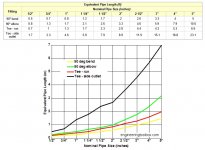
If I study enough I cam make some sense out of the charts and I elude to it some in one of these threads, some regarding fitting capacity or ratings. This chart refers to it in velocity I think, I might go back and look but,,,,,, while all of that does have some effect it is dependant on applied load. The losses would be greater with identical loads in 1/2 than in 3/4. For practical matters for guys on the forum who are loading a pipe,, or wire to 1/2 capacity then it's all moot, got a 3/4 feeding a 1/2 drop to 50 ft of 3/8 hose then the losses down the main is irrelevent. If we are engineering a complex machine running it all out then it's different.
Kind of like improved air filter on an engine, on a 600 hp race car means something at wot, put the same filter on a 4 cyl ant cruise speed not so much to gain at 1/2 throttle. We put a 20A breaker on a circuit and calculate v drop at 20,, then use it for a 7A grinder or 50 watt, or even 500 watt light, drop might be a consideration at full capacity but with a less tool doesn't matter or is irrelevent.
Guys are using 3/4 pipe here, worry about losses wouldn't be a concern with a 1/2 with the tools they are using. Doubly or so considering some of the short distance. Pex has some neat charts, one they publish for 100 ft but another for 60 which is close to most circuits than 100, quite a little difference under max velocity figures, really changes a leap when the load is reduced. A guy can really see this across voltage drop charts for 120v, at 20A starts adding up fast, at 5 is a different matter.


 "Minimalist Lifestyle"
 ...and come up with things that fit our own personal needs.