To avoid these ads, REGISTER NOW!

Solid Rivets 101

machine_punk

Well-known member
Joined
May 14, 2011
Messages
2,540
Location
Napa Valley, California
Introduction to Solid Rivets 101

I've had a lot of requests lately for information on using solid rivets. In fact, I've had people from other forums join Garage Journal, where I host my main thread, just to 'private message' me about solid rivets. There really isn't a single 'clearing house' of solid rivet information on the web for the hobby riveter out there, so I guess it is time to finally start writing the long-promised "Solid Rivets 101" post. If you follow me on any of the Internet forums, you know me as Machine_Punk. I work out of the attached, 2-car garage at my home, in an artistic metalworking studio I call The Aerodrome Studio.

The moniker Machine_Punk comes from the combination of two different terms: Machine Shop and Steam Punk. While I am a pretty fair woodworker, I have always loved working in metal. After far too many years as a nomad, traveling and living all over the world, I recently settled down to one place and am able to apply myself to working in metal. While I was living in England, I went over to the Contour Autocraft basic metalshaping 5-day course. I did learn to TIG weld shaped-steel panels together to form whatever size of panel needed, but I learned something even more important. I don't like pretty, flat joints on sheets of metal. I like rivets, and lots of them. While I did originally start my foray back into metal fabrication with machine shop principles, I began to get restless to learn what I really wanted to do...joining things with solid rivets.

There are three main artistic influences in my work. The first is Art Deco. Centered around Paris in the 1920's, and the rest of the world in the 1930's, it is characterized by bold geometric designs, with influences from many of the world's major cultures
, combined with Machine Age elements. The Chrysler Building, the beach-front buildings in Miami, and pretty much every classy movie theater you have ever been in are all excellent examples of the Art Deco style.

The second main influence for me are the Celtic symbols and knots. I haven't quite figured out how to apply that to my metalworking, yet, though I have made my own pen-and-paper-based contribution to Celtic symbols. I might have to share that with you some time.


The other major artistic influence for me is called Steam Punk. Do I hear you say you have never heard of it? Do a quick web search and you will find plenty of examples. I'd sum it up by saying that it takes modern modern conveniences, such as computers and telephones, and makes them appear to be steam powered contrivances of the Edwardian or Victorian eras--the 1800's. It was a time of steam power--with boilers and cogs and rivets (men, please feel free to insert a primal grunt here). There you go. Now you know why I took the name Machine_Punk. I suppose now you are wondering where The Aerodrome Studio got its name.

I spent a good month working on the name for the studio. I suppose I should start with the fact that it is a 'studio,' and not a 'workshop.' While I do work in there and a lot of metalworking happens there, I rarely ever build anything without considering appearance. Even if I am building a simple bracket, my goal is to build an artistic bracket out metal. The place where artists work is universally called a studio--whether that is a guitarist, recording the next hit song, or a painter, creating a masterpiece for future generations. That means part of the name is sorted. Whatever it is, it will definitely be a studio. I've still got the document of all the different ideas I thought of. I really wanted to use the word 'consortium,' but really, right now, it's just me. One person hardly makes a consortium. Hmmm. Strike that word.

Now, I know that I want to build aeroplane-like furniture eventually, once I get all my shop...errr studio...fixtures built. I also tend to like older stuff. Older versions of what we commonly call an airport in the United States were called aerodromes. In Europe, aerodrome is still a valid word for an airport, even though modern airports look nothing like their aerodrome predecessors. The original aerodrome was really just a large, grass field, with a flag in the middle. The early pilots used the flag to determine which way the wind was blowing, then just land whichever direction they needed to on the field. With the aeroplane reference, and the way the word 'aerodrome' flows off the tongue, I had found the name of my work space: The Aerodrome Studio. Of course, that means that now I cannot use the word 'air' in my threads...you will always see me replace it with the more European 'aero,' whenever possible. "Is it drafty in here? I feel some aer on the back of my neck." See, it doesn't always work!

The first few posts on this thread will be reference material--so you don't have to sift through the whole thread and comments to find 'that table with rivet sizes.' After that, I'll post the actual Solid Rivets 101 course, based on material and pictures I've been putting together for a while. Then, you'll have the chance to comment.

Machine_Punk
 
Last edited:
To avoid these ads, REGISTER NOW!
OP
M

machine_punk

Well-known member
Joined
May 14, 2011
Messages
2,540
Location
Napa Valley, California
Current Project Pictures

The Fantastic Light Bracket...

View media item 25181


View media item 25180


View media item 13067


View media item 13063


Which will eventually hold these Pelton & Crane dental lights, on the Reconfigurable Tool Rack...

View media item 12624


Dual Digital Still and Video Camera Bracket

View media item 11683
View media item 11684
View media item 11680
View media item 11687
View media item 11692


The Reconfigurable Tool Rack...

View media item 13995


View media item 14162

View media item 14164
A bracket, which fits in the Reconfigurable Tool Rack, to hold the rivet sets for my pneumatic rivet squeezers...

View media item 14310

View media item 15804
A 5X7 Picture Frame...

View media item 11335


View media item 11336

A new centerpiece for a new fan in the studio...
View media item 22549
A shelf for my iPod speaker system. It fits in the Reconfigurable Tool Rack...
View media item 23910

Lotsa rivet practice, before I ever got to a real 'project...'
View media item 11622


And finally, a few pics of The Aerodrome Studio...

View media item 20571


View media item 20570


View media item 20569

Kev
 
Last edited:
OP
M

machine_punk

Well-known member
Joined
May 14, 2011
Messages
2,540
Location
Napa Valley, California
Different Types of Rivets:

Blind Rivets: These are used when you must 'blind' set the rivet--when you do not have access to the back of the joint and you need to completely set the rivet from one side. These are made in numerous materials and sizes. While they all work on the same principle, there are different styles of blind rivet guns, including a pneumatic version.

View media item 25695
View media item 25689
View media item 25691
View media item 25690

View media item 25688
Cherry Rivets: A brand of blind rivet, which meets strict specifications for aerospace use. Often used in building aircraft, where you don't have access to back of the panel. These rivets meet stringent military standards for fasteners used in aerospace.
View media item 25692


Drive Rivets: There are a couple of different fasteners which are commonly called drive rivets.

-- The first is a complex little device with a pin sticking out of it. It is sort a cross between a rivet and a wall anchor. Plastic versions of these are used frequently to hold plastic panels on car interiors. Once the two pieces are in place, the pin is 'driven' in place and compresses the body of the rivet in the hole.
View media item 25694

-- The second one looks a lot like a regular solid rivet, but it has a twisty shank. This rivet is 'driven' into pre-drilled holes of both objects being joined. This is the classic 'square peg in a round hole' and works by deforming the round holes. This seems to be used frequently where the joint calls for a rivet, but the customer needs to install it. Say you wanted a customer to install an updated metal data plate to a piece of installed equipment. Rivets are the classic answer for that, but most customers don't have the tools to set solid rivets. Most customers do have a hammer, though and that is all a drive rivet needs.

View media item 25693

POP Rivets: A specific brand name of blind rivet.


Rivnuts: A specific style of blind rivet, which leaves a threaded hole when set. This gives you a reusable, captive 'nut' in the metal sheet. I don't have any experience with these, but they seem to use a special setting device, which has a threaded rod to hold the rivet.

View media item 25696
Solid Rivets: This is what we will be talking about in Solid Rivets 101. These rivets are solid, unlike blind rivets, and use very special tools to set them. The rivet comes with a pre-made 'factory' head on one end. In the process of setting these rivets, you make the 'shop' head. These come in as many sizes and materials as you can imagine...from the smallest copper rivet, hammered over a copper washer called a burr, to fasten two pieces of leather together; to the huge wrought iron rivets, which must be driven while hot, used to hold bridges and buildings together. We will mostly be talking about aerospace style rivets, since that is what I do. Most of this will apply to steel rivets you might want to use in a car too.
 
Last edited:
OP
M

machine_punk

Well-known member
Joined
May 14, 2011
Messages
2,540
Location
Napa Valley, California
Internet Resources:

Books, Manuals, Pamphlets, Flyers, Circulars, Articles, PDF's, and Notes Taken on the Back of Envelopes
:

-
Standard Aircraft Handbook for Mechanics and Technicians, by Larry Reithmaier. I have the Kindle version of this and I recommend it.

- FAA AC 43.13, Chapter 4 :repairs on metal-skinned aircraft.
http://www.airweb.faa.gov/Regulatory_and_Guidance_Library/rgAdvisoryCircular.nsf/0/99C827DB9BAAC81B86256B4500596C4E?OpenDocument

- Military Handbook 5H
http://snap.lbl.gov/pub/bscw.cgi/d87465/MIL-HDBK-5H%20Design%20with%20Metals.pdf


Videos, Moving-Picture Shows, Talkies, & Silent Movies:

EAA
is the Experimental Aircraft Association--the organization for folks who build their own aeroplanes. They have videos on using a lot of different materials for building aeroplanes. I think their videos on building with sheetmetal and rivets are some of the best I've seen online. This is a great place to begin:
- Hints for Homebuilders (the main directory for all of their technical videos).
http://www.eaavideo.org/channel.aspx?ch=ch_hints

- Videos on Building with Sheet Metal (you will find the videos on riveting nestled in here...along with a lot of great tips for fabricating your aluminum parts).
http://www.eaavideo.org/channel.aspx?ch=ch_hints_sheetmetal


The Ballard Forge is home of a modern blacksmith, Steve Howell, who does really large, architectural steel rivets. This isn't quite what we are going to learn to do here, but fills in the foggy edges of the riveting picture and shows you some of what inspires me. Check out all of the cool things on this guy's web site...don't just review his stuff on rivets:
- Ballard Forge page for Riveted Structural Steel.
http://ballardforge.com/web/rivets.html

- Hydraulic Hot Riveting: 3/4" (19mm) Rivets in Structural Steel

- One-Man Rivet Gang: 3/4" Hot Rivets With The 50-Ton press
http://www.youtube.com/watch?NR=1&v=Ncgq6OPmY4o&feature=endscreen

-Hydraulic Hot Riveting.


Machine_Punk builds aeroplane-like projects out of The Aerodrome Studio.

-2012 Cuesta College Metal Meet - with a few moments of Kevin, teaching solid rivets to a bunch of metal shapers.


Everything Else:


Jason Beaver is a homebuilder...a person who built his own plane a home, using a LOT of rivets--then spent a LOT of time documenting the build with pictures and commentary
. I have spent hours reviewing his build site pictures to see how it is really done.
http://www.jasonbeaver.com/rv7/2009/05/


Kent White
aka the Tin Man. I'm not sure there is anything this man hasn't done, when it comes to shaping metal...including repairing damage to aircraft with solid rivets.
https://www.tinmantech.com/

Big Flats Rivet Co deals with solid rivets for cars. For those of you who are here to figure out how to reinstall the solid rivets in your Ford Model A or Model T. This guy seems to be pretty knowledgeable.
http://www.bigflatsrivet.com/install.html


Contour Autocraft
does not, as far as I know, do much with rivets. They are, however, where I took my basic metalshaping course, learned to weld really smooth panels together for vintage Jaguars, and realized that no matter how good I got at autologous TIG welding--the truth is that I really prefer the look of a riveted panel. As a complete side note, they built the copper petals for the 2012 London Olympics.
http://www.contourautocraft.co.uk/


- - -

Kev
 
Last edited:
OP
M

machine_punk

Well-known member
Joined
May 14, 2011
Messages
2,540
Location
Napa Valley, California
Tools for Solid Rivets
(still working on this block - 11/6/12)

View media item 11337


View media item 11623


View media item 11624


View media item 11625


View media item 11618

View media item 14083
View media item 13418
View media item 13358

Supplies for Solid Rivets:

Suppliers I Use:
- Brown Aviation Tool Supply Company: This is my first choice for new and surplus tools and tooling, including drill bits. They are not always the cheapest, but they do usually have US-made options for things they sell.
http://www.browntool.com/Default.aspx?tabid=254

- Aircraft Spruce: This is where I buy all my aircraft-rated solid rivets. I also buy the occasional tool here, when Brown Tool doesn’t have what I am looking for (Brown Tool only supplies one size of rivet fan…I wanted both sizes, so I used Aircraft Spruce). They ship quickly!
http://www.aircraftspruce.com/categories/aircraft_parts/ap/menus/ha/rivets.html

c. eBay: I buy a lot of used tools on eBay. You really just have to know what you are shopping for, know what a good price is, and watch constantly for good deals. The rivet gun I like is definitely out there, the Cleco 4X.

- TM Technologies / Tin Man / Kent White: He sells the reconditioned Cleco 4X for a fair price (along with pretty much every other sheet metal tool). He sells the Cleco 4X for flow forming, but it is the same one I use for riveting and he has reconditioned them. This guy knows his stuff, when it comes to sheet metal.
https://www.tinmantech.com/

- Sheet and plate stock: I get my sheet, plate, and angle locally. You can try scrap yards and sheet metal shops for cutoffs, or try your local steel supplier for full sheets. Whatever you do, try NOT to use your local box store or hardware store. They are generally very expensive for any significant quantity of materials.

- Craig’s List: I don’t find much in the way of rivet-specific tools here, but I do search ‘materials’ for aluminum, copper, and other materials for building projects.


Non-Aircraft-Certified Rivets:
While I haven’t used a lot of non-aluminum rivets, here are a couple of sources I am going to try out for non-aircraft-rated rivets in pretty much any material you can imagine.
- Hanson Rivets:

http://www.hansonrivet.com/


- Jay-Cee Sales & Rivet, Inc:

http://www.rivetsinstock.com/


Other Aircraft Tool Suppliers: There are lotsa other aircraft tool suppliers out there. I have generally heard good things about these two, but I haven’t used them myself. Feel free to check them out:

- The Yard Store:

http://www.yardstore.com/


- Avery Tools:

http://www.averytools.com/

Kev
 
Last edited:
OP
M

machine_punk

Well-known member
Joined
May 14, 2011
Messages
2,540
Location
Napa Valley, California
Cool, Luvit! I wondered how long it would take for someone to see my noodling. Trying to get some spots reserved, so I can put stuff up front later on...and keep people from having to dig to get to 'that thing which I know is somewhere in the rivet post.'

I've got most of this written so far, in different places...just a matter of pulling it all together and grabbing photos from my GJ albums.

Kev
 

raskal

Well-known member
Joined
Aug 16, 2005
Messages
290
Location
British Columbia
I'm having a hard time even finding solid rivets,... every time I ask a store about rivets, they think pop rivets, I ask about solid rivets they have a blank look
 

luvit

Well-known member
Joined
Jul 11, 2011
Messages
1,580
i turned-down some solid rivets at a garage sale this summer...
they looked chromed or polished, but i didn't like them cause they were kinda threaded or corkscrewed i guess to "dig in" to the hole.

the small box of solid rivets i have are older than me. once i got around to studying it, i was considering to buy more. now i have this thread to watch.
.
 

Jbizzle

Well-known member
Joined
Oct 14, 2012
Messages
136
Location
New Mexico

racingtadpole

Well-known member
Joined
Dec 3, 2011
Messages
2,029
Location
The far side of crazy.. but sometimes Australia
To avoid these ads, REGISTER NOW!

luvit

Well-known member
Joined
Jul 11, 2011
Messages
1,580
i turned-down some solid rivets at a garage sale this summer...
they looked chromed or polished, but i didn't like them cause they were kinda threaded or corkscrewed i guess to "dig in" to the hole.

the small box of solid rivets i have are older than me. once i got around to studying it, i was considering to buy more. now i have this thread to watch.
.
ah, these are called "drive rivets" ..i c now from post #3 being updated
.. i regret not buying them (200 ct), but my wife was with me and everything i pick up at garage sales, she questions the necessity.
so i avoided the rivets and bought a push broom.

.
 

Kevin54

MEMBER EMERITUS
Joined
Jan 12, 2005
Messages
29,341
Location
Urbana, Ohio
i turned-down some solid rivets at a garage sale this summer...
they looked chromed or polished, but i didn't like them cause they were kinda threaded or corkscrewed i guess to "dig in" to the hole.

the small box of solid rivets i have are older than me. once i got around to studying it, i was considering to buy more. now i have this thread to watch.
.

The correct name is "Drive Screws". They are used to fasten labels or other sheetmetal onto, say for instance cast iron parts. You drill the proper size hole, then drive them in with a hammer or a hammer and punch.
 
OP
M

machine_punk

Well-known member
Joined
May 14, 2011
Messages
2,540
Location
Napa Valley, California
WOW! You guys have already taken off with this thread...you hardly need me here! I know that some of you guys do this for a living...if there are any glaring errors, please PM me, so I can take a look at the issue.

If anyone has any additional info, please feel free to post in the thread.


Please go back and take a look at the Reference Material sections at the beginning of the thread...a lot of them have been updated. I want to keep the main reference material near the front, so you would not have to dig through the teaching material and comments to find a reference.


I'll be posting the first section of actual Solid Rivets 101 material here in a few minutes...


Kev.
 
Last edited:
OP
M

machine_punk

Well-known member
Joined
May 14, 2011
Messages
2,540
Location
Napa Valley, California
Solid Rivet Terminology and How to Measure a Rivet:

Solid rivets are a way of permanently fastening two materials. They are used extensively in a couple of major industries: aeroplanes and over-the-road trucking. Solid rivets can be made in any number of materials, including aluminum, brass, copper, iconel, monel, stainless steel, & steel.

I wo
rk primarily with aerospace rivets, so that is where we will start. Since aeroplanes are a high-reliability item (people die if aeroplanes fall out of the sky, so they must be very reliable), they have some pretty strict guidelines on the manufacture of rivets for building aeroplanes. Rivets built to these standards have some very specific nomenclature: The 'AN' standard, which stands for Army Navy, and the 'MS' standard, which stands for Military Specification.

Solid rivets come from the
manufacturer with one head already formed, which is called the FACTORY HEAD. The head you form, when you set the rivet, is called the SHOP HEAD.
Rivets for aeroplanes usually have a couple of pieces of information stamped on the head: the rivet material and the manufacturer's mark. There are several different head shapes for aerospace rivets, but we will start by discussing just two of these.

The '470,' is a UNIVERSAL HEAD rivet (it can be driven with a specially-shaped rivet set OR with a flush rivet set--we will discuss that in depth later), and the '426,' which is a 100-degree countersink head.

Rivets are classified by the material from whichthe rivet is made. Here are a few common material codes:
A = Aluminum (1100 series)
AD = Hardened Aluminum (2117 T4 series)
C = Copper
F = Stainless Steel
M = Monel

Rivets are classified by the diameter of the shank, in 32nds of an inch. The four most common aviation rivet sizes are:
-3 = 3/32" (dash three)
-4 = 4/32" (dash four)
-5 = 5/32" (dash five)
-6 = 6/32" (dash six)

Rivets are also classified by their length, in 16ths of an inch. This is measured from different places, depending on the head style of the rivet [see diagram below]. The head of the universal head rivet is NOT included in the 'length,' because it sits above the material to be fastened. The head of the countersunk rivet IS included in the length, because it sits within the material, when set.

View media item 25800


Now, we have all the information we need to specif y a particular rivet for our project:

- Head style - material - shank diameter - length -

See below for some examples for you to
practice. I will go through the first one slowly, then you can look through the rest and figure them out on your own:

AN 470 A 3 - 12

AN = Army Navy Standard
470 = Universal Head
A = Aluminum (soft, 1100 series alloy)
-3 = 3/32" shank diameter
-12 = 12/16" long (3/4")

Or:
Army Navy Standard, Universal Head, Soft Aluminum, 3/32" diameter, 3/4" long solid rivet

View media item 25801
Stay tuned for more information on Solid Rivets...

Kev

 
Last edited:

NASTYZEN

Well-known member
Joined
Jun 11, 2010
Messages
2,823
Location
St-Colomban,Que. Canada
Have you any info on color coding for Alu. rivets?
I think there are 3 main colors for detecting hardness. soft, medium, hard.
Probably lots more to it but thats what I've mainly come across.
I riveted some tubs with purple ones of different shades not long ago.
 

racingtadpole

Well-known member
Joined
Dec 3, 2011
Messages
2,029
Location
The far side of crazy.. but sometimes Australia
Have you any info on color coding for Alu. rivets?
I think there are 3 main colors for detecting hardness. soft, medium, hard.
Probably lots more to it but thats what I've mainly come across.
I riveted some tubs with purple ones of different shades not long ago.

If Im not mistaken (and I may very well be) the purple ones are harder, which I assume (possibly incorrectly) to mean stronger
 
Last edited:
OP
M

machine_punk

Well-known member
Joined
May 14, 2011
Messages
2,540
Location
Napa Valley, California
NASTYZEN: I have not run across color coding for rivets. Hmmm...I wonder if that is a Canadian thing? I remember, from your thread, that you restoring a race car of some sort and the customer, or your inner drive to get it 'perfect,' required the use of purple rivets.

I do know that the rivets I use come with a golden anti-corrosion coating (with a very cool look...it has that golden flat color to it, similar to cast magnesium). It doesn't take much to wear this coating off and it very easy to remove, with any polishing at all.

You can see the anti-corrosion coloring on the rivets in these next 2 pictures...
View media item 11623
View media item 11622

I don't think that is the 'coloring' you are talking about, though. I wonder if the purple coloring was anodizing, which would lend it's own anti-corrosion effect? I am certainly open to hearing more about it, if anyone has any info!


KAMS2973: I am open to using any aerospace fasteners. The LOOK is what really draws me to rivets and the Hi Loks seem to have flat or countersunk heads, instead of the universal heads I gravitate towards. I'm not sure what the benefit of a Hi Lok would be, over regular rivets.

At the normal aircraft spacing, the rivets I am using are already WAY stronger than I need for my non-critical projects. In fact, I've been thinking of going to regular, 'non-certified' rivets for my projects. I don't know a lot
about hi-loks, other than they take different installation
and removal tools. If you know of a reason that hi-loks might be beneficial to my projects, I'd certainly like to hear about it. Here is some information I dug up on Hi Loks, for the edification of all...

An assortment of Hi Lok fasteners:

View media item 25821


A few Hi Lok fasteners, installed...

View media item 25822


A Hi Lok installation kit...

View media item 25823


The specifications for a Hi Lok fastener...

View media item 25824

The odd thing about this is that I've really only been doing this for a little over a year and a half (My first practice rivet sample is dated April of 2011). I am sure there are lotsa folks on this forum who are far more qualified to teach this...I just want to share a little bit of my passion with you guys.

For those of you who use the 'first unread post' function, please make sure you go back and look at the reference material at the beginning of this thread...I've been a busy beaver updating that stuff lately.


Kev
 
OP
M

machine_punk

Well-known member
Joined
May 14, 2011
Messages
2,540
Location
Napa Valley, California
Subscribed. I like nice work/art of about any genre. Keep posting.
Thanks! I even practical project to have a little bit of 'art' to them.
Subscribed!

Cool! I suspect you know a lot more about this than me.
Can't wait. Subscribed.

Great!
The appearance of this thread is rather timely. I have a project Im considering using countersunk solids for.

I shall be watching with interest.


I hope I can show you enough to get you going on your project.
I'm having a hard time even finding solid rivets,... every time I ask a store about rivets, they think pop rivets, I ask about solid rivets they have a blank look

You will not find solid rivets at a local store (unless you live near an airport and go to the aircraft tool supplier at the airport). You will have to order from specialty rivet shops. I have that list updated now...feel free to go back and check out the list of suppliers I use.
http://www.aircraftspruce.ca/menus/ha/rivets.html?UCOUNTRY=CAN

Aircraft supplier in Brantford (at the airport), I have not used them as a supplier (yet).

Good call on Aircraft Spruce! They are on my suppliers list and I use them often.
i turned-down some solid rivets at a garage sale this summer...

they looked chromed or polished, but i didn't like them cause they were kinda threaded or corkscrewed i guess to "dig in" to the hole.

the small box of solid rivets i have are older than me. once i got around to studying it, i was considering to buy more. now i have this thread to watch.

.

Someone else answers this too. What you found there is called a DRIVE RIVET or DRIVE SCREW. See the newly-updated "DIFFERENT TYPES OF RIVETS" post, in the reference section at the front of this thread.
Hey machine_punk, have you ever read or are you familiar with AC 43.13-1B? It is kind of an aviation mechanics bible of acceptable methods, techniques and practices for aircraft inspection and repair. I would suggest you start with chapter 4 section 4. Basic repairs and information for almost anything you could ever want to know about repairing an aircraft is in this manual.


Why yes, I have! I learned a LOT from that guide. Thanks for posting it. I'll get it into the reference section at the front of this thread.


I was one of the pestering pm'ers, in for info!

Cool! I hope this thread ends up answering your questions about solid rivets. Looking forward to seeing your solid rivet projects posted in Garage Journal.

Ive used these guys quite a bit. Competitive pricing, and easy to deal with (they mis-quoted freight once and emailed to tell me why there was a delay in shipping and they were prepared to wear it, to the tune of $38 or there abouts). No affiliation other than a happy customer.


I think this post is referring to Aircraft Spruce, which is one of my favorite places to buy aerospace rivets. They ship quickly! I live relatively close to the Southern California warehouse, so things get to me quickly.

---

Wow, guys! I am overwhelmed by the interest in this thread. I hope to meet your expectations.

Kev
 
OP
M

machine_punk

Well-known member
Joined
May 14, 2011
Messages
2,540
Location
Napa Valley, California
I've used there services a few times.
Top notch and professional all the way. Used to buy from Leavins Aviation out of Pearson, but they closed a while back.

I may have to add these suppliers to my list. If anyone has a supplier they have really had good service from, PM me, so I can add it to the suppliers list.

ah, these are called "drive rivets" ..i c now from post #3 being updated

.. i regret not buying them (200 ct), but my wife was with me and everything i pick up at garage sales, she questions the necessity.
so i avoided the rivets and bought a push broom.

.


Drive rivets do have their place...sorry to hear that you couldn't pick them up at the garage sale. The little bit of research I've done is that they are fantastic for attaching things like metal product tags to cast iron parts. They are also frequently used when a manufacture ships something to you which needs to be assembled, and the part should be riveted, but doesn't want you to have to have special equipment to put it together (drive rivets only require a drill and hammer).
..
View media item 25693
Really looking forward to this.

I'm looking forward to finally getting this written.

........Bookmarked into my "how to do stuff" file!


Glad to hear it! Thanks.

Cool! My only foray into solid rivets was assembling a 1919a4 -- and I could use some more practice!


OH...one of these. I'll bet that's a lot of fun to play with!
View media item 25825
The correct name is "Drive Screws". They are used to fasten labels or other sheetmetal onto, say for instance cast iron parts. You drill the proper size hole, then drive them in with a hammer or a hammer and punch.


Thanks for the info!

---

EveryOne: Thanks for taking the time to post! I have a lot of plans for this thread, but I also want to answer your burning questions about solid rivets, if I can.

Kev
 

mattygee

Well-known member
Joined
Apr 30, 2011
Messages
1,180
Location
MA USA
In most aircraft applications, you'll commonly see 4 rivet aluminum alloys, which are determined by head marking, not color.

A- plain head are 'A' rivets which are the softest type. These would be found in on-structural areas, like interior assemblies.

AD- which is 1 dimple. These are used in structural applications are installed 'uncooked'

D- raised dot. These fall between AD and DD in strength. Larger sizes need to be cooked for ease of driving.

DD- 2 raised dashes. Strongest aluminum rivet. These have to be heated to 900 degrees for an hour, quenched in water, then kept on dry ice to keep them soft enough to drive. Once they return to room temp they will reharden and are impossible to buck without cracking them.

I guess there is also an 'E' rivet out there now that has the strength of a 'DD' without the need for heat treatment. I've never used them.

Matt
 
Last edited:

luvit

Well-known member
Joined
Jul 11, 2011
Messages
1,580
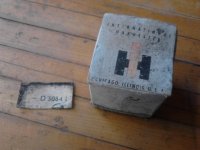
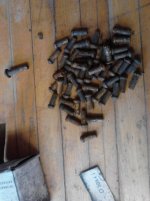
here are my rivets.. i only have 50... plus one bigger one. :(
IH riverts, though :) lol

.
 

Attachments

  • 1109120925.jpg
    1109120925.jpg
    124 KB · Views: 142
  • 1109120925a.jpg
    1109120925a.jpg
    127.7 KB · Views: 199

smithbd2

Active member
Joined
Dec 23, 2010
Messages
43
Location
TN
"here are my rivets.. i only have 50... plus one bigger one.
IH riverts, though lol"


I think those are for the blades on a sickle mower, but you may have already known that.
 
To avoid these ads, REGISTER NOW!
Top Bottom