To avoid these ads, REGISTER NOW!

Solid Rivets Teach me the way

grego

Well-known member
Joined
Apr 25, 2009
Messages
251
Location
Sac, CA
I purchased a lagre wooden box at a garage sale and inside it has a ton of regular rivets and all these different sized solid rivets.

What tools do you need to use these, is there a plier type tool or c clamp type? Do you just hit them with a drift and a hammer?

Any pictures or videos would be great.
 
To avoid these ads, REGISTER NOW!

ZRX61

Well-known member
Joined
Aug 15, 2006
Messages
28,716
Location
Solar Blight Valley, SoCal
Last time someone asked me to show em how it's done I knocked this out...

9-14-11005-1.jpg


9-14-11003-1.jpg


9-14-11004-1.jpg


9-14-11006-1.jpg
 

bradweingartner

Well-known member
Joined
Sep 30, 2009
Messages
149
Good video of the basic idea. Air Rivet hammer on one side (The side with the head) and a dolly on the back to flatten it out.


J.Lind

Well-known member
Joined
Sep 14, 2011
Messages
51
Location
Everett, WA, USA
Beautiful work, ZRX61.

First time I bucked a rivet it wasn't as hard as I expected, but definitely wasn't easy either. So simple to bounce the dolly and leave a mark, or the air hammer slips off.

Lots of fun, though. Considering I never did it to make money, I bet it gets real old real fast :D
 

mrb

Well-known member
Joined
Dec 31, 2008
Messages
3,734
I think you get the rivets red hot then use a jack hammer to put them in steel. At least that's what I've seen on the History Channel.

actually i think someone else gets the rivet red hot then he throws it at you
 

larry_g

Well-known member
Joined
Apr 28, 2007
Messages
16,858
Location
oregon
There are many types of rivets, materials, and intended uses. My use of rivets is to put sicyle sections on a cutter bar for the combine. These can be set with a screw clamp or piened over with a ball pien hammer against a backer on the head. So you may want to be a bit more specific on size and material of the rivets you have. Rivets are used in many different industries and how there set varies with the industry.

lg
no neat sig line
 

iron_worker

Well-known member
Joined
Mar 15, 2011
Messages
102
Why would you want to rivet a sickle to the cutter bar? Where I'm from a sickle change happens quite often and riveting it on ther just seems silly. Old design?

I was dealing with an almost new 8120 Case Combine. Great machine.

IW
 

Buckgnarly

Well-known member
Joined
Oct 8, 2010
Messages
7,648
Location
VT
Why would you want to rivet a sickle to the cutter bar? Where I'm from a sickle change happens quite often and riveting it on ther just seems silly. Old design?

I was dealing with an almost new 8120 Case Combine. Great machine.

IW

My BCS hand tractor uses rivets on the sickle bar.....which reminds me I have to replace a few this Fall...
 

diesel research

Well-known member
Joined
Sep 12, 2010
Messages
5,440
Location
gulf coast, TEXAS
We had a guy who would set rivets 1 handed with a snap on ph3050a air hammer. Needless to say he ended up with some kind of tendonitis or something. He is only about 5'4" so the amount of force to keep an automotive air hammer steady is pretty great.

His logic was a proper rivet setting hammer was more controllable, but slower. I think he didn't know they made rivet setters more powerful than 3x...
 

Milton Shaw

Well-known member
Joined
Feb 11, 2011
Messages
4,835
The Golden Gate bridge is put together with Rivets, the kind that were heated red hot, thrown, caught, put into holes, bucked and riveted. The hot rivets burned the paint on the beams and workers got lead poisoning from the fumes. They were using Red Lead Primer on the original bridge. Used air riveters are available on Ebay all the time look under aircraft tools. A lot of the rivets are countersunk so the head is not in the air stream creating drag on airplanes. They use a microstop cage to countersink the hole before they rivet (look on EBay for microstop to see what I am talking about, it's a very accurate countersink drill guide. Most of the iron, aluminum, metal work before WWII was riveted as welding was not in use much before WWII.
 

mrobins297aaa

Well-known member
Joined
Sep 20, 2010
Messages
3,283
Location
south east michigan
when I started in the sheetmetal trade in 1967 solid rivets or tinners rivets as we called them were on there way out in favor of pop rivets and drill screws. you used either a stake or if that was not possible you had some one on the other side bucking the rivets with a dolly block. And then you finished them off with a rivet set. The tool has a hole for drawing the rivet thru the metal and then a cup like dish that you set the rivet to get the nice round finish. each set has a number on it for the size rivet you are using.
see the attached pic's
 

Attachments

  • DSCN7099.jpg
    DSCN7099.jpg
    126.8 KB · Views: 164
  • DSCN7102.jpg
    DSCN7102.jpg
    135.9 KB · Views: 180

theoldwizard1

Well-known member
Joined
Feb 22, 2011
Messages
43,072
Location
SE MI
actually i think someone else gets the rivet red hot then he throws it at you

While we have all seen that in cartoons, it was REAL in the early part of the last century.

What I think is interesting is today the iron workers working on high rise buildings that are erecting the beams only put in a few bolts, hand tight. After the floor is complete, another crew comes in with come-a-longs and gets all the beams plumb, square and straight and then inserts the rest of the bolts and torques them to spec.
 

GirlnAgarage

Well-known member
Joined
Jan 21, 2011
Messages
4,668
Location
Texas
In my work I use copper rivets and washers. Use an anvil and a hammer to dome them and set them. Don't know much more than that.
 
To avoid these ads, REGISTER NOW!
OP
G

grego

Well-known member
Joined
Apr 25, 2009
Messages
251
Location
Sac, CA
Thank you all for the insight, ZRX61, that is beautiful work. I would love to get to a point where I could make gastanks and covers for my hotrods and shop equipment and have it turn out like that. I will start searching for the tools and get started. It seems that you need a lot of practice and patience get it to come out clean and leave no marks.
The mind is racing with projects.
I will take some pictures and measurements of the rivets I have so that we can narrow down the techniques.
Thanks again everyone.
 

ZRX61

Well-known member
Joined
Aug 15, 2006
Messages
28,716
Location
Solar Blight Valley, SoCal
That right there covers all kinds of aspects of putting something together. Cool!
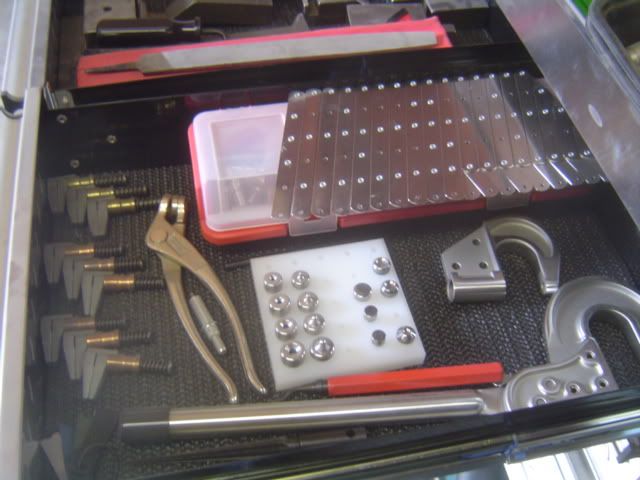
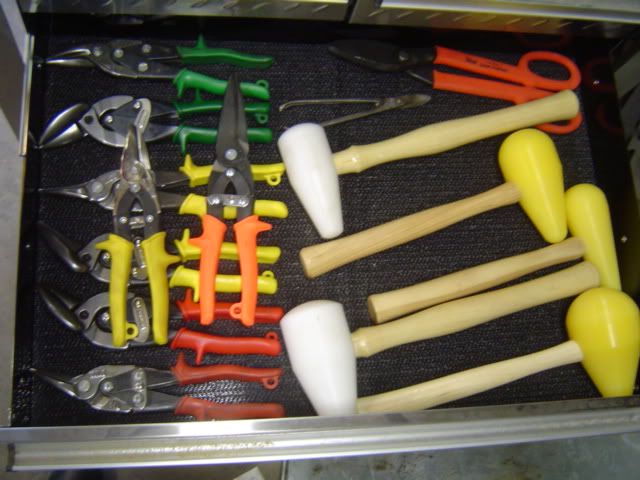
What about the tools you used to buck all of those? It would be nice to see.
Thank's.
I have pics of some of the stuff... don't seem to have a pic of my 3X gun tho. The sneaky part is what appears to be 4 pieces of 90deg angle on that display piece actually aren't 90deg at all & they also have different radius

2-19-11Tools003.jpg


2-19-11Tools004.jpg


Mallets002.jpg
 
Last edited:

theoldwizard1

Well-known member
Joined
Feb 22, 2011
Messages
43,072
Location
SE MI
Last time someone asked me to show em how it's done I knocked this out...

9-14-11003-1.jpg
First, the riveting and rest of the fab looks awesome !

I know nothing about aircraft design, but I have 2 questions, that may or may not be relevant if this is just an example piece.

This looks like part of a wing, so ...

  • Wouldn't the "open" seam at the top cause a lot of turbulence as the air traveled over it ?
  • On the overlapping seam on the bottom shouldn't the trailing piece be stepped in so the leading edge (curved) piece can mate flush with no bump ?
 

ZRX61

Well-known member
Joined
Aug 15, 2006
Messages
28,716
Location
Solar Blight Valley, SoCal
First, the riveting and rest of the fab looks awesome !

I know nothing about aircraft design, but I have 2 questions, that may or may not be relevant if this is just an example piece.

This looks like part of a wing, so ...

  • Wouldn't the "open" seam at the top cause a lot of turbulence as the air traveled over it ?
  • On the overlapping seam on the bottom shouldn't the trailing piece be stepped in so the leading edge (curved) piece can mate flush with no bump ?
Thanks :)
It was just a rough "this is how it's done" deal. The overlapping part of it was to show how to joggle the skin with a brake is all. It's actually quite small, it's only 12in wide & 4 or 5in tall. If it was going on an actual aircraft it would be better (& a lot bigger).
 

NASTYZEN

Well-known member
Joined
Jun 11, 2010
Messages
2,823
Location
St-Colomban,Que. Canada
Thanks ZRX61. I see that you need all kinds of bucking bars for all the nooks n crannies an airplane has...
Fortunately what I have to do is pretty accessible. My worries is that I will be using an air hammer for the job.Iv'e done one of these before and it turned out well. Just don't like the possibilities of leaving air hammer tracks on some thing I've spent so much time on as this.
Only about 25% of the riveting is solid the rest are pull type.

imgp6153.jpg


I got all the bits from the platers this week. I am almost ready to assemble three of these soon.
Do Aircraft assemblies use structural glue? I have used T-88 glue on all previous tubs. I would prefer a more urathany type bond. It seems the bond is not that good where it's oily or when the joint gets knocked around for a long time.
 

hunter1151

Well-known member
Joined
Jun 19, 2011
Messages
202
Location
Kansas
Thanks ZRX61. I see that you need all kinds of bucking bars for all the nooks n crannies an airplane has...
Fortunately what I have to do is pretty accessible. My worries is that I will be using an air hammer for the job.Iv'e done one of these before and it turned out well. Just don't like the possibilities of leaving air hammer tracks on some thing I've spent so much time on as this.
Only about 25% of the riveting is solid the rest are pull type.

imgp6153.jpg


I got all the bits from the platers this week. I am almost ready to assemble three of these soon.
Do Aircraft assemblies use structural glue? I have used T-88 glue on all previous tubs. I would prefer a more urathany type bond. It seems the bond is not that good where it's oily or when the joint gets knocked around for a long time.


Are you using 3003 or 5052 on that tub??
 

ZRX61

Well-known member
Joined
Aug 15, 2006
Messages
28,716
Location
Solar Blight Valley, SoCal
A lot of the smilies & dings left by rivet guns can be prevented just by sticking a bunch of rivets in the holes & then taping them in place with blue masking tape. They do actually sell a *special* tape for holding rivets in place, but 3M blue works just as well & costs a LOT less..

There's a 2x3ft panel that I bashed about 750 ****** rivets into for a instructor at a local college so she could then have it painted up with WWII looking nose art. I should go get a photo of that sometime...It was just a rush/freebie job so I didn't even bother to put any shape into the panel (which I think was about .090 thick). Seem to recal several different sizes of both AN470 & AN426's.

AC43-13 has all ya need to know to get started with rivet bashing. It's a DOT/FAA publication
 

ZRX61

Well-known member
Joined
Aug 15, 2006
Messages
28,716
Location
Solar Blight Valley, SoCal
First time I bucked a rivet it wasn't as hard as I expected, but definitely wasn't easy either. So simple to bounce the dolly and leave a mark, or the air hammer slips off.

Lots of fun, though. Considering I never did it to make money, I bet it gets real old real fast :D

Worse was bashing 1/4in(?) steel rivets into Browning M2 side plates on the receivers. That got old REAL fast. Only rebuilt a few of those (less than 30), but that few was WAY more than enough. :mad:
 

hunter1151

Well-known member
Joined
Jun 19, 2011
Messages
202
Location
Kansas
Here is one........military aircraft rib. Will be using DD rivets, they are shipped as heat treated rivets 2024-T4, they must be sent back to heat treat before installation, and put in the AQ condition, kept in a freezer at -10F, taken out of freezer and squeezed and left to assume room temperature, which takes it back up to T-4. What a pain in the azz...........

All parts were made in house, shrunk the angle and T-extrusion to curve, sent the T out for joggle, made the form block for the "former" at the nose, and hydro-formed with 2400 ton hydro press. And people wonder why airplanes cost so much.
 

Attachments

  • IMAG0167.jpg
    IMAG0167.jpg
    140.9 KB · Views: 109
  • IMAG0168.jpg
    IMAG0168.jpg
    142 KB · Views: 100
  • IMAG0169.jpg
    IMAG0169.jpg
    147.6 KB · Views: 102
  • IMAG0170.jpg
    IMAG0170.jpg
    142.7 KB · Views: 81
  • IMAG0174.jpg
    IMAG0174.jpg
    140.8 KB · Views: 97
  • IMAG0175.jpg
    IMAG0175.jpg
    145.7 KB · Views: 77

gymbo39

Well-known member
Joined
Dec 27, 2009
Messages
153
Location
So Calif
with all the posts here i thought someone may have told the story. whether squeezing with a rivet squeezer or shooting the rivet with a rivet gun and using a bucking bar, the proper way is to expand the rivet one and one half times the diameter of the rivet shaft with one and one half the diameter protruding through the rivet hot hole. typically rivets have to be trimmed to the desired length prior to setting the rivet.
 

hunter1151

Well-known member
Joined
Jun 19, 2011
Messages
202
Location
Kansas
with all the posts here i thought someone may have told the story. whether squeezing with a rivet squeezer or shooting the rivet with a rivet gun and using a bucking bar, the proper way is to expand the rivet one and one half times the diameter of the rivet shaft with one and one half the diameter protruding through the rivet hot hole. typically rivets have to be trimmed to the desired length prior to setting the rivet.

Yes what you say is true, but we are held to **** spec standards that are different with each aircraft company...........They list the heighth and the diameter of the ****.
 

ZTFab

Well-known member
Joined
Jan 6, 2008
Messages
397
Location
Upland, CA
Here is one........military aircraft rib. Will be using DD rivets, they are shipped as heat treated rivets 2024-T4, they must be sent back to heat treat before installation, and put in the AQ condition, kept in a freezer at -10F, taken out of freezer and squeezed and left to assume room temperature, which takes it back up to T-4. What a pain in the azz...........

All parts were made in house, shrunk the angle and T-extrusion to curve, sent the T out for joggle, made the form block for the "former" at the nose, and hydro-formed with 2400 ton hydro press. And people wonder why airplanes cost so much.

Wow hunter....nice work! :beer:

Is the rib 2024 as well or maybe a 6000 series? 6013?
 

NASTYZEN

Well-known member
Joined
Jun 11, 2010
Messages
2,823
Location
St-Colomban,Que. Canada
Aircraft parts always amaze me in there complexity. That's very nice work you do Hunter.:thumbup:

Time for riveting! Ive gathered all I'm gonna get, so here goes nothing.
No squeeze gun just my crappo air hammer.

imgp6430v.jpg
 
To avoid these ads, REGISTER NOW!
Top Bottom