To avoid these ads, REGISTER NOW!

Some cool Tekton updates

AJHD

Well-known member
Joined
Jan 4, 2020
Messages
3,005
Location
AZ
So I looked at our inventory program and it looks like only select stores in our region got them. 5 of 14 stores in our district got them. The website says that they are temporarily unavailable at our store but they are on that power panel.

Interesting. Looks like a test, see if and how well they sell.

Speaking of which, I probably won't buy any of it. But I'd like to check them out in person. I don't shop at TSC, but I will stop by while I'm out and if the store is near by.
 
To avoid these ads, REGISTER NOW!

Firebrick43

Well-known member
Joined
May 12, 2015
Messages
13,971
Location
West central Indiana
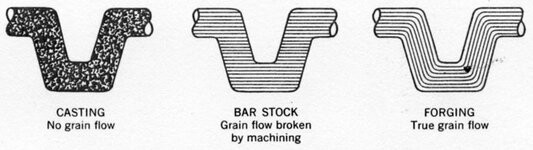
Generally not the case because the forging die will cause the grain to flow in a direction favorable to the stress loading.
1745787602072.jpeg


The cost of forging tooling is precisely why “billet” parts are often used for prototypes and custom pieces. But it’s not because forging is inferior in a metallurgical sense. It’s because it’s inferior in an economic sense. Yes, it takes a LOT of time to cut and grind something like a crankshaft from a solid log of 4340. But even those hours of machine time are still cheaper than a custom forging tool that will only be used a couple times. In order for a forging tool to be cost effective, you have to be able to run a lot of parts to amortize the tooling cost.
Yes, for lower performance steel in mass production the grain flow helps. , Again, cheaper steel it is used, its done for cost. Its cost effective and pretty good strength to cost ratio

But for many chromemolys if properly heat treated the grain flow advantages are lost and exceeded by the heat treatment itself.

Some performance companies have the forging dies for their performance line of cranks, yet their upper line for higher HP is billet. Even though they have the forging dies and presses at their disposal, their strongest products they choose not to use it.

https://maxtorqueperformance.com/in...s-billet-callies-explains-crankshaft-choices/
 
Last edited:

Steve_P

Well-known member
Joined
Sep 15, 2010
Messages
5,181
It does. Heat treatment is not a replacement for forging. If it was, nothing would ever be forged (it’s too expensive for tooling).

Heat treat affects microstructure, but not the same way.

At high quantities, forging is a cost savings vs machining a bar; this is why it's primarily used in manufacturing- cost savings.

And I've never seen a true apples-to-apples statistical comparison that actually proves the theoretical strength benefits of forging. But again, at quantity it can be >50% cheaper to forge somthing due to less machining time.
Generally not the case because the forging die will cause the grain to flow in a direction favorable to the stress loading.
1745787602072.jpeg


The cost of forging tooling is precisely why “billet” parts are often used for prototypes and custom pieces. But it’s not because forging is inferior in a metallurgical sense. It’s because it’s inferior in an economic sense. Yes, it takes a LOT of time to cut and grind something like a crankshaft from a solid log of 4340. But even those hours of machine time are still cheaper than a custom forging tool that will only be used a couple times. In order for a forging tool to be cost effective, you have to be able to run a lot of parts to amortize the tooling cost.


Ok, but like I said on page one, where's the real statistical analysis test data to support that forging has strength benefits vs solely machined steel bar in an apples-to-apples comparison in something like a hand tool? Again, I feel that forging has to have some slight strength or fatigue advantage; but I've never seen it in a study. And forging has been used in modern industry for 100+ years where we've had the ability to prove that it has some advantages besides cost savings at high production volumes.

So, where is the data?
 

Hohn

Well-known member
Joined
Aug 25, 2016
Messages
2,613
Location
Diesel Central, Indiana
Yes, for lower performance steel in mass production the grain flow helps. , Again, cheaper steel it is used, its done for cost. Its cost effective and pretty good strength to cost ratio
No. For EVERY steel grade, the grain flow helps because it is a fundamental quality of the material. Grain flow in steel is not much different than grain flow in wood. I presume most people know how important grain orientation is to wood’s mechanical properties.

But for many chromemolys if properly heat treated the grain flow advantages are lost and exceeded by the heat treatment itself.

Some performance companies have the forging dies for their performance line of cranks, yet their upper line for higher HP is billet. Even though they have the forging dies and presses at their disposal, their strongest products they choose not to use it.

https://maxtorqueperformance.com/in...s-billet-callies-explains-crankshaft-choices/
Consider the case of a Carillo rod:
1745831455031.png

They are forged. And every part of that rod is machined. There is ZERO cost savings to forging this rods vs just hogging it from plate. Now if forging was only to save machining time, why would the incur the cost of machining the entire thing AND forging? Why not just water jet the rod from plate? Why aren’t high end connecting rods “billet”?

Not only does grain flow make a forging stronger than a simple machine from stock, but the *kind* for forging even varies in strength due to grain flow.

1745832009302.png


There are lots of reasons to prefer a “billet” part vs a forging. Mostly it has to do with the fact that the tiny fatigue life advantage of a forging isn’t worth the high tooling cost for a low volume racing application, and might be possible to overcome just by making the part beefier than a forged counterpart. Especially if the product is something like a high end crankshaft where every surface will get machined. OEM forgings only get the functional surfaces machined.

In the lab, the forged part will test as having a higher fatigue life if the geometry and material are identical with the billet counterpart. Grain flow matters and its real and not something that just goes away with heat treat.

However, just because the forging *process* is produces stronger metallurgy doesn’t mean a forged *part* is necessarily stronger because there are always design details that matter and can cause one to be strong than the other depending on how those details are addressed.
 
Last edited:
To avoid these ads, REGISTER NOW!

Etchase

Well-known member
Joined
Nov 10, 2017
Messages
1,957
Location
Hawaii
Fatigue strength is important in reciprocating engine parts and artificial joints, but I don’t see its relevance in hand tools. The cost advantages of forging in manufacturing are enormous. They even get the dies right on the first iteration sometimes these days. The modeling is impressive to me.
 

four.cycle

Well-known member
Joined
Oct 19, 2015
Messages
28,429
Location
Tacoma, Washington
Tekton DBA93100 bit set.jpg

-------- Original Message --------

Subject:​
DBA93100 is now in stock!
Date:​
2025-05-07 11:35 am
From:​
Tekton <[email protected]>
To:​


The item you requested is now available​

4 mm Precision Bit Set with Driver and Case (97-Piece)
#DBA93100 • $50
Buy Now
On April 28, 2025, you requested to be notified when the 4 mm Precision Bit Set with Driver and Case (97-Piece), item #DBA93100, was in stock. That item is now available on a first-come, first-served basis and quantities may be limited. We're sending this notification to 84 customers.
You can shop this item at https://www.tekton.com/4-mm-shank-bit-driver-and-bit-set-with-case-97-piece-dba93100.
 
To avoid these ads, REGISTER NOW!
Top Bottom