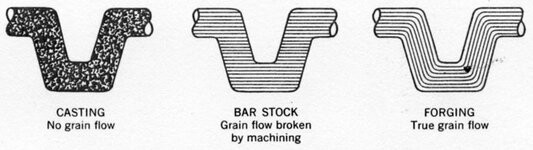
Yes, for lower performance steel in mass production the grain flow helps. , Again, cheaper steel it is used, its done for cost. Its cost effective and pretty good strength to cost ratio
No. For EVERY steel grade, the grain flow helps because it is a fundamental quality of the material. Grain flow in steel is not much different than grain flow in wood. I presume most people know how important grain orientation is to wood’s mechanical properties.
But for many chromemolys if properly heat treated the grain flow advantages are lost and exceeded by the heat treatment itself.
Some performance companies have the forging dies for their performance line of cranks, yet their upper line for higher HP is billet. Even though they have the forging dies and presses at their disposal, their strongest products they choose not to use it.
https://maxtorqueperformance.com/in...s-billet-callies-explains-crankshaft-choices/
Consider the case of a Carillo rod:

They are forged. And every part of that rod is machined. There is ZERO cost savings to forging this rods vs just hogging it from plate. Now if forging was only to save machining time, why would the incur the cost of machining the entire thing AND forging? Why not just water jet the rod from plate? Why aren’t high end connecting rods “billet”?
Not only does grain flow make a forging stronger than a simple machine from stock, but the *kind* for forging even varies in strength due to grain flow.

There are lots of reasons to prefer a “billet” part vs a forging. Mostly it has to do with the fact that the tiny fatigue life advantage of a forging isn’t worth the high tooling cost for a low volume racing application, and might be possible to overcome just by making the part beefier than a forged counterpart. Especially if the product is something like a high end crankshaft where every surface will get machined. OEM forgings only get the functional surfaces machined.
In the lab, the forged part will test as having a higher fatigue life if the geometry and material are identical with the billet counterpart. Grain flow matters and its real and not something that just goes away with heat treat.
However, just because the forging *process* is produces stronger metallurgy doesn’t mean a forged *part* is necessarily stronger because there are always design details that matter and can cause one to be strong than the other depending on how those details are addressed.