four.cycle
Well-known member
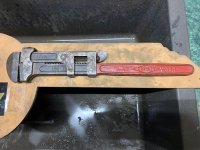
^ Yes. One of the advantages of Evaporust is that it does not remove the paint from steel surfaces.

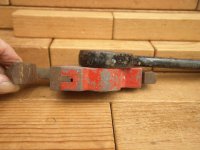
Aren't you the arteest?What paints would have iron oxide pigments

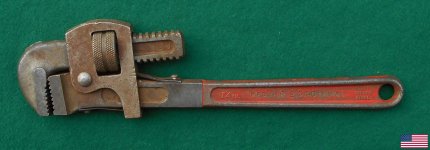

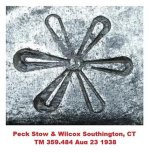

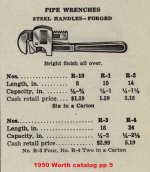

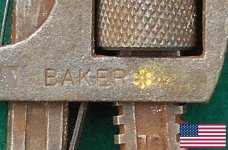

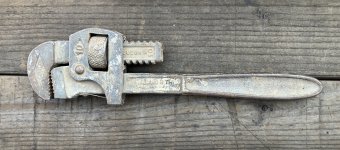
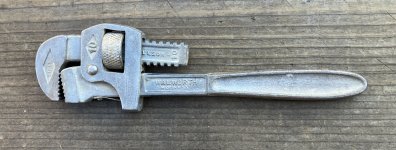
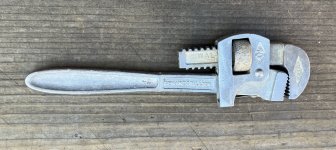
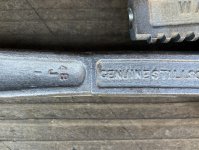
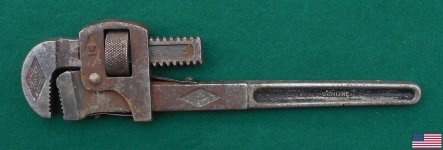
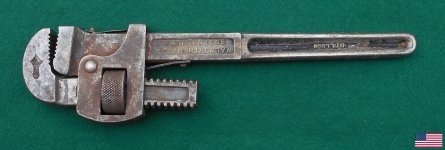
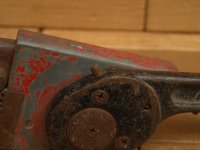
I wasn't aware they had date codes. I'll have to look at those two I've acquired recently.The body of the wrench is dated 1948 and the jaw 1942.
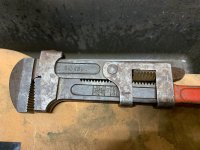
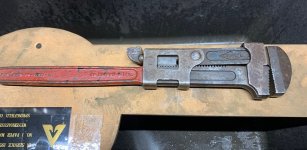
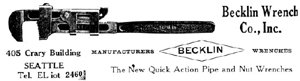
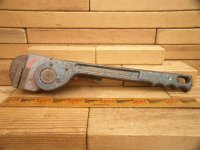
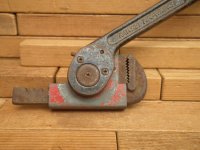
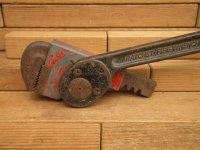
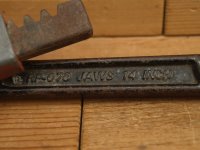
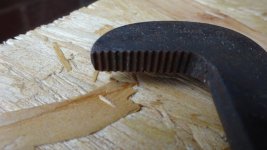
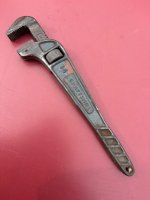
Nice one! I had fun playing around with a couple of those last year at the Flywheelers swap. May have been the first I've run into as well. Really cool design how the teeth mesh together. Unfortunately the wrench prices did not align with reality.Here a pipe wrench I plucked out of a Habi tat store yesterday. It was in a pile with several other pipe wrenches all priced the same. I couldn't find a Becklin, made in Seattle, in this thread and this may be the first one I've ever seen. I'm not sure this method of securing the jaw has many advantages over the usual nut but it is interesting. The size marking on the beam do help to line things up for thread engagement. A few pics of a 14" Becklin with a 1920 patent date. Ed.

I saw your post on the wrench's you saw at Flywheelers while searching this site for Becklin. It was a short list of posts and I think yours was the only one with an actual pipe wrench picture. I'm a sucker for unique adjusting methods on most any wrench...as long as they aren't ridiculously overpriced that is.Nice one! I had fun playing around with a couple of those last year at the Flywheelers swap. May have been the first I've run into as well. Really cool design how the teeth mesh together. Unfortunately the wrench prices did not align with reality.
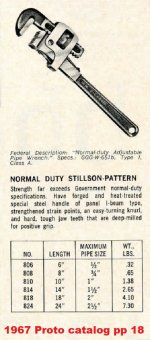
I did not find any.Don’t be surprised if you don’t find any date codes. Many of the Walworth Stillson pipe wrenches don’t have them.

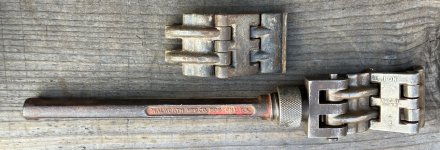

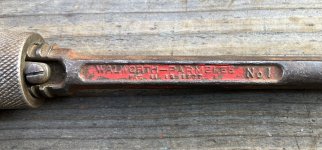

The "Parmalee" wraps around the full outer circumfrence of the pipe and grabs it all the way around - same as if you grabbed it with your hand - and was designed so that soft alloy tubing wasn't crushed or distorted when serviced or installed.So explain that tool. The jaw wraps around the pipe, and only works for a 1” pipe, and the knurled nut secures the jaws. Then what?
The original Parmelee patent (1888) and wrench (my example of one is linked upthread here) didn't have the threaded nut, it used a cam and constant manual pressure. Homer Parmelee (and eventually his son, Roy) kept tinkering with different mechanisms to secure the grip in three subsequent patents (1897, 1900, and 1907 - @3baygarage 's example of this type linked upthread here), well before Walworth assumed production in 1914. I don't recall if I ever tracked down the patent, if there was one, for the later production Walworth-Parmelee variants with the threaded nut. They have the 1907 patent date on them, but the 1907 patent is not a nut....and the knurled nut secures the jaws.
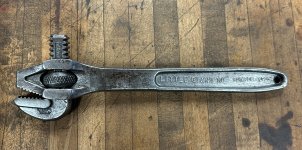
Interesting that the dynamic head can be reversed. Not sure i understand why.Little Giant 10” pipe wrench (patent date Feb. 4, 1913 in handle). Marked with “GTD" logo for Greenfield Tap & Die Co. Mine still has some specks of orange paint in the handle too.
Metric on one side, SAE on the other side.Interesting that the dynamic head can be reversed. Not sure i understand why.
Of course. And i guess that’s the origin of the left handed monkey wrench.Metric on one side, SAE on the other side.


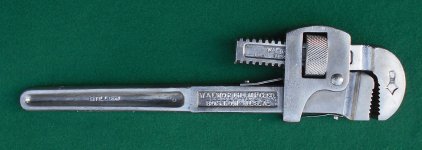


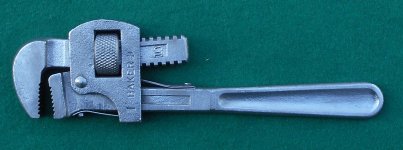
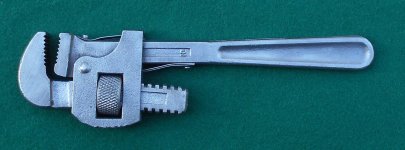
Nice find, Fred. If you're unfamiliar with these, note that the longer variants are actually 4 Ways! More information in my reply to Otg2 below.Little Giant 10” pipe wrench (patent date Feb. 4, 1913 in handle). Marked with “GTD" logo for Greenfield Tap & Die Co. Mine still has some specks of orange paint in the handle too.
If you're scratching your head thinking that simply flipping the wrench over to the other side would result in the same exact configuration as going through the seemingly squirrely trouble of pulling the dynamic jaw out and installing it in the other direction, you are correct, of course, and you wouldn't be the first to question the mirror logic.Not sure I understand why.
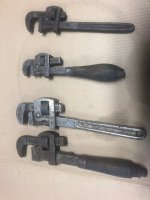
Where have I heard that before??too odd to leave behind
Where have I heard that before??
Seems like a solution seeking a problem.
I’m more novice than knowledgeable ‘bout Pipe Wrenches in general.Great minds!
I’m more novice than knowledgeable ‘bout Pipe Wrenches in general.
Pretty sure you know you know a bunch, so . . . is it possible this Wrench would have a practical application?
My fun find at yesterday morning’s estate sale was this Footprint brand wrench/pliers tool.Very similar to Olli's, this "Blitz" wrench has an old D.R.G.M. number of 29923 stamped on it. This pattern of wrench/pliers was made by more than one company. Figuring out who that patent was issued to might offer a clue as to who was making these early on (other than Ellin/Footprint.)
I don't recognize that herald mark on Olli's specimen. Wondering if maybe Wolfgang's site might offer a clue on that.
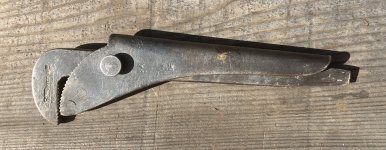

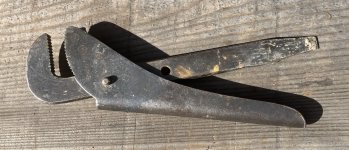


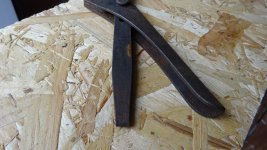
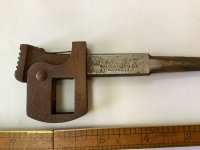

Would evaporust be the right process?