To avoid these ads, REGISTER NOW!

Splicing 1/0 wire?

gmtech

Well-known member
Joined
May 22, 2018
Messages
85
Location
nc
Planning electrical service for my garage that I'm currently building. Planning to run 1/0-1/0-1/0-4 Aluminum MHF fed from my main panel inside house. Total run is about 150'. About 10' of that will be inside my house, so obviously I cant run the MHF inside. Is it possible to transition from the MHF to SER inside a 2'' LB? Will it physically fit? Split bolts? Polaris connectors?

Other option I have considered is a dual lug meter base so I don't have to enter the house at all, but Im having trouble locating a 200 amp base with an extra set of lugs?
 
To avoid these ads, REGISTER NOW!

PCustoms

Well-known member
Joined
Jul 23, 2011
Messages
23,074
Location
VT
Why can't you run MHF inside in condiut?

And no, splices won't fit inside the LB.
 
OP
G

gmtech

Well-known member
Joined
May 22, 2018
Messages
85
Location
nc
I can do the conduit, it will just be a hard transition and hard to pull the wires, or so it would seem. No first hand experience doing so. Im dealing with a crawl space (No basement) so while that may be what I have to do, was trying to avoid it.
 

Norcal

Well-known member
Joined
Mar 16, 2008
Messages
13,761
It's also not code compliant to splice in a conduit body.

It is if marked with the cubic inch capacity of it, but 1/0 would not be feasible to splice in a LB anyway you look at it.
 
OP
G

gmtech

Well-known member
Joined
May 22, 2018
Messages
85
Location
nc
MHF doesn't come in 1/0. Sizes are 2, 2/0, 4/0. If using conduit for the underground run use 1/0 xhhw-2.

You are correct. Bare with me as I'm trying to wrap my head around all of this. The stuff I was referring to that I plan to use is 1/0-1/0-1/0-2 aluminum URD quadruplex placed in 2'' conduit.
 

PCustoms

Well-known member
Joined
Jul 23, 2011
Messages
23,074
Location
VT
You are correct. Bare with me as I'm trying to wrap my head around all of this. The stuff I was referring to that I plan to use is 1/0-1/0-1/0-2 aluminum URD quadruplex placed in 2'' conduit.

That cannot go into the house. Out a big junction outside and splice to SER.
 

alfredeneuman

Well-known member
Joined
Mar 3, 2011
Messages
4,581
Location
Fullerton, CA
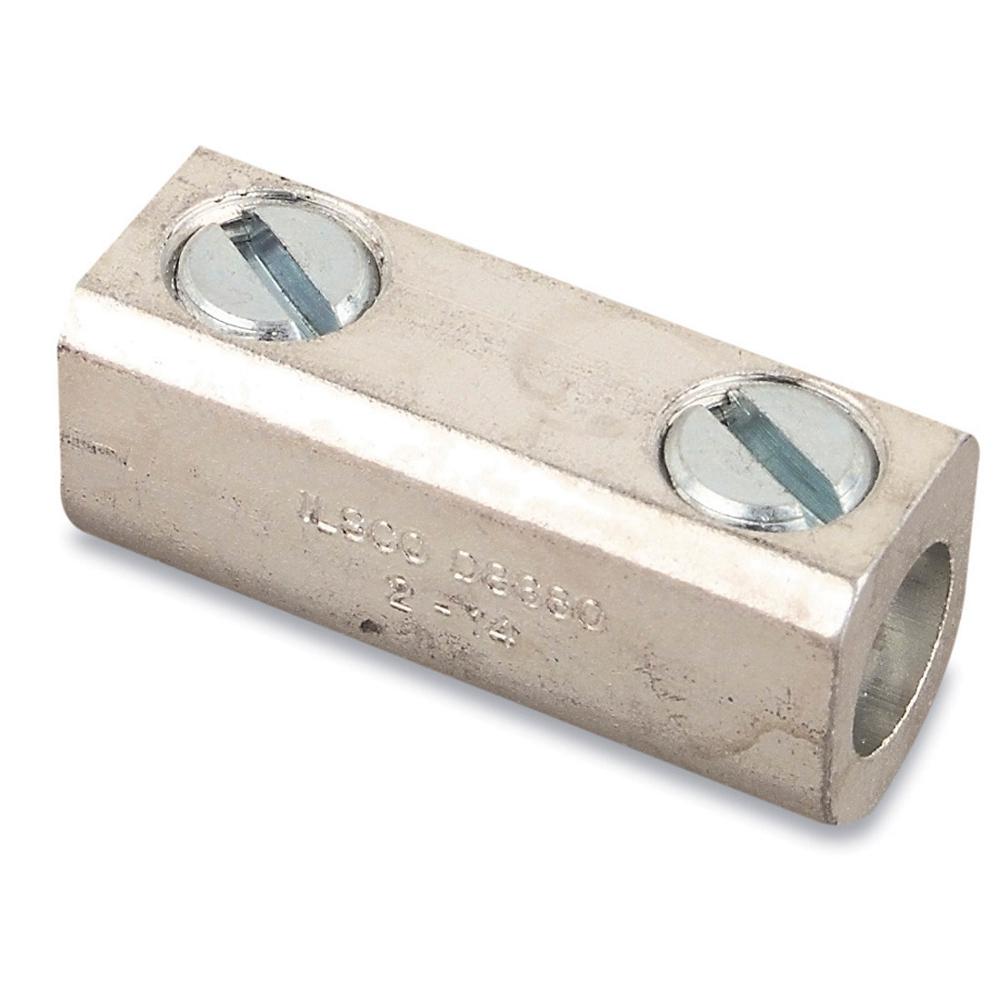
You have multiple choices for splicing
An NSI Polaris connector, which doesn't need insulating (it's also the most expensive)

A split bolt connector rated for AL, that requires lots of taping with at least 2 types of tape.

And a splicer/reducer that also need taping though not as much, because of it's shape, as the split bolt.
blackburn-wire-connectors-wire-terminals-asr1114-b2-10-64_400_compressed.jpg
 

rlitman

Well-known member
Joined
Oct 18, 2010
Messages
24,620
Location
Long Island
You have multiple choices for splicing
An NSI Polaris connector, which doesn't need insulating (it's also the most expensive)

A split bolt connector rated for AL, that requires lots of taping with at least 2 types of tape.

And a splicer/reducer that also need taping though not as much, because of it's shape, as the split bolt.
blackburn-wire-connectors-wire-terminals-asr1114-b2-10-64_400_compressed.jpg


I recently used some of those when I replaced a taped split bolt connection. Instead of tape, I opted for 1000V rated heat shrink. The connections were much more compact. Still won't fit in an LB though.
 

shaggyant

Well-known member
Joined
Oct 10, 2011
Messages
201
Location
North Idaho
I bought 1/0 USE-2 wire and ran them individually. I ran the portion inside the house in conduit. The 1/0 pulled fine in 2” schedule 80 with wire lube.
 

pattenp

Well-known member
Joined
Jun 4, 2008
Messages
10,175
Location
Virginia - USA
I bought 1/0 USE-2 wire and ran them individually. I ran the portion inside the house in conduit. The 1/0 pulled fine in 2” schedule 80 with wire lube.

Sorry to say if it's just USE-2 single rated wire it's not fire resistant and is not approved for inside installation, even in conduit.
 
To avoid these ads, REGISTER NOW!

pattenp

Well-known member
Joined
Jun 4, 2008
Messages
10,175
Location
Virginia - USA

dscheidt

Well-known member
Joined
Apr 26, 2017
Messages
2,900
It's also not code compliant to splice in a conduit body.

It is if the conduit body is marked with a volume, and you meet the volume requirements. See 314.15 (C) (2) in the 2017 code.

You end up needing a bigger body than you otherwise would, but you can do it. You can even put a device in one, if you can find a suitable cover for it.
 

Fasthotrod

Well-known member
Joined
Dec 14, 2015
Messages
218
Location
Oklahoma
Other option I have considered is a dual lug meter base so I don't have to enter the house at all, but Im having trouble locating a 200 amp base with an extra set of lugs?

I was in a similar situation. The local power company had a list of approved meter cans, and only the 320A and above had dual lugs. Instead, I went with a 200A meter/main panel with feed-through lugs with the thought that I'd pass through to the house, then add a breaker or sub-feed block in the panel to feed my shop. So I bought this guy:

https://www.lowes.com/pd/Square-D-16-Circuit-8-Space-200-Amp-Main-Breaker-Load-Center/1196613

Then I found one of these on eBay:

https://www.schneider-electric.us/en/product/HOML2225/circuit-breaker-sub-feed-lug/

It basically clips in like a breaker, taking up 4 positions.

The only "problem" doing this is that the meter/main becomes the service entrance point, with the neutral/ground bond. The house and shop become sub-panels, requiring some rework in the main house panel. (Remove neutral/ground in panel, install ground bar in panel, move ground wires to new ground bars.)

It's not the cheapest solution, but it was what made sense to me at the time. It was either that, or going with a NEMA 3R box with a terminal block mounted in it, and I just didn't have the space in the wall of the house for it without reworking a few things.

I ended up going in a slightly different direction at the recommendation of my POCO, but that's a story for another time. Good luck with your decision. :beer:

Mark
 
OP
G

gmtech

Well-known member
Joined
May 22, 2018
Messages
85
Location
nc
Bumping this back up with another question/idea, hopefully it gets seen.

Would it work to use SER from my house panel to an outside 100amp disconnect, then from the disconnect to my detached garage with my MHF?
 

Norcal

Well-known member
Joined
Mar 16, 2008
Messages
13,761
Bumping this back up with another question/idea, hopefully it gets seen.

Would it work to use SER from my house panel to an outside 100amp disconnect, then from the disconnect to my detached garage with my MHF?

You can but a WP can will probably be cheaper depending on what you choose.
 

tyme2par4

Well-known member
Joined
May 16, 2016
Messages
571
Location
NH
Bumping this back up with another question/idea, hopefully it gets seen.

Would it work to use SER from my house panel to an outside 100amp disconnect, then from the disconnect to my detached garage with my MHF?

As long as the SER doesn't go underground.
 
OP
G

gmtech

Well-known member
Joined
May 22, 2018
Messages
85
Location
nc
No underground, but it will be unprotected in the crawl space. Roughly 4-6 feet.

Just now looking online, 100 amp disconnects are quite expensive. But an outside single 100amp breaker panel is only $60. Would that fly?

Sent from my SAMSUNG-SM-G890A using Tapatalk
 
OP
G

gmtech

Well-known member
Joined
May 22, 2018
Messages
85
Location
nc
What I'm trying to do is not have to splice SER to MHF. I'd rather use a breaker or disconnect to make things much easier for me. I originally just planned to run MHF all the way to my panel in conduit, until I found this (see pic) other option, is to go all the way up the side of my house and straight into the back of my panel with an LB. (See 2nd pic) with MHF, which would be easiest I think, but would not look very good. The house panel is located to the right of the window in 2nd pic. Hope this makes sense.aec14b89f88030771508aeabfdcb2224.jpg

Sent from my SAMSUNG-SM-G890A using Tapatalk
ee6c2e21552ac7d9f82d7c62012b72b1.jpg
 

Attachments

  • aec14b89f88030771508aeabfdcb2224.jpg
    aec14b89f88030771508aeabfdcb2224.jpg
    50.1 KB · Views: 0
  • ee6c2e21552ac7d9f82d7c62012b72b1.jpg
    ee6c2e21552ac7d9f82d7c62012b72b1.jpg
    29.5 KB · Views: 0

Jim greengo

Well-known member
Joined
Sep 3, 2018
Messages
7,415
Location
Behind my house
The double lugs usually bolt on in place of single lug inside of meter socket,you'll probably need another disconnect depending on what your town requires.
 

dcg9381

Well-known member
Joined
Jun 20, 2018
Messages
11,778
Location
Austin, TX
Other option I have considered is a dual lug meter base so I don't have to enter the house at all, but Im having trouble locating a 200 amp base with an extra set of lugs?

You may be able to add a lug.. Have you looked into that?

From what I read MHF CAN be used indoors if rated for such. It appears that many MHFs are indoor rated (use your own due diligence) - Needs to be in conduit outside.

URD can be used also for indoor IF DUAL RATED. I think this is harder to find.


I just pulled 2-2-2-4 through 2", but relatively straight. Use 1.25" or better conduit, lube (there's a great foaming lube) - and a guide wire if you have a lot of transitions.
 

wyliesdiesels

Well-known member
Joined
Aug 14, 2012
Messages
20,029
Location
Modesto, CA
You may be able to add a lug.. Have you looked into that?

From what I read MHF CAN be used indoors if rated for such. It appears that many MHFs are indoor rated (use your own due diligence) - Needs to be in conduit outside.

URD can be used also for indoor IF DUAL RATED. I think this is harder to find.


I just pulled 2-2-2-4 through 2", but relatively straight. Use 1.25" or better conduit, lube (there's a great foaming lube) - and a guide wire if you have a lot of transitions.

MHF is a type of wire made by southwire and it is rated for indoor use but must be in conduit. the only place it does not need to be in conduit is underground because it is direct bury rated but conduit is advised for underground use as well.
 

Bert_

Well-known member
Joined
Dec 24, 2016
Messages
9,749
Location
NW Iowa
I don't get why everyone here is so quick to recommend MHF in conduit. If you are running conduit the whole way then just pull some xhhw individual conductors.

I would recommend MHF only if you intend on direct burial.
 

75gmck25

Well-known member
Joined
Jul 21, 2014
Messages
1,325
Location
Alexandria, VA
I think 2-2-2-4 AL MHF is recommended so often because its a readily available solution that is relatively uncomplicated if you buy dual rated wire by the foot. For example, if you need 70 feet you can just go down to almost any HD or Lowes and buy it off the reel. It is not always the optimal solution, but its at a good price point for a 90 amp feed.

Based on this site's prices 2-2-2-4 MHF is $1.17/foot, while 3 AWG copper XHHW is $1.02/foot. https://www.wireandcableyourway.com/xhhw/ I assume the larger wire sizes have a similar price difference.

On another note - I used SER and transitioned to MHF in a junction box at the exterior wall. Based on what I found as requirements for large gauge wiring, I found that junction box size for splicing is determined by the conduit, size, not the wires. This was one of the references I found. https://www.ecmweb.com/code-basics/sizing-junction-boxes

Bruce
 
Last edited:

pattenp

Well-known member
Joined
Jun 4, 2008
Messages
10,175
Location
Virginia - USA
You need to compare aluminum MHF to aluminum XHHW in the same sizes. As said on wireandcableyourway.com a foot of 2-2-2-4 MHF is $1.17 but the price of the same 4 sizes of a foot of XHHW is $1.31. The MHF is more convenient to use since its a preassembled cable besides being slightly cheaper per foot. And as pointed out the MHF is normally carried at the big box stores whereas XHHW is not.
 

Innovate1

Well-known member
Joined
Jul 28, 2014
Messages
4,289
Location
Illinois near St. Louis, Missouri
Correct me if I am wrong but from my reading on this the downside of MHF is that the wires are twisted so a bit harder to pull, especially if the conduit size is on the small side. Otherwise it seems like a good way to go - generally the cheapest and most readily available. The price difference given isn't large. Then there are the issues of needing conduit inside but both MHF and XHHW are the same in that regard.
 
To avoid these ads, REGISTER NOW!
Top Bottom