
kitdoctor
Well-known member
What do forum members think about this approach?
In my shed build I'm proposing to mount two split system outdoor units inside. When I've searched the web for recommendations on this, the general advice is not to do it but there must be circumstances (???) where really it's no different to mounting them outside because the indoor space is so large that heat dissipation (one of the usual objections) is not a problem. The issue of disposing of condensate has been dealt with.
I'm doing it for two reasons, primarily aesthetics, to maintain a clean looking exterior and to keep the units out of the weather.
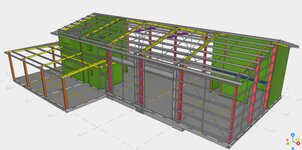
Below is a model of the shed. In the south-east corner (LHS) there's an accommodation module over two levels and in the north-west corner there's a ground level workshop with a storage room on the second level. It's the living room/kitchenette of lower level of the accommodation module and the workshop that will be air-conditioned. The construction technique is a mixture of steel portal framing and light-weight steel stud framing for the buildings within the larger buiding.
The whole shed is insulated. The entire roof is insulated with foil bubble insulation with an R0.21 (metric rating) value. This material also provides a thermal break between the metal corrugated cladding and steel frame, as well as having some insulation benefit. This has also been used on the walls of the shed in the area that will not be air-conditioned.
The workshop etc. have R5.0 rated glass fibre insulation batts in the ceiling spaces and suspended floors. The walls, including those that face inwards to the shed have R2.7 batts. A high density foam strip R0.65 acts as the thermal break between cladding (i.e. exterior metal corrugated cladding and timber weatherboards used inside) and stud wall framing.
If I subtract the volume occupied by the accommodation module and workshop/storage room from the shed's total volume, the volume of the working space of the shed that is not conditioned is 1735 cu m (61600 cu ft). The volume of the workshop is 79 cu m (2790 cu ft) and the volume of the living room/kitchenette is 93 cu m (3280 cu ft). So, in terms of relative volume, the ratio of the not conditioned space to conditioned space is about 10. Is this calculation useful?
In the summer I can open the two vehicle access doors which have a clear opening of 3.6 m (12') wide by 4.2 m (14') high. In the winter, I'd keep them closed.
I've done some analysis and the air-conditioner usage might be 20 days in summer and 30 days in winter. This would of course not be running the systems for 24 hours per day.
Thoughts on this?
In my shed build I'm proposing to mount two split system outdoor units inside. When I've searched the web for recommendations on this, the general advice is not to do it but there must be circumstances (???) where really it's no different to mounting them outside because the indoor space is so large that heat dissipation (one of the usual objections) is not a problem. The issue of disposing of condensate has been dealt with.
I'm doing it for two reasons, primarily aesthetics, to maintain a clean looking exterior and to keep the units out of the weather.
Below is a model of the shed. In the south-east corner (LHS) there's an accommodation module over two levels and in the north-west corner there's a ground level workshop with a storage room on the second level. It's the living room/kitchenette of lower level of the accommodation module and the workshop that will be air-conditioned. The construction technique is a mixture of steel portal framing and light-weight steel stud framing for the buildings within the larger buiding.
The whole shed is insulated. The entire roof is insulated with foil bubble insulation with an R0.21 (metric rating) value. This material also provides a thermal break between the metal corrugated cladding and steel frame, as well as having some insulation benefit. This has also been used on the walls of the shed in the area that will not be air-conditioned.
The workshop etc. have R5.0 rated glass fibre insulation batts in the ceiling spaces and suspended floors. The walls, including those that face inwards to the shed have R2.7 batts. A high density foam strip R0.65 acts as the thermal break between cladding (i.e. exterior metal corrugated cladding and timber weatherboards used inside) and stud wall framing.
If I subtract the volume occupied by the accommodation module and workshop/storage room from the shed's total volume, the volume of the working space of the shed that is not conditioned is 1735 cu m (61600 cu ft). The volume of the workshop is 79 cu m (2790 cu ft) and the volume of the living room/kitchenette is 93 cu m (3280 cu ft). So, in terms of relative volume, the ratio of the not conditioned space to conditioned space is about 10. Is this calculation useful?
In the summer I can open the two vehicle access doors which have a clear opening of 3.6 m (12') wide by 4.2 m (14') high. In the winter, I'd keep them closed.
I've done some analysis and the air-conditioner usage might be 20 days in summer and 30 days in winter. This would of course not be running the systems for 24 hours per day.
Thoughts on this?
Last edited: