To avoid these ads, REGISTER NOW!

Spray foam regrets?

bluedog225

Well-known member
Joined
Jan 31, 2012
Messages
3,252
Location
Texas
Does anyone regret applying spray foam? Open or closed cell.

Any issues with trapped water or odor?

First hand or second hand stories welcome.


I’m a big fan of blown cellulose but I’m trying to keep an open mind.

The r values are tempting. But trapped water or chemical odors will be an issue.

Thanks
 
To avoid these ads, REGISTER NOW!

cannuck

Well-known member
Joined
Nov 30, 2021
Messages
4,599
Location
Rural SK
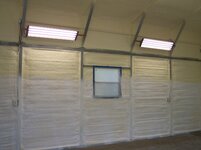
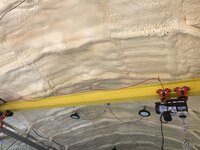
Last year in Oct I took down the 6" glass fiber rolls in my steel shop roof. The foil backing and tape had failed resulting in condensation on back side of the steel. Did 5.5" of closed cell foam, fully aware that the steel was not as clean as I would have preferred, but also aware I would get pretty decent bond. DID NOT replace the roof screws and washers until later in summer (could not be home when I needed to do that) so have some small worries about trapped water (you can tell the few screws that leaked as they were rusty (been there 39 years) and the rest pristine, so a small but real concern. My only regret is I couldn't do the screws ahead of time and in any practical terms wash down the bonding surface. Still have 6" glass in walls (with 5.5" purlins so no compressed areas) but the difference in insulation to the whole building overall is huge. No chem odors I can detect after a short cure time. You are right to be concerned, but if you do everything by the book (that means a SEALED roof - think of the seams) you can be allright.

When I can afford to do new shop, roof will be 6" (but by then hope I can get 8") in MIPs (metal insulated panels in closed cell PU) that have no possibilities of void against outer (or inner) skins. (note: NOT SIPs -that are glued styrene). FAR better than sprayed foam (and something I did consider to re-roof the old shop with).
 
Last edited:

theoldwizard1

Well-known member
Joined
Feb 22, 2011
Messages
43,106
Location
SE MI
The only bad thing I have heard is on retro-fit, in wall foam. Kind of like retro-fit blown in insulation where they make holes on the outside but instead of blowing in cellulose or fiberglass they squirt in foam. They have to use low expansion foam to prevent blowing out the drywall. Problem is that is does a poor job of filling the cavity.

This is a one time job. Go thick or plan on adding more layers later.
The r values are tempting.
I did not think the R value was superior to similar thickness of other insulation. The win is in no house wrap required, gap/crack sealing and speed of installation.
 

meathooker

Well-known member
Joined
Dec 10, 2013
Messages
254
Location
Iowa
I did closed cell on the walls of my house and my entire metal shop

I regret not spending the money to do the ceiling of my house. It’s amazing stuff for sure. Everyone that comes in my shop comments how nice it feels in there.
 

wssix99

Well-known member
Joined
Mar 2, 2011
Messages
5,156
Location
Chicago, IL
You have to watch out for the company you have doing the job. Any jackhole can buy a foam rig and start an insulating business. There is a big difference between a foam job done right and one done wrong. (So, you'll want to do your homework. Use a company that has been in business a long time, one that brings more to the table than what you know after doing your research, etc.)

Even with a good company, you need to watch out a little bit. there are trade-offs between open cell and closed cell foam. Vapor barrier fundamentals still apply. (Closed cell foam blocks vapor, open cell lets it through.)

I had a good installer, but they were still very resistant to switch rigs to give me open cell in some locations (my ceilings) and closed cell everywhere else. It took a lot of debate and negotiation to get them to agree to do the right thing. There is also a current thread here with a member having humidity issues because they have closed cell all the way around. (I suspect their installer went this way for the same economic motivations.)
 

Kpaige

Well-known member
Joined
Aug 12, 2015
Messages
751
Location
Big Lake Minnesota
I had an addition spray foamed 15 yrs ago and the contractor was new to the process which I did not know. Anyway it was done wrong and never fully cured it was releasing off gas for years. Had to have it removed and resprayed.

But I live in a fully spray foamed house now with no issues.
 

u2slow

Well-known member
Joined
Nov 20, 2011
Messages
3,583
Location
BC
I'm too DIY and cheap to hire somebody for spray foam. Im also always changing things after the fact, so spray is too permanent. I did R22 batts and vb.
 

improperyour

Member
Joined
Nov 16, 2023
Messages
10
I had a good installer, but they were still very resistant to switch rigs to give me open cell in some locations (my ceilings) and closed cell everywhere else. It took a lot of debate and negotiation to get them to agree to do the right thing.
Curious as to the reason why you did open cell in the ceiling and closed on the walls ("right thing")?

I hadn't heard that. I am planning to do all closed foam (and got a bid for such) but your words have me cautious/curious.

I live in a moderate climate (coldest it gets is high 20's - super rare, high is around 100 - bit more common). The degree difference in a typical day ranges about 20-30 degrees.

Doing a google search I couldn't find any reason to do what you are doing, but my search capabilities may be hamstrung.
 

Youngandfree

Well-known member
Joined
Dec 29, 2020
Messages
877
Location
VA
Curious as to the reason why you did open cell in the ceiling and closed on the walls ("right thing")?

I hadn't heard that. I am planning to do all closed foam (and got a bid for such) but your words have me cautious/curious.

I live in a moderate climate (coldest it gets is high 20's - super rare, high is around 100 - bit more common). The degree difference in a typical day ranges about 20-30 degrees.

Doing a google search I couldn't find any reason to do what you are doing, but my search capabilities may be hamstrung.
If your roof leaks the open cell will allow it to drain through
 
OP
B

bluedog225

Well-known member
Joined
Jan 31, 2012
Messages
3,252
Location
Texas
Does anyone have a link to the other thread that was mentioned regarding foam and humidity problems?

Is this it?


ALinCarolina

Well-known member
Joined
Dec 29, 2014
Messages
757
Location
NC Piedmont
When building our 32x48 farm building there was a shortage of closed cell at the time. I held out until my guy could get the closed cell and couldn't be happier. Not to change the subject but I bought the building minus the roof and had a local roofing company install a snap-lock metal with no exposed fasteners.
 

wssix99

Well-known member
Joined
Mar 2, 2011
Messages
5,156
Location
Chicago, IL
Does anyone have a link to the other thread that was mentioned regarding foam and humidity problems?

Is this it?


That's it.

Curious as to the reason why you did open cell in the ceiling and closed on the walls ("right thing")?

I hadn't heard that. I am planning to do all closed foam (and got a bid for such) but your words have me cautious/curious.

I live in a moderate climate (coldest it gets is high 20's - super rare, high is around 100 - bit more common). The degree difference in a typical day ranges about 20-30 degrees.

Doing a google search I couldn't find any reason to do what you are doing, but my search capabilities may be hamstrung.

Best practice will vary based on one's location. In my area, (similar area as the thread above) making an air-tight house on 5 sides traps humidity and wreaks havoc. (My wife is a general contractor and had some bad experiences building energy efficient houses in our area, so we knew to look out for this in advance.)

I haven't seen any "foam" articles that lay this issue out. As mentioned above, many are just set up to spray the foam and are not professional insulators. IMO - If you can find a full-service insulating company; one that does bats, blown insulation, foam, etc. - they are gems and probably have a lower likelihood of having conflicts of interest in what material to use.

Here is a semi-technical article on vapor barriers: https://insulationinstitute.org/im-...idance-2/moisture-management/vapor-retarders/

^ Like many similar articles, there's not a lot of prescriptive information for us, but I think the great bit of advice they give is to call your local code office to get direction on how vapor barriers should be applied in your area. From there, you can be informed as to how closed cell will act since it will retard vapor.
 

unslow1

Well-known member
Joined
Mar 3, 2012
Messages
7,880
Location
Illinois
In this area roof leaks would be a major concern. Then of course high humidity around here already causes a lot of mold/mildew problems.

It's been almost 10 years since did any work with home inspection or electrical companies but I've never seen a spray foamed building in this area.
 

kj_mustang

Well-known member
Joined
Feb 9, 2011
Messages
1,213
Location
Harrisonburg, VA
Almost 10 years since my building was sprayed. Zero issues and love it. Any building being spray foamed needs to have all the climate and hvac factors considered before doing it.
 

My Old Tools

Well-known member
Joined
Jun 4, 2014
Messages
5,427
Location
Hamrick Lake, TX
I skipped foam on the advice of my building contractor. I used 4" fiberglass with plastic backing on the frame before sheeting. After it was fully enclosed, they added another 8" of fiberglass to the roof with strapping. It has been 7 years and it works great in our climate. We see low 20's occassionally and saw -12 two years ago. Our highs are routinely over 100 in the summer. We are humid except for late July-September usually. I installed a 36k MrCool a few years ago and it works great.
 

Attachments

  • 20180128_104250.jpg
    20180128_104250.jpg
    521.6 KB · Views: 116

Juiced06GTO

Well-known member
Joined
Jun 1, 2014
Messages
356
Location
Sutton, MA
I spray foamed my entire shop, open cell all the way around. The company I went with does all types and I originally asked for a mix of closed/open, but was told the open cell would be the better fit for my application. I have about 7" on the walls and more than that on the ceiling. Last year with no hvac in the barn, I don't believe it ever fell below freezing in there throughout our winter (I am in central Mass) I now have my radiant floor set up and set to 58 degrees. So far the the system runs about 2-3hrs a day to keep it at temp, depending on outside temps. I couldn't be happier with how it is working. The cost was a bit out of what I budgeted, but I feel it was worth it, about $9k to do my 30x40x12 building with 9:12 pitch roof. The key is finding a good contractor as well. These guys were clean, professional, and efficient in doing the job. I have a bunch of pics on my build thread that show the process too!
 

dougf

Well-known member
Joined
Feb 22, 2013
Messages
402
Location
Missouri
I regret the 2" of closed cell sprayed directly to my metal roof in my shop. It deformed the metal and created a couple leaks. Dripped right through the closed cell foam. The first two months after the foam was applied my building would make "popping" noises when the sun hit the roof, now all the foam has seperated from the metal. It's still in place on the ceiling between the metal truss system, but im wondering when it's going to fail.
 

Earp69

Well-known member
Joined
Sep 20, 2016
Messages
859
I got quoted for 1" of close cell, and then they put R19 batts over it. 1" came out to more like 3" which is fine with me. I love it, shops tighter than a gnats ***
 
To avoid these ads, REGISTER NOW!

b-boy

Well-known member
Joined
Oct 2, 2013
Messages
2,155
Location
Buffalo NY
I did my walk up attic about 6 months ago. I had 4.5" of closed cell foam sprayed. Prior to that the attic was pretty much uninsulated. The company I hired did mostly commercial, but did some residential too. They were very highly recommended by other contractors. Most of the contractors I spoke to said that they subcontract all their foam work to these guys.

So far it's been great.

My house was much easier to keep cool during the Summer. The attic stays pretty close to the temp of the rest of the house. I was able to
work up there all Summer without any problems. We've had temps down into the 20s and the attic is still pretty warm.

My biggest concern is snow loads. With the extra insulation, snow will not melt like it used to. We had 7 ft last December, so that's a legit concern. :D

Also, everything I've read before and since the work was done says that the installation process is absolutely critical. If it's not done correctly it can pretty much ruin your roof. Plus, it can take up to 8 years before you start seeing problems.
 

dcg9381

Well-known member
Joined
Jun 20, 2018
Messages
11,635
Location
Austin, TX
Does anyone regret applying spray foam? Open or closed cell.
I'm on my 3rd structure with open cell. I'd absolutely use closed cell if I had a "space" issue, but it's more expensive per effective R value.

As this is my 3rd application, I assume that it's clear that I like the stuff... Other than it's obvious downside (cost).
Any issues with trapped water or odor?
I had one residence with water leak. Just like any other insulation, we opened the drywall, fixed the source of the leak and let it dry out.

Closed cell say on a roof deck can make finding the location of the leak challenging. It could, in theory, contain a leak against a roof deck which wouldn't be ideal long term.

My advice before installing any insulation, make sure you get a good rain in to proof the building exterior.

I'm in the south and we run HVAC most of the year, this (in my experience) makes fresh-air systems and de-humidification systems unnecessary. In full disclosure, I've never had indoor air quality tested, but here HVAC takes out the humidity. Up north and heating with something like propane, I'd assume I need a de-humidification system.


I’m a big fan of blown cellulose but I’m trying to keep an open mind.
I'd use hybrid insulation in a heartbeat, including cellulose. And have.

The r values are tempting. But trapped water or chemical odors will be an issue.
It's advantage is really not just R value. It's the ability to tightly seal a building. I think the ideal budget application is sealing the building with an 1 inch (or so) of closed cell and button it up with traditional insulation for desired R value.

I've never had an issue with cure or chemical odors, but I'm not particularly sensitive. The interior of our home (concrete) is done in polyurea so I'm not exactly chasing low VOC products.

I regret the 2" of closed cell sprayed directly to my metal roof in my shop. It deformed the metal and created a couple leaks. Dripped right through the closed cell foam. The first two months after the foam was applied my building would make "popping" noises when the sun hit the roof, now all the foam has seperated from the metal. It's still in place on the ceiling between the metal truss system, but im wondering when it's going to fail.

That *****. I've read about the deformation issue with steel buildings on a few occasions, but I think it was with "lighter" 29 gauge steel. I have a 2400 sqft building, think it's 26 gauge, zero deformation at all... I can't explain to you why if it's not gauge of metal. We get a ton of direct heating (Texas) and no separation.... I'd wager that the roof deck on the house is hotter (composite) but adhesion is probably better to wood material.
 

dcg9381

Well-known member
Joined
Jun 20, 2018
Messages
11,635
Location
Austin, TX
Why would anyone use open cell ?
Because accomplishes the tight envelope thing and is less expensive for the same R value.
It holds moisture !
What traditional insulation do you know about that does well exposed to moisture or water?

Open cell if exposed to a leak will actually drop the water (with gravity) if it has a leak above it, closed cell wont do that... Which is both an advantage and disadvantage.
 

BombShelter

Well-known member
Joined
Nov 16, 2015
Messages
541
Location
State of Hockey
I see a lot of basement remodels where they finish the area and use spray foam to insulate. If the basement is not properly waterproofed and there's water issues, the insulation does not stop it and it's a big hassle to fix.

The insulators don't care, it's not their scope but the customers seem to think it will stop water but there's no wording in the warranty that it will.
 

b-boy

Well-known member
Joined
Oct 2, 2013
Messages
2,155
Location
Buffalo NY
When I spoke to my contractor about spray foam, he said he could do 2" of closed cell followed by open cell. He gave me a quote both ways.
Using some open cell was cheaper, but not that much cheaper.

He didn't recommend it.

He said different climates require a different approach for spray foam. He said in the Northeast, he'd always go with closed cell only.
 

shibertus

Well-known member
Joined
Nov 13, 2018
Messages
275
We had our attic insulation replaced with spray foam a few years ago. It did stink for a bit but went away pretty quickly. The foam noticeably improved the comfort in the house. Would do it again.
 

olytdi

Well-known member
Joined
Dec 3, 2011
Messages
2,202
Location
Olympia, Washington
This subject seems to be voodoo physics that few understand well. Definitive reference material should be available that lays out exactly what kinds of insulation will work/not work given the building materials used, building technique employed, climate of location, and use; as well as how and when to use particular types of moisture barriers.

Why isn't this available?

It doesn't leave one confident hearing so many divergent stories about successes and failures.
 

yhprum

Well-known member
Joined
Jul 27, 2006
Messages
1,381
Location
Brisbane Australia
Not really related, but how does foam insulation compare for noise reduction, in terms of escaped noise outside the shop? I can’t help but guess it’s pretty good at that, keeping the neighbours happy.
 

kj_mustang

Well-known member
Joined
Feb 9, 2011
Messages
1,213
Location
Harrisonburg, VA
This subject seems to be voodoo physics that few understand well. Definitive reference material should be available that lays out exactly what kinds of insulation will work/not work given the building materials used, building technique employed, climate of location, and use; as well as how and when to use particular types of moisture barriers.

Why isn't this available?

It doesn't leave one confident hearing so many divergent stories about successes and failures.
The same as all other trades, some know what they are doing, some don't. Plenty of reference material available from spray foam manufacturers and other studies done if you search enough. You are correct though that all factors need to be considered which is why I said that in my first post in this thread. If the building owner is making a decision that they are spraying foam without considering all interior and exterior environment conditions and their planned usage of the building, they may be setting themselves up for issues. I suspect that most foam contractors will bid what the owner requests and take the money when done without saying anything.
 
Last edited:

Mike65

Well-known member
Joined
Mar 7, 2007
Messages
3,030
Location
Horse Pasture, Va.
Not really related, but how does foam insulation compare for noise reduction, in terms of escaped noise outside the shop? I can’t help but guess it’s pretty good at that, keeping the neighbors happy.
I think it is good at noise reduction except if I have the garage/shop doors open which is most of the time. Most of the houses where we live are on at least 1-1 1/2 acres so we are not close to each other. So far after 2 years I have not had any complaints from any of the neighbors, plus my neighbor across the street from me is a car guy so that helps.
 

jollygreengiant

Well-known member
Joined
Nov 10, 2013
Messages
2,354
Location
Ontario, Canada
I haven't seen this myself, but I've heard from multiple sources than spray foam in an older building is risky because the buildings movement can crack and separate the foam?
 

MovingAlong

Well-known member
Joined
Aug 17, 2013
Messages
1,201
This subject seems to be voodoo physics that few understand well. Definitive reference material should be available that lays out exactly what kinds of insulation will work/not work given the building materials used, building technique employed, climate of location, and use; as well as how and when to use particular types of moisture barriers.

Why isn't this available?

It doesn't leave one confident hearing so many divergent stories about successes and failures.

It is available in the form of professionals (which can be surprisingly hard to find). HVAC seems to be both art and science - depending on what you like. Lived in a humid area for a bit, most folks liked an undersized unit as it draws more humidity out. Friend of mine put in an oversized unit with the idea that it would run less. Well, yes, that was true. But it left the house very humid... His priority was on the money and not comfort. I went with a fully variable unit where you could set the indoor humidity level and it would adjust the run times accordingly. My sales guy had 40 yrs experience and interviewed us quite thoroughly over a half hour or so on a simple 1000' square foot block house before making a recommendation. I didn't care about the cost, comfort was my goal. It was time well spent for both of us. :ROFLMAO:

Point being - sometimes the variables are inconsistent and vary depending on your priorities and goals for the system.

I haven't seen this myself, but I've heard from multiple sources than spray foam in an older building is risky because the buildings movement can crack and separate the foam?

Are these sources professionals with actual experience? Not to cast aspersions on your research but I'd stick to talking with the folks who'll be standing behind the product and the installation with a full warranty. Even folks with first hand customer experience (positive or negative) don't always know the minute details that went into the product selection, preparation work or the install method. Again, that's (hopefully) the professional that made all those choices... right or wrong.
 

billconner

Well-known member
Joined
Jul 20, 2021
Messages
6,937
Location
Thousand Islands NYS
Not really related, but how does foam insulation compare for noise reduction, in terms of escaped noise outside the shop? I can’t help but guess it’s pretty good at that, keeping the neighbours happy.
The assembly - wall or ceiling - is likely to transmit more sound. It forms a relatively rigid connection of exterior and interior skins. fiberglass, Rockwell, cellulose, etc , do not.
 

cannuck

Well-known member
Joined
Nov 30, 2021
Messages
4,599
Location
Rural SK
The assembly - wall or ceiling - is likely to transmit more sound. It forms a relatively rigid connection of exterior and interior skins. fiberglass, Rockwell, cellulose, etc , do not.
that same mechanical tie is as you mention relatively rigid, not perfectly rigid and dampens vibrations of drywall very effectively. Commonly used to create effective sound barriers. Couples mechanically but not accoustically.

If you want to assess a material's sound transmission properties, just take a piece of wood and whack it. Steel roof panel will ring like a bell. Drywall or plywood will vibrate quite easily and loudly. A urethane foam layer will just make a tiny and non-sustainable thud as it will effectively dampen vibration. Same applies when it exists when bonded to otherwise resonant surface.
 
Last edited:

billconner

Well-known member
Joined
Jul 20, 2021
Messages
6,937
Location
Thousand Islands NYS
Perhaps spray polyurethane foam is not as rigid as rigid foam used on roofs, which seem to amplify rain noise, but they're more rigid than materials like fiberglass, and thus transmit more sounds. And of course open cell spray foam is better at sound attenuation than closed cell.

From:

"Spray foam or spray polyurethane foam significantly reduces sound, but it's not nearly as effective as other insulation materials such as fiberglass insulation and mineral wool. Additionally, fiberglass and rock wool are better fire retardants than spray foam insulation."

And I'm addressing transmission - through a wall or roof assembly - not absorbing sound within a space.
 

WisJim

Well-known member
Joined
Dec 20, 2010
Messages
2,264
Location
Menomonie, WI
My garage/shop building is stick framed, sheathed with waferboard, wrapped with Tyvek, and sided and roofed with pole barn steel. I had it all closed-cell spray foamed and have had no problems, no smell a day or so after it was done, and the building was immediately quieter after the foam went on. And it is easy to warm up when I want to work in the shop, and it cools down slowly (and in the summer it stays comfortably cool all the time, even with a dehumidifier running).
 
To avoid these ads, REGISTER NOW!
Top Bottom