To avoid these ads, REGISTER NOW!

Sprayfoam insulation on a garage roof.

tonydanzah

Well-known member
Joined
Nov 14, 2009
Messages
5,275
Location
the champagne of people
I live in michigan, i recently finished my garage walls. I was going to insulate the ceiling but i'm unsure the best route. Is it possible to have the underside spray foamed? Or does spray foam still need an area of air flow for moisture?
 
To avoid these ads, REGISTER NOW!

Voi

Well-known member
Joined
Oct 10, 2010
Messages
5,150
Location
Western South Dakota
I live in michigan, i recently finished my garage walls. I was going to insulate the ceiling but i'm unsure the best route. Is it possible to have the underside spray foamed? Or does spray foam still need an area of air flow for moisture?

Do you mean spraying the underside of the roof deck or the back side of the ceiling?

[EDIT] Given your title and a re-read on my part I assume you mean the underside of the roof deck. In that case it is possible to have the underside of your roof sheathing sprayed with closed cell. See my comments in post #10 for more info.
 
Last edited:

matt_i

Well-known member
Joined
Mar 14, 2008
Messages
10,741
Location
SE Michigan
Imo, easiest is to install metal skin or drywall on the ceiling and then install loose cellulose insulation on top of that, to a depth that suits you.

The warm-room/cold-roof has been proven to work quite well. You also reduce the "cubic volume" of air that has to be heated in total. The ceiling is also typically a reasonably good fire-barrier.

Not to say that the spray foam won't work but its fairly expensive, and you still need a circulation device to move the heated air back down from where it concentrates up near the roof peak.
 

rwilner

Well-known member
Joined
Apr 26, 2013
Messages
104
Location
Boston, MA
I'm in Boston. I put 8" of open cell foam in between the rafters of my 36x23 garage. Heating is done with a mini split and a 240 construction heater when it's really cold. I have 2 fans to circulate air.

I'm sure there are other solutions but this has worked well for me. I can work on the cars comfortably in single digits.

Hope that helps.

Sent from my Nexus 7 using Tapatalk
 

kbs2244

Well-known member
Joined
Nov 11, 2006
Messages
14,065
You can spray it on the underside of the roof slope.
It is sticky and will not fall off.
The "crust" it gets when it dries is fine as a vapor barrier.
But if you cut the crust off for any reason you may want to reseal it.
In a commercial install they put in the rough electrical and such so they do not cut the crust.
 
Last edited:

jchetty

Well-known member
Joined
Aug 18, 2005
Messages
431
Location
Central New Jersey
After seeing a video about what happens when sprayfoam is done poorly- I will pass.
The problem is it is mixed on site so quality control can be an issue.

Def do not go to the cheapest. I would highly consider not being there during the spray & for 24 hours afterwards and then allowing ventilation just in case the mix is not done right.

Don't get me wrong, done correctly it is amazing. But not worth the hassle for me.
 

D45

Well-known member
Joined
Mar 21, 2014
Messages
4,836
Location
NW INDIANA
I am also very interested in this

I do not want to insulate the ceiling, because I use the joists for storage

I would rather insulate the underneath side of the roof, up against the roof sheathing

I do have soffits on the outside perimeter and 5-6 roof vents (not a ridge vent) and am concerned about moisture and air flow
 

Voi

Well-known member
Joined
Oct 10, 2010
Messages
5,150
Location
Western South Dakota
I am also very interested in this

I do not want to insulate the ceiling, because I use the joists for storage

I would rather insulate the underneath side of the roof, up against the roof sheathing

I do have soffits on the outside perimeter and 5-6 roof vents (not a ridge vent) and am concerned about moisture and air flow

As you seem to already know, without a continuous ridge vent it is problematic to insulate between the rafters or upper chords since every bay needs a continuous baffle from soffit to ridge. If your roof is hipped it's even more problematic.

Closed cell spray foam can be used on the underside of the roof deck, effectively sealing off your current ventilation system.

For it to work you need at least two inches of closed cell in any climate zone (IIRC). If you want do "flash and batt" then you'll need the right R ratio of closed cell to fiberglass (or cellulose, rock wool, or whatever) for your climate zone.

How deep are your rafters or upper chords and what R value do you desire or are you required to have?
 

D45

Well-known member
Joined
Mar 21, 2014
Messages
4,836
Location
NW INDIANA
I have a 3.5/12 roof in the garage......soffits with a few roof vents

I would have to check, but I believe the roof rafters are 2x6s

The walls are already insulated, all the way around

I have a 45K BTU natural gas heater in the garage addition, and know I am losing heat through the roof


IMG_20161210_130353613_zpsscg1egd6.jpg
 

73RR

Blank Email
Joined
Dec 13, 2016
Messages
300
Location
Central Ory-Gun
I have used spray foam on several buildings and love it. Yes, it is a bit more money but you cannot seal up a building with other insulation the way you can with foam. It gets into every nook and cranny and stops air infiltration. You will not have soffit vents or roof pots to deal with and no condensation issues.
There should be no issues with 'proper mixing' if the applicator has done more than two buildings in his life. The companies that make/sell the foam only sell to applicators with proper training.

Think in terms of a giant picnic cooler.
 

Voi

Well-known member
Joined
Oct 10, 2010
Messages
5,150
Location
Western South Dakota
I have a 3.5/12 roof in the garage......soffits with a few roof vents

I would have to check, but I believe the roof rafters are 2x6s.

Yeah not only do you not have a ridge vent, you don't even have a ridge.

Short of re-roofing and putting rigid foam above the deck, flash and batt or flash and fill are ideal in this situation.

Your area of Indiana is Climate Zone 5. I believe you'll need a minimum of 41% of your R value from foam. If you had 2" sprayed to achieve the minimum for vapor barrier that would give you R-13 and another 3.5" in your rafter bays.

Whether you use fiberglass or rock wool you're only around R-13 to R-15, giving an approximate total of R-26 to R-28.

Either way you're well above the 41% minimum suggested for your climate zone.

For what it is worth, I just had a small job spray foamed at 85 cents per board foot (85 cents per square foot at 1" thick).

You should double check everything I wrote. I'm home sick. Feeling bad enough to stay home but well enough to be bored and brain function is probably nowhere near 100%.
 

D45

Well-known member
Joined
Mar 21, 2014
Messages
4,836
Location
NW INDIANA
Yeah not only do you not have a ridge vent, you don't even have a ridge.

Short of re-roofing and putting rigid foam above the deck, flash and batt or flash and fill are ideal in this situation.

Correct, no ridge vent :( .........no ridge :(

Flash and batt? (batt style insulation?)

Flash and fill? (loose fill insutlation?)

What do you mean "flash"? Thin layer of spray foam?

Are you saying that spray foam up against the underneath side of the roof will not be cost effective or efficient?
 
Last edited:
To avoid these ads, REGISTER NOW!

Voi

Well-known member
Joined
Oct 10, 2010
Messages
5,150
Location
Western South Dakota
Correct, no ridge vent :( .........no ridge :(

Flash and batt? (batt style insulation?)

Flash and fill? (loose fill insutlation?)

What do you mean "flash"?

Are you saying that spray foam up against the underneath side of the roof will not be cost effective or efficient?

The flash part is the closed cell spray foam. The batt or fill part is really any sort of typical batt/roll, or blown in insulation. I wouldn't say "thin" layer of spray foam. You want the right ratio for your climate zone and a 2" minimum for vapor barrier. In your case the 2" works for both. If your rafters are deeper than 2x6 then that layer might need to be thicker.

I do not mean to imply this method is cost ineffective or inefficient. If anything it's one of the better choices for this type of situation.
 
Last edited:

D45

Well-known member
Joined
Mar 21, 2014
Messages
4,836
Location
NW INDIANA
What about the soffits and roof vents with air movement/moisture?

Does closed cell foam spray seal it up, so that this is not a concern or not needed?

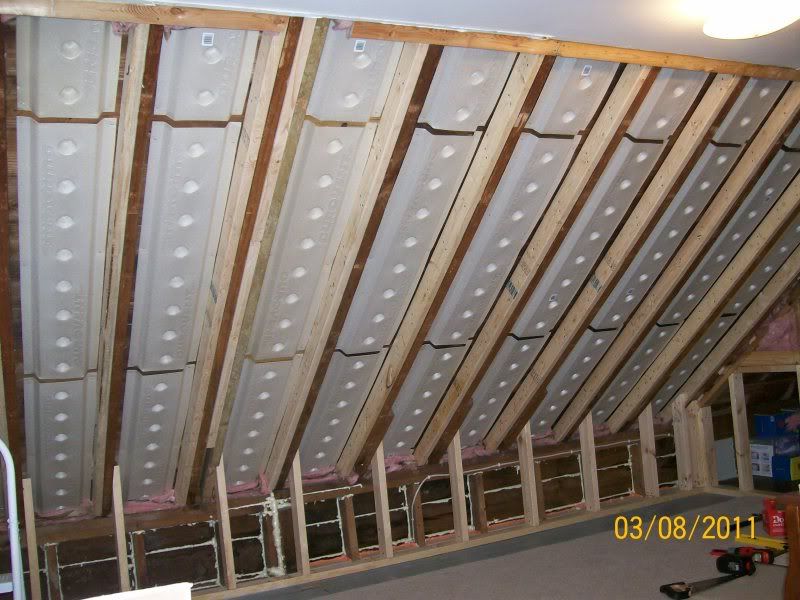
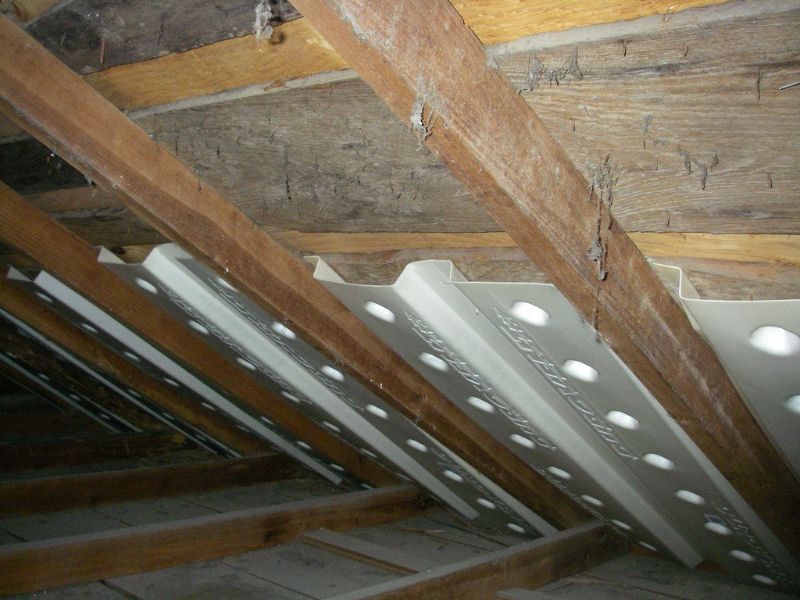
Are roof baffles then not needed or used......only if using traditional rolls/batts of insulation?


baffle1_zps8vybsxo2.jpg


baffle_zpslzn6eifo.jpg
 
Last edited:

Voi

Well-known member
Joined
Oct 10, 2010
Messages
5,150
Location
Western South Dakota
What about the soffits and roof vents with air movement/moisture?

Does closed cell foam spray seal it up, so that this is not a concern or not needed?

Are roof baffles then not needed or used......only if using traditional rolls/batts of insulation?

Closed cell spray foam is used to close up soffit and roof or ridge vents all the time. It is considered safe as long as the closed cell layer is sufficiently thick for vapor and dew point control (this is where minimum thickness and the R value ratio comes in).

Baffles are not needed. In your case you'd need continuous baffles from soffit to top and a roof vent for each rafter bay.

I will add that this is the currently understood "safe" way to have an unventilated roof. Some have argued that in a garage with a vented combustion heat source and no other sources of moisture one can get away with much more "risky" roof assemblies.

I was on the fence with my cabin project but when I priced closed cell at 85 cents per board foot it became a no-brainer to me.
 

DeltaWye

Well-known member
Joined
Sep 26, 2016
Messages
114
Location
Toronto, Canada
Bear in mind that spray foam is best applied at warm temperatures. You will need to heat the surface up which is going to be difficult if it's extremely cold outside. If you're planning on doing it during the winter and the contractor doesn't mention this, I'd be very wary. Also, make sure that the installer has been on the job for at least a day or two.
 

D45

Well-known member
Joined
Mar 21, 2014
Messages
4,836
Location
NW INDIANA
Wow, so if I decide on closed cell foam, they spray over the soffits and spray over the vents and seal everything up?

Seems like not having any air movement, whatsoever would be a bad thing, but would definitely help lock in the heat
 

DeltaWye

Well-known member
Joined
Sep 26, 2016
Messages
114
Location
Toronto, Canada
I will add that this is the currently understood "safe" way to have an unventilated roof.

That's good to hear; we held off on having the underside of the flat roof part of our old house spray foamed 10 years ago because at the time it was considered a no-no to seal off the cavity completely due to concerns about lack of ventilation causing rot of the roof deck and deterioration of roofing materials.

I'd like to read up on this a bit if you have a source.
 

Voi

Well-known member
Joined
Oct 10, 2010
Messages
5,150
Location
Western South Dakota
That's good to hear; we held off on having the underside of the flat roof part of our old house spray foamed 10 years ago because at the time it was considered a no-no to seal off the cavity completely due to concerns about lack of ventilation causing rot of the roof deck and deterioration of roofing materials.

I'd like to read up on this a bit if you have a source.

With a flat roof it is especially important that the roof be able to dry in one direction or the other. With all the methods of sealing a flat roof plus different climates this is not a one answer fits all sort of situation. And a truly flat roof may be the one situation where this is still risky.

Here are some articles. I think all of them deal with rigid foam but I believe one of them throws spray foam into the mix as well. If not in the article in the comments.

If not let me know and I'll see if I can find a better article.

On their forums they use the recommended ratios interchangeably for rigid and closed cell spray foam. But they try to avoid recommending spray foam as much as possible, hence why it doesn't get much mention in their published articles. They know it has its place but believe rigid outside of the framing is always a better choice when possible.

One of them also mentions rigid foam up against the underside of the roof sheathing. A method now referred to as "cut and cobble". The experts over on GBA have really backed away from mentioning or recommending this approach.

http://www.greenbuildingadvisor.com/blogs/dept/musings/how-build-insulated-cathedral-ceiling

http://www.greenbuildingadvisor.com...mbining-exterior-rigid-foam-fluffy-insulation

http://www.greenbuildingadvisor.com...lating-minimum-thickness-rigid-foam-sheathing

http://www.greenbuildingadvisor.com/articles/dept/musings/how-install-rigid-foam-top-roof-sheathing
 

Voi

Well-known member
Joined
Oct 10, 2010
Messages
5,150
Location
Western South Dakota
Wow, so if I decide on closed cell foam, they spray over the soffits and spray over the vents and seal everything up?

Yup. Roof sheathing still needs to be able to dry in one direction. With shingles above your drying path will need to be towards the interior. I gather the permeability of closed cell at 2" to 3" is considered sufficient for drying to the interior.
 

73RR

Blank Email
Joined
Dec 13, 2016
Messages
300
Location
Central Ory-Gun
Wow, so if I decide on closed cell foam, they spray over the soffits and spray over the vents and seal everything up?

Seems like not having any air movement, whatsoever would be a bad thing, but would definitely help lock in the heat

Yup, think of the room in terms of a giant picnic cooler. If this is habital space then some means of air exchange must be included. You can read up on this problem on forums dealing with ICF construction since ICF creates incredibly tight buildings.
The biggest problem with most stick-framed construction is that of air infiltration. Nails, screws, and glue are great for holding pieces together but 'stuff' never really gets sealed tight with batts or loose fill material in between framing members.
Some folks still cling to the idea of forcing material into a cavity but that actually lessens the effective R number since insulation relies on dead air to do the work. This is why spray foam, open or closed, reins supreme....a bazillion little air pockets.:thumbup:
 

CTyankee

Well-known member
Joined
Jan 13, 2013
Messages
3,802
Location
CT
I have used spray foam on several buildings and love it. Yes, it is a bit more money but you cannot seal up a building with other insulation the way you can with foam. It gets into every nook and cranny and stops air infiltration. You will not have soffit vents or roof pots to deal with and no condensation issues.
There should be no issues with 'proper mixing' if the applicator has done more than two buildings in his life. The companies that make/sell the foam only sell to applicators with proper training.

Think in terms of a giant picnic cooler.

I'll respectfully disagree if you are saying you cannot seal up a building with any other insulation than spray foam. Just the nature of the beast can lead to issues with the job being done incorrectly, proper training or not. And while it can be addressed..thermal bridging is still going to occur in most cases. It may have it's place...but for it's certainly not the end all to end all some make it out to be. JMO.
 

73RR

Blank Email
Joined
Dec 13, 2016
Messages
300
Location
Central Ory-Gun
I'll respectfully disagree if you are saying you cannot seal up a building with any other insulation than spray foam. Just the nature of the beast can lead to issues with the job being done incorrectly, proper training or not. And while it can be addressed..thermal bridging is still going to occur in most cases. It may have it's place...but for it's certainly not the end all to end all some make it out to be. JMO.

ICF blocks? yes, equal to or better than.
SIPS design? again equal to
As to being done correctly or not, that goes with every part of every facet of any building project.
Thermal bridging? The only way to kinda-sorta stop that is a wall with staggered studs but that is not the topic of the OP's post and thermal bridging in a roof is not usually an issue unless you have an interior surface finished with sheet goods of some sort.
And, we can agree to disagree about what methods and materials will seal a wall constructed with plywood and 2x's, but there is little doubt as to the ability of spray foam to get into every nook and cranny and stop the air.

Be all end all? Nope, but pretty damned close for the average property owner.
 

aunsafe2015

Well-known member
Joined
Apr 2, 2016
Messages
436
Location
Northern VA
I have used spray foam on several buildings and love it. Yes, it is a bit more money but you cannot seal up a building with other insulation the way you can with foam. It gets into every nook and cranny and stops air infiltration. You will not have soffit vents or roof pots to deal with and no condensation issues.
There should be no issues with 'proper mixing' if the applicator has done more than two buildings in his life. The companies that make/sell the foam only sell to applicators with proper training.

Think in terms of a giant picnic cooler.
so does a spray foamed roof have zero ventilation? No soffit vents, no ridge vent, nothing? Just completely sealed with spray foam?

Sent from my F5321 using Tapatalk
 
Last edited:
To avoid these ads, REGISTER NOW!
Top Bottom