To avoid these ads, REGISTER NOW!

Spreading the Bonney affliction!

LesserSon

Well-known member
Joined
Feb 7, 2016
Messages
5,050
Location
PA USA
I saw more Zenel DOEs today at Jakes than I’ve seen altogether in the past year or more. Most would have brought my dupes above 6, though, so I just bought two non-PWA 3725Bs. And a 10” S-adjustable.
Also, Utica-made B24 pliers, a 825A wrench, and a 1923ish nickel-plated combo pliers (1923-$1.50 2019-$1.00).
 

Attachments

  • 17B8DED7-0C90-4F9A-806E-ED8301B63F32.jpg
    17B8DED7-0C90-4F9A-806E-ED8301B63F32.jpg
    160.8 KB · Views: 21
  • 27BBA344-CB71-47CC-A482-2542F9A2D0F8.jpg
    27BBA344-CB71-47CC-A482-2542F9A2D0F8.jpg
    152.1 KB · Views: 19
  • 1DF897D1-B552-40DE-B29E-6CE7EC6FE9A8.jpg
    1DF897D1-B552-40DE-B29E-6CE7EC6FE9A8.jpg
    147.5 KB · Views: 20
Last edited:
To avoid these ads, REGISTER NOW!

Private Lugnutz

Well-known member
Joined
Mar 30, 2012
Messages
30,486
Location
The Authentic Jersey Shore
It’s kind of difficult to grasp how the internals work like that.

Pretty darn neat though how there are the two variations, yours even having a detent hole for the ratchet.
It is neat, and yes, the internals are beguiling. Out of all the funky ratchet adapters and attachments I have, definitely ranks up there as one of the coolest. I plan to read the patents and see what else I can find out with some research after that.
 

Private Lugnutz

Well-known member
Joined
Mar 30, 2012
Messages
30,486
Location
The Authentic Jersey Shore
3baygarage:

Some interesting progress on our adjustable sockets...

It looks like William H. Fisher was working on a socket wrench with adjustable jaws for engaging nuts and bolt heads for at least seven (7) years, between 1922 and 1929. A man on a mission! :)

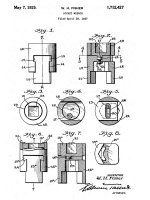
Turns out the two patents listed on your Bonney No. 2550 adjustable socket (1,554,963 and 1,554,965) were the second and third of four patents I have been able to find. Each of the four patents use different mechanisms, moving from a "spring-bearing and lugs" (filed in 1922, granted 1924) to "tongue and groove" (filed Oct 20, 1924), granted Sep 22, 1925), quickly followed by a modification (filed Feb 3, 1925, granted Sep 22, 1925) to "pin-and-slot" (in 1929).

I posted the first pages with diagrams for the middle two patents upthread (see post #2605). Here are the first (1924) and fourth (1929).

attachment.php


attachment.php


Read them all when you get the opportunity (although reading the first isn't really necessary except for context) and let me know what you think.

At face value, and without taking them apart, mine and yours both seem to "look" and operate the most like the 1929 patent. In fact, the 1,554,963 patent explicitly states that movement on one direction will open the jaws, while movement in the opposite direction will close them (see lines 65-58), whereas the 1,712,427 patent describes the continual movement. I am not sure why Bonney would even cite the other patents along with the PATENTS PENDING. But if my interpretation is correct, it does help narrow our production to no earlier than 1929, and probably the 30's, as I suspected.

I haven't been able to track down the connection between W. H. Fisher and Bonney.

I did located a gravestone for a William H. Fisher (1872-1932) in Altoona. That would've made him 60. Good possibility it's him, but I haven't been able to find any biographical information.

No data on William H. Fisher or any of these patents on DATAMP.

Alloy Artifacts does not have a Bonney 2550 (or unmarked) adjustable socket in their collection and therefore, no information.
 

Attachments

  • Fisher 1924 patent.jpg
    Fisher 1924 patent.jpg
    68.4 KB · Views: 160
  • Fisher 1929 patent.jpg
    Fisher 1929 patent.jpg
    83.3 KB · Views: 160

LesserSon

Well-known member
Joined
Feb 7, 2016
Messages
5,050
Location
PA USA
Lugz- The William H Fisher you located by burial died with carcinomas, as a retired clerk from Gable’s department store in Altoona. Not saying he’s not the inventor, but Gable & Co seems to have been more into soft goods than hardware. Maybe best to keep a wide net. It’d be nice if the US Census data were searchable by occupation.
 

Private Lugnutz

Well-known member
Joined
Mar 30, 2012
Messages
30,486
Location
The Authentic Jersey Shore
As I said, I wasn't able to find any biographical data. It was a possibility based purely on his location and age. I agree the occupation doesn't match. I've tried obituaries to no avail, so far. We'll unearth something eventually, hopefully.
 
OP
B

bonneyman

Well-known member
Joined
Apr 22, 2010
Messages
8,767
Location
Desert SW
Came across this Bonney-made Matco combination wrench yesterday. Was looking thru the DVD's at the local humane society thrift store. They always get new stuff in.
They had a bin of old wrenches and screwdrivers, so I gave a casual glance into them. The unique chrome of this wrench stood out. I usually don't pass up quality metric tools, and one can't have too many 10mm wrenches. :lol_hitti

Total cost: 50 cents
 

Attachments

  • IMG_7155.JPG
    IMG_7155.JPG
    100.8 KB · Views: 40
Last edited:
OP
B

bonneyman

Well-known member
Joined
Apr 22, 2010
Messages
8,767
Location
Desert SW
Wow, nice find! Been keeping an eye out for some of those to fill out my metric set.


Sent from my iPhone using Tapatalk

This particular wrench is not Loc-Rite on the box end but was too nice to pass up. I tend to find Bonney-made Matcos every so often in tool bins - I don't think many people know about the connection.
 

LesserSon

Well-known member
Joined
Feb 7, 2016
Messages
5,050
Location
PA USA
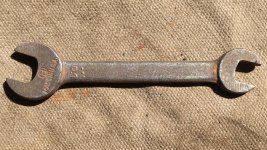
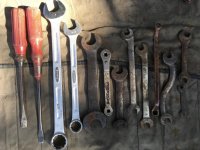
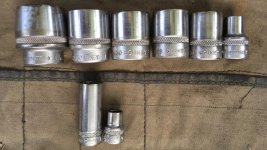
Lovely trip northeast to Blue Ridge flea market in Saylorsburg PA this morning netted some interesting Bonney gems. The miniature DOE 1/4x5/16 is not a regular size for the H-series. The screwdrivers took some real scrutinizing. I was able find “Bonney” on the celluloid-handled one, but my faith in the wood-handled one is derived from “Stanley” not being stamped on the ferrule. My joy in finding a 25F and a 501A in the same clutch cannot be exaggerated. Then a 33C and a 27. Wow.
Edit - I forgot to include the sockets. And here’s what I mean about “Stanley“.
 

Attachments

  • 9AD7EEB1-F031-410A-B10F-23B07CBADA53.jpg
    9AD7EEB1-F031-410A-B10F-23B07CBADA53.jpg
    156.5 KB · Views: 40
  • 75D3FEA3-30BE-4E3E-9994-8547154C63BE.jpg
    75D3FEA3-30BE-4E3E-9994-8547154C63BE.jpg
    160.3 KB · Views: 36
  • B82AAF7F-C190-4DBE-ACA8-60521EF721D9.jpg
    B82AAF7F-C190-4DBE-ACA8-60521EF721D9.jpg
    145.5 KB · Views: 35
  • 823BD65C-D74E-4C5C-8619-267043FC9614.jpg
    823BD65C-D74E-4C5C-8619-267043FC9614.jpg
    150.3 KB · Views: 23
  • A5DC4C30-1A69-46EE-B3A4-E8AAD67CF70A.jpg
    A5DC4C30-1A69-46EE-B3A4-E8AAD67CF70A.jpg
    102.9 KB · Views: 23
Last edited:

LesserSon

Well-known member
Joined
Feb 7, 2016
Messages
5,050
Location
PA USA
What is the date code on that NAF wrench, LS?! Neat with the B-Circle forge mark.

DQ, so April 1939
I guess it’s really a 1020, not an H-series. I’ll have to set it side-by-side to see how it compares.
 

Attachments

  • BBE2ACF3-23CC-40B5-9964-83BFB6E35487.jpg
    BBE2ACF3-23CC-40B5-9964-83BFB6E35487.jpg
    156.1 KB · Views: 22
Last edited:

LesserSon

Well-known member
Joined
Feb 7, 2016
Messages
5,050
Location
PA USA
The Bonaloy 2804L turned out to be JS (Oct1941). It was so crusted-over, I had no idea, and almost left it behind.
I had my hands on a jellybean 504 today. It was pitted and rusted, and I have one in better shape. Same vendor had a A707 ratchet with a STREAMLINE handle. Really surprised me. I almost don’t believe my own memory, and wish I’d taken a picture.
He said, “You’re not going to like the price on that.” “Tell me,” says I. “$20; I see what they are on the computer.” “You’re right,” says I, and put it down. I might have bought it if I didn't have an Outline A707 and a AA707. I would still have bought it, for half.
 

Attachments

  • D30F249F-D2EB-4F82-A60E-BDA6CA983BAA.jpg
    D30F249F-D2EB-4F82-A60E-BDA6CA983BAA.jpg
    156.2 KB · Views: 18
  • 84ED5149-A395-43B8-BCFF-8D8A4AB53E4A.jpeg
    84ED5149-A395-43B8-BCFF-8D8A4AB53E4A.jpeg
    115.1 KB · Views: 16
Last edited:

LesserSon

Well-known member
Joined
Feb 7, 2016
Messages
5,050
Location
PA USA
Just a 23F away from my first set. And two deep into a second set. I’ve grabbed a goodly number of Williams and/or Billings, and thrown them down in despair. Why are the little ones so hard to spot?
 

Attachments

  • 45FF32FE-12A6-4B5B-8F62-7B2CF961BF51.jpg
    45FF32FE-12A6-4B5B-8F62-7B2CF961BF51.jpg
    151 KB · Views: 27

Private Lugnutz

Well-known member
Joined
Mar 30, 2012
Messages
30,486
Location
The Authentic Jersey Shore
Nice, LS.

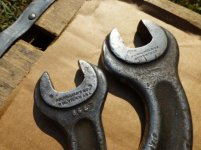
Those have always been headscratchers for me, because they don't match any DOE wrench depicted and listed by type in any early catalog (1915, 1923, 1925). They have the reinforced jaws of the early machinery wrenches, tool post wrenches and the like, which none of the double head, engineers, general purpose, checknut, etc wrenches have. The only place DOE wrenches like that are shown (in blurry minutiae) and listed with those model numbers is the 'Ford Owner's Wrench Kit No. 9'. I posted a catalog excerpt in post #1631, linked here. Is that the set you are referring to? If so, I think I may have an extra 100F Reverse Gear Wrench if you need one to complete the kit.
 

LesserSon

Well-known member
Joined
Feb 7, 2016
Messages
5,050
Location
PA USA
Those wrenches are depicted in the 1920 Bonney No.70 display board brochure. I think the pdf was posted by Twertsy. He has the board itself, too.
The literature says the five wrenches turn every bolt in a Ford, so I see it as the grand-daddy of the No.25 set.
Thanks for the offer, but I already have the RGW.
 

Attachments

  • 3C9E6803-9D41-47D1-8B35-BC1D86EFABF3.jpg
    3C9E6803-9D41-47D1-8B35-BC1D86EFABF3.jpg
    148.2 KB · Views: 16
Last edited:

Private Lugnutz

Well-known member
Joined
Mar 30, 2012
Messages
30,486
Location
The Authentic Jersey Shore
Let me be clearer about why I find them unusual. Yes, they're on the figure and in the list of the No. 70 and No. 80 boards in the 1923 and 1925 catalogs, too, along with the Ford kit. You have to strain your eyes to see them, but they're there. What they don't have is their own section that precedes the pages with the boards, like every other wrench on those boards, and as all the other wrenches that Bonney made was afforded, as is typically done in catalogs by all mfgrs. In those sections you can see a larger rendering of the wrench, by type, with a description, and a full table of sizes. They are unique in that sense and I find it very odd, maybe especially because they don't look like automotive engineer wrenches with those reinforced jaws. Perhaps they were given a full introduction in a prior catalog we don't have.
 

LesserSon

Well-known member
Joined
Feb 7, 2016
Messages
5,050
Location
PA USA
Yes, they are weird in those respects. Presumably, they were reinforced only because they are carbon steel, and I think not hardened quite as much as more standard mechanic’s tools. Maybe marketed to car owners, so the tool deforms instead of damaging the automobile or snapping (potentially injury). Bonney was not alone in producing these, so maybe clues could be found in Billings or Williams catalogs.
 

Private Lugnutz

Well-known member
Joined
Mar 30, 2012
Messages
30,486
Location
The Authentic Jersey Shore
Bonney was not alone in producing these, so maybe clues could be found in Billings or Williams catalogs.
See that's just the point, though, LS. I think they were alone. Off the top of my head, I don't recall seeing DOE wrenches with bulky reinforced jaws made and marketed explicitly for automotive maintenance by Billings, Williams, or any other mfgrs. Again, that's why I consider these Bonney wrenches so strange. They just sort of show up on those two boards and in the Ford Car Owners Kit in the 1923 catalog and yet they beg for an explanation precisely because they are not an industry standard thing. Machine wrenches, tool post wrenches, and set screw wrenches? Yes. Engineers wrenches aimed at automotive maintenance? No. I am perfectly willing to be proven wrong about this, and will double-check myself when I get home to my references.
 
To avoid these ads, REGISTER NOW!

leg17

Well-known member
Joined
Aug 11, 2011
Messages
1,369
Location
Kentucky
I try to pay attention to Williams, and I don't recall ever seeing a comparable design from them.
Modern Euro and Asian designs feature this but likely as a strength/material consideration using alloy materials.
 

LesserSon

Well-known member
Joined
Feb 7, 2016
Messages
5,050
Location
PA USA
Okay. Maybe I’m misremembering what I thought I’ve seen. Next time I see something similar from a different mfr, I’ll document it.
 

leg17

Well-known member
Joined
Aug 11, 2011
Messages
1,369
Location
Kentucky
I try to pay attention to Williams, and I don't recall ever seeing a comparable design from them.
Modern Euro and Asian designs feature this but likely as a strength/material consideration using alloy materials.

Well, I AM a pure idiot.
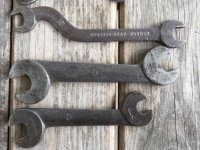
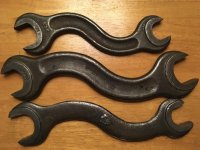
I completely forgot this Williams design that they called " "S" Wrench with Concave Handle" in the 1912 catalog.

LesserSon, one of us is fading and it certainly looks like it ain't you.
 

Attachments

  • P1010454.jpg
    P1010454.jpg
    64.1 KB · Views: 22
  • P1010455.jpg
    P1010455.jpg
    46.9 KB · Views: 15

MR.X

Well-known member
Joined
Dec 13, 2010
Messages
1,792
What is the date code on that NAF wrench, LS?! Neat with the B-Circle forge mark.

DQ, so April 1939
I guess it’s really a 1020, not an H-series. I’ll have to set it side-by-side to see how it compares.

Very cool. Made during the FDR run up to the war. I don't think I have any wrenches with the B circle forge mark. I have a BSP ratchet with that on it, though.

"run up to the war"..... the 4 or 5 Plomb DOE wrenches I have with 310692- markings all have date codes of either 39, 40 or 41. I do have a B-circle NAF DOE buried but can't remember if it's a 310692 or if it's one of the earlier contract #'s.
 

LesserSon

Well-known member
Joined
Feb 7, 2016
Messages
5,050
Location
PA USA
Well, I AM a pure idiot.

Not at all. I, and I think Lugz, was referring specifically to the straight-shank wrenches.
I have a Williams 263. A Bonney 866C (which corroborates Lugz’s point about textile/machinery). A fairly unmarked Bonney with the reenforced faces but no concavity in the shank.
It could be I’ve mistaken a tool post wrench. I just really think I remember the part number being similar to the 2_F format. I will have to keep a look out.
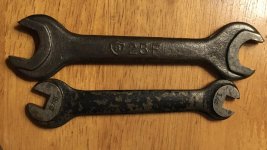
Edit- here is a 25F with a small textile wrench for comparison. Note that not merely the gullet, but also the geometry of the reenforced faces, is different.
 

Attachments

  • 538760B4-9A14-43EE-BC9D-E5DB2235C6F7.jpg
    538760B4-9A14-43EE-BC9D-E5DB2235C6F7.jpg
    149.5 KB · Views: 14
  • 24D511FF-FBB4-454A-8A1E-15529A2B5190.jpg
    24D511FF-FBB4-454A-8A1E-15529A2B5190.jpg
    149.1 KB · Views: 15
  • CAECC2C5-195B-4DF0-9359-DE71DA7B02A4.jpg
    CAECC2C5-195B-4DF0-9359-DE71DA7B02A4.jpg
    147.9 KB · Views: 11
  • 67C14590-D154-4C31-ADDC-DA58E8096832.jpg
    67C14590-D154-4C31-ADDC-DA58E8096832.jpg
    150.7 KB · Views: 10
Last edited:

leg17

Well-known member
Joined
Aug 11, 2011
Messages
1,369
Location
Kentucky
Well, I AM a pure idiot.
I completely forgot this Williams design that they called " "S" Wrench with Concave Handle" in the 1912 catalog.

LesserSon, one of us is fading and it certainly looks like it ain't you.

I need to quit speed reading and slow down.

Lugz, these Williams may be earlier than anyone's auto specific line so the info might not be completely relevant to the discussion.

The joys of the golden years.
 

Private Lugnutz

Well-known member
Joined
Mar 30, 2012
Messages
30,486
Location
The Authentic Jersey Shore
I, and I think Lugz, was referring specifically to the straight-shank wrenches.
I was. I have a partial set of the Williams "S" concave panel wrenches, which they also made with square openings for set screws, but I think of them as general service wrenches, and they are never described as automotive related. Leg has a point though. Similar, at least. The oldest Billings catalog I have is 1934, but I also have a raft of ads from 4.c from the 1920's, and the only wrenches they made with reinforced jaws were machine, set screw, and tool post.

The Bonney "F" series (obviously for Ford, right?!) are not in the 1915 catalog, but Todd sent me a couple scans from the 1919 catalog. Essentially the same as the 1923 catalog, in which they don't have their own page (unlike the engineer, check nut, machine, set screw, etc wrenches), they just show up on boards No. 70, No. 80, and in the Ford Owner's Kit No 9, with no explanation except their description as having openings "especially milled to fit every nut on a Ford car." That explains the sizes, not the odd (and I still argue unique - for automotive work) construction!

EDIT: Remember that Bonney was making typical carbon steel engineers wrenches at this time, without reinforced jaws, many of which are hanging on the boards with the strange "F" series, which makes them all the more curious.
 
Last edited:

twertsy

Well-known member
Joined
Jan 5, 2014
Messages
6,726
Location
Reedville, VA
Just a 23F away from my first set. And two deep into a second set. I’ve grabbed a goodly number of Williams and/or Billings, and thrown them down in despair. Why are the little ones so hard to spot?

Nice LS. 23 & 25F are my only blank spots in my big Ford Wrench board. Those suckers are tough to find, particularly without excessive pitting.
 

Private Lugnutz

Well-known member
Joined
Mar 30, 2012
Messages
30,486
Location
The Authentic Jersey Shore
Considering that Germany didn't invade Poland until September, 1939, I'm not sure I would identify it as "made during FDR's runnup to the war".....
That's a very narrow view of WWII. While the first shot of the war - by the German ship Schleswig-Holstein, on a Polish naval base - was not fired until September 1, 1939, most historians consider it the perfunctory start, at best. Except for the strictest isolationists, Germany reoccupying the Rhineland in March 1936 was the first major milestone, getting everyone’s attention, and the annexation of Austria two years later (March 1938) and the Sudetenland portion of Czechoslovakia only seven months after that confirmed it. Despite the Neutrality Laws that Congress passed in 1935 and 1937, FDR did everything he could to prepare for war, arguing, correctly, that we needed to re-arm.

It seems almost impossible to imagine today, but the US had very little military might at the time and we were not considered an international threat. We had no capability to deter aggression and self-defense was a serious concern. While our Navy was allowed, by treaty, to be as large as the British Royal Navy, capacity was limited. Our Army and Air Corps was tiny and ill-equipped. FDR began quietly reversing that.

By 1938 we were not only building up ourselves, but giving financial aid to our eventual Allies. In November 1939, when the “cash-and-carry” laws were passed, allowing the Allies to buy weapons, ammunition, and equipment from the US if they picked it up and transported it across the Atlantic in their own ships, how do you think that was possible without us already having ramped up production?

When France fell in June 1940, all pretense was dropped. All of the well-known and inevitable “history book” precursors to US entry into WWII (Two-Ocean Navy act, the Draft, and Lend-Lease) were just the overt signs of a build-up that was already well underway.

If you read FDR’s papers, or any good biography, he has said that he was thinking about the war that would eventually break out as early as 1933, when he was first elected, and when Japan and Germany left the League of Nations.
 

Private Lugnutz

Well-known member
Joined
Mar 30, 2012
Messages
30,486
Location
The Authentic Jersey Shore
Did you just cite the size of your library to rationalize your disagreement with my historical summary? That's just a desperate debate tactic, RJ. Unless you can cite a specific statement, event, and date that you are claiming is inaccurate, I'm not about to produce a bibliography.

As a reminder, we are talking about a wrench, made in April 1939, with a Naval Air Factory stock number on it. Again, at that time, Nazi Germany had already broken the Treaty of Versailles, and Austria and Czechoslovakia had already capitulated without a fight. In the Pacific, which I hadn't even mentioned yet, Japan had already invaded China. Again, if you're arguing that we sat idly by and didn't prepare to increase military production within the arsenals of the technical services one iota until Nazi Germany invaded Poland, you are mistaken.

The outbreak of actual armed conflict in Poland certainly allowed FDR to be more transparent about things (including use of the “Educational” orders that were being placed with weapons, ammunition, and equipment makers by our arsenals), and it certainly turned the tide of sentiment in the populace at large and with Congress. But it was far from the first prompt, indication or warning. If you think April 1939 is too early for an NAF wrench to be considered part of the “Defense Period” (commonly attributed to 1939-1941) build up, we’ll just have to agree to disagree.
 

Farmer J.

Well-known member
Joined
Sep 18, 2016
Messages
1,995
Location
UK, Cornwall/Hertfordshire.
Well said, but not entirely accurate. I have over two hundred books just on WW2, and about that many on WW1. I'm not going to argue, but do respectfully disagree with the revisionist superficial history. Perhaps if sources are quoted.....

Thanks Ricky, I will bear that information in mind also. I'm no authority on this at all and the only source I can quote is the memory of my late Father. He used to say things like "FDR could see it coming, he was getting things ready as much as he could for several years ahead of the conflict, so we have a lot to thank him for". Then he would quote what he had said as early as 1933. Let's stick to spanners for our debates....
 
Last edited:

Private Lugnutz

Well-known member
Joined
Mar 30, 2012
Messages
30,486
Location
The Authentic Jersey Shore
Bravado on top of braggadocio doesn't improve your case, RJ. You still have not made an argument or pointed out any of the supposed inaccuracies in anything I posted. You can keep saying that I'm wrong, and that you know more than I do about the wars, but that becomes patently ridiculous until you actually say something concrete to the contrary.

Nothing I have posted is subjective, nothing required analysis. I drew no conclusions. Worse yet, everything I posted is considered common knowledge by anyone who has delved into WWII just a little deeper than secondary level. I do have the advantage of a few Army War College courses that are probably not in the public domain, which I wouldn't expect you to have copies of, but they only enriched my understanding of a timeline that is basic to most encyclopedic treatments of the subject.

Apparently none of the two hundred plus books in your library covered the Industrial Mobilization Plans of 1933, 1935, and 1938, the Shephard-Hill Bill, the May Bill, the Educational Orders Act of 1938, or FDR's letters to Congress. Normally I wouldn't persist, but since you continue to claim I am wrong without providing any substantive facts to the contrary, I will try to find some time to provide you some pointers and references tomorrow.

EDIT: As for this being off-topic, I appreciate Farmer J's attempt to steer around a controversy, but I disagree. These kinds of historical contextual forays are good for the forum. The life surrounding that little 1939 Bonney-made NAF DOE wrench that LS found is germane.
 
Last edited:

rickhigginshtbr

Well-known member
Joined
Aug 7, 2012
Messages
1,551
Location
Lower Bucks, PA
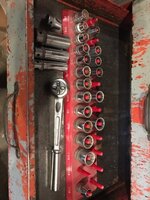
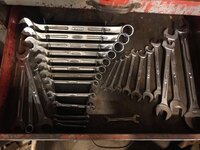
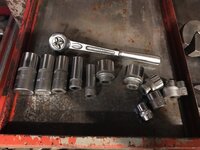
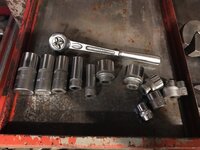
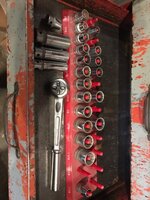
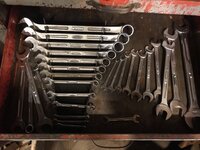
So, my collection is slowly growing. Well, nearly doubled after that haul a couple weeks back. Here’s what staying in my personal collection so far

bd6ce0dbeb94af6d3b8ba91e465dfd7d.jpg

Up front are A series sockets, behind are D series. With only a couple deep sockets so far as well. All 1/2” Drive.

2410271a388015febc44a9438fe767c2.jpg

My combo set is complete, unless I somehow find the real large ones in Streamline. To the left of that is the random metric pieces I’ve found. To the right, half of the combo’s in the late-50’s catalog. Early 50’s set is probably finished, but that double doubled in size as the decade went on with oddball sizes.

ac13cc1cf6cc06f5249be9f79a9361af.jpg

3/8” Drive I’m severely lacking. And I currently have zero 1/4” Drive as well.

All pics are of my Bonney tools sitting in my currently-unrestored Bonney roller. Going to try to fill it completely up some day! Streamline and Allentown marked tools first.

Speaking of. For the locals, going to try to hit the Q mart Sunday. Told the main tool man there I’d be back in early October to load up again before winter.


Sent from my iPhone using Tapatalk
 

Attachments

  • ac13cc1cf6cc06f5249be9f79a9361af.jpg
    ac13cc1cf6cc06f5249be9f79a9361af.jpg
    76.8 KB · Views: 3
  • bd6ce0dbeb94af6d3b8ba91e465dfd7d.jpg
    bd6ce0dbeb94af6d3b8ba91e465dfd7d.jpg
    92.3 KB · Views: 3
  • 2410271a388015febc44a9438fe767c2.jpg
    2410271a388015febc44a9438fe767c2.jpg
    82.6 KB · Views: 4

Private Lugnutz

Well-known member
Joined
Mar 30, 2012
Messages
30,486
Location
The Authentic Jersey Shore
Bonney brethren,
This is going to be a long post. If you’re not interested in WWII history, kindly just skip it. I am sure someone will soon come along with a nice Bonney tool or two to drool over. If you are interested, for your skimming convenience, I have used bolds and italics to highlight key sentences.

RJ,
To set the table, I will start with some high level typical coffee table book level material, then go deeper, and finish with some recommended further reading references.
-------------------------------------------------------------------------------------------

“Roosevelt, at heart, believed the United States had an important role to play in the world, an unsurprising position for someone who counted Theodore Roosevelt and Woodrow Wilson among his political mentors. But throughout most of the 1930s, the persistence of the nation's economic woes and the presence of an isolationist streak among a significant number of Americans (and some important progressive political allies) forced FDR to trim his internationalist sails. With the coming war in Europe and Asia, FDR edged the United States into combat…[ ]… In this ominous environment, the United States had adopted an official policy of neutrality. Indeed, between 1935 and 1939, Congress passed five different Neutrality Acts that forbade American involvement in foreign conflicts. …[ ]…Roosevelt tried to water down these laws—which often made no distinction between the aggressor and the victim.
- William E. Leuchtenberg, Professor Emeritus of History, FDR: Foreign Affairs, UVA, Miller Center

“Most Americans blamed Germany for starting the war and hoped that Britain and France would win it, but they were also very clear that the USA should stay out of it. President Roosevelt and his government saw things a little differently. They recognized the evil of the Nazi regime, and of Japan’s militarism, and that they represented a real threat to USA’s interests...[ ]....and worked steadily to oppose them. The details changed over time, but the general principles held good up to December 1941. Opponents, however, said that he deceived the American people over just how far he was going.
- Donald Sommerville, World War II, Hermes House, Leicestershire, 2012, 60-61

“World War II began, some would say, in September 1931, when Japan attacked and in effect annexed the Chinese province of Manchuria…[ ]…In March 1936 Hitler sent troops into the Rhineland area, demilitarized by the Versailles terms…[ ]…In March 1938 the next step was to merge Austria into Germany…[ ]…Clearly, this was not going to be his last target.
- Sommerville, 18-19

By 1936, the War Industries Administration, which was understood from the start to be the largest and most important wartime agency, had been renamed the War Resources Administration. Its responsibilities were to include control of war finance, trade, labor, and price control organizations, with only the selective service and public relations still autonomous….[ ]…In so doing, it actually became a transitional agency, until the establishment of the projected civilian superagency at the outset of war. As such, the board drew up lists of critical materials, studied raw material needs, and eventually obtained modest appropriations for importing and stockpiling critical materials. The board also made industrial surveys and apportioned productive capacity of firms and industries whose products were sought by both services. By mid-1939, President Franklin D. Roosevelt recognized the board's importance by placing it in the executive office of the president. Thereafter, Roosevelt had direct control of the board which in turn enjoyed unanticipated prestige and visibility...[ ]...The twenty years since the end of the Great War had seen the breakdown of an international system based on the League of Nations and arms limitation agreements. The resultant American disillusionment with international affairs expressed itself in strong isolationist and pacifist sentiments. Although President Roosevelt neither shared nor pandered to this viewpoint, he understood the strength of the isolationist position. With one eye on his upcoming reelection bid in 1940, he acted carefully. Some of his New Deal supporters, notably labor leaders, feared that a preparedness drive centered on a powerful War Resources Administration would undermine much recent social legislation. So, rather than begin a massive central rearmament effort, he launched a limited preparedness campaign at the beginning of 1939, with his emphasis on increasing the striking power of the Army Air Corps. The Army, in turn, used the opportunity of the air buildup and the $575 million appropriation for a more balanced expansion. Momentum picked up after the German invasion of Poland in September and the outbreak of a general European war.”
- Marvin A. Kreidberg and Merton G. Henry, History of Military Mobilization in the United States Army, 1775-1945 (1955)

On November 14, 1938, FDR held a meeting with key War Department officials, the Army Chief of Staff General Malin Craig, deputy Chief of Staff Brigadier General George C. Marshall, and Major General Henry “Hap” Arnold, in addition to others, to discuss the state of the Army air forces. Secretary of the Treasury, Henry Morgenthau was present and noted in his diary that “the president remarked he was not sure that encouraging Hitler to make peace at Munich would save lives in the long run.” The president also wondered whether “a United States capability to produce 10,000 planes per year, and the sale of these resources to Europe, would have deterred Hitler from mobilization and subsequent occupation of the Sudetenland only months earlier”.
- Morgenthau diary as quoted in David Kaiser, No End Save Victory: How FDR led the Nation into War (New York: Basic Books, 2014), 49-50.

On November 25, 1938, retired Army General John J. Pershing wrote to the president to express his concern over the situation of US Army ground forces. Citing his experience from World War I, he urged the president “to address defense deficiencies sooner rather than later”.
- A letter from General Pershing to President Roosevelt mentioning a previous conversation to which the General was taking opportunity to summarize his “most important considerations” with respect to the status of air and ground forces with another world war looming. Franklin Delano Roosevelt. F.D.R.: His Personal Letters; 1928 – 1945, vol. 2, Elliott Roosevelt, ed. (New York: Duell, Sloan and Pearce, 1950), 837-838.

On January 12, 1939, President Franklin D. Roosevelt delivered a written message to the first session of the Seventy-Sixth Congress urging the legislative branch to move past political differences, and given the threat of another world war, to establish an even sharper increase in appropriations than 1938, needed for the national defense.
- US House Congressional Record document, “An adequate National Defense as outlined by the message of the President of the United States.” War Department General and Special Staffs, War Plans Division, RG 165, General Correspondence, 1920-1942, National Archives, College Park, MD, box 183, file 4132

“As in Volume I, primary emphasis is placed upon developments during the period when the United States was actually involved in the war—from December 1941 through August 1945. However, a history of Quartermaster activities in World War II could not begin with the attack upon Pearl Harbor or even with the declaration of the limited national emergency in 1939, for many of the Corps' wartime policies had their roots in an earlier period.”
- Keiffer and Risch, The U.S. Army in WWII, The Technical Services, The Quartermaster Corps: Organization, Supply, and Services, Center for Military History (CMH) Publication 10-12-1, Washington DC, 1955, ii

“Its Personnel Branch supervised procurement and other activities relating to personnel, both military and civilian, while its War Plans and Training Branch established and directed policies and plans pertaining to the organization of Quartermaster units, to the mobilization and movement of troops, and to all phases of training. The War Plans and Training Branch had been in effect since 1937.
- CMH Pub 10-12-1, 142

"Early in 1939, at the direction of the General Staff, The Quartermaster General requested the Quartermaster Board to make a thorough study of all Quartermaster T/O's and recommend any revisions in the tables for motor transport and supply units considered necessary to make them conform to provisions of the Protective Mobilization Plan…[ ]…Reorganization was already under way when the war broke out in Europe and the President proclaimed a limited national emergency.”
- CMH Pub 10-12-1, 281

Since 1933 there had been mounting appropriations for defense, the largest peacetime appropriations for military purposes in the history of the United States. When President Roosevelt stood before a joint session of Congress on 16 May 1940 to ask for over a billion dollars more, his program was almost unanimously approved by the lawmakers and the press. But some members of Congress were demanding to know whether new appropriations would "go down the same rat hole into which we have poured $7,000,000,000 during the last 6 years.
- Thomson and Mayo, The U.S. Army in WWII, The Technical Services, The Ordnance Department: Procurement and Supply, Center of Military History (CMH) Publication 10-10, Washington D.C. 1960, 2

The build-up of munitions for the U.S. Army was proceeding cautiously but picking up speed. Using a financial yardstick, General Wesson summed it up in the fall of 1939 as follows: In the fiscal year 1938 approximately $25,000,000 was expended for the procurement of Ordnance material. In the fiscal year 1939 approximately $50,000,000 has been and is being expended for like purposes. In the fiscal year 1940 a total of approximately $150,000,000 has been made available.”
- CMH Pub 10-10, 10

In 1937 the Ordnance Department established an office in Wilmington, Delaware, to carry on this work, and in 1938 Congress appropriated funds for the purchase of some of the highly specialized machinery required for the mass production of powder and small arms and for the operation of loading plants.”
- CMH Pub 10-10, 11

“Perhaps the most radical departure from conventional practice, and the most highly publicized feature of Ordnance prewar procurement plans, were the educational orders. Approved by Congress in 1938,…[ ]…the purpose was to give selected manufacturers experience in producing munitions and to procure essential tools and manufacturing aids. Other supply services participated in the program to some extent, but the bulk of the educational orders were for Ordnance materiel.”
- CMH Pub 10-10, 19

“It is no doubt true, as General Harris asserted, that there was never a time in the 1938-40 period when he could not gain a sympathetic hearing from the president of any leading corporation in the United States to discuss procurement plans.”
- CMH Pub 10-10, 22

“The only qualifying element in the picture is the delay inherent in drafting requirements and forwarding them through the proper channels to Congress, with the result that expansion plans drawn up in mid-1939 before the European war broke out were obsolete when they reached Congress a year later. But the notion that the Army set its sights too low and had to be prodded into preparedness by the civilian agencies hastily organized in 1940 is a myth.”
- CMH Pub 10-10, 59

Equipped in 1938 and 1939 with many new machine tools…[ ]…., the Ordnance arsenals were ready in 1940 to go immediately into production.”
- CMH Pub 10-10, 72

“Despite Springfield Armory's production potential, Ordnance had decided to award an educational order for the Garand rifle because of the large requirement for rifles in the Protective Mobilization Plan. In the spring of 1939 the Infantry listed the new rifle as the top priority item in the rearmament program. The million-dollar contract went to Winchester, was successfully completed, and was soon followed by large production orders.”
- CMH Pub 10-10, 158

“Springfield Armory, the traditional center for military rifle production, had begun as early as 1937 to tool up for mass production of the new Garand rifle.
- CMH Pub 10-10, 160

“When Congress in 1938 appropriated $1,800,000 for retooling, Ordnance anticipated the project would be completed by the end of the following year and would boost production from ten thousand to fifty thousand rifles per year. This sum supplemented approximately one million dollars that had already been expended at Springfield for new equipment and gages since 1935. As the years from 1935 on had brought a gradual upswing in all activities at the Armory, Ordnance decided to modernize, to the extent of funds available, the whole Springfield manufacturing plant during the process of tooling up for output of the new rifle. While no new buildings were erected at the Armory before 1940, many improvements such as better wiring, new floors, and strengthening of supports as well as the shifting of existing machinery were required to house the new rifle producing equipment and reorganize the production line.
- CMH Pub 10-10, 162

“When Ordnance called for bids in the summer of 1939, two famous gunmaking concerns, Remington and Winchester, responded. Each submitted a bid based on the assumption that it would furnish all necessary tools and equipment. Winchester not only turned in the lower bid on this basis but also submitted an alternate bid —$1 million less—assuming use of tools and equipment being procured under its educational order. On the basis of this latter proposal, Winchester received a contract for 65,000 Garand rifles to be completed by June 1942.”
- CMH Pub 10-10, 163

In the spring of 1939, Rock Island installed a production line capable of turning out .30-caliber machine guns at the rate of twenty five per day.”
- CMH Pub 10-10, 180

“Private companies received no contracts during the 1930's for military ammunition because they could not underbid Frankford, and the Army was forbidden by law to purchase from industry unless the price was less than the cost of arsenal-produced ammunition. But by 1936 two facts had become apparent to Army planners: (1) a major war would require, in addition to Frankford's production, large-scale manufacture by commercial arms makers in existing plants, and (2) this production would have to be supplemented by a new government-owned ammunition plant in the midwest operated for the government by a leading industrial firm. In 1936 and 1937 Ordnance representatives conferred frequently with officials of the Remington Arms Company with a view to having Remington expand its capacity in time of emergency and also take over operation of a proposed new government plant. Following these discussions a formal statement of the plan drawn up by Frankford Arsenal was concurred in by Mr. C. K. Davis, president of Remington, in 1938.”
- CMH Pub 10-10, 191

“From 1920 to 1935 no more than thirty-five tanks were built, each one a different model. The essence of mass production—acceptance of design and its exact reproduction in volume—was altogether lacking. Not until 1935-36 when sixteen medium tanks were made at Rock Island Arsenal was more than one tank of any specific model produced.
- CMH Pub 10-10, 224

After 1935, procurement for "remotorization of the Army" was in full swing.
- CMH Pub 10-10, 273

As the inspection work load mounted during 1938 and 1939 the districts appealed to the arsenals for help in supplying qualified inspectors. Nearly every district obtained one or two arsenal inspectors, but the arsenal commanders, faced with mounting work loads of their own, were reluctant to release more.”
- CMH Pub 10-10, 323

The broad background of all these events is described in Smith, Army and Economic Mobilization, Chapter V.

See also Harry B. Yoshpe, "Economic Mobilization Planning between the Two World Wars," Military Affairs (Summer 1952), p. 76.

And U.S. Congress, Senate. 74th Congress, Second Session. Hearings Before Subcommittee of Committee on Military Affairs on S. 4268, 20 May 1936

Also, if you’re familiar at all with the concept of counterintelligence, one fundamental principle is to understand your enemy through their own lens. For a good sense of how far FDR was surreptitiously going, and how it was being received by his opponents, see Borg, Dorothy, Notes on Roosevelt's "Quarantine Speech", Political Science Quarterly 72.3 (1957): 405-433, the editorial in Saturday Evening Post, vol. 211, No. 22 (November 26, 1938), which attacks the Industrial Mobilization Plan as "articles of war-time dictatorship", and in that same vein, I highly recommend any editions of the New International from 1936 through 1938, culminating in Vol IV, No. 11, November 1938, 337-340. The intellectual class Marxists in the US, concerned about the deleterious effects that a centralized government control of the entire economy would have on labor, produced some of the more detailed observations about US industrial and military mobilization in the 30's.
 
Last edited:

Farmer J.

Well-known member
Joined
Sep 18, 2016
Messages
1,995
Location
UK, Cornwall/Hertfordshire.
Thanks for going to the trouble of posting the historical context Lugz, with the references. I did find it an interesting read, and appreciate that you have gone to some trouble to look it all up. It's another of your posts that I will save.
 

Private Lugnutz

Well-known member
Joined
Mar 30, 2012
Messages
30,486
Location
The Authentic Jersey Shore
You're quite welcome, J. My readings in this prewar area springs from an interest I share with a collector colleague in England in defining what constitutes "wartime" in terms of hand tool and other production. I have pointed many times before to the Alphabetic Listing of Major War Supply Contracts, published by the Industrial Statistics Division of the Civilian Production Administration (new postwar name for War Production Board) in late 1945, which begins in June 1940. The fact that the WPB backed up their definition of "war supply" records to June 1940, a full year and a half before Pearl Harbor, gave us a lot of credence to explore it even deeper. My colleague has an interest in Lend-Lease tools, and even earlier Cash-and-Carry tools, both of which were contracted by the Treasury Department. Hence, why an April 1939 N.A.F. wrench doesn't seem so early to me anymore. Or at least more Prewar - in the period of FDR's quiet and modest but important military expansions and preparations - than Interwar. That is to say, no trouble at all, and these references and passages were obviously at the ready of my fingertips.
 

LesserSon

Well-known member
Joined
Feb 7, 2016
Messages
5,050
Location
PA USA
I did not anticipate the depth or direction of discussion the little wrench would elicit, but I am grateful for it. It was for me, only a minor curiosity, but it is now invested with far greater significance.
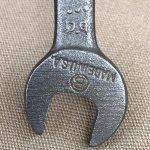
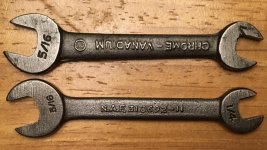
I did my side-by-side with the closest approximation in my possession, a plain steel finish CV 1020 from Oct1942. The openings are the same, but the overall impression is the 1020 is heavier—in particular, the tapered shank. The NAF has circular faces, whereas the CV has more pear-shaped faces. I had doubted the online examples of the circle-B logo were actually Bonney, and if the forged-in date code markings were not so distinctively Bonney, I would still doubt it.
 

Attachments

  • FD2126F2-36CF-4BE2-BE84-D33AD568EDB1.jpg
    FD2126F2-36CF-4BE2-BE84-D33AD568EDB1.jpg
    156.2 KB · Views: 29
  • 2B2B19B6-6364-44FF-8DFC-F435BF0E86F3.jpg
    2B2B19B6-6364-44FF-8DFC-F435BF0E86F3.jpg
    157.3 KB · Views: 29
Last edited:
To avoid these ads, REGISTER NOW!
Top Bottom