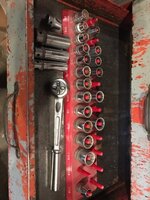
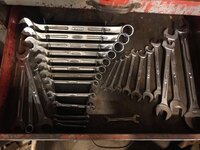
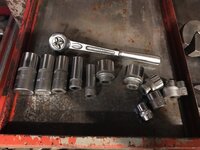
Bonney brethren,
This is going to be a long post. If you’re not interested in WWII history, kindly just skip it. I am sure someone will soon come along with a nice Bonney tool or two to drool over. If you are interested, for your skimming convenience, I have used bolds and italics to highlight key sentences.
RJ,
To set the table, I will start with some high level typical coffee table book level material, then go deeper, and finish with some recommended further reading references.
-------------------------------------------------------------------------------------------
“Roosevelt, at heart, believed the United States had an important role to play in the world, an unsurprising position for someone who counted Theodore Roosevelt and Woodrow Wilson among his political mentors. But throughout most of the 1930s, the persistence of the nation's economic woes and the presence of an isolationist streak among a significant number of Americans (and some important progressive political allies) forced FDR to trim his internationalist sails. With the coming war in Europe and Asia, FDR edged the United States into combat…[ ]… In this ominous environment, the United States had adopted an official policy of neutrality. Indeed, between 1935 and 1939, Congress passed five different Neutrality Acts that forbade American involvement in foreign conflicts. …[ ]…Roosevelt tried to water down these laws—which often made no distinction between the aggressor and the victim.”
- William E. Leuchtenberg, Professor Emeritus of History, FDR: Foreign Affairs, UVA, Miller Center
“Most Americans blamed Germany for starting the war and hoped that Britain and France would win it, but they were also very clear that the USA should stay out of it. President Roosevelt and his government saw things a little differently. They recognized the evil of the Nazi regime, and of Japan’s militarism, and that they represented a real threat to USA’s interests...[ ]....and worked steadily to oppose them. The details changed over time, but the general principles held good up to December 1941. Opponents, however, said that he deceived the American people over just how far he was going.”
- Donald Sommerville, World War II, Hermes House, Leicestershire, 2012, 60-61
“World War II began, some would say, in September 1931, when Japan attacked and in effect annexed the Chinese province of Manchuria…[ ]…In March 1936 Hitler sent troops into the Rhineland area, demilitarized by the Versailles terms…[ ]…In March 1938 the next step was to merge Austria into Germany…[ ]…Clearly, this was not going to be his last target.”
- Sommerville, 18-19
“By 1936, the War Industries Administration, which was understood from the start to be the largest and most important wartime agency, had been renamed the War Resources Administration. Its responsibilities were to include control of war finance, trade, labor, and price control organizations, with only the selective service and public relations still autonomous….[ ]…In so doing, it actually became a transitional agency, until the establishment of the projected civilian superagency at the outset of war. As such, the board drew up lists of critical materials, studied raw material needs, and eventually obtained modest appropriations for importing and stockpiling critical materials. The board also made industrial surveys and apportioned productive capacity of firms and industries whose products were sought by both services. By mid-1939, President Franklin D. Roosevelt recognized the board's importance by placing it in the executive office of the president. Thereafter, Roosevelt had direct control of the board which in turn enjoyed unanticipated prestige and visibility...[ ]...The twenty years since the end of the Great War had seen the breakdown of an international system based on the League of Nations and arms limitation agreements. The resultant American disillusionment with international affairs expressed itself in strong isolationist and pacifist sentiments. Although President Roosevelt neither shared nor pandered to this viewpoint, he understood the strength of the isolationist position. With one eye on his upcoming reelection bid in 1940, he acted carefully. Some of his New Deal supporters, notably labor leaders, feared that a preparedness drive centered on a powerful War Resources Administration would undermine much recent social legislation. So, rather than begin a massive central rearmament effort, he launched a limited preparedness campaign at the beginning of 1939, with his emphasis on increasing the striking power of the Army Air Corps. The Army, in turn, used the opportunity of the air buildup and the $575 million appropriation for a more balanced expansion. Momentum picked up after the German invasion of Poland in September and the outbreak of a general European war.”
- Marvin A. Kreidberg and Merton G. Henry, History of Military Mobilization in the United States Army, 1775-1945 (1955)
On November 14, 1938, FDR held a meeting with key War Department officials, the Army Chief of Staff General Malin Craig, deputy Chief of Staff Brigadier General George C. Marshall, and Major General Henry “Hap” Arnold, in addition to others, to discuss the state of the Army air forces. Secretary of the Treasury, Henry Morgenthau was present and noted in his diary that “the president remarked he was not sure that encouraging Hitler to make peace at Munich would save lives in the long run.” The president also wondered whether “a United States capability to produce 10,000 planes per year, and the sale of these resources to Europe, would have deterred Hitler from mobilization and subsequent occupation of the Sudetenland only months earlier”.
- Morgenthau diary as quoted in David Kaiser, No End Save Victory: How FDR led the Nation into War (New York: Basic Books, 2014), 49-50.
On November 25, 1938, retired Army General John J. Pershing wrote to the president to express his concern over the situation of US Army ground forces. Citing his experience from World War I, he urged the president “to address defense deficiencies sooner rather than later”.
- A letter from General Pershing to President Roosevelt mentioning a previous conversation to which the General was taking opportunity to summarize his “most important considerations” with respect to the status of air and ground forces with another world war looming. Franklin Delano Roosevelt. F.D.R.: His Personal Letters; 1928 – 1945, vol. 2, Elliott Roosevelt, ed. (New York: Duell, Sloan and Pearce, 1950), 837-838.
On January 12, 1939, President Franklin D. Roosevelt delivered a written message to the first session of the Seventy-Sixth Congress urging the legislative branch to move past political differences, and given the threat of another world war, to establish an even sharper increase in appropriations than 1938, needed for the national defense.
- US House Congressional Record document, “An adequate National Defense as outlined by the message of the President of the United States.” War Department General and Special Staffs, War Plans Division, RG 165, General Correspondence, 1920-1942, National Archives, College Park, MD, box 183, file 4132
“As in Volume I, primary emphasis is placed upon developments during the period when the United States was actually involved in the war—from December 1941 through August 1945. However, a history of Quartermaster activities in World War II could not begin with the attack upon Pearl Harbor or even with the declaration of the limited national emergency in 1939, for many of the Corps' wartime policies had their roots in an earlier period.”
- Keiffer and Risch, The U.S. Army in WWII, The Technical Services, The Quartermaster Corps: Organization, Supply, and Services, Center for Military History (CMH) Publication 10-12-1, Washington DC, 1955, ii
“Its Personnel Branch supervised procurement and other activities relating to personnel, both military and civilian, while its War Plans and Training Branch established and directed policies and plans pertaining to the organization of Quartermaster units, to the mobilization and movement of troops, and to all phases of training. The War Plans and Training Branch had been in effect since 1937.”
- CMH Pub 10-12-1, 142
"Early in 1939, at the direction of the General Staff, The Quartermaster General requested the Quartermaster Board to make a thorough study of all Quartermaster T/O's and recommend any revisions in the tables for motor transport and supply units considered necessary to make them conform to provisions of the Protective Mobilization Plan…[ ]…Reorganization was already under way when the war broke out in Europe and the President proclaimed a limited national emergency.”
- CMH Pub 10-12-1, 281
“Since 1933 there had been mounting appropriations for defense, the largest peacetime appropriations for military purposes in the history of the United States. When President Roosevelt stood before a joint session of Congress on 16 May 1940 to ask for over a billion dollars more, his program was almost unanimously approved by the lawmakers and the press. But some members of Congress were demanding to know whether new appropriations would "go down the same rat hole into which we have poured $7,000,000,000 during the last 6 years.”
- Thomson and Mayo, The U.S. Army in WWII, The Technical Services, The Ordnance Department: Procurement and Supply, Center of Military History (CMH) Publication 10-10, Washington D.C. 1960, 2
“The build-up of munitions for the U.S. Army was proceeding cautiously but picking up speed. Using a financial yardstick, General Wesson summed it up in the fall of 1939 as follows: In the fiscal year 1938 approximately $25,000,000 was expended for the procurement of Ordnance material. In the fiscal year 1939 approximately $50,000,000 has been and is being expended for like purposes. In the fiscal year 1940 a total of approximately $150,000,000 has been made available.”
- CMH Pub 10-10, 10
“In 1937 the Ordnance Department established an office in Wilmington, Delaware, to carry on this work, and in 1938 Congress appropriated funds for the purchase of some of the highly specialized machinery required for the mass production of powder and small arms and for the operation of loading plants.”
- CMH Pub 10-10, 11
“Perhaps the most radical departure from conventional practice, and the most highly publicized feature of Ordnance prewar procurement plans, were the educational orders. Approved by Congress in 1938,…[ ]…the purpose was to give selected manufacturers experience in producing munitions and to procure essential tools and manufacturing aids. Other supply services participated in the program to some extent, but the bulk of the educational orders were for Ordnance materiel.”
- CMH Pub 10-10, 19
“It is no doubt true, as General Harris asserted, that there was never a time in the 1938-40 period when he could not gain a sympathetic hearing from the president of any leading corporation in the United States to discuss procurement plans.”
- CMH Pub 10-10, 22
“The only qualifying element in the picture is the delay inherent in drafting requirements and forwarding them through the proper channels to Congress, with the result that expansion plans drawn up in mid-1939 before the European war broke out were obsolete when they reached Congress a year later. But the notion that the Army set its sights too low and had to be prodded into preparedness by the civilian agencies hastily organized in 1940 is a myth.”
- CMH Pub 10-10, 59
“Equipped in 1938 and 1939 with many new machine tools…[ ]…., the Ordnance arsenals were ready in 1940 to go immediately into production.”
- CMH Pub 10-10, 72
“Despite Springfield Armory's production potential, Ordnance had decided to award an educational order for the Garand rifle because of the large requirement for rifles in the Protective Mobilization Plan. In the spring of 1939 the Infantry listed the new rifle as the top priority item in the rearmament program. The million-dollar contract went to Winchester, was successfully completed, and was soon followed by large production orders.”
- CMH Pub 10-10, 158
“Springfield Armory, the traditional center for military rifle production, had begun as early as 1937 to tool up for mass production of the new Garand rifle.”
- CMH Pub 10-10, 160
“When Congress in 1938 appropriated $1,800,000 for retooling, Ordnance anticipated the project would be completed by the end of the following year and would boost production from ten thousand to fifty thousand rifles per year. This sum supplemented approximately one million dollars that had already been expended at Springfield for new equipment and gages since 1935. As the years from 1935 on had brought a gradual upswing in all activities at the Armory, Ordnance decided to modernize, to the extent of funds available, the whole Springfield manufacturing plant during the process of tooling up for output of the new rifle. While no new buildings were erected at the Armory before 1940, many improvements such as better wiring, new floors, and strengthening of supports as well as the shifting of existing machinery were required to house the new rifle producing equipment and reorganize the production line.
- CMH Pub 10-10, 162
“When Ordnance called for bids in the summer of 1939, two famous gunmaking concerns, Remington and Winchester, responded. Each submitted a bid based on the assumption that it would furnish all necessary tools and equipment. Winchester not only turned in the lower bid on this basis but also submitted an alternate bid —$1 million less—assuming use of tools and equipment being procured under its educational order. On the basis of this latter proposal, Winchester received a contract for 65,000 Garand rifles to be completed by June 1942.”
- CMH Pub 10-10, 163
“In the spring of 1939, Rock Island installed a production line capable of turning out .30-caliber machine guns at the rate of twenty five per day.”
- CMH Pub 10-10, 180
“Private companies received no contracts during the 1930's for military ammunition because they could not underbid Frankford, and the Army was forbidden by law to purchase from industry unless the price was less than the cost of arsenal-produced ammunition. But by 1936 two facts had become apparent to Army planners: (1) a major war would require, in addition to Frankford's production, large-scale manufacture by commercial arms makers in existing plants, and (2) this production would have to be supplemented by a new government-owned ammunition plant in the midwest operated for the government by a leading industrial firm. In 1936 and 1937 Ordnance representatives conferred frequently with officials of the Remington Arms Company with a view to having Remington expand its capacity in time of emergency and also take over operation of a proposed new government plant. Following these discussions a formal statement of the plan drawn up by Frankford Arsenal was concurred in by Mr. C. K. Davis, president of Remington, in 1938.”
- CMH Pub 10-10, 191
“From 1920 to 1935 no more than thirty-five tanks were built, each one a different model. The essence of mass production—acceptance of design and its exact reproduction in volume—was altogether lacking. Not until 1935-36 when sixteen medium tanks were made at Rock Island Arsenal was more than one tank of any specific model produced.”
- CMH Pub 10-10, 224
“After 1935, procurement for "remotorization of the Army" was in full swing.”
- CMH Pub 10-10, 273
“As the inspection work load mounted during 1938 and 1939 the districts appealed to the arsenals for help in supplying qualified inspectors. Nearly every district obtained one or two arsenal inspectors, but the arsenal commanders, faced with mounting work loads of their own, were reluctant to release more.”
- CMH Pub 10-10, 323
The broad background of all these events is described in Smith, Army and Economic Mobilization, Chapter V.
See also Harry B. Yoshpe, "Economic Mobilization Planning between the Two World Wars," Military Affairs (Summer 1952), p. 76.
And U.S. Congress, Senate. 74th Congress, Second Session. Hearings Before Subcommittee of Committee on Military Affairs on S. 4268, 20 May 1936
Also, if you’re familiar at all with the concept of counterintelligence, one fundamental principle is to understand your enemy through their own lens. For a good sense of how far FDR was surreptitiously going, and how it was being received by his opponents, see Borg, Dorothy, Notes on Roosevelt's "Quarantine Speech", Political Science Quarterly 72.3 (1957): 405-433, the editorial in Saturday Evening Post, vol. 211, No. 22 (November 26, 1938), which attacks the Industrial Mobilization Plan as "articles of war-time dictatorship", and in that same vein, I highly recommend any editions of the New International from 1936 through 1938, culminating in Vol IV, No. 11, November 1938, 337-340. The intellectual class Marxists in the US, concerned about the deleterious effects that a centralized government control of the entire economy would have on labor, produced some of the more detailed observations about US industrial and military mobilization in the 30's.