
You are using an out of date browser. It may not display this or other websites correctly.
You should upgrade or use an alternative browser.
You should upgrade or use an alternative browser.
Spreading the Bonney affliction!
- Thread starter bonneyman
- Start date
Private Lugnutz
Well-known member


Raineman
Well-known member
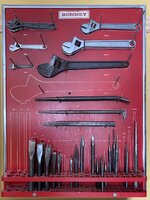
Oh wow LS. I didn't know they were stacked 3 deep. Sweet.I have the chisels 2/3 represented and the total about 44% filled. Most of the chisels I see are older than the board, made from heavier steel, so a few don’t fit the holes. Several of the long sizes I have never seen.
Oldtuleguy
Well-known member
- Joined
- Nov 4, 2017
- Messages
- 10,486


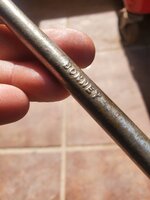

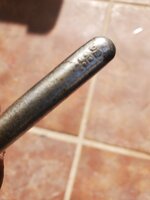

Christmas in June! I had purchased a double-handful of Bonney out of one guy’s bins at Jake’s last fall, and apparently left them wrapped up in a double bag, having never documented them. Moving some stuff around, I came across them this morning. What a great surprise.
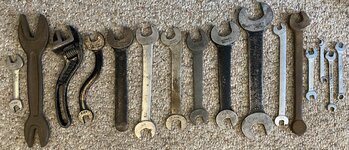
The japanned S-DOE and the Streamline combo are both Whitworth. The unfinished combo has no identifying marks, but is identical in length and geometry to TuType TuHex166 / Bonaloy1166 from 1930/40s, though Armstrong and Billings from then are also very similar.
The japanned S-DOE and the Streamline combo are both Whitworth. The unfinished combo has no identifying marks, but is identical in length and geometry to TuType TuHex166 / Bonaloy1166 from 1930/40s, though Armstrong and Billings from then are also very similar.
Oldtuleguy
Well-known member
- Joined
- Nov 4, 2017
- Messages
- 10,486

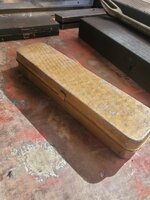

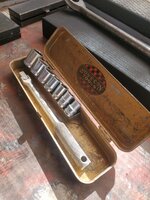

GarageHobbyist
Well-known member
This is my first Bonney tool (I think, I might have a wrench somewhere). Need to get them cleaned up.
1610 locking pliers.


1610 locking pliers.
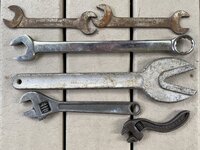
Picked up a few more yesterday morning at Leesport flea market, all for $18.
Two CV 408 tappet wrenches, date code AP (Jan1924). Interestingly, I already had exactly one 408, and it has the same date code.
Full polish LocRite broach 1-1/16” 1171 combo. I have seen these in similar sizes and been unable to negotiate them down below $20!
No3 fixed jaw pipe wrench with “Bonney Vise and Tool Works Inc Allentown PA USA” and no date code, so 1909-1921.
BW10 adjustable, Utica-mfd, plain finish.
6” S-adjustable with shield broach. I have occasionally seen this size, but never for less than 3x what I paid. I already have an 8” with this style broach, so only my way to a collection.
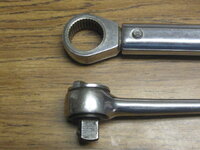
Some time ago I learned off the forum about putting 3/8" drive anvils into 1/4" ratchet body's. The idea being one could only fit a 1/4" ratchet into a space, but needed a larger socket than typical 1/4" drive sockets provide. I assemble a couple, and they are quite novel. With Bonney's, the 3/8" TR gear assembly would swap right into one of their 1/4" drive -702 ratchets. Since then I've wondered whether a 1/2" drive TR gear would fit into a 3/8" drive ratchet? A stubby 3/8" with a 1/2" anvil might be useful, though I can't think of a reason I would need one. Perhaps a front end guy could use such a contraption to initially run up a nut or something.
Well, the answer is YES! Came across a Utica TR 1/2" drive for $10, and grabbed it to see if the gear assembly would slide into a 3/8" rat. It does! So I post some pics for those interested.
The gear teeth on the TR gear are fairly worn. Come to find out they are the same size as the 3/8" pawls. Maybe Bonney pushed the steel a little too far by going to the higher torque of the 1/2" drive? Anyway I'll keep a lookout for a 3/8" donor rat and swap out the pawls
Well, the answer is YES! Came across a Utica TR 1/2" drive for $10, and grabbed it to see if the gear assembly would slide into a 3/8" rat. It does! So I post some pics for those interested.
The gear teeth on the TR gear are fairly worn. Come to find out they are the same size as the 3/8" pawls. Maybe Bonney pushed the steel a little too far by going to the higher torque of the 1/2" drive? Anyway I'll keep a lookout for a 3/8" donor rat and swap out the pawls
Attachments


GarageHobbyist
Well-known member
Here is a before and after on these 1610s


mritchie77
Well-known member
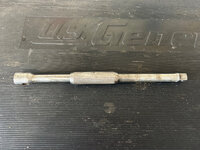
Bonney "CV" 4091 1/2dr extension that I picked up on eBay for the MC set that I am very slowly building. Honest wear, not beat up.
Oldtuleguy
Well-known member
- Joined
- Nov 4, 2017
- Messages
- 10,486
Any pics of set?
3baygarage
Well-known member


Oldtuleguy
Well-known member
- Joined
- Nov 4, 2017
- Messages
- 10,486
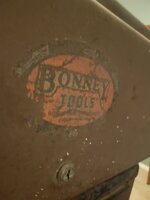
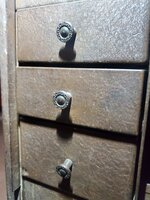
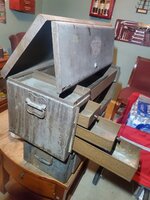
Picked this up for 40 clams after wagonho! put out an apb on it...
Attachments



Private Lugnutz
Well-known member
Wow. Wartime brown and a martial "US" stamp!
Oldtuleguy
Well-known member
- Joined
- Nov 4, 2017
- Messages
- 10,486
The guy said it was from a military base.
Mikeske
Well-known member
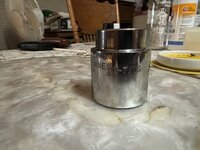
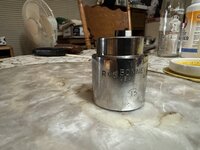
Mikeske
Well-known member
OH yes things like the wings attachments, the tail, engines, landing gear and multiple other things that required larger fasteners, If you notice on the pictures there is a circle around the letter B and another thing that says TR 814. The TR 814 was a toolroom on the 747 line when it was an active program. The 747 is no produced and the area has been cleared for other purposesDid you use alot of 3/4" drive stuff on aircraft, Mike?
Patrick Eubanks
Well-known member
- Joined
- Mar 15, 2023
- Messages
- 517
Man that’s nicePicked this up for 40 clams after wagonho! put out an apb on it...
Oldtuleguy
Well-known member
- Joined
- Nov 4, 2017
- Messages
- 10,486
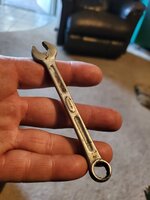

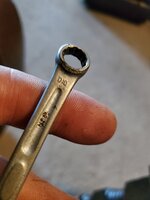
Oh, OK, I didn't realize that you did all that. I kinda figured there were specialties within aviation repair - instrumentation, airframe, powerplant, etc. - and didn't know what you did. In HVAC there are a bunch of different specialties, and most technicians choose one area that they want to focus on. I figured - wrongly as it worked out - that those rules applied to you.OH yes things like the wings attachments, the tail, engines, landing gear and multiple other things that required larger fasteners, If you notice on the pictures there is a circle around the letter B and another thing that says TR 814. The TR 814 was a toolroom on the 747 line when it was an active program. The 747 is no produced and the area has been cleared for other purposes
Mikeske
Well-known member
I was aircraft structural repair and that entails almost the entire aircraft (including composite panels). The areas I did not do was avionic, hydraulic, air conditioning and functional testing as that was a specialist job. My last 20 years in the field I mainly worked on the interior installation because I had an inner ear disorder (inherited) that would give me vertigo at the worst possible moments so it kept me off the exterior of the aircraft. I had to shift my focus but I worked in the cargo bays, and the main deck of the aircraft. I still was able to keep my airframe and power plant certs which also afforded me premium pay for it.Oh, OK, I didn't realize that you did all that. I kinda figured there were specialties within aviation repair - instrumentation, airframe, powerplant, etc. - and didn't know what you did. In HVAC there are a bunch of different specialties, and most technicians choose one area that they want to focus on. I figured - wrongly as it worked out - that those rules applied to you.
mritchie77
Well-known member

Patrick Eubanks
Well-known member
- Joined
- Mar 15, 2023
- Messages
- 517
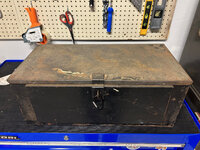
I really like that box. Much different lay out than mineApologies for the delay. Here are some.

mritchie77
Well-known member
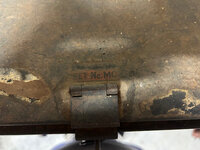
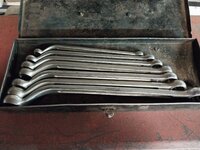
@Oldtuleguy and @Patrick Eubanks, forgot to put this one up earlier, but the original "Set No. MC" decal is present next to the latch.
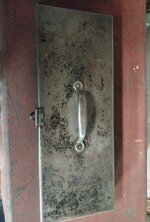
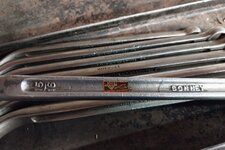
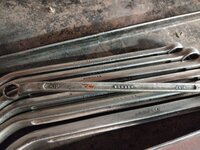
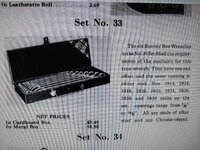
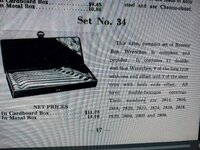
7/16 to 15/16 same size on each end box wrenches. Offset and straight. Still have the little label on them. Date codes are T,U,V (1928 - 1930 ) and it looks like the correct box. I wonder if a set from the factory would have date codes from 3 different years.
Edit: The box looks like the No 34 set, but it would be missing the 3 small wrenches. It has all the wrenches for the No 33 set.
Edit: The box looks like the No 34 set, but it would be missing the 3 small wrenches. It has all the wrenches for the No 33 set.
Attachments
Last edited:
RTM
Well-known member
Funny, I pulled one of these from last weekend's shop cleanout, a 2820 5/8" Bonnet Zenel. Just finished taking pix a few minutes ago, so the print may still be a bit damp.7/16 to 15/16 same size on each end box wrenches. Offset and straight
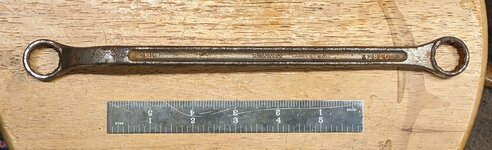
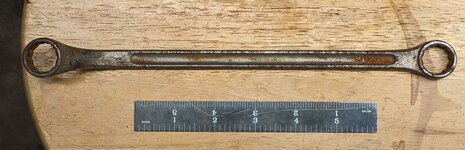
Again, if this finishes a set for someone, holler. I'm a long way away from a set, unlike ararat.
Last edited:
Private Lugnutz
Well-known member
Short answer:Date codes are T,U,V (1928 - 1930 ) and it looks like the correct box. I wonder if a set from the factory would have date codes from 3 different years.
Based on my collection, I believe your wrenches are original to your box and vice versa, and the alternatives (a PO or multiple PO's bought the set, some of the wrenches, and then some replacements in a three-year series of stages) is far less reasonable. I have several sets that span two years. Granted, three years is quite a stretch, but not those three years, in particular. The Great Depression started in 1929. I have several Snap-on pieces in the 'Great Depression drawer' of my Snap-on Wing that have 1928, 1929, and 1930 date codes, and even one with all those and a 1931 date code! In that case, they kept re-coding them until they sold, years later. In your case, I would speculate that the pieces were sitting in unsold inventory until they were plucked out of their respective bins and assembled for that set.
Longer answer with examples to follow...
Private Lugnutz
Well-known member
Longer answer:
As you may recall, @ararat, I have three complete Bonney wrench sets in pouches and I have no reason to doubt their provenance together: a No. 25 engineers wrench set, a No. 412 tappet wrench set, and a No. 20 -ZENEL- miniature engineers wrench set.
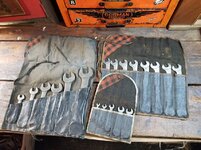
None of them have 'perfectly matching' date codes (i.e., from the same month-year or even from the same year). Close, but they are all "mixed" in terms of date codes.
The No. 25 engineers set dates codes are "CV" (1027-C), "DV" (1731-A), "GV" (1033-C), "GV" (1028-S), and "FU" (1723). So, produced between early to mid 1943 and then in early 1944.
The No. 20 miniature engineers -ZENEL- set has three wrenches with an "ET" code, and the rest too hard to read. Probably all 1942.
The No. 412 tappet set dates codes are "LP" (404, 405) and "EQ" (402, 403), so, late 1924 and then mid 1925.
I also have a No. ES5 extra small sockets & tools set in its original steel case.
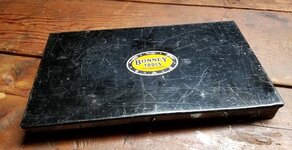
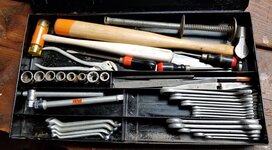
This is a prewar set. Most of the tools are original to the case, but are not date coded. The box wrenches (E40, E42, E44, E46) have date codes “FM”, “HM", “IM” and "IM", so, all made in 1935, but, note, over a 4-month span. (The other wrenches will be no help here, they are all 1947 replacements.)
As I alluded to in the short answer above, and as I have discussed on this thread before, I think the mixed date codes we see in Bonney sets are a function of an operation in which the manufacturing (drop forging, finishing, and storing) was always ahead (in considerable surplus) of production (assembly, packaging, and distribution) and sales. In short, I believe Bonney tools in the 1920's and 1930's were in fact routinely sitting around for some length of time - weeks, months, and sometimes many months spanning two years before they were assembled into sets (pouches, boxes, etc). When that assembly happened, I don't believe the assemblers cared about date codes, and inevitably, some would be the same month-year, some might be a few months behind, but the same year, and, less commonly, some might be several months and possibly a year behind.
I don't believe I have ever seen ANY Bonney set of tools in a pouch or case with all the same exact date codes (from the same month-year). It's possible. I'm just saying it's not at all uncommon to see them more varied.
As you may recall, @ararat, I have three complete Bonney wrench sets in pouches and I have no reason to doubt their provenance together: a No. 25 engineers wrench set, a No. 412 tappet wrench set, and a No. 20 -ZENEL- miniature engineers wrench set.
None of them have 'perfectly matching' date codes (i.e., from the same month-year or even from the same year). Close, but they are all "mixed" in terms of date codes.
The No. 25 engineers set dates codes are "CV" (1027-C), "DV" (1731-A), "GV" (1033-C), "GV" (1028-S), and "FU" (1723). So, produced between early to mid 1943 and then in early 1944.
The No. 20 miniature engineers -ZENEL- set has three wrenches with an "ET" code, and the rest too hard to read. Probably all 1942.
The No. 412 tappet set dates codes are "LP" (404, 405) and "EQ" (402, 403), so, late 1924 and then mid 1925.
I also have a No. ES5 extra small sockets & tools set in its original steel case.
This is a prewar set. Most of the tools are original to the case, but are not date coded. The box wrenches (E40, E42, E44, E46) have date codes “FM”, “HM", “IM” and "IM", so, all made in 1935, but, note, over a 4-month span. (The other wrenches will be no help here, they are all 1947 replacements.)
As I alluded to in the short answer above, and as I have discussed on this thread before, I think the mixed date codes we see in Bonney sets are a function of an operation in which the manufacturing (drop forging, finishing, and storing) was always ahead (in considerable surplus) of production (assembly, packaging, and distribution) and sales. In short, I believe Bonney tools in the 1920's and 1930's were in fact routinely sitting around for some length of time - weeks, months, and sometimes many months spanning two years before they were assembled into sets (pouches, boxes, etc). When that assembly happened, I don't believe the assemblers cared about date codes, and inevitably, some would be the same month-year, some might be a few months behind, but the same year, and, less commonly, some might be several months and possibly a year behind.
I don't believe I have ever seen ANY Bonney set of tools in a pouch or case with all the same exact date codes (from the same month-year). It's possible. I'm just saying it's not at all uncommon to see them more varied.
Private Lugnutz
Well-known member
@ararat
In my alacrity to provide an answer and some back-up that would ease your mind on the originality of your No. 33/34 single offset DBE kit, I failed to congratulate you on your find and/or acquisition! It's a wonderful kit, and were it mine, I would use it like a 'Living History' display for the start of the Great Depression.
In my alacrity to provide an answer and some back-up that would ease your mind on the originality of your No. 33/34 single offset DBE kit, I failed to congratulate you on your find and/or acquisition! It's a wonderful kit, and were it mine, I would use it like a 'Living History' display for the start of the Great Depression.
I appreciate the fact that I am in the distinct minority, but I am not completely convinced that these are, in fact, date codes.
I don't see how the logistics of constantly re-marking the dies would be practical. Especially considering there does not seem to be any 'witness' to the changes.
Just my opinion, as I have NOTHING concrete to base that on.
I am always interested in following these date code threads.
Thanks all for your posts.
I don't see how the logistics of constantly re-marking the dies would be practical. Especially considering there does not seem to be any 'witness' to the changes.
Just my opinion, as I have NOTHING concrete to base that on.
I am always interested in following these date code threads.
Thanks all for your posts.
four.cycle
Well-known member
^ I would not only fully agree with that, I'd posit the same situation existed at other tool manufacturing factories as well. It simply would not be possible, in a 20-day work month, to set up production lines and produce every single item in the catalog within that month.the mixed date codes we see in Bonney sets are a function of an operation in which the manufacturing (drop forging, finishing, and storing) was always ahead (in considerable surplus) of production (assembly, packaging, and distribution) and sales.
<edit> Even if it was wartime production, 7 days a week, running three shifts, you'd still have the same situation: there's too many part numbers to produce all of them at the same time.
Thanks for the great information. I was leaning towards it being an original group. They might not have cared about First in, First out inventory and could have led to multiple years in the same set if the stock didn't get depleted. The depression slowing down sales makes sense.@ararat
In my alacrity to provide an answer and some back-up that would ease your mind on the originality of your No. 33/34 single offset DBE kit, I failed to congratulate you on your find and/or acquisition! It's a wonderful kit, and were it mine, I would use it like a 'Living History' display for the start of the Great Depression.
Not sure if I will try to add wrenches to complete the No 34 or leave it as a No 33.
That No ES5 set is awesome.
Ricky Joe
Well-known member
During the war, production got far ahead of demand; so much so that manufacturers started pushing for “reconversion “, the ability to sell to the public consumer again, which had been denied by wartime restrictions. Almost immediately, there developed shortages, on paper at least, so that justification for reconversion would not be, and wartime restrictions remained in place until the war was declared won. Quite an interesting side note regarding tool production.^ I would not only fully agree with that, I'd posit the same situation existed at other tool manufacturing factories as well. It simply would not be possible, in a 20-day work month, to set up production lines and produce every single item in the catalog within that month.
<edit> Even if it was wartime production, 7 days a week, running three shifts, you'd still have the same situation: there's too many part numbers to produce all of them at the same time.
Private Lugnutz
Well-known member
That's a fallacy. No wartime restrictions ever forbade consumer sales. No total ban on commercial hand tools ever existed during WWII....the ability to sell to the public consumer again, which had been denied by wartime restrictions.
Most major hand tools mfgrs (including Snap-on, Cornwell, Plomb, Williams, and several others) published commercial sales catalogs during WWII. All of them have WPB Limitation Order L-216 notices. None of the notices indicate a total ban. The catalogs or accompanying price lists are redlined.
WPB Limitation Order L-216 restricted manufacturers from making specific types and sizes of tools. In all cases the tools that were restricted were, by definition, functionally redundant to other types and sizes of tools that were available to consumers in other configurations. Think about the overlaps in openings in socket drive sizes, for example, where the largest two or three 3/8-drive socket openings were available in the smallest two or three 1/2-inch drive socket openings. Scratched. Think about extensions in three or four different OALs. Scratched. Think about ratchets with different OALs. Scratched. Think about box ends with different kinds of offsets. Scratched. Selling entire sets of tools was also restricted, because big master sets included restricted tools, and because that practice could potentially quickly deplete inventory and turn into new demand for steel.
The goal was the conservation of precious alloys.
I have a copy of WPB Limitation Order L-216 and I have examined it against the wartime catalogs of the major mfgrs I alluded to above. They are perfectly consistent.
Private Lugnutz
Well-known member
Snagged a couple Bonney pieces at the flea this morning.
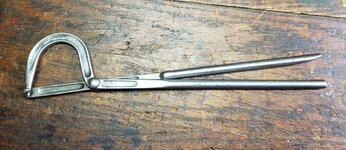
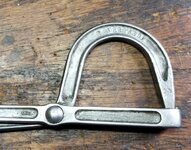
Up first, these No. 2680 brake spring pliers. I've found and posted a few of these before, moved on to other collectors years ago. They were first introduced in the 1939 catalog. Some are marked PAT PEND on the horseshoe, some are marked with the patent (2,264,391), which was granted in 1941. They are featured in WWII Ordnance Dept maintenance catalogs. I've had them with prewar, wartime, and postwar date codes. This example is 1953 (E:Q).
Up first, these No. 2680 brake spring pliers. I've found and posted a few of these before, moved on to other collectors years ago. They were first introduced in the 1939 catalog. Some are marked PAT PEND on the horseshoe, some are marked with the patent (2,264,391), which was granted in 1941. They are featured in WWII Ordnance Dept maintenance catalogs. I've had them with prewar, wartime, and postwar date codes. This example is 1953 (E:Q).
Attachments


Private Lugnutz
Well-known member
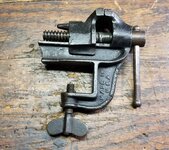
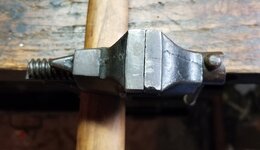
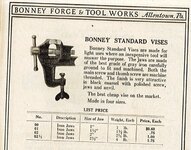
Also snagged this Standard No. 00 (1" jaws) vise. No Bonney logo, but the "MADE IN U.S.A." marking matches my other Bonney vises, the appearance is unmistakable, and the "00" marking nails it. Missing the cup for the bench clamp, unfortunately. @LesserSon found and posted one back in March.
Attachments

Ricky Joe
Well-known member
I don’t mean to beat a dead horse, but are you not familiar with the efforts for reconversion and against it during the last two years of the war? As thorough as I know you to be, it is hard for me to believe that you are not at least tangentially aware of efforts to obtain a lifting of restrictions by manufacturers who had far exceeded wartime contract quotas and the efforts to prevent reconversion by some of the big companies, to the point that shortages miraculously appeared in areas that had shown surplus supplies immediately before the effort. I find it interesting.That's a fallacy. No wartime restrictions ever forbade consumer sales. No total ban on commercial hand tools ever existed during WWII.
Most major hand tools mfgrs (including Snap-on, Cornwell, Plomb, Williams, and several others) published commercial sales catalogs during WWII. All of them have WPB Limitation Order L-216 notices. None of the notices indicate a total ban. The catalogs or accompanying price lists are redlined.
WPB Limitation Order L-216 restricted manufacturers from making specific types and sizes of tools. In all cases the tools that were restricted were, by definition, functionally redundant to other types and sizes of tools that were available to consumers in other configurations. Think about the overlaps in openings in socket drive sizes, for example, where the largest two or three 3/8-drive socket openings were available in the smallest two or three 1/2-inch drive socket openings. Scratched. Think about extensions in three or four different OALs. Scratched. Think about ratchets with different OALs. Scratched. Think about box ends with different kinds of offsets. Scratched. Selling entire sets of tools was also restricted, because big master sets included restricted tools, and because that practice could potentially quickly deplete inventory and turn into new demand for steel.
The goal was the conservation of precious alloys.
I have a copy of WPB Limitation Order L-216 and I have examined it against the wartime catalogs of the major mfgrs I alluded to above. They are perfectly consistent.
Oldtuleguy
Well-known member
- Joined
- Nov 4, 2017
- Messages
- 10,486
It's all about the Benjamin's