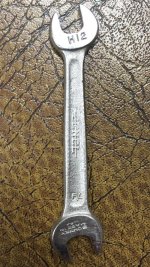
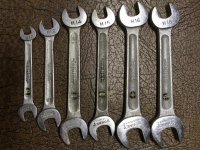
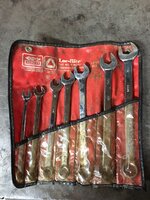
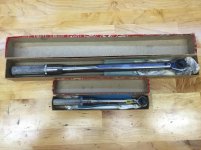
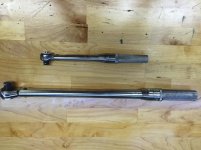
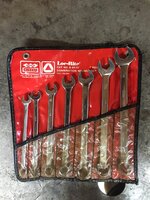
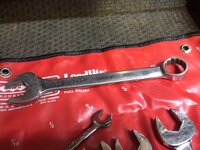
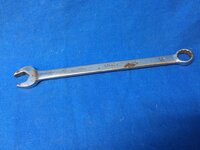
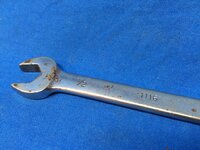
I was looking at my Zenel does today (I know, what else do people do on Mondays?) and thinking about date codes. I expect my collection is small enough that any statistical observations I make are bound to be misleading, but I noticed that I tend to have multiple examples of a specific month/year, with large time gaps between, rather than several months and years spread evenly through a period of time.
For instance, one Dec1934; one Nov1936; one Aug1940; three Jan1943; three Nov1945; one Feb1946, one Jun1946, two Oct1946; two Jan1947, two Mar1947, one Jun1947.
If this pattern held true for larger sample sizes (ideally, everyone's Bonney collection) it could show production patterns of various tools. It seems unlikely Bonney would have a dedicated forging set-up for every tool they offered in constant production, but rather they would respond to demand on dwindling supply by assigning the production of that tool to equipment that was currently producing something for which demand was lower than existing inventory.
This would mean, perhaps, no Zenel does (of a given size at least) might be produced in 1944, despite being sold continuously from existing inventory.
Also, since the forged date codes actually mark the creations of forging dies, rather than individual tools, it may be the gaps represent periods when the tools were actually in production, but on dies created months and even years prior. Maybe gaps such as I am seeing (again, my sample size is so small as to mislead), indicate that dies were never created for certain months, and perhaps, certain years, because existing dies were in good condition, whether the tools were in or out of production.