To avoid these ads, REGISTER NOW!

Spreading the Bonney affliction!

Private Lugnutz

Well-known member
Joined
Mar 30, 2012
Messages
30,473
Location
The Authentic Jersey Shore
Hmmm, I could go for that. I think they dropped the ball in a few areas. Heck, most companies do.
Agreed. You guys won't like to hear it, but the ball started dropping, in my opinion, when they were conglomerated with Herbrand and Utica in South Carolina. I'm not saying they made inferior tools in the Triangle era. I just think that step was the long beginning of the end. Once they lost control of their designs, die-making and dies, the concept of outsourcing everything is one easy step away.
 
To avoid these ads, REGISTER NOW!

Mikeske

Well-known member
Joined
Apr 28, 2017
Messages
2,122
Location
Washington State
Agreed. You guys won't like to hear it, but the ball started dropping, in my opinion, when they were conglomerated with Herbrand and Utica in South Carolina. I'm not saying they made inferior tools in the Triangle era. I just think that step was the long beginning of the end. Once they lost control of their designs, die-making and dies, the concept of outsourcing everything is one easy step away.
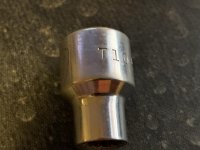
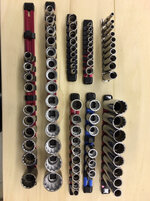
Yeah I have to agree with that statement as they just kind of lost it when they were combined. But then today I hit a pawn shop that I got Bonney tools out of and in the first bin at the door and about the third socket I pick up I found a T10 Bonney 5/16ths 3/8th drive socket. For .35 cents I have another item for the collection. That makes it the third one I have in that size.

I am willing to barter for any of the extras
 

Attachments

  • fullsizeoutput_e58.jpg
    fullsizeoutput_e58.jpg
    130.2 KB · Views: 12
  • fullsizeoutput_e59.jpg
    fullsizeoutput_e59.jpg
    125 KB · Views: 10
  • fullsizeoutput_e5b.jpg
    fullsizeoutput_e5b.jpg
    146.5 KB · Views: 11
Last edited:
OP
B

bonneyman

Well-known member
Joined
Apr 22, 2010
Messages
8,758
Location
Desert SW
Agreed. You guys won't like to hear it, but the ball started dropping, in my opinion, when they were conglomerated with Herbrand and Utica in South Carolina. I'm not saying they made inferior tools in the Triangle era. I just think that step was the long beginning of the end. Once they lost control of their designs, die-making and dies, the concept of outsourcing everything is one easy step away.

Agreed. When a company gets absorbed, annexed, conglomerated, merged, etc it's most often NOT a good sign. Lets face it - if a company was doing great, is well respected, and established, they won't be bought out. Usually.
The company stockholders had to have agreed to the merger with K-H, so, for some reason those people decided it was more advantageous to sell out. Then it was resold and rebought out a couple more times before finally the end came. Not due to anything Bonney itself was doing as far as the tools were concerned. So it was all due to the higher ups. Sad.
 

LesserSon

Well-known member
Joined
Feb 7, 2016
Messages
5,047
Location
PA USA
Bonney’s story reminds me of a Thomas Hardy novel.
CS Bonney gave it life and a name. It labored as a cheerful naif, custom-forging the diverse products of his inventive mind. Then, just as it began to display the awkward charms of adololescece, it was indentured, passed around like chattel to Newkirk, Ritchie, then Bills, finally plucked like a destitute jade from the gutter by JE Durham, rehabilitated and presented as a graduation present to his sons.
It remained a family-owned, family-run business for over forty years. The Durham brothers diversified its line and built it into an industry leader. But it was a TINY GIANT.
Fred Durham died in 1949. His brother and his son continued for a couple years without him, but Bonney is really just a well-regarded brand with a few promising assets after its acquisition by Miller, paraded like arm candy for a decade before being spurned off to Utica, the domineering madame of Kelsey-Hayes. In the final act, Bonney finds redemption through honest work under the sheltering roof of Triangle house commune, only to have THAT absorbed and digested by Cooper. Bonney is stripped of its tool-making habiliments and cast aside, too gray-haired and wise now to be a mere toy or corporate plaything, finding honest, fulfilling work again forging valves and fittings for a world-wide market. -fin-
1949 Fred S Durham I dies
1953 Miller Manufacturing acquires Bonney
1954 Fred S Durham II resigns
1955 J Edward Durham dies
1956 Alliance plant opens
1961 LocRite patent applied for
1964 Utica(Kelsey Hayes) acquires Bonney, LocRite patent issued, Alliance plant closed
1967 Triangle formed, LocRite goes into production, Fred S Durham dies
 
Last edited:
OP
B

bonneyman

Well-known member
Joined
Apr 22, 2010
Messages
8,758
Location
Desert SW
Yeah, Lesser, it does seem like Bonney opened, closed, and moved facilities alot. Maybe the mother company didn't know what to do with it, or had other plans already. Just seems like so many people speak so highly of Bonney and it's quality and wishing it could come back, makes you wonder how such a great company could go under. :(
 

GrayFlattop

Well-known member
Joined
Jan 18, 2018
Messages
1,039
Location
Chicago
Sadly, even if a company makes a top-notch product, that alone does not guarantee profitability or longevity.

And times change. If a company is not nimble enough to adapt to changes in marketing strategies / preferences, that too can create too much of a headwind to overcome (i.e. Sears).

I never knew that Bonney attempted distribution via tool trucks (learn something new on GJ every day), but that is a difficult arena in which to survive. The Industrial distribution channel (I do remember when WW Grainger carried the line) is also an uphill battle that was filled with many worthy full-line competitors such as Proto, Williams, Armstrong, etc. - how do you effectively elbow your way into that market on a sustained basis?

And then, before the auto parts market became flooded with mass-marketers (such as AutoZone, Advance Auto, Pep Boys going from regional to National, etc.) there was a niche channel known as Automotive Warehouse / Distributors (automotive WD) that served as regional wholesalers to the many independent auto parts stores across the land. I know as I worked for two different ones in the 80's and it was a cut throat business (four years of my life on that detour, but I was able to buy a bunch of tools at cost!). To get shelf space in parts stores, tool manufacturers would buy back inventory from their competitors (a practice known as inventory lift). Manufacturers would have miscellaneous tools from other brands by the truckload and they would sell them the same way - by the pound. Auto parts stores would flip from Duro (or any brand) to SK (or any brand) for better terms - tool quality was a secondary consideration.

I had one customer that ran a phone room (this was pre-internet) and he would literally buy trailers of inventory lift, go through it, make sets and market it by having his crew cold-call repair shops and farmers - selling to them direct at very good margins, but it was a grind of an existence for their telemarketers. The literally did it the old fashioned way using phone books as their source of leads - it was almost like something out of a movie.

It was through this customer that I got my hands on my first Bonney full-polish line wrenches. The tools were beautiful and the broaching performed so very well as we know. Prior to that, my first Bonney was a 40's breaker bar followed by a Utica Bonney 1/2" torque wrench in the early 80's (it made my C-Man torque wrench look sick by comparison).

Sadly by the time I was admiring those full polish line wrenches, the final chapters of Bonney seemed preordained. Good domestic competition that became commoditized - the distribution network turned on its head and the flood of good quality imported tools from Japan - (followed by ham-fisted tools from Taiwan that subsequently morphed into high quality competition).

Then the Internet happened - BOOM.

Honestly, it's a miracle that companies like Proto and Williams have managed to hang on.

But when you hold a classic tool in your hand, you are holding more than a tool - you are holding a bit of our history and that the other reason I suspect most of us have turned to collecting. Using these tools pays tribute.

Thanks for listening.

Pardon me know while I go to ebay to see what I can find this morning...
 

Private Lugnutz

Well-known member
Joined
Mar 30, 2012
Messages
30,473
Location
The Authentic Jersey Shore
I'll agree with "tiny giant," an apt description, LS!

Even though the ownership changed hands quite a bit, I'm not sure I would characterize Bonney as having a history of opening, closing, and moving, bonneyman. Keep in mind that they had one plant, in Allentown, PA, between 1906 and 1956. That was a good long run of high-quality tools under one roof. And, even though the new Alliance, Ohio plant (under Miller ownership) was considered their new home in 1957, they never did close the Allentown plant behind them. LesserSon may know the exact date the Allentown plant closed, but it may have even remained in operation after the move from Alliance, Ohio to Orangeburg, SC, under Kelsey-Hayes ownership, with Utica and Herbrand, in 1964. In my opinion, they soon began to lose their unique identity after that.

EDIT: As for going under, weren't the operations of Bonney, Utica, and Herbrand all discontinued by Cooper (who acquired Triangle) at the same time in the late 90's? Weren't the tools by then so indistinguishable that it would be hard to pinpoint their demise to the engineering, manufacturing or marketing of any one of the three brands?
 
Last edited:

Private Lugnutz

Well-known member
Joined
Mar 30, 2012
Messages
30,473
Location
The Authentic Jersey Shore
One more quick note about LesserSon's excellent Bonney timeline summary...

Loc-Rite really doesn't belong in there as far as I have been able to determine. It seems to get linked to Bonney all the time, by virtue of their production numbers, but Loc-Rite was not a Bonney design.

When Alfred Kavalar applied for the patent in 1961, he was an assignor to Kelsey-Hayes. Bonney was not bought by Kelsey-Hayes until 1964, when the Loc-Rite patent (3,125,910) was granted. The design, with fixed rounded rocking action, can be traced to Kavalar’s earlier Cam-Loc design, with spring-loaded moving rollers rocking action, which he cites among others in his Loc-Rite patent. When Kavalar patented Cam-Loc (2,550,010) in 1951, he had no connection to Bonney or any other tool makers. As far as I have been able to determine, he licensed use-rights for his Cam-Loc design to several tool makers, including T.K. Fisher, Swagelok, Snap-on, and of course, Bonney.

Note also that the Loc-Rite name was trademarked by Kelsey-Hayes (EDIT: #789,030, May 4, 1965, first use - Feb 14, 1964) and placed on wrenches branded Kelsey-Hayes, Utica, and Bonney. I’m not sure why they never gave it to Herbrand.

If LS or anyone has different data, I'd be curious to see it.
 
Last edited:
OP
B

bonneyman

Well-known member
Joined
Apr 22, 2010
Messages
8,758
Location
Desert SW
One more quick note about LesserSon's excellent Bonney timeline summary...

Loc-Rite really doesn't belong in there as far as I have been able to determine. It seems to get linked to Bonney all the time, by virtue of their production numbers, but Loc-Rite was not a Bonney design.

When Alfred Kavalar applied for the patent in 1961, he was an assignor to Kelsey-Hayes. Bonney was not bought by Kelsey-Hayes until 1964, when the Loc-Rite patent (3,125,910) was granted. The design, with fixed rounded rocking action, can be traced to Kavalar’s earlier Cam-Loc design, with spring-loaded moving rollers rocking action, which he cites among others in his Loc-Rite patent. When Kavalar patented Cam-Loc (2,550,010) in 1951, he had no connection to Bonney or any other tool makers. As far as I have been able to determine, he licensed use-rights for his Cam-Loc design to several tool makers, including T.K. Fisher, Swagelok, Snap-on, and of course, Bonney.

Note also that the Loc-Rite name was trademarked by Kelsey-Hayes (EDIT: #789,030, May 4, 1965, first use - Feb 14, 1964) and placed on wrenches branded Kelsey-Hayes, Utica, and Bonney. I’m not sure why they never gave it to Herbrand.

If LS or anyone has different data, I'd be curious to see it.
I have a pretty good amount of research over at the GG, but here are some highlights.

A. Kavalar lived in Detroit and worked for Ford in the 1940's. According to the patent, his Cam-Loc roller design appears to have been manufactured by T.K.F. (Timmerman, Kipp, and Foster), a company who specialized in brewery equipment and pasteurizers at the time. Seems as though they were looking for a wrench to evenly tighten the fittings on their drinking stuff!
Right after WW2 UMS (I have wrench's marked that way) became a full-fledged division at GM, and one of their sub-divisions (Delco) started focusing on brake systems and boosters. Cam-Loc would have been a boon to that industry!
Kelsey-Haynes was formed in 1927. After weathering the Depression they started making brakes components for Ford. In 1947 they acquired another brake parts manufacturer and started supplying brake components to all the Detroit car makers. And evenly-torqued, liquid-tight connections were a necessity, which the Cam-Loc fulfilled.
All of these happening around the same time - in Detroit - probably lead to alot of technology licensing and sharing, as I have examples of wrenches bearing all these trademark names.

As Lugnutz has stated, Loc-Rite is a derivation of Cam-Loc, patented about 13 years later. At that time it was assigned to K-H out of Romulus, Michigan (a suburb of Detroit). My feeling is K-H had seen the benefits of the off-corner engagement system and thought a forged steel version would prove effective - and lot cheaper to manufacture than the movable pins of Cam-Loc.
 
Last edited:
OP
B

bonneyman

Well-known member
Joined
Apr 22, 2010
Messages
8,758
Location
Desert SW
I'll agree with "tiny giant," an apt description, LS!

Even though the ownership changed hands quite a bit, I'm not sure I would characterize Bonney as having a history of opening, closing, and moving, bonneyman. Keep in mind that they had one plant, in Allentown, PA, between 1906 and 1956. That was a good long run of high-quality tools under one roof. And, even though the new Alliance, Ohio plant (under Miller ownership) was considered their new home in 1957, they never did close the Allentown plant behind them. LesserSon may know the exact date the Allentown plant closed, but it may have even remained in operation after the move from Alliance, Ohio to Orangeburg, SC, under Kelsey-Hayes ownership, with Utica and Herbrand, in 1964. In my opinion, they soon began to lose their unique identity after that.

EDIT: As for going under, weren't the operations of Bonney, Utica, and Herbrand all discontinued by Cooper (who acquired Triangle) at the same time in the late 90's? Weren't the tools by then so indistinguishable that it would be hard to pinpoint their demise to the engineering, manufacturing or marketing of any one of the three brands?

I should have specified the time frame on the relocating statement. From the 1950's on it sure seemed like Bonney was moving manufacturing alot. Though once they moved to Orangeburg, S.C. they seemed to stay there until they were shut down.

From what I've been able to decipher, Herbrand was still soldiering on into the 1970's but was eventually folded as a distinct branding.
http://progress-is-fine.blogspot.com/2013/04/we-used-to-make-things-in-this-country_13.html

Utica and Bonney were kept rolling. I surmise that the existing tooling was kept running and not majorly modernized or updated, which probably helped Bonney stay profitable to the end. ( I surmise this from the fact that I own Cam-Loc wrenches marked Bonney and Utica, but otherwise identical. I don't see the company re-doing the tooling on a wrench style that was obviously in decreasing demand). But then Cooper swooped in, and basically all they wanted was the Utica division for their pliers - Bonney just came along for the ride. When the Bonney tooling needed some capital investment, Cooper decided to pull the plug. (Info from Epstein's). That's when HJE got all the Bonney inventory East of the Mississippi - Charlie's Second Hand tools in Denver got most of everything West of the River.
Granco Industries somehow obtained the Bonney dies and pull broaches from the demise, and was in the process of re-releasing Bonney tools. But they ran into financial trouble and went bankrupt.

As far as Loc-Rite and it's licensing and distribution, I've never seen it on any tool other than Bonney (or Bonney-made contract tools like Matco and John Deere). Just recently I saw a pic of a Bon-E-Con combo wrench with lobed broaching. I didn't know Bonney put Loc-Rite on their budget line of tools.
 
Last edited:

Private Lugnutz

Well-known member
Joined
Mar 30, 2012
Messages
30,473
Location
The Authentic Jersey Shore
As far as Loc-Rite and it's licensing and distribution, I've never seen it on any tool other than Bonney (or Bonney-made contract tools like Matco and John Deere).
If you got to eBay right now and search on "Loc-Rite" you will find a whole page of Loc-Rite tools, from line wrenches to crows feet to deep sockets. Most of them are Kelsey-Hayes, but many are Utica, and there are a few Bonney. KH owned the Loc-Rite patent and trademark and they used it on KH-, Utica-, and Bonney-branded tools. Again, not sure why they left Herbrand out of that, but Herbrand is the only brand they owned they did not use it on for some reason.
 

Private Lugnutz

Well-known member
Joined
Mar 30, 2012
Messages
30,473
Location
The Authentic Jersey Shore
T.K.F. (Timmerman, Kipp, and Foster)
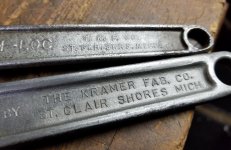
I'd like to see your reference material for that connection, bonneyman. Unless there is some big fat whopping weird coincidence, I think that "T.K.F. Co." may be The Kramer Fabricating Company.

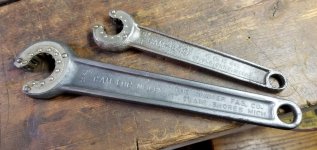
I forget I had these wrenches.

attachment.php


attachment.php


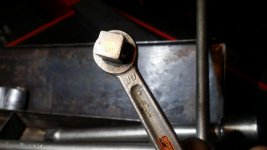
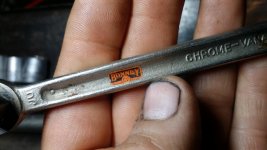
Note that larger one (7/8" service opening) with a much larger shank is marked The Kramer Fab. Co. / St Clair Shores Mich. Note that the smaller one (5/8" service opening) with a much smaller shank is marked, in abbreviation of the larger marking, T.K.F. Co. / St. Clr. Shrs. Mich..

Finding them made me go review my notes, which prompts me to make some corrections.

Just upthread I named the company as T.K. Fisher. Not sure where I got that from, but I don't think it's correct.

Also upthread I said that Alfred Kavalar had no connection to a mfgr. That's also not accurate.

According to this Google Books search snippet-only view result from a 1956 issue of Product Engineering, he was the chief engineer for The Kramer Fabricating Company.

attachment.php


Here is an excerpt from a 1959 edition of Popular Mechanics confirming that.

attachment.php


Note that the address is given as Detroit, but note that St Clair Shores is a section of East Detroit. I have seen T.K.F. CAM-LOC's marked Detroit instead of St Clair Shores. Not sure if they moved or it was just a marking variance.

Sorry to side-track the thread with this mini Cam-Loc/Loc-Rite deep dive.
 

Attachments

  • T.K.F. Co Cam-Loc Pop Mech Apr 1961.jpg
    T.K.F. Co Cam-Loc Pop Mech Apr 1961.jpg
    116.6 KB · Views: 97
  • T.K.F. Co Cam-Loc Prod Eng 1956.jpg
    T.K.F. Co Cam-Loc Prod Eng 1956.jpg
    40.6 KB · Views: 98
  • 20190126_153925.jpg
    20190126_153925.jpg
    152.8 KB · Views: 100
  • 20190126_153852.jpg
    20190126_153852.jpg
    149.5 KB · Views: 99
Last edited:

GrayFlattop

Well-known member
Joined
Jan 18, 2018
Messages
1,039
Location
Chicago
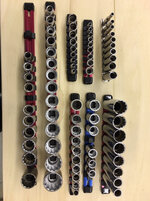
As long as folks are sharing, here are some of my Bonney sockets. They range from tired to NOS 7d53452041929a793e1d89147b5bee41.jpg
3825a3eec30d8eb5540e631f5dd4761e.jpg

The metric 1/2 drive “set” is not only incomplete, but is a mixed marriage of newer and older (knurled band) sockets, but all have beautiful broaching.


Sent from my iPhone using The Garage Journal mobile app
 

Attachments

  • 7d53452041929a793e1d89147b5bee41.jpg
    7d53452041929a793e1d89147b5bee41.jpg
    756.7 KB · Views: 1
  • 3825a3eec30d8eb5540e631f5dd4761e.jpg
    3825a3eec30d8eb5540e631f5dd4761e.jpg
    776.2 KB · Views: 3
OP
B

bonneyman

Well-known member
Joined
Apr 22, 2010
Messages
8,758
Location
Desert SW
If you got to eBay right now and search on "Loc-Rite" you will find a whole page of Loc-Rite tools, from line wrenches to crows feet to deep sockets. Most of them are Kelsey-Hayes, but many are Utica, and there are a few Bonney. KH owned the Loc-Rite patent and trademark and they used it on KH-, Utica-, and Bonney-branded tools. Again, not sure why they left Herbrand out of that, but Herbrand is the only brand they owned they did not use it on for some reason.

That's a bit of a mystery to me.
Yes, I've got some double flare wrenches marked "Loc-Rite Kelsey-Haynes", and I've seen "Loc-Rite Utica" stamped tools. They must have been made from 1964 (when the patent was issued) to 1967 (when they sold the divisions to Triangle). Why K-H would produce tooling of the new broaching - and then turn around and sell all of it off in 3 years doesn't seem logical.
However, Loc-Rite broaching didn't appear on Bonney tools until after 1967, as that years catalog shows Bonney wrenches with a V-gullet open end but no LR on the box ends. (Nor do any sockets have LR).
I can only guess that there was alot of consolidation and retooling going on, and Triangle couldn't do everything they wanted overnight.
 
Last edited:
OP
B

bonneyman

Well-known member
Joined
Apr 22, 2010
Messages
8,758
Location
Desert SW
No need to apologize for the small sidetrack, Lugnutz - this has made me dig into my old notes.

The TKF wrench I have is marked Detroit, and upon searching I came to this company.

http://tkf.com/about/history

I only assumed they made tools, as the patent # cited on the one tool says "TKF Co., Detroit"

http://www.datamp.org/patents/displayPatent.php?number=2550010&typeCode=0

I had no idea there were St. Claire marked tools out there, nor that it was a suburb of Detroit.

And I didn't know Kavalar worker for a Kramer Fabricating Company. So he came up with the idea during the war, and then applied for the patent a few years later. that's the missing link! Thanks!
 

Attachments

  • IMG_3019.JPG
    IMG_3019.JPG
    115.1 KB · Views: 9
  • IMG_3839.JPG
    IMG_3839.JPG
    119.9 KB · Views: 12
Last edited:
OP
B

bonneyman

Well-known member
Joined
Apr 22, 2010
Messages
8,758
Location
Desert SW
Nice collection, Gray! And "tired" sockets are just fine.

I'm growing a bit tired in age myself - and I think I still have alot to give!:lol_hitti
 

Private Lugnutz

Well-known member
Joined
Mar 30, 2012
Messages
30,473
Location
The Authentic Jersey Shore
That was an interesting guess based on the initials, and coincidentally not altogether unreasonable (i.e., an industry with machines with lines and fittings), but I am pretty sure the references I found nail TKF as The Kramer Fabricating Company. BTW I have asked Google to unlock the Product Engineering magazine so we can finish reading the rest of the snippet!
 
OP
B

bonneyman

Well-known member
Joined
Apr 22, 2010
Messages
8,758
Location
Desert SW
That was an interesting guess based on the initials, and coincidentally not altogether unreasonable (i.e., an industry with machines with lines and fittings), but I am pretty sure the references I found nail TKF as The Kramer Fabricating Company. BTW I have asked Google to unlock the Product Engineering magazine so we can finish reading the rest of the snippet!

Yeah, I think it nails it, too.
Do you know what became of The Kramer Company? I've been surfing a bit and can't find anything even close.
 

Mikeske

Well-known member
Joined
Apr 28, 2017
Messages
2,122
Location
Washington State
Interesting discussion on the history of the various tools. I have enjoyed it. The thing is I have exactly one metric one half inch drive socket. When I originally bought I primarily was going for SAE and not metric so much as in the aviation aircraft structural repair field I was in it was SAE only and I have never worked on a AirBus aircraft. I worked on Lockheed, Boeing, McDonald Douglas and Bombardier aircraft with a emphasis on Boeing and Lockheed. Boeing on the civilian side and Lockheed on the military side.

Metric tools just were not used much on aircraft. Now that the years have gone by I just never got any Bonney metric 1/2" drive sockets. I do have metric 1/2 sockets that are a mix of various brands. I have 3/8ths and 1/4" metric as they sold those to me in my original kit that I bought.
 
Last edited:
To avoid these ads, REGISTER NOW!

LesserSon

Well-known member
Joined
Feb 7, 2016
Messages
5,047
Location
PA USA
Lugz & Bonneyman
I agree with what you say about Loc-Rite; I’m sorry I put it in that chronology, because doing so does imply it was one of Bonney’s “assets,” when in fact the asset is merely the capacity to forge Loc-Rite wrenches.
I don’t agree that Bonney closed Alliance or moved to Orangeville. That way of expressing what happened fits Bonneyman’s repeated characterization that Bonney failed in some way (addiction to government contracts, moving around too much, etc) to remain competitive in the face of an increasingly global marketplace, and went belly-up. But by then it is a subdivision of Utica, which is itself just the tool division of K-H. Bonney wasn’t making any of those decisions. Those who had run Bonney were dead.
I rather think saying “Bonney failed” is like saying “Grand-dad’s Thunderbird failed” when Junior sold it, the new owner entered it in a demolition derby, then sold it to a guy who was going to restore it, but had to scrap it for parts to pay his bills.

Finally, Bonney is NOT DEAD, but alive and well and COMPETITIVE in the global marketplace; they just don’t make tools.
 
Last edited:

Oldtuleguy

Well-known member
Joined
Nov 4, 2017
Messages
10,454
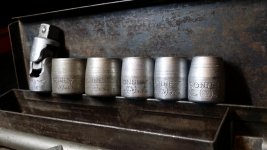
Picked up this old bonney 3/8 set. If I am reading the date code correctly 1929?
 

Attachments

  • 20190126_070645.jpg
    20190126_070645.jpg
    150.8 KB · Views: 20
  • 20190126_071026.jpg
    20190126_071026.jpg
    118.6 KB · Views: 17
  • 20190126_071117.jpg
    20190126_071117.jpg
    85.6 KB · Views: 20
  • 20190126_071101.jpg
    20190126_071101.jpg
    122.7 KB · Views: 25
  • 20190126_070930.jpg
    20190126_070930.jpg
    142.8 KB · Views: 18
  • 20190126_070617.jpg
    20190126_070617.jpg
    84 KB · Views: 20

Private Lugnutz

Well-known member
Joined
Mar 30, 2012
Messages
30,473
Location
The Authentic Jersey Shore
I rather think saying “Bonney failed” is like saying “Grand-dad’s Thunderbird failed” when Junior sold it, the new owner entered it in a demolition derby, then sold it to a guy who was going to restore it, but had to scrap it for parts to pay his bills.
Well put and entertaining analogy, LS! That's what I was alluding to with respect to them really just being a brand name managed by others after conglomeration.

LesserSon said:
Bonney is NOT DEAD, but alive and well and COMPETITIVE in the global marketplace; they just don’t make tools.
I had NO IDEA! Thank you. This is a great story, and in perfect keeping with the original spirit of the company, which forged many products for others (e.g., Bethlehem Spark Plug Company, US Army Ordnance Dept, and many other customers) in parallel to making its own products.

Picked up this old bonney 3/8 set. If I am reading the date code correctly 1929?
Yes.
 
OP
B

bonneyman

Well-known member
Joined
Apr 22, 2010
Messages
8,758
Location
Desert SW
I don't think Bonney "failed". As long as the tools themselves exist, that proves their success!

That what it is for me - the tools. When people ask about Bonney tools, I share the info that I have. And I make assumptions based on that info, which I try and frame as such. Simply because I'd like to know what happened. If that's interpreted as characterization, fine. And if someone has information that can enlighten me or fill in some blanks, I'm open to it. I'd like to learn all I can about Bonney tools....especially where I can find some more NOS.
 

Mikeske

Well-known member
Joined
Apr 28, 2017
Messages
2,122
Location
Washington State
I don't think Bonney "failed". As long as the tools themselves exist, that proves their success!

That what it is for me - the tools. When people ask about Bonney tools, I share the info that I have. And I make assumptions based on that info, which I try and frame as such. Simply because I'd like to know what happened. If that's interpreted as characterization, fine. And if someone has information that can enlighten me or fill in some blanks, I'm open to it. I'd like to learn all I can about Bonney tools....especially where I can find some more NOS.
I have to agree that Bonney did not fail but the several different tool divisions management failed them not once but several times. I also think towards the end when they really needed to replace the tooling to build the tools that selling it to Cooper which got all the patients and sell off all of those and keep only the ones that they wanted in the beginning. I am speculating on these remarks but it seems that Cooper was known for doing this. The whole thing was at the end of Bonney, Herbrand and Utica the global market was not yet really there as it is today. It had started to gain ground but I cannot blame it for the demise of the tool division as much as poor management decisions and the catch all remark that at the sell even companies today make is "we are going back to our core market". For Bonney it should have stayed with the tools along with the forging operations. After all one of the first names it had was "Bonney Tool and Forging".
 
OP
B

bonneyman

Well-known member
Joined
Apr 22, 2010
Messages
8,758
Location
Desert SW
On a more technical note, I'd like to know how Bonney plated their tools. The catalogs mention "nickel chrome over full polish". I'm wondering if the nickel is what gives Bonney chrome it's decidedly greyish hue, as opposed to many brands that have a mirror-like shine to the finish.
Was it done because it was traditional for Bonney? Or more durable? Or cheaper? Also, the interior broaching of the sockets are real hit-and-miss with the chrome. Some are nicely done, but most are rough and more satin - an almost painted look.
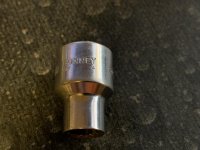
Most of my sockets appear to have very little finishing and plating applied. (The picture is an example of the better condition finish). Could that indicate later production and cost-cutting? Could that be something to date the sockets?
 

Attachments

  • IMG_0649.JPG
    IMG_0649.JPG
    106.3 KB · Views: 19

LesserSon

Well-known member
Joined
Feb 7, 2016
Messages
5,047
Location
PA USA
I don’t have much understanding of the processes involved. I suspect the rougher areas you mention exist because they aren’t easily polished before plating. My observation of the relative merits of nickel and chrome, individually: nickel is more flexible, lustrous and less resistant to chemical reaction; chrome is rigid, glossy and more resistant to chemical reaction.
If the underlying metal is also rigid, the chrome-plated tool is probably superior for work on equally hardened objects, and certainly resists stains. But if the underlying metal is soft or flexible, chrome finish will craze, admiting oxidation of the underlying metal, inevitably causing the chrome to flake off. These flakes and splinters are often razor-sharp, and the surface they leave behind can also have sharp edges.
I prefer nickel both aesthetically and practically. It does scratch and wear more easily, but it seems to adhere better.
I suppose a blend of the two offers a compromise of the best properties of both.
 
Last edited:

Provincial

Well-known member
Joined
Sep 21, 2011
Messages
6,855
Location
Near Salem, OR
At least on decorative automotive item like bumpers the old standard was three layers. Copper first for better attachment to the steel. Then Nickel as a buildup, topped off with chrome for durability and appearance.
 
OP
B

bonneyman

Well-known member
Joined
Apr 22, 2010
Messages
8,758
Location
Desert SW
But if the underlying metal is soft or flexible, chrome finish will craze, admiting oxidation of the underlying metal, inevitably causing the chrome to flake off. These flakes and splinters are often razor-sharp, and the surface they leave behind can also have sharp edges.

So I guess that explains impact sockets not being chromed? The minute flexing of the steel during use would cause the chrome to flake off.
And I've been cut by flakes of chrome, especially when digging thru bins of tools in a pawn shop. Something I have to watch out for. That - and razor blades, which invariably get dumped in with tools and sometimes pop out of their storage container.
 
OP
B

bonneyman

Well-known member
Joined
Apr 22, 2010
Messages
8,758
Location
Desert SW
At least on decorative automotive item like bumpers the old standard was three layers. Copper first for better attachment to the steel. Then Nickel as a buildup, topped off with chrome for durability and appearance.

Copper, eh? I guess an electromagnetic process would allow for a great attachment of the copper. I have seen tools with what looks like a reddish layer. Not rust.
 

Slackmaster G

Well-known member
Joined
Jan 19, 2017
Messages
93
I just picked up 8 Bonnie’s , a blueprint supreme and a Williams wrench at a sale for $7. A wealthy estate where no one cared
 

GrayFlattop

Well-known member
Joined
Jan 18, 2018
Messages
1,039
Location
Chicago
Provincial is spot-on. For a top-tier plating job, Copper plating is usually the first step, then the copper is buffed to create a smooth substrate. Historically, this has been followed by one or more layers of Nickel (Dull, followed by Bright - then more buffing) then finally by the chrome plating. These are all distinct process steps. At the beginning - and between steps, parts are subject to one or more heated wask operations (typically using a strong alkaline compound then a rinse - oft time repeated.

I asked one of our long-time plating suppliers this morning about what it takes to get a beautiful finish. They are an established concern that performs a lot of automotive and aerospace work and their GM has been with them for decades.

His take on it is that the cost of imparting a top level chrome finish would likely surpass the underlying cost of the tool as the chemicals involved are quite toxic and are subject to close scrutiny in the US & EU (that may be one explanation why Taiwan and China have emerged as dominant suppliers in the tool sector). If you have ever spent any amount of time in a plating plant, you would most certainly come to the conclusion that it is an unpleasant place to work - even with good ventilation. Your throat burns after an hour or so. Also - the polishing itself can be very labor intensive, so labor cost is another factor.

The process used is electroplating - a negative charge is applied to the object being plated and for chrome, theelectrolyte bath is Chromic Acid - that gets a positive charge and the Chromium migrates to the object being plated. The layer is typically 0.0002-0.0004" thick. Other plating methods would use sacrificial anodes, but I was already spending too much time with him this morning - but I feel as if I need to find out more.

All this is well and good; however, that doesn't tell me exactly what method Bonney employed.

To bonneyman's open question, I believe Impact sockets were never really chrome plated as a matter of tradition as well as cost. A phosphate conversion coating is durable, and very inexpensive. And given the use these sockets get, they would look pretty crummy in short order. I'm just surmising there, we do know that Impact sockets are generally "softer" but I'm not certain that the relative flexibility of the substrate is the reason for the cheaper "finish".


The plater's opinion in terms of flaking chrome is that the root cause was poor surface preparation / contamination during the process. And as LesserSon pointed out, it only takes a few pinholes in the chrome surface to allow for oxidation to get under the layer of chrome.

I did ask what the process was for re-plating something that was previously plated (selfishly, of course). and my guy said that you have to strip the chrome off first as very little will adhere to it. Some very strong acids will do that, or you can put it in the plating bath with a reverse polarity. His claim is that it is almost never worth it due to the cost. Perhaps that was his way of telling me to forget about bringing him a box of tired tools...

I don't claim to be an expert on Chrome plating - most of our product receives zinc or iron phosphate or is zinc plated.

I do know a little bit about the PVD (Physical Vapor Deposition) process that is used to coat tooling with Titanium Nitride or other coatings - that is a fascinating thing to witness. That leaves a very hard layer that is measured in microns...
 

GrayFlattop

Well-known member
Joined
Jan 18, 2018
Messages
1,039
Location
Chicago
Picked up this old bonney 3/8 set. If I am reading the date code correctly 1929?

I can't tell you much about the date codes, but that is a cool set. Oddly enough, I've been adding 3/8 sets to my collection - for no real good reason - other than they are cool and evoke a certain time. I should take some pix and post 'em.
 

GrayFlattop

Well-known member
Joined
Jan 18, 2018
Messages
1,039
Location
Chicago
GrayFlattop, the reason those chemicals are under such close scrutiny might surprise you. Those chemicals are essential to the manufacture of lysergic acid diethylamide (LSD). One of the ways the government tries to find who is making it is to monitor supplies. The chrome plating industry is virtually the only legitimate user.

Color me surprised! I just know that the chemicals the platers use are nasty and the local EPA and the local water treatment authority regularly monitors the output from all of our suppliers.

And don't worry - I won't ask you how you know so much about lysergic acid diethylamide, lol. And I'll just add that to the long list of things I'm never interested in trying...
 
OP
B

bonneyman

Well-known member
Joined
Apr 22, 2010
Messages
8,758
Location
Desert SW
GrayFlattop, the reason those chemicals are under such close scrutiny might surprise you. Those chemicals are essential to the manufacture of lysergic acid diethylamide (LSD). One of the ways the government tries to find who is making it is to monitor supplies. The chrome plating industry is virtually the only legitimate user.

Maybe that explains why I have flashbacks to high school after cleaning my chrome tools?:lol_hitti
 

Mikeske

Well-known member
Joined
Apr 28, 2017
Messages
2,122
Location
Washington State
Maybe that explains why I have flashbacks to high school after cleaning my chrome tools?:lol_hitti
:bowdown: :bowdown: :bowdown: Wait until you have to use the old corrosion treatments for aircraft aluminum. It was Caustic soda solution, then rinse in water, then a mild acid etching, rinse in water then alodine for 5 minutes then rinse in water. When I was in the Air Force that is the treatment used and we wore respirators and full face mask and heavy rubber aprons and rubber boots to just do the treatments. After that off to the autoclave to heat treat the part.
 
To avoid these ads, REGISTER NOW!
Top Bottom