Private Lugnutz
Well-known member
That very well could be, humber. Good thought.


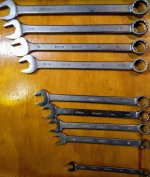
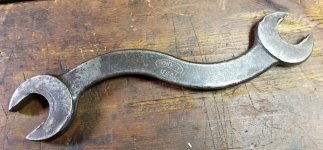
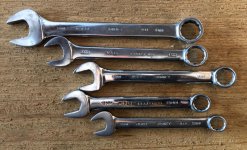
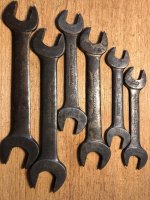
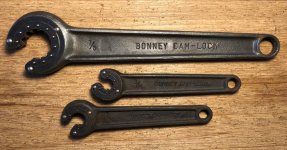
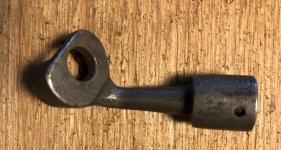
outof bounds, that 3/8" drive wrench in the far right photo of post #2905 is for the cylinder base (hold-down) nuts of Pratt & Whitney radial engines.
More
https://www.garagejournal.com/forum/attachment.php?attachmentid=975535&d=1581198638
Whatcha got here? post 2902
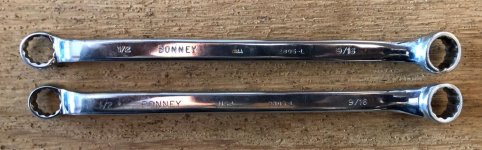
I am trying to fill a 311 Bonney board in the 1926 catalog found on ToolArchives.
Great getting a chance to meet, Larry! Best of luck, and hope we cross paths again.

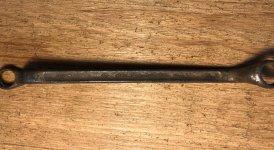
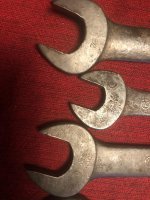
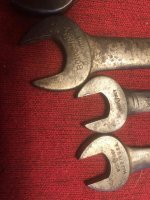
outofbounds is getting back to me to check on some of his tappets he just acquired. I believe he has a specialty wrench. At first I thought it was just a mistake in reading the product number, but the wrench in post 2902 is marked 412A. It is the same profile as the 401 series tappets. The difference is that 412A wrench has two different size openings while the 401 series were one size DOEs. The 420 series was the one with two sized openings.
I tried to find info on the catalogs in archive.org, but didn't find anything.
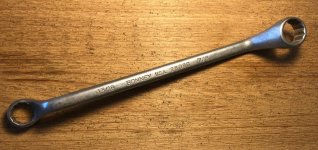
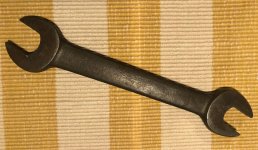
Ironically, and not surprisingly, after a large buy of Bonney items (shown earlier here from the other day), this Krieger was actually found in a mixed box of Druo-Chrome & Chrome X Quality wrenches that I also purchased. I'm not entirely versed in the Krieger Bonney connection, but I understand there was a very short window of production for these, which I'll presume has some relevance to War Era collectors. Nice lightweight and resilient hand feel to this wrench.
Private Lugnutz posted an explanation and snippet of the wartime contract here. And an example of the same model as yours here. Notice that there are a different number of extra dots near the JU (Oct1943) date code.
If you search “Krieger” on this thread, there are a few other reported findings and some other conversation on them.
Leg,
I offer additional detail to aid in your evaluation of P/Ns, mfr dates, and condition of fittings. If these suit you, some or all, let me know what a fair number might be. Thanks, Tom!
Thanks OOB.
I will pass on these.
The couple I am looking for are a little rough.
But, again, thanks. also Tom
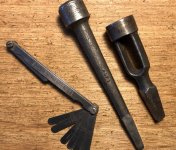
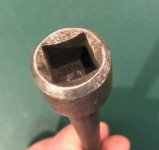
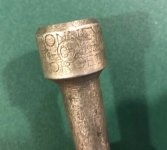
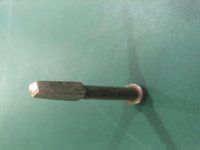
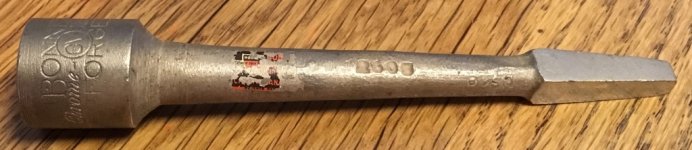
I recently was perusing 1930s Bonney catalogs looking for this specialty socket and couldn't seem to locate it. (Toolarchives.com is amazing twertsy!!) Model 2621 it appears to me. Can anyone illuminate me on the purpose of this socket? Honestly, I have two other simialr pieces uncovered in the same cache, a "no brand" version of the same, and an unusual piece with the same tapered fitting on one end, but with a drill chuck on the other. Welcoming the education!
Yes, as trumpetdude is alluding to, that's a male brace bit type drive tang for turning the square socket with a brace type speeder with a female opening that people typically associate with auger type drill bits and drilling. Late 20's. Several mfgrs went that route before everything got standardized on detachable female forged sockets turned with male drive tools. Goodell-Pratt made some. As did Braunsdorf-Mueller. Here is a BMCo bit brace type hex socket.
Yes and no. Yes because 30's is too late, but no because we have a gap in the late 20's for catalogs. They jump from 1926 to 1932 on TA 2.0. I've never seen brace bit type sockets in a Bonney catalog. As of 1926, Bonney wasn't making any socket drive wrenches or tools of any kind. Just end wrenches. (I have a theory about them using their forge contract services for Bethlehem Speak Plug Company socket drive sets, specifically ratchets, to bootstrap themselves into the socket wrench game.) And by the mid 30's they were making routine heavy walled sockets with female drive ends.Apparently I was looking in the wrong catalogs.
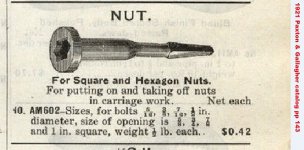
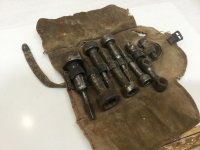
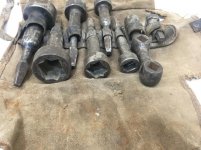

I have only seen a few "brace socket" catalog listings. They were a "thing" way back, but it appears not for a very long time. A couple examples for reference (NOT Bonney):
The connection is, at minimum, the rivers.Interesting that The E.F. Reece Co. hailed from the same small bucolic burg as Goodell-Pratt tools. I wonder of there's a connection.
The connection is, at minimum, the rivers.
Water-driven mills and interlinking canals were the infrastructure of the first industrial revolution. Bucolic is not a word I would choose to describe the busy hubbub of the industrial centers of those times.
Beyond your comment, LesserSon, I still struggle to envision Greenfield, MA as an industrial hub rather than a niche location for small forges, that still afforded the worker there a exurban respite that the same worker on the Eastern Seaboard never even knew existed. Perhaps growing up in Detroit fails me that perspective.
Compared to Detroit, Greenfield had a 15-year head start with European settlement (1686v1701), but over the next two centuries Detroit had grown to 50x the size of Greenfield (4000v200000), if resident population can be used as a measure of industrial capacity.
Still, “bucolic,” deriving from the Greek word for “cowherd,” connotes a qualitative contrast (more along the lines of The Egg and I or derivatives like Green Acres) than the quantitative difference in scale of production between two industrial centers.
Private Lugnutz said:Cool ads, 4.c. Just as an FYI, for future reference, or if you'd like to move those, we have a tap and die thread. Click the link in the Index in the Sticky.
I totally agree....life inside the stacked bricks of whatever factory a worker resided was largely the same...
Maybe you’re right about this, too. And yet, Detroit is the one that grew. Must have had something going for it.The difference is in what greeted them arriving home, or steps from the edge of town.