To avoid these ads, REGISTER NOW!

Spreading the Bonney affliction!

OP
B

bonneyman

Well-known member
Joined
Apr 22, 2010
Messages
8,773
Location
Desert SW
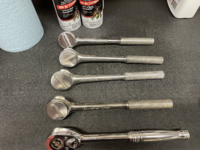
Here's a mix of some of my Bonney and B-Hex 3/8 & 1/2 ratchets. The Bonney AA707-H, IMHO, is one of the worst 1/2 models Bonney came out with. Im not a fan of it.... Then the T703-K 3/8 Tri- Wing flex head in the front, overbuilt, front heavy,, but very smooth. Definitely one of my favs! Then the older but sweetest IMHO A700 and 4080L in the back which are a tally my favorites!

20210808-062447.jpg
Nice collection, sir!

Say, that stubby on the right, fourth row up from the bottom. Did you do that mod work? It looks good enough to be factory but I don't think they came like that. (y)
 
To avoid these ads, REGISTER NOW!

amecks

Member
Joined
Jun 5, 2012
Messages
18
Location
Jordan, NY
I picked up this 6" adjustable at a yard sale for a buck. Model BW-6.
 

Attachments

  • 20210806_155932.JPG
    20210806_155932.JPG
    517.4 KB · Views: 40

LesserSon

Well-known member
Joined
Feb 7, 2016
Messages
5,053
Location
PA USA
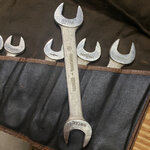
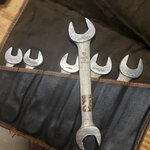
Does anyone on the thread have access to an actual, physical, ink-on-paper Catalog #23 (copyright1922)?
I was comparing some early wrenches to illustrations in the pdf and noticed the tappet wrench on p33 is shown with forged-in date codes. The resolution is just a little too low to be sure what the two letters are, though one does look like “M” (1921).
Also noted that “CHROME-VANADIUM” is shown, both on the tappet and on the DOE on the preceding page - without an accompanying “CV”-circle. On the DOE there is a “B”-shield where the “CV”-circle would be expected.
These details caught my attention, because I noticed my O-year(1923) and N-year(1922) DOEs also have “CHROME-VANADIUM” sans “CV”-circles, while my P-year(1924) DOEs have the “CV”-circle. I do not recall ever seeing “CHROME-VANADIUM” with a forged-in “B”-shield as shown on p32. Anyone have one like that?
0FDBADCB-E228-40C0-A5F0-4802B7ABD63A.jpeg5A538DBD-0315-4B08-80D0-3F071FD95E05.jpeg
While it seems natural enough that “CV” could have first use after “CHROME-VANADIUM” (as acronyms naturally come after long names), AA states that “CV” first use was actually before “CHROME-VANADIUM” (11/04/1922 v 11/15/1922), applied for and granted 1923 v 1925.
Does anyone have a “CV”-circle wrench earlier than 1924?
 
Last edited:

JjKk40

Well-known member
Joined
Jan 10, 2021
Messages
616
Location
New York
I have 1923 forged code "GO". Ill post a pic in a minute. Whats odd is it is in a set and all other circle CV Chrome- Vanadium wrenches are year 1924 date code "AP, HP, JP"

20210810-171317.jpg
20210810-171306.jpg
20210810-171259.jpg
 
Last edited:

Ricky Joe

Well-known member
Joined
Sep 15, 2013
Messages
2,452
Location
Roanoke, Va.
I posted these in another thread about access and obstruction tools, but now I am curious to know what the original intent was for these Bonney extensions. I’ve had them for years and found them useful if not indispensable at times. My guess is for transmission work. Anyone know?
 

Attachments

  • image.jpg
    image.jpg
    489.2 KB · Views: 36

Chrome Vanadium Cody

Well-known member
Joined
Jul 25, 2021
Messages
663
So happy to have found this thread! Bonney is my sleeper pick for favorite tool brand- I have never even heard anyone else mention them until now but ever since using some of their flare nut wrenches on fuel lines I think the quality is great and I pick them up whenever I can. I found out Epsteins has a bunch of Bonney old stock so I am putting together an order for some odds and ends I need around the shop- some a 1/4" drive deep sockets and a few other sockets, a couple long pattern wrenches, and a manifold wrench. My question to you is: are there any must have Bonney tools I should add to my order while I'm at it?
 

Attachments

  • Screen Shot 2021-08-11 at 11.01.21 AM.png
    Screen Shot 2021-08-11 at 11.01.21 AM.png
    93.4 KB · Views: 22
  • Screen Shot 2021-08-11 at 11.01.13 AM.png
    Screen Shot 2021-08-11 at 11.01.13 AM.png
    129.7 KB · Views: 16
OP
B

bonneyman

Well-known member
Joined
Apr 22, 2010
Messages
8,773
Location
Desert SW
So happy to have found this thread! Bonney is my sleeper pick for favorite tool brand- I have never even heard anyone else mention them until now but ever since using some of their flare nut wrenches on fuel lines I think the quality is great and I pick them up whenever I can. I found out Epsteins has a bunch of Bonney old stock so I am putting together an order for some odds and ends I need around the shop- some a 1/4" drive deep sockets and a few other sockets, a couple long pattern wrenches, and a manifold wrench. My question to you is: are there any must have Bonney tools I should add to my order while I'm at it?
Welcome to the party!

Their angles wrenches are nice, and their double box ends are superb. Metrics will be tough to find but worth every penny.

And I couldn't get by with a set of their flare wrenches. Double flare ends and flare/box combos. And they made these ratcheting flare wrenches that while bulky really help with things like carpal tunnel.
 

Mikeske

Well-known member
Joined
Apr 28, 2017
Messages
2,125
Location
Washington State
The later model ratchets are not the best as they are rather crude in action. That being said I always preferred a different companies ratchets over the Bonney even if I have a collection of them. The later edition sockets, wrenches, flare wrenches and other tools are really good.

It all depends if you collecting them for the sake of collecting the ratchets or then for daily use I look at older Snap-on, SK, Wright or some other brands
 
Last edited:

RTM

Well-known member
Joined
May 13, 2019
Messages
13,093
Location
SF Bay Area
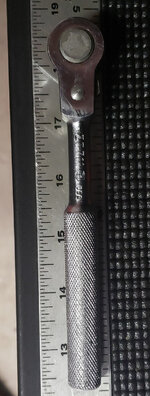
All, couple of years back, I posted about my mostly there Bonney socket set. I had spent quite a bit of time looking for a Bonney ratchet to put in the box, and Mikeske sold me one, which of course opened up the floodgates.

I have since found two more, and I think this one is most appropriate for the set, as it has a triangle in the logo on the shaft. The fun thing is, it still has part of a price tag on it, for $17.**. The down side, the exposed part of the ratchet drive is quite rusty. Can I toss the ratchet assembly in evaporust without fouling up the guts! Or do I need to be a bit more cautious with the rust removal?


the only price list I can find at ITCL is 1958, and it was only $5.50. Inflation.


PXL_20210807_204118763-X3.jpg
 

Ricky Joe

Well-known member
Joined
Sep 15, 2013
Messages
2,452
Location
Roanoke, Va.
The later model ratchets are not the best as they are rather crude in action. That being said I always preferred a different companies ratchets over the Bonney even if I have a collection of them. The later addition sockets, wrenches, flare wrenches and other tools are really good.

It all depends if you collecting them for the sake of collecting the ratchets or then for daily use I look at older Snap-on, SK, Wright or some other brands
I agree with you except for this one. It is a great ratchet for me.
 

Attachments

  • image.jpg
    image.jpg
    288.4 KB · Views: 13
  • image.jpg
    image.jpg
    260.4 KB · Views: 13

Mikeske

Well-known member
Joined
Apr 28, 2017
Messages
2,125
Location
Washington State
All, couple of years back, I posted about my mostly there Bonney socket set. I had spent quite a bit of time looking for a Bonney ratchet to put in the box, and Mikeske sold me one, which of course opened up the floodgates.

I have since found two more, and I think this one is most appropriate for the set, as it has a triangle in the logo on the shaft. The fun thing is, it still has part of a price tag on it, for $17.**. The down side, the exposed part of the ratchet drive is quite rusty. Can I toss the ratchet assembly in evaporust without fouling up the guts! Or do I need to be a bit more cautious with the rust removal?


the only price list I can find at ITCL is 1958, and it was only $5.50. Inflation.


PXL_20210807_204118763-X3.jpg
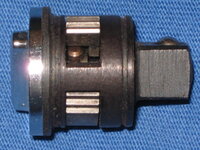
There is a spring retainer just under the anvil and against the main body of the ratchet I would carefully take the retainer off then slide the guts out and try them in the rust treatment. That way you get at the internals and after the treatment spray down the internals with brake cleaner blow dry it and then apply a healthy coating of your favorite grease slip the internals back in the ratchet without putting the retaining ring back in and turn the anvil with a extension it for several turns then slide it back apart and apply a little additional grease. Then reassembly the ratchet. If you need I can take a picture of the retainer ring and what the guts looks like on a rebuild kit I have. Doing the rust treatment you really have nothing to lose
 

Mikeske

Well-known member
Joined
Apr 28, 2017
Messages
2,125
Location
Washington State
I agree with you except for this one. It is a great ratchet for me.
These are the ratchets I am referring to as they ain't the smoothest but they are durable and I have no complaint about the durability of this style ratchet in that regard. The smoothest ratchets I have are of course the Snap-ons from that era.
 

Attachments

  • tempImageKBzr02.png
    tempImageKBzr02.png
    4 MB · Views: 17

swshawaii

Well-known member
Joined
Jan 9, 2013
Messages
66
Here is my minor contribution to the affliction. Found this a few years back, it serves as my front of the garage socket set, for those quick jobs where its not worth walking to the back and pulling out the big heavy sets with all the universals, extensions, etc. This is the as found state. I have added an appropriately shaped CrMo ratchet made in Japan, and a Sparta 3" extension, but I am on the lookout for the appropriate T702K ratchet. I see this as a 1967- 1976 version, as it has the triangle under the Y, but is a metal case, vs. the plastic seen in the 1977 catalog. This should be a 19 piece set, counting the case. I only saw one other similar red metal case in the thread, and can't find it again to see if they are different. It has a faint Utica and Bonney sticker on the box front. The TH22 11/16" socket is double struck if someone is into that.

Can anyone tell me what type of ratchet is correct for that era, X shaped lever, or Dash shaped, so if it ever turns up, I know if its correct? I am buying any T702K I find, so it really doesn't matter, but on the off chance I have a choice.

Thanks for a great information thread on these tools

IMG_20191019_143400-X2.jpg

IMG_20191019_143409-X2.jpg
RTM. your 18 piece (B-80336) set can be found in the 1986 catalog.

It is NOT a "Richard Petty" set as the eBay seller describes. Missing TLH-20R 5/8" spark plug socket.
https://www.ebay.com/itm/164892058779

s-l1600 (5).jpg
 
Last edited:
To avoid these ads, REGISTER NOW!

Mikeske

Well-known member
Joined
Apr 28, 2017
Messages
2,125
Location
Washington State
Here is where the retainer for the head of the ratchet in the first picture is as I have slightly raised it from the body of the ratchet. Being very careful as the retainer will fly off if you don't take care removing it and fly to parts unknown. I used a pick to slightly pry it up and then you can slowly walk it off. IN the 2nd picture is the rebuild kit kit of the ratcheting part. Edit: The third picture is the retaining ring independent of the ratchet
 

Attachments

  • tempImagegJAIIs.png
    tempImagegJAIIs.png
    2.4 MB · Views: 19
  • tempImagewAKPGX.png
    tempImagewAKPGX.png
    2.8 MB · Views: 14
  • tempImage5xlPIO.png
    tempImage5xlPIO.png
    2.6 MB · Views: 14
Last edited:

LesserSon

Well-known member
Joined
Feb 7, 2016
Messages
5,053
Location
PA USA
I think that's the B-Hex for BonECon line.
No. I thought the same at a casual glance, but a hexagon has 6 sides, and RJ’s are definitely 5-sided. I’m uncertain whether they are actually Bonney. Bonney didn’t own the letter “B.” Billings is B in a triangle, for instance. And as we all know, it’s hip, hip, so hip to B square.
 
Last edited:

LesserSon

Well-known member
Joined
Feb 7, 2016
Messages
5,053
Location
PA USA
RTM, if it were me, I would completely disassemble the guts of that ratchet and scrape the rust carefully from each piece with a small screwdriver. Then I would wire brush them so they were shiny black. Lube and reassemble. Except for any pitting, it will look new. The retaining ring has been the only part with any serious rust on the couple I’ve done that way, and for what it does, the pitting is only cosmetic.
Rust remover will strip the magnetite off with the hematite, leaving them gray. Okay functionally, but somewhat more vulnerable to rusting again, and IMO, just not ****.
Soaking in ATF would limber it up, possibly loosen but not eliminate the rust inside, which then works as an abrasive, shortening the life of the parts. Fine if you have rebuild kits and are primarily interested in putting it to work.
 
Last edited:

JjKk40

Well-known member
Joined
Jan 10, 2021
Messages
616
Location
New York
No. I thought the same at a casual glance, but a hexagon has 6 sides, and RJ’s are definitely 5-sided. I’m uncertain whether they are actually Bonney. Bonney didn’t own the letter “B.” Billings is B in a triangle, for instance. And as we all know, it’s hip, hip, so hip to B square.

Good eye man and I see what your saying! I didn't notice it before! My appoligies for wrong info!
 

JjKk40

Well-known member
Joined
Jan 10, 2021
Messages
616
Location
New York
I agree with you except for this one. It is a great ratchet for me.

The A700 and the longer version 4080L are one of my favorite ratchets. Bonney actually calls them "Planetary" style ratchets. I've found them in the 1947 catalog, 1951 catalog but they're labeled 4080- 10" and 4080L- 15" in the catalogs. I've yet to find it labeled A700. Also I've noticed some minor differences as well. I do love the style tho!
 

Old Radar

Well-known member
Joined
Apr 17, 2019
Messages
2,754
Location
San Antonio, TX
All, couple of years back, I posted about my mostly there Bonney socket set. I had spent quite a bit of time looking for a Bonney ratchet to put in the box, and Mikeske sold me one, which of course opened up the floodgates.

I have since found two more, and I think this one is most appropriate for the set, as it has a triangle in the logo on the shaft. The fun thing is, it still has part of a price tag on it, for $17.**. The down side, the exposed part of the ratchet drive is quite rusty. Can I toss the ratchet assembly in evaporust without fouling up the guts! Or do I need to be a bit more cautious with the rust removal?


the only price list I can find at ITCL is 1958, and it was only $5.50. Inflation.


PXL_20210807_204118763-X3.jpg
You've received some good advice from Mike and LS, but I'm not sure they addressed your real question. You said " the exposed part of the ratchet drive is quite rusty. Can I toss the ratchet assembly in evaporust without fouling up the guts".

1. That little bit of surface rust will come off easily with the application of a wire brush and a little elbow grease.
2. If the guts are still greased, they shouldn't need the Evaporust treatment but I wouldn't want to rely on that grease to do its job after a soak in it, so you would need to scrape it out and clean it up anyway--so why not do that first?
3. In this case, the old adage is true, short cuts make for long delays. If the guts are all right, wire-brush the drive face and be done. If the internals need work, do it right by disassembling and cleaning out the old grease first as Mike and LS said, above.
 

Mallen

Well-known member
Joined
Aug 11, 2021
Messages
649
Hello guys, new guy here! Love the Bonney stuff! I have 2 BonECon Ratchets, a 3/8" & a 1/2". The 3/8" was locked up so I disassembled it and low and behold the smallest spring I have ever seen (lol) was broken (pawl to lever spring) in 2 pieces. To make matters worse I lost the bigger broken piece! So I disassembled the 1/2" (wanted to clean and service it anyway) to compare what that spring was like. The measurements of both are in a pic in this post. My question is this; is there a company who makes small precision springs? Or a company who can make custom springs?
I have the same ratchet with the same part broken. When I get a chance in the next few days I'm going to try the local locksmith. They use tiny springs like that. Gun springs are another good idea.

The spring is made from 0.015 wire. It is 0.050 in diameter. The problem is, that leaves the ID at 0.020. The spring would normally be wound from piano wire on a mandrel a little smaller than the finished size. On small springs you use a little tube. But the I'd on that is so small that a piece of wire that size doesn't make a stiff enough mandrel. I was thinking that it might work to anneal the wire, then wind it over the smallest drill but that works. Then loop each end over two small drill bits and twist the spring to collapse the windings down with a piece of the same wire inside the coil. Then slide the spring inside a metal tube, heat, quench and temper. (Its so small, with so little thermal mass I doubt you could heat treat it by itself. )

Another thought was just to slide a piece of 0.020 piano wire inside the two broken halves.
 
OP
B

bonneyman

Well-known member
Joined
Apr 22, 2010
Messages
8,773
Location
Desert SW
I keep a stash of old ball point pen springs. Many a job has been fixed by using one of them.

These are the ratchets I am referring to as they ain't the smoothest but they are durable and I have no complaint about the durability of this style ratchet in that regard. The smoothest ratchets I have are of course the Snap-ons from that era.

Yeah, I always felt the -702 ratchets were a bit "clunky". Stout but not smooth. Considering the dual see-saw pawl setup they should be quite fine action. Worn-in examples seem to be better.
 

Attachments

  • IMG_0757.JPG
    IMG_0757.JPG
    147.5 KB · Views: 19

leg17

Well-known member
Joined
Aug 11, 2011
Messages
1,369
Location
Kentucky
I am leaning toward the idea that the date codes on these 1920's Bonney wrenches indicates the date that the die was made, rather than the date that it was used to produce a wrench. There are many instances of dies, (and molds), using some die ID for tracing. The concern was more towards which iteration of a die or mold was used, rather than any specific production date. I understand that forging dies had a relatively short life and would need periodic replacement in some cases.
In this scenario, a set of say five wrenches could have all been made during some period of weeks, but the dies that were used may have dates that span a longer time period.
FWIW (My thoughts based on a manufacturing background.)
 

Private Lugnutz

Well-known member
Joined
Mar 30, 2012
Messages
30,498
Location
The Authentic Jersey Shore
Interesting theory, leg. I was reading your post as a non-sequitur, so I went back to see what prompted it. Not sure if you're referring specifically to JjKk's set or all sets. But the codes show up religiously on most wrenches.

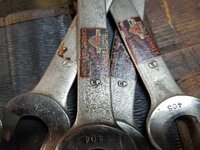
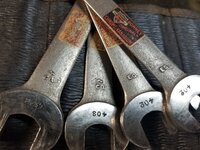
I have three Bonney wrench sets that I acquired complete and which seem to have been original to each other and the pouch. A No. 25 engineers wrench set, a No. 412 tappet wrench set, and a No. 20 -ZENEL- miniature engineers wrench set. None of them have 'perfectly matching' date codes (i.e., from the same month-year or even from the same year). Close, but they are all "mixed" in terms of exact date codes. In fact, I don't believe I have ever seen ANY Bonney wrench set with all the same exact date codes.

Not that I strongly disagree with your theory, because I don't have an implacable contention either way, but in my opinion, another just as plausible explanation could be due simply to different departments. When wrenches came off the drop forge manufacturing line, they weren't put into pouches. They went to wet grinding and dry grinding and buffing and finishing etc. From there they were probably put in hoppers. The department putting sets together and putting the Bonney stickers on the wrenches and preparing them for sales were not in the same area. Too messy. They were probably grabbing them out of the hoppers. I can see how sets would not be consistent. I can see how stragglers would get left behind and then put in with wrenches that were newer by weeks and even a few months or several months.

But again, I don't have a strong contention either way.

Photos attached.

The No. 25 engineers set is GV (1033-C), DV (1731-A), GV (1028-S), CV (1027-C), and FU (1723). So 1943 and 1944.

The No. 20 miniature engineers -ZENEL- set has three wrenches with an ET code, and the rest too hard to read. Probably all 1942.

The No. 412 tappet set is EQ (402, 403) and LP (404, 405). So, late 1924 and early 1925.
 

Attachments

  • 20210812_201937.jpg
    20210812_201937.jpg
    502 KB · Views: 15
  • 20210812_201510.jpg
    20210812_201510.jpg
    331.7 KB · Views: 14
  • 20210812_201221.jpg
    20210812_201221.jpg
    389.2 KB · Views: 11
  • 20210812_201807.jpg
    20210812_201807.jpg
    387.5 KB · Views: 11
  • 20210812_201811.jpg
    20210812_201811.jpg
    412.6 KB · Views: 18

Provincial

Well-known member
Joined
Sep 21, 2011
Messages
6,856
Location
Near Salem, OR
From a manufacturing standpoint, it is unlikely that one machine, and the corresponding dies, was assigned to make just one type and model of wrench forever. More likely is that that machine was assigned to make several (or many) different wrenches of similar size, based on the capacity of the machine. The dies would have been switched out when converting between wrench models.

The higher the volume of sales of a particular wrench, the more likely it is that the machine spent more time on that one. With high enough sales volume, it becomes practical to dedicate one machine to that product. This is unlikely in the tool industry, where flexibility is (was) necessary to keep capital investment costs under control.

As far as the dies go, it is unlikely that a die would be discarded and replaced simply because of a date code engraved on it. They were too expensive for that. More likely, they were run until there was enough wear to affect the cosmetics or structural strength of the product. Given that, the question becomes, "what about the date code"?

If the date code was placed within a field that was established by the main forging die, it could be changed fairly readily. Since this is not the case here ( and in most forgings) the date code was built into the main die. Making a main die is expensive and time consuming, so the dies would not have been replaced just to change date codes. A possibility is that the dies were "revised" with a new date code by welding up the area and redoing the date code. This would be a manageable expense that would have been useful for tracking production lots. If you are making one lot (or less) per month, a month/year date code is adequate for tracking lots. The month number/letter does not even have to match the actual month the product was forged, as long as the records show when that date code was used.

Another possibility is leg's theory, if the sole purpose of the date code is tracking the dies, rather than the product.
 

RTM

Well-known member
Joined
May 13, 2019
Messages
13,093
Location
SF Bay Area
Can I toss the ratchet assembly in evaporust without fouling up the guts! Or do I need to be a bit more cautious with the rust removal?

PXL_20210807_204118763-X3.jpg

You've received some good advice from Mike and LS, but I'm not sure they addressed your real question.

1. That little bit of surface rust will come off easily with the application of a wire brush and a little elbow grease.
.
Old Radar had the winning answer. By the time I posted, I had already had the guts out, and was trying to decide the path forward. As LS noted, the gray is not attractive, and getting it off all the innards would be a bear. So I did as OR suggested, and wire brushed it. The rust layer was pretty thin, unusual for the seller this came from. There was some bit of pitting, both on the face and on the retaining ring, the ring cleaned up, but the face didn’t, even with a bit of abrasive applied.

One interesting thing, the ratchet is a hair longer, and does not fit in the cutout in the red box. Oh well, into one of the mismatched boxes for it.

thanks for the pointers.
 

Mikeske

Well-known member
Joined
Apr 28, 2017
Messages
2,125
Location
Washington State
Old Radar had the winning answer. By the time I posted, I had already had the guts out, and was trying to decide the path forward. As LS noted, the gray is not attractive, and getting it off all the innards would be a bear. So I did as OR suggested, and wire brushed it. The rust layer was pretty thin, unusual for the seller this came from. There was some bit of pitting, both on the face and on the retaining ring, the ring cleaned up, but the face didn’t, even with a bit of abrasive applied.

One interesting thing, the ratchet is a hair longer, and does not fit in the cutout in the red box. Oh well, into one of the mismatched boxes for it.

thanks for the pointers.
We now need pictures of the rust free ratchet

On occasion you will find rebuild kets on eBay and it is a good investment IF the rest of the ratchet is in pristine shape.
 

Private Lugnutz

Well-known member
Joined
Mar 30, 2012
Messages
30,498
Location
The Authentic Jersey Shore
leg

Just a few more comments on Bonney date codes...

As I have pointed out before, most recently to LS in post #3521 on page 89 of this thread, Bonney third party production for Krieger during WWII is a great case study for the trustworthiness of the codes as production dates. At least in that era, and probably in general, by extension. All the Krieger wrenches bear a late 1943 (e.g., "JU") or a very early 1944 (e.g., "AV") date code, which coincides precisely with the reported start and end dates of Krieger's contract for engineering wrenches with the Ordnance Dept in the WPB Major War Supply Contracts books.

And another wartime era point with respect to my jumbled bins theory. I don't think a prolonged process like that, from manufacturing in April, for example, to being included in a set for sale and distribution in June, but mixed in with other wrenches made in May, for example, was confined to Bonney. When the WPB established alloy restrictions (gradually, late 1941 through mid 1942), they gave tool makers until November 1942 - with a 60 day leniency period on top of that - to sell off old stock. After that it was subject to seizure.

Lastly, and this one might go to your point, or at least dabbles around in the topic. They're rare, but there are Bonney CV wrenches with spring of 1943 date codes. Were they truly CV composition and allowed for some unknown special purpose and client? Or were they actually NE triple alloy steel composition and someone used an old (CV) die by mistake? Nobody has figured that one out yet.
 

leg17

Well-known member
Joined
Aug 11, 2011
Messages
1,369
Location
Kentucky
One additional comment.
I don't think I have seen any date codes that show indications of modification or re-work. Welding a hardened die, probable annealing to allow stamping of a revised date code, and re-hardening, would somehow leave a 'witness'. All the examples I have seen don't show that. As stated above, replacing a usable die simply to update the date code would seem a wasteful expense.
 

Provincial

Well-known member
Joined
Sep 21, 2011
Messages
6,856
Location
Near Salem, OR
It would be nice if we had a (even retired) diemaker that was experienced in making forging dies to give us some information on making and maintaining forging dies.
 

LesserSon

Well-known member
Joined
Feb 7, 2016
Messages
5,053
Location
PA USA
The date codes discussion…there’s a limit on what we can know.
I agree, it would be magnificent to talk to a surviving employee, but there are a few problems. The era of date codes ended more than fifty years ago. Someone just starting at Bonney in 1966 would be more than seventy now. I have the impression - surprising, given the scope of production - that there were never many employees (tens, not hundreds). Alliance was open less than ten years of that era, and Orangeburg only two. Mostly, date codes are on Allentown-production tools.
I’ve been an Allentown resident for three decades, and despite expressing interest in the history of Bonney socially, I have never met a former employee, nor a spouse nor descendant. Most of the people who were living here when I moved in are gone. I don’t need to ask around to know that it’s not just on my block, because the reported demographics of the population have entirely flipped.
I suspect the number of experienced die-makers alive today, who worked at Bonney, during the date-codes era can probably be counted on one hand, if the number exceeds zero.

And I do understand that is not what you were suggesting, Prov. It’s just that a die maker could explain to us what’s practible, but unless they were there, not definitively what was done.
 
Last edited:

JjKk40

Well-known member
Joined
Jan 10, 2021
Messages
616
Location
New York
I have the same ratchet with the same part broken. When I get a chance in the next few days I'm going to try the local locksmith. They use tiny springs like that. Gun springs are another good idea.

The spring is made from 0.015 wire. It is 0.050 in diameter. The problem is, that leaves the ID at 0.020. The spring would normally be wound from piano wire on a mandrel a little smaller than the finished size. On small springs you use a little tube. But the I'd on that is so small that a piece of wire that size doesn't make a stiff enough mandrel. I was thinking that it might work to anneal the wire, then wind it over the smallest drill but that works. Then loop each end over two small drill bits and twist the spring to collapse the windings down with a piece of the same wire inside the coil. Then slide the spring inside a metal tube, heat, quench and temper. (Its so small, with so little thermal mass I doubt you could heat treat it by itself. )

Another thought was just to slide a piece of 0.020 piano wire inside the two broken halves.


I used the spring from a beat up T707 ratchet. I had to cut it open tho as its a sealed head. Its nice tho because you caN swap in the finer tooth gear and pawl from the t707 into the other ratchet!
 

RTM

Well-known member
Joined
May 13, 2019
Messages
13,093
Location
SF Bay Area
So here is my cleaned up ratchet, bit of pitting on the face. The retainer came out ok, not great. Cleaned up the crud off the body, but left the price sticker.

Also included is a 15/16 Bon E Con, and a 1-3/16" Bonney recently acquired. Both need a bit of cleanup.

PXL_20210815_212453918-X2.jpg
 

Mikeske

Well-known member
Joined
Apr 28, 2017
Messages
2,125
Location
Washington State
So here is my cleaned up ratchet, bit of pitting on the face. The retainer came out ok, not great. Cleaned up the crud off the body, but left the price sticker.

Also included is a 15/16 Bon E Con, and a 1-3/16" Bonney recently acquired. Both need a bit of cleanup.

PXL_20210815_212453918-X2.jpg
I have a parts ratchet if you are interested. It had the handle broken in shipment by the post office. The eBay seller had poorly packed the ratchet and of course the gorillas in the post office figured out how to break the handle. The red tint to this is just from reflections from my t-shirt I am wearing. PM me if interested with a address. All I want is shipment cost
 

Attachments

  • tempImage8UMxiZ.png
    tempImage8UMxiZ.png
    2.9 MB · Views: 24
  • tempImageFNfK9Z.png
    tempImageFNfK9Z.png
    2.8 MB · Views: 25
To avoid these ads, REGISTER NOW!
Top Bottom