
You are using an out of date browser. It may not display this or other websites correctly.
You should upgrade or use an alternative browser.
You should upgrade or use an alternative browser.
Spreading the Bonney affliction!
- Thread starter bonneyman
- Start date

Ricky Joe
Well-known member
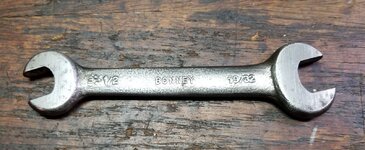
My pleasure. One addendum on the "720" marking, which continues to fascinate me....
Even though Bonney, like many other mfgrs, adopted the Williams numbering scheme (whose high and almost unanimous adoption rate is why it became known as the industry standard), they also extended it - apparently some time between 1925 and 1933, which contains the year (1929) your wrench was made.
This will take some explanation.
Most DOE engineers wrench charts start at 721, which is a 5/16" x 3/8" wrench. Williams' own wrench charts in Williams period catalogs up through 1943 start at 721. I couldn't find a Williams catalog with a 20 wrench in it. And true to form, in the Bonney 1925 catalog their smallest wrench is the 721. However, in the Bonney 1933 catalog, their smallest wrench is a 1020 (5/16" x 1/4").
If you don't understand ISN-embedded model numbering schemes, the "20" is the ISN. The "1" is a type of wrench or steel prefix that many mfgrs, including Bonney, used to distinguish engineers wrenches of different compositions, typically alloy from carbon, or alloy from special alloy. The "0" is just a filler, because that digit is needed for ISN's with a "7" prefix. Williams' first wrenches all had whole number model numbers, 21 through 40 or whatever. When they started making them with new, different milled openings, they needed a way to give them a model number that fit the system, but all the whole numbers were taken, so they used the "7" prefix to squeeze in a smaller wrench, and a letter (A, B, and C) suffix to squeeze in larger wrenches. A 723 (3/8" x 7/16"), for example, is smaller than a 23 (13/32" x 1/2"), but they couldn't give it a "22" because that was already taken for the 5/16" x 1/2" wrench. A 723-A (3/8" x 1/2") is bigger than a 23, but they couldn't give it a "24", because that was already taken for the 13/32" x 19/32" wrench. If you look at any DOE wrench chart in any period catalog, this will all become very apparent.
That was all necessary prelude to make sure the significance of my real point is understood.
Bonney's carbon steel line wrenches had straight up ISN numbers. Their CV line used 1XXX. Later, their Zenel line used 3XXX.
A Bonney CV eng wrench with 5/16" x 1/4" openings, therefore, was model number 1020. "1" for the series, "0" as filler, and "20" as the embedded ISN.
A Bonney -ZENEL- eng wrench with 5/16" x 1/4" openings was model number 3020. "3" for the series, "0" as filler, and "20" as the embedded ISN.
To emphasize my point, here're examples that have a 7XX ISN...
A Bonney CV eng wrench with 7/16" x 3/8" openings was model number 1723. "1" for the series, and "723" as the ISN.
A Bonney -ZENEL- eng wrench with 7/16" x 3/8" openings was model number 3723. "3" for the series, and "723" as the ISN.
Finally, the point.
A Bonney carbon steel wrench with 7/16" x 3/8" openings was model number 723. No prefix for CV or Zenel. Just 723. And again if you look at any wrench charts, you will find 27's, 727's, and 727C's, 29's and 729's, etc etc.
A Bonney carbon steel wrench with 5/16" x 1/4" openings should have been a "20", NOT a "720." The "7" in "720" implies smaller than "20" sizes.
When Bonney decided to make a wrench smaller than the 721 in 1929, I think they made a mistake giving it the 720. It should've been just a 20. And it was a mistake they recognized and corrected in the 1933 catalog.
You have a cool novelty wrench there.
If this is of interest: the Bonney is date coded GU. The Merit is a 21 and sized 13/32 - 5/16.It wasn't very far!
It was bothering me, so I went digging in a box of old weird miscellaneous wrenches I haven't pulled out in years.
Sure enough, I have an ISN 25 of the same style wrench as your ISN 720. And I have to take back the wartime 585 adjacent theory. I think they may have harkened back to this marking scheme when they were turning those out, but our wrenches are much older. You can tell by the thick shanks and thick, round heads. Mine is also an "LU" code, but it refers assuredly to 1929, and together our wrenches allude to either an incredible cross-Atlantic coincidence, or a very short production run. I'm going with the latter.



Attachments


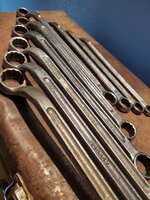
I need another collection like I need a hole in my head, but the ones I'm interested in have both box ends the same size, with one end bent and the other straight. For certain compressor and motor bracket jobs having a straight end with a deep offset end could've helped. Not doing that work anymore getting them is just a hobby. As I recall the smallest size was 7/16" then went up to 1".Something like this Bonneyman. What is in the picture is 3 of the 2893B one of the 2894C and one of the 2895C. Interested in any of them private message me.
Like this:
Attachments

Oldtuleguy
Well-known member
- Joined
- Nov 4, 2017
- Messages
- 10,486




RTM
Well-known member
Sleek
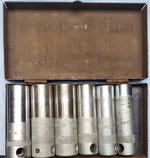
Picked this up rescently. Theyre circle CV except the 13/16 whuch is still pre '47 as it has "Made In USA", just no circle CV. It also has the LD25 socket which is 25/32 which is cool. Pretty clean set. Seems as it didn't have much of any use through the years! These deep sockets are one of my favorite designed sockets!


Private Lugnutz
Well-known member
That's a sweet set. Love the mix of chrome and satin finishes. And that box has probably one of the more intact babysh*t brown wrinkle finishes I have seen here.
Thanks Lugz! That's one of the things that caught me was the condition of the box. I wonder why Bonney didn't apply one of their painted logos on the cover? This might have been included in one of the bigger sets maybe?
Username already in use
Well-known member

Private Lugnutz
Well-known member
That's a good thought. I have a midget set with the same finish with no sign of there ever being a decal.I wonder why Bonney didn't apply one of their painted logos on the cover? This might have been included in one of the bigger sets maybe?
Oldtuleguy
Well-known member
- Joined
- Nov 4, 2017
- Messages
- 10,486
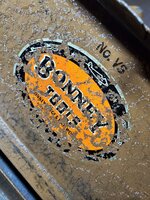
The decal was a waterslide type and disappeared easily. I clearcoated this one to stop the inevitable decal disintegration

Private Lugnutz
Well-known member
I've seen yours and others before, OTG. And of course I have all kinds of waterslide decals in various states of intactness or disintegration on other brands' boxes. I didn't mean to suggest that none of these Bonney boxes had them. And I don't mean to suggest that it's not possible that decals wore off. But I am saying that it's possible that some never had one. In cases where there is no wear of the finish itself, I think some iota of remains of the decal would be there, and I think JjKk's theory has some possible merit.
Too many projects already but we could probably try to get to the bottom of it with catalogs and magnifying glasses.
Too many projects already but we could probably try to get to the bottom of it with catalogs and magnifying glasses.
I've seen yours and others before, OTG. And of course I have all kinds of waterslide decals in various states of intactness or disintegration on other brands' boxes. I didn't mean to suggest that none of these Bonney boxes had them. And I don't mean to suggest that it's not possible that decals wore off. But I am saying that it's possible that some never had one. In cases where there is no wear of the finish itself, I think some iota of remains of the decal would be there, and I think JjKk's theory has some possible merit.
Too many projects already but we could probably try to get to the bottom of it with catalogs and magnifying glasses.
My thought was that possibly it has something to do with it coming together in a bigger set for example; the AA2; or something similar. I also have a red box similar to this with no logo or anything. Oh and what years did Bonney use the brown boxes or the red boxes or the black boxes? Could you have chosen the color back then? If I remember correctly in my #139 catalog one of the adds gives a choice between the 3 colors.
Oldtuleguy
Well-known member
- Joined
- Nov 4, 2017
- Messages
- 10,486
Could have come that way jk. Lugz I know you are very familiar with these sets and the decals!
Private Lugnutz
Well-known member
Not really. Not as much as you may think. In Bonney I only have the one 1/4-drive set in a box with that brown wrinkle finish. I am just skeptical of the idea that all found boxes with no decals means it wore off.Lugz I know you are very familiar with these sets and the decals!
Private Lugnutz
Well-known member
Good questions. Maybe LS has a better handle on this. I sure don't. My Bonney affliction stems from wartime and most of the Bonney tools I collected for years were not toolbox tools. Not sets, anyway. DOEs and DBEs. As my collection has grown away from that into socket wrenches and other things, my knowledge base has not really caught up. My hunch would be black (early), brown (wartime), and then red (postwar), but I could be wrong.Oh and what years did Bonney use the brown boxes or the red boxes or the black boxes?
Interesting.Could you have chosen the color back then? If I remember correctly in my #139 catalog one of the adds gives a choice between the 3 colors.
Private Lugnutz
Well-known member
Okay, you know how I hate unresolved questions..
I just went through the 1933 (No. 33), 1939 (No. 139), 1941 (No. 41), 1946 (No. 46-J), and 1951 (No. M-2) catalogs, reading all the box descriptions, and I think my hunch was correct.
The color is not named in the 1933 catalog, but they all look black and shiny, not textured, and my 43-pc No. VS5 ignition kit is in a shiny, black box with an original decal.
The color is not named in the 1939 catalog for any of the small or larger carry boxes or chests, but they all look textured, some color not as dark as black, and they are called "attractively finished." On page 44, the No. CC roller cabinet has the same exact appearance, lighter than black, and textured, and it is described as "crackle tan enamel." I think that's what we refer to here as the 'wrinkle brown' for sure, and I think it can be applied to all the boxes based on the identical appearance.
Everything is the same in the 1941 catalog. They reuse a lot of the same graphics and text. Not until we get to the rollers (page 33) is the finish described as "crackle tan enamel."
Same goes for the extremely abbreviated postwar 1946 catalog. Same boxes, same description.
In 1951, the boxes all change to "red crackle enamel" or just "red."
That "crackle tan enamel" (which is way darker than tan in my color palette!) was their version of a wartime camouflage color! I brown babysh*t you not!
So, black early and at least through 1938, then brown from 1939 through at least 1946, then red.
I just went through the 1933 (No. 33), 1939 (No. 139), 1941 (No. 41), 1946 (No. 46-J), and 1951 (No. M-2) catalogs, reading all the box descriptions, and I think my hunch was correct.
The color is not named in the 1933 catalog, but they all look black and shiny, not textured, and my 43-pc No. VS5 ignition kit is in a shiny, black box with an original decal.
The color is not named in the 1939 catalog for any of the small or larger carry boxes or chests, but they all look textured, some color not as dark as black, and they are called "attractively finished." On page 44, the No. CC roller cabinet has the same exact appearance, lighter than black, and textured, and it is described as "crackle tan enamel." I think that's what we refer to here as the 'wrinkle brown' for sure, and I think it can be applied to all the boxes based on the identical appearance.
Everything is the same in the 1941 catalog. They reuse a lot of the same graphics and text. Not until we get to the rollers (page 33) is the finish described as "crackle tan enamel."
Same goes for the extremely abbreviated postwar 1946 catalog. Same boxes, same description.
In 1951, the boxes all change to "red crackle enamel" or just "red."
That "crackle tan enamel" (which is way darker than tan in my color palette!) was their version of a wartime camouflage color! I brown babysh*t you not!
So, black early and at least through 1938, then brown from 1939 through at least 1946, then red.
I think that is the right sequence, Lugz. Probably good dates, too.
But I think some box models were smooth brown during the black/dark gray era, and there seem to be some early red in the brown era. I’ll have to check my boxes in sunlight to figure which ones gave me the idea.
One carry box I bought a few years ago had a bad black brushed repaint, but in places a brush couldn’t go, it was red crackle. I expected the plaid decal, but it was the plane, boat, automobile decal. I have not IDed it in a catalog - illustrations too dark or blurry to be sure, and the dimensions don’t quite match. It seems to be a Union-mfd box. So maybe not as clean a break as implied by looking at the catalogs alone.
I think there was probably some color crossover between eras - maybe one box mfr offered red earlier than another, or one box model was only available in black longer, or some kits sold faster than others and they used up their stock before switching to the next color.
But I would put them in the same order.
But I think some box models were smooth brown during the black/dark gray era, and there seem to be some early red in the brown era. I’ll have to check my boxes in sunlight to figure which ones gave me the idea.
One carry box I bought a few years ago had a bad black brushed repaint, but in places a brush couldn’t go, it was red crackle. I expected the plaid decal, but it was the plane, boat, automobile decal. I have not IDed it in a catalog - illustrations too dark or blurry to be sure, and the dimensions don’t quite match. It seems to be a Union-mfd box. So maybe not as clean a break as implied by looking at the catalogs alone.
I think there was probably some color crossover between eras - maybe one box mfr offered red earlier than another, or one box model was only available in black longer, or some kits sold faster than others and they used up their stock before switching to the next color.
But I would put them in the same order.
Back in the '80s I had (I think) a set of Bonney ratcheting flare-nut wrenches. They seemed pretty new when I had them. I never used them, but they seemed pretty slick.
I lost them when my box got boosted in that same decade. I've looked a good bit, but I have never seen another wrench anything like them.
Does anyone know what I'm taking about and perhaps have a picture?
I lost them when my box got boosted in that same decade. I've looked a good bit, but I have never seen another wrench anything like them.
Does anyone know what I'm taking about and perhaps have a picture?
Back in the '80s I had (I think) a set of Bonney ratcheting flare-nut wrenches. They seemed pretty new when I had them. I never used them, but they seemed pretty slick.
I lost them when my box got boosted in that same decade. I've looked a good bit, but I have never seen another wrench anything like them.
Does anyone know what I'm taking about and perhaps have a picture?
Are these the ones you're referring to?
They were called Cam-Loc wrenches. I've got a nearly complete set. Where they'll fit, they work great.
There were single end and double end versions. Really nice for repetitive work!
Attachments


Are these the ones you're referring to?
They were called Cam-Loc wrenches. I've got a nearly complete set. Where they'll fit, they work great.
There were single end and double end versions. Really nice for repetitive work!
Yeah, l had 4 or 5, single-end black, like the attached. Did you buy any of them from a fat drug addict?
They were cool, but did not seem very robust. Probably great for bleeding injectors and whatnot.
Are they still made?

Ricky Joe
Well-known member
I have a set, actually two sets, of the TAC sockets, which I have found to be great after the nuts are loosened. They are much more versatile than the cam locks because cam locks have to be in line to work. The worse thing about them is that they are Proto, so don’t really belong in this thread, but I thought it worth the diversion.
Username already in use
Well-known member
A couple of big Bonney that I snagged for scrap prices at the local recycling yard. They cleaned up pretty well.
The SOE is a #9 with a service opening of 1-7/16”. The DOE is a #1737 with 1-1/8” and 1-1/4” openings.

The SOE is a #9 with a service opening of 1-7/16”. The DOE is a #1737 with 1-1/8” and 1-1/4” openings.
Unfortunately, no. Not even the Chinese wanted to re-issue them - there's too many small parts and springs inside and after all they're quite large so not conducive to work in a modern car engine bay.Yeah, l had 4 or 5, single-end black, like the attached. Did you buy any of them from a fat drug addict?
They were cool, but did not seem very robust. Probably great for bleeding injectors and whatnot.
Are they still made?
I never found them lacking in strength. Though I never tried to break a frozen fitting loose with a cheater bar on them.
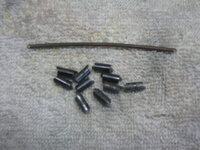
Here's one I took apart to get working again. Took some doing to hold all the moveable pins in place against the spring while fitting the other pins - and cover - in place!
Attachments



Last edited:
Unfortunately, no. Not even the Chinese wanted to re-issue them - there's too many small parts and springs inside and after all they're quite large so not conducive to work in a modern car engine bay.
I never found them lacking in strength. Though I never tried to break a frozen fitting loose with a cheater bar on them.
Here's one I took apart to get working again. Took some doing to hold all the moveable pins in place against the spring whil fitting the other pins and cover in place!
Yeah, I'm guessing too many warranty claims
GreenIron
Well-known member
A Bonney Collectors Item.
Manufactured for John Deere's 1973 year sales slogan, "MORE Profit FOR 73".
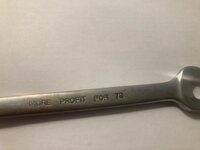

Manufactured for John Deere's 1973 year sales slogan, "MORE Profit FOR 73".
That, and the production costs. There must have been a crazy amount of hand labor to assemble that thing. Even the Chinese couldn't figure out a way to make it work and produce the profit they wanted. Given that probably not many would be sold. Too many simpler ratcheting OE tools out there already.Yeah, I'm guessing too many warranty claims
Last edited:
four.cycle
Well-known member
(* if any of you are looking for original drive couplers for 1/2" or 3/4" female drive ratchets see HERE: https://www.garagejournal.com/forum...eals-permathread.275031/page-119#post-9303681 )
I picked up these 2 off Marketplace rescently. The flex head is "circle CV" and is the shorter version of 1/2" drive at about 11". The stud remover is also the "circle CV" style!
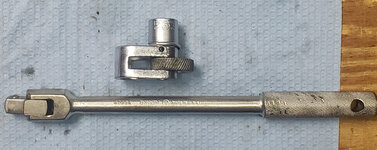
Here is both the flex head breaker bars next to one another 4096 and 4096A...

I love these older tools that have the detent ball in the handle for a crossbar!!!
Here is both the flex head breaker bars next to one another 4096 and 4096A...
I love these older tools that have the detent ball in the handle for a crossbar!!!
Last edited:
Cool! Never knew about the detent ball in the handle hole. And since acquiring my 1/2" drive Bonney stuff I've been looking to grab a stud remover. Nice design where the grip wheel is reversible, doubling tool life.
1928 patent by David Hume & JE Durham Jr.
From the differences in the logos, I would guess the stud remover to be from the late 1920s (although it could have persisted longer) and the hinge handles to be from the 1930s.
Last edited:

1928 patent by David Hume & JE Durham Jr.
From the differences in the logos, I would guess the stud remover to be from the late 1920s (although it could have persisted longer) and the hinge handles to be from the 1930s.
Whats your opinion on the years spread on the script style font; ie: this pic of a socket; Bonney used?

That is the logo that appears on their first line of sockets in 1927. There is a variant of “Chrome Vanadium” with upright (roman) letterforms, which I think followed briefly, prior to the CV-circle being relocated from centered under “Bonney” to in-line to the right of “Bonney,” sometime in the 1930s.
Bonney didn’t typically update catalog illustrations to reflect modest changes in the appearance of tools, so not much help pinning down a date for the logo transition. Magazine advertisements might help a bit more.
Bonney didn’t typically update catalog illustrations to reflect modest changes in the appearance of tools, so not much help pinning down a date for the logo transition. Magazine advertisements might help a bit more.
Last edited:
BTW, not to insist, because I see “script” misused a lot on this site, but that is italics, not script. Script is also slanted, but the letters connect, as though handwritten without lifting the stylus.
Similarly, posters use “typewriter font” when they mean slabserif.
Similarly, posters use “typewriter font” when they mean slabserif.
Last edited:

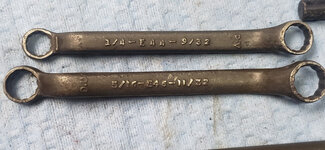

four.cycle
Well-known member
I know nothing about "Facebook" or Bonney. This was posted in the "Ebay hot deal" thread yesterday at 15:11 Pacific Time. May or may not still be available, but for those interested:
 www.garagejournal.com
Ebay or Auction Deals Permathread!
* shipping costs may vary depending upon your location! * * twertsy's tool extravaganza continues! * https://www.ebay.com/usr/vintageratchets ;)
www.garagejournal.com
I know nothing about "Facebook" or Bonney. This was posted in the "Ebay hot deal" thread yesterday at 15:11 Pacific Time. May or may not still be available, but for those interested:
Ebay or Auction Deals Permathread!
* shipping costs may vary depending upon your location! * * twertsy's tool extravaganza continues! * https://www.ebay.com/usr/vintageratchets ;)
That was me. FB links ****. Ill try to link it again here....
This works^^^... You might have to join the group to message back and forth but you can see the boards in this link. Theurr the Bonney/Utica LockRite boards in great shape.