
You are using an out of date browser. It may not display this or other websites correctly.
You should upgrade or use an alternative browser.
You should upgrade or use an alternative browser.
Spreading the Bonney affliction!
- Thread starter bonneyman
- Start date

Short answer - the all-sanserif font is later than the mixed one. Because of design similarity to Streamline combos and DOEs, all three ratchets should be from 1949-1959. But styling changes occured on different tools at different times. For ratchets, the handle form and exact mechanism of the ratchet guts / selector may be better for locking down production dates than the logo style. I also entertain the notion that finishing procedure changed a bit from 1952 to 1954, leading up to the purchase by Miller Manufacturing, and possibly again, with the opening of the Alliance OH plant in 1956. Your top ratchet seems to have slightly sharper corners, which in combos I date to pre-1953.
From my ongoing study of 1/2dr sockets, it appears to me that the styling of the stamped company name may have alternated between the form with the B/Y large, slab serif and ONNE small, sanserif (plus superscript, which I cannot emulate with the thread controls) from the 1940s through the 1960s. So the progression is something like this:
BONNEY earliest, centered over CV
BONNEY late 1930s to mid-1940s, left of CV
BONNEY 1946ish(?)
BONNEY 1947 to 1967
BONNEY 1968 onward
This does not wholey agree with what is stamped on DOEs, which, having a more similar stampable surface to ratchets, might be more useful. But the differences are more in the 1930s & 1940s.
You don’t show in your pics the rest of the ratchet, including the phrasing & punctuation of the COO notice, which also seems to alternate (giving me the idea of the brief sanserf blip in 1946): “MADE IN U.S.A.” “MADE IN USA” “U.S.A.” and “USA”, which may also be useful.
From my ongoing study of 1/2dr sockets, it appears to me that the styling of the stamped company name may have alternated between the form with the B/Y large, slab serif and ONNE small, sanserif (plus superscript, which I cannot emulate with the thread controls) from the 1940s through the 1960s. So the progression is something like this:
BONNEY earliest, centered over CV
BONNEY late 1930s to mid-1940s, left of CV
BONNEY 1946ish(?)
BONNEY 1947 to 1967
BONNEY 1968 onward
This does not wholey agree with what is stamped on DOEs, which, having a more similar stampable surface to ratchets, might be more useful. But the differences are more in the 1930s & 1940s.
You don’t show in your pics the rest of the ratchet, including the phrasing & punctuation of the COO notice, which also seems to alternate (giving me the idea of the brief sanserf blip in 1946): “MADE IN U.S.A.” “MADE IN USA” “U.S.A.” and “USA”, which may also be useful.
Last edited:
Yeah, I always associated fancy script and serif letters to be indicative of earlier tools. It's like people in general - and artists in particular - added those flourishes. Manufacturers did this, too. I think that earlier machinists and tool/die makers liked adding personal touches to their work. Hence, fancy fonts and detailed logos and nameplates.
Then more modern tools went to simple block lettering. I never tried to nail down the years that these things occurred but fancy fonts on tools grab my attention.
Then more modern tools went to simple block lettering. I never tried to nail down the years that these things occurred but fancy fonts on tools grab my attention.
Oldtuleguy
Well-known member
- Joined
- Nov 4, 2017
- Messages
- 10,486
Short answer - the all-sanserif font is later than the mixed one. Because of design similarity to Steamline combos and DOEs, all three ratchets should be from 1949-1959. But styling changes occured on different tools at different times. For ratchets, the handle form and exact mechanism of the ratchet guts / selector may be better for locking down production dates than the logo style. I also entertain the notion that finishing procedure changed a bit from 1952 to 1954, leading up to the purchase by Miller Manufacturing, and possibly again, with the opening of the Alliance OH plant in 1956. Your top ratchet seems to have slightly sharper corners, which in combos I date to pre-1953.
From my ongoing study of 1/2dr sockets, it appears to me that the styling of the stamped company name may have alternated between the form with the B/Y large, slab serif and ONNE small, sanserif (plus superscript, which I cannot emulate with the thread controls) from the 1940s through the 1960s. So the progression is something like this:
BONNEY earliest, centered over CV
BONNEY late 1930s to mid-1940s, left of CV
BONNEY 1946ish(?)
BONNEY 1947 to 1967
BONNEY 1968 onward
This does not wholey agree with what is stamped on DOEs, which, having a more similar stampable surface to ratchets, might be more useful. But the differences are more in the 1930s & 1940s.
You don’t show in your pics the rest of the ratchet, including the phrasing & punctuation of the COO notice, which also seems to alternate (giving me the idea of the brief sanserf blip in 1946): “MADE IN U.S.A.” “MADE IN USA” “U.S.A.” and “USA”, which may also be useful.
A very detailed analysis. Not something I have payed close attention to, always assumed fancier logo older.
0
Thank you for such a detailed response on this matter Lesserson! I've posted these ratchets previously here in this thread but I don't remember the post #. All 3 of these have "USA".
Short answer - the all-sanserif font is later than the mixed one. Because of design similarity to Steamline combos and DOEs, all three ratchets should be from 1949-1959. But styling changes occured on different tools at different times. For ratchets, the handle form and exact mechanism of the ratchet guts / selector may be better for locking down production dates than the logo style. I also entertain the notion that finishing procedure changed a bit from 1952 to 1954, leading up to the purchase by Miller Manufacturing, and possibly again, with the opening of the Alliance OH plant in 1956. Your top ratchet seems to have slightly sharper corners, which in combos I date to pre-1953.
From my ongoing study of 1/2dr sockets, it appears to me that the styling of the stamped company name may have alternated between the form with the B/Y large, slab serif and ONNE small, sanserif (plus superscript, which I cannot emulate with the thread controls) from the 1940s through the 1960s. So the progression is something like this:
BONNEY earliest, centered over CV
BONNEY late 1930s to mid-1940s, left of CV
BONNEY 1946ish(?)
BONNEY 1947 to 1967
BONNEY 1968 onward
This does not wholey agree with what is stamped on DOEs, which, having a more similar stampable surface to ratchets, might be more useful. But the differences are more in the 1930s & 1940s.
You don’t show in your pics the rest of the ratchet, including the phrasing & punctuation of the COO notice, which also seems to alternate (giving me the idea of the brief sanserf blip in 1946): “MADE IN U.S.A.” “MADE IN USA” “U.S.A.” and “USA”, which may also be useful.
Thank you for such a detailed response on this matter Lesserson! I've posted these ratchets previously here in this thread but I don't remember the post #. All 3 of these have "USA".
WNYflyer
Well-known member
Bonney wrench set picked up last weekend at an estate sale. Since it was in such good shape I really didn't look at it too closely for a few days and then when really taking a close look realized it was a Whitworth sized set. Wrench model numbers start with a W. Guess I shouldn't have been surprised since the previous owner had a bunch of old motorcycles though I didn't see any British bikes at the time of the sale.

Ricky Joe
Well-known member
Nice looking set. That style is my favorite for Bonney. Williams did one similar.Bonney wrench set picked up last weekend at an estate sale. Since it was in such good shape I really didn't look at it too closely for a few days and then when really taking a close look realized it was a Whitworth sized set. Wrench model numbers start with a W. Guess I shouldn't have been surprised since the previous owner had a bunch of old motorcycles though I didn't see any British bikes at the time of the sale.
outofbounds
Well-known member
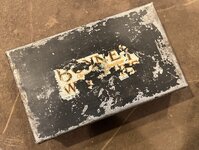
Similar to a socket set box shown by Old Tool Guy earlier upthred I found a box I’ll presume as a 1/4 Drive box, if for no other reason than there were a small handful of sockets inside but I think they’re later
Attachments

four.cycle
Well-known member
^ I need a C-series Craftsman 9/32" socket to complete a set. 
outofbounds
Well-known member
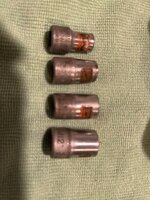
Sorry 4C, this one is 1/4” double square^ I need a C-series Craftsman 9/32" socket to complete a set.
outofbounds
Well-known member
Thanks for setting that straight LS! Sockets are M8, M9, M11, & M12. All with most or all the original stickers.Those 9/32dr (M not V) sockets are from the 1930s, contemporary to the box. The beautiful decals confirm the age. The single C-series Craftsman socket is old, too: Snap-on is the OEM for that one.
Attachments
Oldtuleguy
Well-known member
- Joined
- Nov 4, 2017
- Messages
- 10,486
A rare early set! Nice find. Box looks similar to the williams configuration 
outofbounds
Well-known member
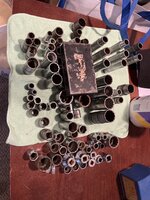
Mine for the “M” set would be 5” x 3” x 1-1/4”Geez, OTG, they sure look like they could have come from the same source! What are the box dimensions, gents?
Came as part of a large Bonney socket lot from several eras.
Attachments
Oldtuleguy
Well-known member
- Joined
- Nov 4, 2017
- Messages
- 10,486
2 3/4 x 5 1/4 for the williams
outofbounds
Well-known member

Oldtuleguy
Well-known member
- Joined
- Nov 4, 2017
- Messages
- 10,486
Early ones had no knurling
Here’s a recent purchase for which I seek the Brake Set #.
The tools are all date coded DT, ET or FT which puts them back to 1928.
The Catalog page from #34 which I show alongside shows larger sets #37 and #38
I see a challenge derusting these without losing the surviving transfers, suggestions welcome please.

The tools are all date coded DT, ET or FT which puts them back to 1928.
The Catalog page from #34 which I show alongside shows larger sets #37 and #38
I see a challenge derusting these without losing the surviving transfers, suggestions welcome please.
akasrick
Well-known member
Here’s a recent purchase for which I seek the Brake Set #.
The tools are all date coded DT, ET or FT which puts them back to 1928.
The Catalog page from #34 which I show alongside shows larger sets #37 and #38
I see a challenge derusting these without losing the surviving transfers, suggestions welcome please.
Would heat shrink be of any help?
akasrick
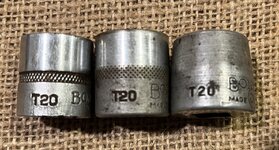
I agree with OTG - rightmost is earliest, maybe as early 1927, if they offered 3/8dr that early. Or perhaps we should say most primitive, as they may have continued making/marketing early styles alongside later-developed styles, as it seems maybe with 8pt and specialty sockets.more or less
Is it 6pt or 12pt?
It reminds me of the tapered-wall D-series 1/2dr.
The one in the middle resembles the slightly later straight-walled A-series 1/2dr, which introduced the knurled grip band.
But the leftmost I place immediately post-War, indicated by the “U.S.A.” instead of “MADE IN U.S.A.”
I looked at available catalog pdfs, and - as usual - the illustrations do not resolve sequence questions. Many illustrations of sockets don’t even show the side walls, and then there are many that show a mix of knurled and unknurled sockets.
Last edited:
I generally use mechanical methods, so I would press my (nitrile gloved) thumb or finger over the transfer while fine wire brushing the rest of it, and just accept a little residual rust near the edges of the transfer.suggestions welcome
outofbounds
Well-known member
All are 12 point 5/8" sockets x 3/8 Drive.I agree with OTG - rightmost is earliest, maybe as early 1927, if they offered 3/8dr that early. Or perhaps we should say most primitive, as they may have continued making/marketing early styles alongside later-developed styles, as it seems maybe with 8pt and specialty sockets.
Is it 6pt or 12pt?
It reminds me of the tapered-wall D-series 1/2dr.
The one in the middle resembles the slightly later straight-walled A-series 1/2dr, which introduced the knurled grip band.
But the leftmost I place immediately post-War, indicated by the “U.S.A.” instead of “MADE IN U.S.A.”
I looked at available catalog pdfs, and - as usual - the illustrations do not resolve sequence questions. Many illustrations of sockets don’t even show the side walls, and then there are many that show a mix of knurled and unknurled sockets.
Ricky Joe
Well-known member
If the catalogue is any indication, I would place it about 1930 because of the Pontiac brake adjuster pliers shown.Here’s a recent purchase for which I seek the Brake Set #.
The tools are all date coded DT, ET or FT which puts them back to 1928.
The Catalog page from #34 which I show alongside shows larger sets #37 and #38
I see a challenge derusting these without losing the surviving transfers, suggestions welcome please.
with the picture of steeldaulic brake pliers in the catalog, that probably places the date after 1928. Steeldraulic brakes were used on Pontiac and a few others between 1928 and 1932. I’m sure the pliers were made for longer, but that would have been the application. The wrench to the far left would have been a 5/8” opening and fit Dodge cars in 1925, probably other years. If that helps any.Here’s a recent purchase for which I seek the Brake Set #.
The tools are all date coded DT, ET or FT which puts them back to 1928.
The Catalog page from #34 which I show alongside shows larger sets #37 and #38
I see a challenge derusting these without losing the surviving transfers, suggestions welcome please.
Private Lugnutz
Well-known member
It's the same page in catalog #33 (1933). Unfortunately, we don't have any Bonney catalogs in the public domain between 1925 and that one. The 1939 and 1941 catalog brake sets (#41 and #51) are more diverse.Here’s a recent purchase for which I seek the Brake Set #.
The tools are all date coded DT, ET or FT which puts them back to 1928.
The Catalog page from #34 which I show alongside shows larger sets #37 and #38
When I cannot submerge a whole tool in Evaporust due to a decal or a wooden handle etc, I do one of several things, depending on the tool....I see a challenge derusting these without losing the surviving transfers, suggestions welcome please.
- put the tool in a make-shift holder that allows the rusty part to be submerged and keeps the delicate part above the solution
- wrap only the rusty part in a piece of a rag soaked (but not runny) with the solution and keep it soaked with an eyedropper
- use Rustoleum Rust Remover as a last resort. This is the strongest, safest, easiest HCL acid solution I have found and it's a gel, so it works well on selective spots. It comes in a small squeeze trigger bottle. Let it sit a few minutes and hit it with a hand wire brush. Then wash off well. Then oil.
Username already in use
Well-known member
Another option, Evaporust sells a gel version. I apply the gel and wrap with cling wrap.When I cannot submerge a whole tool in Evaporust due to a decal or a wooden handle etc, I do one of several things, depending on the tool....
Private Lugnutz
Well-known member
Holy fudge! I didn't know that!!!Another option, Evaporust sells a gel version.
Some wood handle flat heads, Phillips, and spark testers! I checked one of the payents on the WP wood handle and it came back to New Britain and Stanley in the 30's! I guess Bonney contracted out for their drivers? And does anyone know if any company still makes the neon tunes that install into these spark testing drivers?
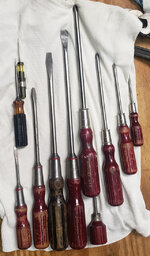


NICE group of drivers!
The black-handled one left of center I would think is actually marked Stanley - I saw a pretty complete set of them in MO a few years ago, and should have bought them.
I don’t know about the neon tubes. I have one or two of that type, but the handle material itself is damaged.
The black-handled one left of center I would think is actually marked Stanley - I saw a pretty complete set of them in MO a few years ago, and should have bought them.
I don’t know about the neon tubes. I have one or two of that type, but the handle material itself is damaged.
Mikeske
Well-known member
Yes I agree that is a nice set of screwdrivers and yes I had the same spark tester in my kit that I acquired in 1983. It also suffered the same issue as the neon tube burned out in mine in 1999 and since Bonney was out of business and I could not locate a replacement neon tube I scrapped the tester by placing it in the garbage. If I had known that the tester was made by Stanley I likely would have tried to get one from them but that was before the widely available resources of the internet.
NICE group of drivers!
The black-handled one left of center I would think is actually marked Stanley - I saw a pretty complete set of them in MO a few years ago, and should have bought them.
I don’t know about the neon tubes. I have one or two of that type, but the handle material itself is damaged.
Thanks LS ! The Black one is actually marked "Bonney W08".
I need to look up the other patent #'s. I only checked the patent on that smaller flat head. These Bonneys came in together with a bunch of other wood handles drivers in a lot. Oll post them up later on in the garage sale thread.
outofbounds
Well-known member
I second that emotion!NICE group of drivers!
I second that emotion!
Thanks for that deal on that 9/32 set man. I recognized who you were the min I saw it on the 'bay!
outofbounds
Well-known member
You and I might have a different definition for the word "deal", JK, but I surely hope you enjoy it!! I'll gather it up with the other lots (and some bonus items), and get it into tomorrow's mail.Thanks for that deal on that 9/32 set man. I recognized who you were the min I saw it on the 'bay!
You and I might have a different definition for the word "deal", JK, but I surely hope you enjoy it!! I'll gather it up with the other lots (and some bonus items), and get it into tomorrow's mail.
Thanks I appreciate that. The 9/32 tuff gives me something to do. A goal to look forward to. Now I have to complete the set which I suspect will take a while!
outofbounds
Well-known member
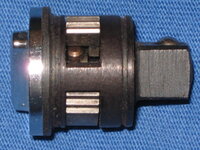
Bought this ratchet in an online auction thinking I was bidding on an A702K, only to pick it up and discover otherwise. First Utica branded tool if it's kind I've seen. Has anyone else seen the sockets or other drive tools? Seems to have more teeth than it's Bonney sister, as I click the square drive around to count them, it feels like it has an alternate stagger (very fine-less fine-very fine-less fine, etc) Anyone know more about this?

The tri-wing selector was early in the acquisition era of Triangle Tools. I haven't been able to nail the year they went to the single ridge selector, but it was in the 70's. (That might help date the ratchets Bonney made for John Deere, as most I've seen are the tri-wing selector).
Also, when Triangle acquired Bonney, Herbrand and Utica came along for the ride. So early on I surmise there was bound to be some cross-over tools as they ran out the existing inventory. I've got some flare end wrenches marked Kelsey-Haynes, Utica, and Bonney. Same tools, different markings.
In 1967 Bonney (Triangle) introduced the Hex-Fit open end with the V-gullet. So I'm thinking they had several years of consolidating, moving production facilities - plus research and development - while selling off that existing inventory. That could account for various markings on basically the same tool.
The gear is a dual pawl system used by Williams Superratchets with each pawl a half a tooth off form the opposite pawl - effectively doubling the tooth count. Their 36 tooth head became a 72 tooth action. (S-K's DL80 rebuild kits are the same deal). I've always noticed that Bonney ratchets feel "clunky" - kinda rough and loose. I believe the pawl set-up causes this. One pawls teeth are worn, the other pawls teeth are less so. After they wear in they're much better, but still feel "stilted" in operation.
Also, when Triangle acquired Bonney, Herbrand and Utica came along for the ride. So early on I surmise there was bound to be some cross-over tools as they ran out the existing inventory. I've got some flare end wrenches marked Kelsey-Haynes, Utica, and Bonney. Same tools, different markings.
In 1967 Bonney (Triangle) introduced the Hex-Fit open end with the V-gullet. So I'm thinking they had several years of consolidating, moving production facilities - plus research and development - while selling off that existing inventory. That could account for various markings on basically the same tool.
The gear is a dual pawl system used by Williams Superratchets with each pawl a half a tooth off form the opposite pawl - effectively doubling the tooth count. Their 36 tooth head became a 72 tooth action. (S-K's DL80 rebuild kits are the same deal). I've always noticed that Bonney ratchets feel "clunky" - kinda rough and loose. I believe the pawl set-up causes this. One pawls teeth are worn, the other pawls teeth are less so. After they wear in they're much better, but still feel "stilted" in operation.
Attachments



Last edited:
Oldtuleguy
Well-known member
- Joined
- Nov 4, 2017
- Messages
- 10,486
Several manufacturers dipped their toes in the offset tooth dual pawl pool, but it was duro that first patented the idea in 1946
Private Lugnutz
Well-known member
Kelsey-Hayes bought Utica in 1956, Herbrand in 1961, and Bonney in 1964. All the tools were made in one big factory in South Carolina. Then, in 1967, it became Triangle. I'm not sure if that was an acquisition or just some kind of corporate restructuring, but the name is certainly evocative of three companies being converged into one. Cross-over is probably the kindest term, as many tools started to look alike, which is understandable for efficiency and branding. The homogenization got worse I suspect under Cooper. But that is way past my knowledge base, and I defer to you guys on how bad that got across all the tool types.Also, when Triangle acquired Bonney, Herbrand and Utica came along for the ride. So early on I surmise there was bound to be some cross-over tools