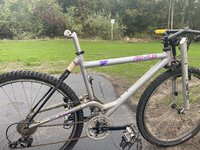
It's really going to come down to which ones are in better shape at that age. The air one will most likely need an air can rebuild at a minimum. Most likely both would benefit from having a full damper rebuild and flush. I'm betting the seals in both have gotten hard and brittle. Should be lots of how to's available for that age of shocks. Only special tools you would provably need is a set of shaft clamps. You can find those cheep on Ebay these days.
Problem is from looking at your picture I dont think that spring is correct at all of that shock. It looks way too short. Wouldn't mind seeing a pic of it with the preload backed off to where it is just touching plus a turn. Backing off the preload will make it feel less stiff. Ideally you should get 25-30% sag of the shock with just your weight on the bike. You achieve that by selecting the closest coil, then adjust the preload to fine tune. Same with an air shock, always inflate it so you get the correct sag, before messing with any of the other settings, such as rebound and compression.
In general, coil setups are more linear than air. As all air suspension ramps up towards the end of the stroke. I.E,. gets progressively harder to compress. Coil shocks also tend to have better small bump sensitivity and are more supple. This why Push and Vorspring both make coil conversion kits to convert modern air forks back to open bath coil systems. It's also why I have converted every bike I have owned for the past 6 years or so to the Push 11-6 rear shocks.
The industry switched to air shocks, as it didnt require having to stock different spring rates for each riders weight and the leverage ratio for each bike. I.E. cheaper for the masses. A properly tuned coil is almost always superior.