Many thanks for the comments and information WWIIJeep and yes it was your thread which actually drew me to the site.
Re: The centrifugal starting switch. I could see it was some sort of centrifugal mechanism but couldn't work out why it appeared to be breaking a circuit rather than making one. Anyway, I decided not to think about it any more and the problem went away. The switch is in good order. The springs and hinges are all free moving.
LOL (laughing at the part I put in bold)
The contacts on that switch automatically close when the motor slows down and stops, completing the circuit for the auxiliary or starting winding. Upon the next application of power, current flows through the starting winding, helping the motor to spin up to speed. At approximately 75% of full speed, centrifugal force moves the spring-loaded device on the rotor shaft and pushes against the switch to open the contacts, thus removing the starting winding from the circuit. From that point on, the motor continues to run only on the main winding, at a full speed of approximately 2850 RPM (assuming you have European 50 HZ power).
The starting winding is only intended to be powered while the motor is starting. If the centrifugal switch fails to operate, keeping current in the starting winding beyond the space of a few seconds, the starting winding will overheat and release the magic smoke.
You may be able to hear the centrifugal device move as the motor spins up, and you should definitely be able to hear it move again when the power is turned off, after the motor has slowed down, not long before it stops completely.
I hope that explanation makes sense. On the other hand, sometimes it's better not to think about it.

My only two issues now (apart from putting the whole thing back together again) are:
do I get a new bearing circlip?
do I get new bearings even thought the originals appear well greased and run sweet.
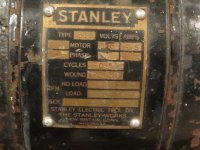
do I drill off the Stanley nameplate before cleaning the casing; or leave it in situ?
That's three issues not two,

but no matter.
Assuming you mean a clip for the side where you said one was missing and perhaps was never installed, you shouldn't need it as long as there is one on the other side, and as long as the motor shaft doesn't slide back and forth without it.
You may have trouble sourcing replacement bearings for that motor, especially since you're not in the US. Stanley changed bearing sizes in those grinders along the way, so it may or may not be an issue. For the style that is now obsolete, there is a close replacement, but you'll have to make a couple of spacers, since the replacements are not as wide as the original.
For the time-being, if the bearings are still good, I'd just put them back in.
I'd suggest leaving the nameplate in place and masking around it if you're going to repaint the grinder.
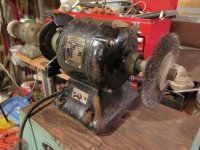
I'm also going to need some new rubber feet to replace the knackered ones you can see on the wiring photo above. If anyone knows where I can source these then please let me know.
Those feet are standard hardware store items in the US. Are they not something commonly used in the UK?
In any case, try to find ones made of relatively resilient rubber. The ones made of hard rubber or plastic tend to let the grinder "walk" across the workbench in use.