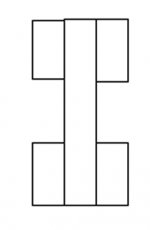
Spot on response. The stiffness is essentially the ability for the beam to resist deflections. Throwing out an equation and a bunch of jargon that many may not understand, the max deflection at the midpoint of a simple span with an evenly distributed load (like a floor system atop the beam), deflection = 5wl^4/384EI. The "w" is the distributed load, "l" is the span length, "E" is the modulus of elasticity (relative to the material used), and "I" is the moment of inertia. Comparing the 2x10 with the 2x4 flange and the sistered 2x10 (essentially a 4x10), the loads, span length, and modulus of elasticity doesn't change. Sooooo, the "stiffness" in this case is a function of the moment of inertia. The more material you put away from the centroid/middle of the beam the higher "I" you get. Using the sistered 2x10, I get an "I" = 198 in^3. Using the 2x10 with 2x4 bottom flange, I get an "I" = 309. This results in an increase in "stiffness" of 56%. One could work a deflection at the midspan if you had the loads and actual span. For a reference, lets use a "l" = 180in span, "w" = 10lb/in, and assume the "E" is 1600000psi (depends on wood type, moisture content, etc). With the sistered 2x10, you would get a max deflection of 0.43in. With the 2x10 and 2x4 bottom flange, you get a max deflection of 0.28in. If you went crazy and used the 2x6 for the bottom flange, you'd get an "I"=349in^4 and a max deflection of 0.25. As you can see, the increase in width really doesn't help a great deal in terms of STIFFNESS. If you used a 4x4 instead of the 2x6, you would get an "I" = 475. As you can see, the idea is to get as much meat away from the centroid of the beam. Once you add a flange, the main thing that will control stiffness is the overall beam depth. The deeper/taller the beam, the greater the stiffness. Now, going with 2x6 will have a larger effect on STRENGTH because the centroid is moving closer to the flange (more mass located in the bottom flange, moving the center of mass towards flange). Strength is how much load the beam can handle before it fails.
I can't really get into the actual Strength values of the two beam types without making a bunch of assumptions, as there are a ton of reduction factors. Design of wood really *****, FYI!
Gluing and proper nail spacing is essential in keeping the 2x4 somewhat composite to the 2x10, so that the tension force is transferred from the 2x10 to the 2x4.....otherwise it'll act independently and the 2x4 becomes merely a decorative facade.
You got it! One other thing that needs consideration is the dead weight of the beam. Doubling up a beam doubles its own dead load, whereas adding a flange only increases it by roughly 33%. The dead load of the beam becomes a point of diminishing returns when you get into a longer span, where the additional dead load of the sistered beam counteracts the strength and stiffness benefits.
Hope this all made a little bit of sense. I can clarify further if one of you guys don't get a part of my explanation, just let me know! I'm a licensed PE and SE and while I primarily design steel/concrete bridges, I still know quite a bit when it comes to wood