
You are using an out of date browser. It may not display this or other websites correctly.
You should upgrade or use an alternative browser.
You should upgrade or use an alternative browser.
Stupid question...radiator fans...ac or dc input?
- Thread starter pipsters
- Start date
Outlawmws
Well-known member
Yep DC.
If we are talking about motor vehicles then they are all 12v DC
I have never heard of any vehicle that uses a low voltage AC for anything.
I could understand someone's confusion to this, because the generator is refered to as an "alternator", it throws people off.
Yep it's 12V DC unless you have something concocted by a rogue engineer in a home garage.
Cryptic1911
Well-known member
I could understand someone's confusion to this, because the generator is refered to as an "alternator", it throws people off.
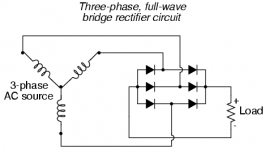
Well, actually a car alternator creates AC (alternating current), but it is run through a series of diodes that create a bridge rectifier to convert to DC current. It takes half of the sine wave and flips it so that there is a semi constant DC current, and then it is run through a regulator to keep it at a steady output to charge your battery

38Chevy454
Well-known member
Well, actually a car alternator creates AC (alternating current), but it is run through a series of diodes that create a bridge rectifier to convert to DC current. It takes half of the sine wave and flips it so that there is a semi constant DC current, and then it is run through a regulator to keep it at a steady output to charge your battery
X2, an alternator does produce alternating current. But it is convertted to direct current by the diodes as stated, so the output is perceived as DC.
Radiator fans on a vehicle will be 12 volts DC. Because of this you can make the motor run in reverse, so make sure your blades are blowing the correct rotation. Most OEM fans have a shaped plug to prevent hooking up wrong.
Alchymist
Well-known member
Well, actually a car alternator creates AC (alternating current), but it is run through a series of diodes that create a bridge rectifier to convert to DC current. It takes half of the sine wave and flips it so that there is a semi constant DC current, and then it is run through a regulator to keep it at a steady output to charge your battery
Nice diagram, but you only got part of it. Most Alternators are 3 phase.
Cryptic1911
Well-known member
Nice diagram, but you only got part of it. Most Alternators are 3 phase.
Oh, I didn't draw it, I just found something online that showed what the rectifier does to the wave to make it dc as an example
magova1104
Well-known member
Nice diagram, but you only got part of it. Most Alternators are 3 phase.
Yeap. 3 phase but it's the same method.
Attachments

Last edited:
Flatintoone
Well-known member
I haven't done any looking myself, but what about variable-speed, brushless radiator fans? When I first saw them in OEMs about 10 years ago, I remember a lot about them being whole new animals. I would guess that they were DC, but I know little enough about the black arts that I'm wondering if they could be AC.
richfinn
Well-known member
I haven't done any looking myself, but what about variable-speed, brushless radiator fans? When I first saw them in OEMs about 10 years ago, I remember a lot about them being whole new animals. I would guess that they were DC, but I know little enough about the black arts that I'm wondering if they could be AC.
Most stuff like this in my experience has a stable DC supply and the ground is pulse width modulated (fast on/off digital signal which is variable depending on conditions and sensor inputs) by a control module to alter speed.
Morrisman
Well-known member
I haven't done any looking myself, but what about variable-speed, brushless radiator fans? When I first saw them in OEMs about 10 years ago, I remember a lot about them being whole new animals. I would guess that they were DC, but I know little enough about the black arts that I'm wondering if they could be AC.
A variable speed motor would be DC. AC motors are fixed speed.
I looked into this when I was running an electric water pump on a hot rod, and they do make a control module that varies the speed of the pump to regulate the engines temperature, but it cost more than the pump itself. This could also be used on a cooling fan for a guess.

Alchymist
Well-known member
A variable speed motor would be DC. AC motors are fixed speed.
I looked into this when I was running an electric water pump on a hot rod, and they do make a control module that varies the speed of the pump to regulate the engines temperature, but it cost more than the pump itself. This could also be used on a cooling fan for a guess.
AC motor speed can be varied by varying the frequency. Newer motors designed for such application have a wide range of speed control with a VFD.
If it goes in a car its 99.999% DC at least to the control module.
PWM, pulse width modulation controllers turn the DC on and off very rapidly, and control the motor by varying the on/off time just like fuel injectors are turned on and off to regulate the amount of fuel flowing through them.
Simple relay controllers turn the DC on and off VERY slowly (infrequently), like on for a minute, off for a minute or two.
PWM, pulse width modulation controllers turn the DC on and off very rapidly, and control the motor by varying the on/off time just like fuel injectors are turned on and off to regulate the amount of fuel flowing through them.
Simple relay controllers turn the DC on and off VERY slowly (infrequently), like on for a minute, off for a minute or two.
X2, an alternator does produce alternating current. But it is convertted to direct current by the diodes as stated, so the output is perceived as DC.
Radiator fans on a vehicle will be 12 volts DC. Because of this you can make the motor run in reverse, so make sure your blades are blowing the correct rotation. Most OEM fans have a shaped plug to prevent hooking up wrong.
As long as we're talking about this and educating some, after the diodes is not really DC. It's rectified, ie single polarity, but still has a lot of high frequency oscillation on it. It must filtered for it to be DC. We often filter with capacitors or with the battery on vehicles.
As long as we're talking about this and educating some, after the diodes is not really DC. It's rectified, ie single polarity, but still has a lot of high frequency oscillation on it. It must filtered for it to be DC. We often filter with capacitors or with the battery on vehicles.
Outside of theory nothing is DC, its very very very very very low frequency, due to at some point going from off to on etc.
In practice headlights don't care, and voltage in a car is loaded with noise, enough that many devices plugged into a cigarette lighter can detect rpm, diode conditions, etc.
Direct current (DC) means current flows in one direction. There's no theory to worry about.
Alternating current (AC) means current flows back and forth.
Therefore, rectified AC is absolutely DC, but not nice and clean like a battery would produce. You can have inductance with pulsating DC, but its still DC.
If you look at the pic by Cryptic above, he has a sine wave AC cycle where Voltage is + and - half the time. Current is flowing one way half the time (above zero), and the other the other (below zero) half of the time.
In the same pic he has the rectified pulsating DC drawing, the voltage (and therefore current) never go below zero, so there is zero AC component.
Again, there can be inductance in a DC circuit. Think of the operation of an ignition using points as the simplest example. Points close, Voltage (magnetic field) increases across the coil (step up transformer), points open, voltage (magnetic field) drops inducing a large voltage on the secondary which leaps across the spark plug gap.
The last paragraph is an example of coercing DC to make AC oriented effects happen, but AC and DC are two different things. The output of an alternator before the rectifier is AC; after the regulator, its DC--pulsating, but still DC.
Alternating current (AC) means current flows back and forth.
Therefore, rectified AC is absolutely DC, but not nice and clean like a battery would produce. You can have inductance with pulsating DC, but its still DC.
If you look at the pic by Cryptic above, he has a sine wave AC cycle where Voltage is + and - half the time. Current is flowing one way half the time (above zero), and the other the other (below zero) half of the time.
In the same pic he has the rectified pulsating DC drawing, the voltage (and therefore current) never go below zero, so there is zero AC component.
Again, there can be inductance in a DC circuit. Think of the operation of an ignition using points as the simplest example. Points close, Voltage (magnetic field) increases across the coil (step up transformer), points open, voltage (magnetic field) drops inducing a large voltage on the secondary which leaps across the spark plug gap.
The last paragraph is an example of coercing DC to make AC oriented effects happen, but AC and DC are two different things. The output of an alternator before the rectifier is AC; after the regulator, its DC--pulsating, but still DC.
redwrench60
Well-known member
If we are talking about motor vehicles then they are all 12v DC
I have never heard of any vehicle that uses a low voltage AC for anything.
Most speed sensors send an AC voltage signal (in millivolts) and oxygen sensors generate an AC voltage (also in millivolts)

Most speed sensors send an AC voltage signal (in millivolts) and oxygen sensors generate an AC voltage (also in millivolts)
I love it when I learn something new in a given day.
Although to be honest when I said I didn't know of any vehicle
that used low voltage AC for anything, I didn't mean that low.

redwrench60
Well-known member
Yep, that's interesting. What happens when rain, rust, dirt, etc. get in there and jack with that mV input?
Scary....
Well, usually an ABS or check engine light but nothing dangerous. Sometimes improper operation of the affected component. For the most part the weather pack seals on connectors do a pretty good job of sealing out contaminants but nothings perfect.
Flatintoone
Well-known member
Most speed sensors send an AC voltage signal (in millivolts) and oxygen sensors generate an AC voltage (also in millivolts)
Is an oxygen sensor's output actually an AC voltage? Its output varies, but isn't that because the engine controller is constantly driving the mixture alternately rich and lean?
Is an oxygen sensor's output actually an AC voltage? Its output varies, but isn't that because the engine controller is constantly driving the mixture alternately rich and lean?
Usually O2 sensors produce output of 0-1VDC.
The only AC voltage that is commonly generated on a vehicle is the internal AC in the alternator, or output from reluctance based sensors (which then is converted to a DC signal at some point for the PCM to use).
Toolhorder
Well-known member
O2 sensors are DC voltage
A/F sensors can be in mA though
A/F sensors can be in mA though
Last edited:
Direct current (DC) means current flows in one direction. There's no theory to worry about.
Alternating current (AC) means current flows back and forth.
Therefore, rectified AC is absolutely DC, but not nice and clean like a battery would produce. You can have inductance with pulsating DC, but its still DC.
If you look at the pic by Cryptic above, he has a sine wave AC cycle where Voltage is + and - half the time. Current is flowing one way half the time (above zero), and the other the other (below zero) half of the time.
In the same pic he has the rectified pulsating DC drawing, the voltage (and therefore current) never go below zero, so there is zero AC component.
Again, there can be inductance in a DC circuit. Think of the operation of an ignition using points as the simplest example. Points close, Voltage (magnetic field) increases across the coil (step up transformer), points open, voltage (magnetic field) drops inducing a large voltage on the secondary which leaps across the spark plug gap.
The last paragraph is an example of coercing DC to make AC oriented effects happen, but AC and DC are two different things. The output of an alternator before the rectifier is AC; after the regulator, its DC--pulsating, but still DC.
No. DC means zero frequency. A rectified AC waveform has a DC component and a large AC component on top of it. In automotive electronics the distinction rarely matters and you can think of it as noisy DC. But to pro EEs such as myself, the distinction becomes rather important.
Alchymist
Well-known member
^^^^ What he said ^^^
Power supplies from rectified AC have the same problem, and requires filters to remove the AC portion. It's one of the causes of the "hum" you hear in the background of a stereo system.
Power supplies from rectified AC have the same problem, and requires filters to remove the AC portion. It's one of the causes of the "hum" you hear in the background of a stereo system.
Cryptic1911
Well-known member
lol, look what I started!
I probably should have found another image online that also showed filtered dc output instead of just the rectified output for less confusion, but the pickins were slim
I probably should have found another image online that also showed filtered dc output instead of just the rectified output for less confusion, but the pickins were slim
Outlawmws
Well-known member
Is an oxygen sensor's output actually an AC voltage? Its output varies, but isn't that because the engine controller is constantly driving the mixture alternately rich and lean?
Usually O2 sensors produce output of 0-1VDC.
The only AC voltage that is commonly generated on a vehicle is the internal AC in the alternator, or output from reluctance based sensors (which then is converted to a DC signal at some point for the PCM to use).
O2 sensors are DC voltage
A/F sensors can be in mA though
Agreed the O2 is DC. you can actually make a direct reading of the O2 sensor and get and idea of the Air/fuel mixture, (which is it indirectly measuring by converting the temperature of the exhaust to a variable DC voltage, albeit a very low voltage.)
Total range if the O2 is near 0 to about 1.1 V or 1100 mv (millivolts or thousandths of a volt), after it has fully warmed up. (takes a minute to a few minutes) and how to convert that to the A/F mix is in the chart below:
I had a DVM connected into my minuscule 4X4 for about a year trying to find an intermittent AF problem that was hitting it hard for top HP, made the difference between hitting the front turbulence of a semi truck and getting kicked back when attempting to pass, and just breezing by in the same pass, and it turned out to be one of the odd ball smog control valves that adjusted the carb.
A lot of Carb tuning info can be found HERE : and looking for the "Carburetor Tuning the Scientific Way: " link down the page.
A lot of Carb tuning info can be found here: and looking for the "Carburetor Tuning the Scientific Way: " link down the page. This guy also sells a nifty little recovery system for oil bottle residue.
Agreed the O2 is DC. you can actually make a direct reading of the O2 sensor and get and idea of the Air/fuel mixture, (which is it indirectly measuring by converting the temperature of the exhaust to a variable DC voltage, albeit a very low voltage.)
Total range if the O2 is near 0 to about 1.1 V or 1100 mv (millivolts or thousandths of a volt), after it has fully warmed up. (takes a minute to a few minutes) and how to convert that to the A/F mix is in the chart below:

I had a DVM connected into my minuscule 4X4 for about a year trying to find an intermittent AF problem that was hitting it hard for top HP, made the difference between hitting the front turbulence of a semi truck and getting kicked back when attempting to pass, and just breezing by in the same pass, and it turned out to be one of the odd ball smog control valves that adjusted the carb.
A lot of Carb tuning info can be found HERE : and looking for the "Carburetor Tuning the Scientific Way: " link down the page.
A lot of Carb tuning info can be found here: and looking for the "Carburetor Tuning the Scientific Way: " link down the page. This guy also sells a nifty little recovery system for oil bottle residue.
Ok I'll let that slide. Rats. I can't. I hate myself. O2 sensor signal will have an AC component oscillating between rich and lean. From the excellent, must read Bosch Fuel Injection & Engine Managment by Charles Probst :

Ok I'll let that slide. Rats. I can't. I hate myself. O2 sensor signal will have an AC component oscillating between rich and lean. From the excellent, must read Bosch Fuel Injection & Engine Managment by Charles Probst
That's still a DC signal.
The voltage varies between 0v and 1v, but it never goes below 0v. Just because the voltage changes, doesn't mean that it has any AC "component" to the signal.
Alchymist
Well-known member
That's still a DC signal.
The voltage varies between 0v and 1v, but it never goes below 0v. Just because the voltage changes, doesn't mean that it has any AC "component" to the signal.
Not really .... any electronics tech will tell you it's an AC signal floating on a DC level. Run it through an RC circuit and it's pure AC.
garfunkle24
Well-known member
I'm not an EE by any means, but surely you wouldn't class any DC signal with varying voltage as AC?
Alchymist
Well-known member
I'm not an EE by any means, but surely you wouldn't class any DC signal with varying voltage as AC?
It's classed as DC with an AC component. Some of you guys are making this harder than it needs to be.
w1im
Well-known member
I'm not an EE by any means, but surely you wouldn't class any DC signal with varying voltage as AC?
I am an EE and Alchymist is right. It is an AC signal with a DC offset. It can also be considered an AC and DC signal that have been combined.
Remember, voltage is all relative. Compared to a different reference, the signal in Vvmvbb's post could be above and below that reference. You can also feed a signal like that into one kind of circuit and get only the DC part of it and a different circuit and only get the AC part of it.
I don't know what an oxygen sensor has inside it, but you would see a similar waveform across the terminals of a DC motor when the shaft is spun by an external source. To get back to true DC you would need to filter out the AC component.
Outlawmws
Well-known member
It's classed as DC with an AC component. Some of you guys are making this harder than it needs to be.
I am an EE and Alchymist is right. It is an AC signal with a DC offset. It can also be considered an AC and DC signal that have been combined.
Remember, voltage is all relative. Compared to a different reference, the signal in Vvmvbb's post could be above and below that reference. You can also feed a signal like that into one kind of circuit and get only the DC part of it and a different circuit and only get the AC part of it.
I don't know what an oxygen sensor has inside it, but you would see a similar waveform across the terminals of a DC motor when the shaft is spun by an external source. To get back to true DC you would need to filter out the AC component.
The bottom line is that you can measure it with a DC DVM in the millivolt range, and get useful info on it...
Lets face it, most current almost anywhere not strictly regulated is pretty "dirty" stuff viewed at the "theoretical" levels. What matters is what you can do with it...
w1im
Well-known member
The bottom line is that you can measure it with a DC DVM in the millivolt range, and get useful info on it...
That DVM when set to DC should give you the DC component and when set to AC should give you the AC component. Always good to check both when looking at a signal with a DVM and not an oscilloscope.
jrlp
Well-known member
Good dvm can show both ac+ dc at the same time. My fluke 189 does.
Sent from my Galaxy Nexus using Tapatalk 2
Sent from my Galaxy Nexus using Tapatalk 2
Yeah verifying the presence of the AC component should be a very good thing to do when troubleshooting O2 (lamda) control, heh? It would tell you that the the control loop is at least trying to work (out of open-loop mode and making fuel adjustments). Next time I change out an O2 sensor I'll grab a scope trace before and after for kicks.
DC coupled probe, of course ;-).
DC coupled probe, of course ;-).