To avoid these ads, REGISTER NOW!

Subpanel help.....

legotech7

Active member
Joined
Oct 10, 2010
Messages
35
Location
Kannapolis NC
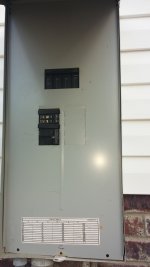
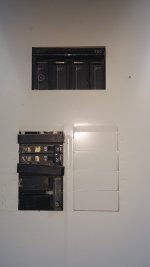
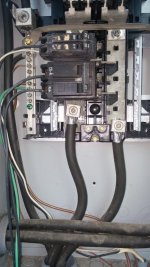
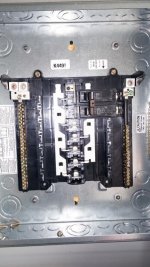
I would like to add a sub panel to my detached garage. I searched here in the forums but could find anything specific to my quandary.I have a 200 amp disconnect that sits next to my meter. Can I tap into the disconnect to connect the sub panel? The disconnect panel has two 40 amp breakers in it. I believe one is for a heat pump, and the other is not marked. What size wire could I use as the feeder? The garage is about 100 feet from the house and was thinking of using 2-2-2-4 aluminum to connect them. I will be adding 15 and 20 amp breakers to the sub panel for lighting and to power some tools. I'll be running and air compressor and a small welder. None of witch will be running simultaneously. The 100 amp sub panel will have a 80amp main breaker. Here are some pics of what I am referring too.... The third one as you can see has more room for breakers, hence the question, is this possible.

Any help with this is greatly appreciated. Thanks Joe....
 

Attachments

  • 20150124_135611.jpg
    20150124_135611.jpg
    33.9 KB · Views: 77
  • 20150124_135642.jpg
    20150124_135642.jpg
    91.2 KB · Views: 69
  • 20150124_135648.jpg
    20150124_135648.jpg
    74.5 KB · Views: 94
To avoid these ads, REGISTER NOW!

wyliesdiesels

Well-known member
Joined
Aug 14, 2012
Messages
19,994
Location
Modesto, CA
Yes u can add a 90a breaker to your main panel pictured. #2 AL is limited to 90a in your situation

Use MHF/mobile home feeder. It can be direct buried and must b in conduit indoors and where exposed. I love would run conduit the whole way.

What else does this panel power? Doesnt have many circuits in it...Is it mounted to your house? Where do the 20a and 40a breakers feed to? The garage? If so u cant have more than one power feed to a detached structure...

Can u post a pic of the breaker panel with the deadfront removed?
 
Last edited:

pattenp

Well-known member
Joined
Jun 4, 2008
Messages
10,175
Location
Virginia - USA
If you purchase a 100A main breaker panel for the sub it should have a 100A main breaker pre-installed in it. Why are you thinking of using a 80A main breaker? The feeding breaker in the main panel is what protects the feeder wire. As stated the #2 Al can be on up to a 90A feeding breaker. The 100A breaker in the sub serves only as a disconnect.
 
OP
L

legotech7

Active member
Joined
Oct 10, 2010
Messages
35
Location
Kannapolis NC
Ok guy's first off, thank you much for your input. Yes I will be using a 100 amp sub panel, but at the main can I use a 100amp breaker as well? I have a few more pics of the disconnect. As I mentioned before the 40 amp double pole breaker is for a heat pump and the other two 20 amp breakers I have no clue as of yet, but I'll figure it out later. This is what the inside of the 200amp disconnect looks like..... what other details should I be concerned about....

Again ,all help appreciated, thanks.......
 

Attachments

  • 20150124_171316.jpg
    20150124_171316.jpg
    59 KB · Views: 100
  • 20150124_171307.jpg
    20150124_171307.jpg
    65.5 KB · Views: 107
  • 20150124_171242.jpg
    20150124_171242.jpg
    140.7 KB · Views: 728

wyliesdiesels

Well-known member
Joined
Aug 14, 2012
Messages
19,994
Location
Modesto, CA
NO you CANNOT use a 100a breaker. #2 al is limited to 90a in your application.

Is there any electrical currently in the garage?
 

theoldwizard1

Well-known member
Joined
Feb 22, 2011
Messages
43,106
Location
SE MI
Okay, educate me !

This load center

attachment.php


looks like total OVERKILL if I understand its use.

First, I have never seen breakers used in parallel, like at the main. Seems odd.

Second, why wouldn't those 2 smaller loads just be placed on the load center on the inside of the building or a sub off of it ? Do you think the electrician who installed that load center used that model to avoid having to have separate disconnects for those other loads ?
 

slow

Well-known member
Joined
Feb 26, 2006
Messages
2,596
Location
near Orlando
What are the other loads for outside. I have seen them do it for the reason listed on air conditioners outside units.

Ryan
 

pattenp

Well-known member
Joined
Jun 4, 2008
Messages
10,175
Location
Virginia - USA
It's just a matter of putting in a double pole breaker up to 90A in the main disconnect panel if using 2-2-2-4 MHF. Just come out the bottom with conduit out to your garage. I see no glaring issues or concerns.
 
OP
L

legotech7

Active member
Joined
Oct 10, 2010
Messages
35
Location
Kannapolis NC
To answer your questions, no there is no power in the garage and I don't know if its over kill. This is new to me, that's why I'm asking questions.. As I mention before, the 40amp breaker is for a heat pump, ac combo....I think.... So....Lets see if I understand what yours saying.... All I need for the main disconnect is a 90amp breaker and feed that with 2-2-2-4 MHF to the sub panel, and I can use the 100 amp breaker in the sub?
 

CNGsaves

Well-known member
Joined
Sep 26, 2012
Messages
13,233
Location
KS and OK
^ ^ Yep, install 90A breaker in main panel at house (one shown on exterior of house). The 100A subpanel breaker in garage just acts as disconnect.

You'll need 4 wires from main panel to sub in garage, and the Al MHF 2-2-2-4 is low cost solution. Garage will need 2 ground rods also.

Suggest you trace the mystery circuits in that exterior main panel.

Also, might want to show GJ Sparky's your indoor subpanel in house to ensure it's done properly (ie 4 wire from that exterior main panel).
 

wyliesdiesels

Well-known member
Joined
Aug 14, 2012
Messages
19,994
Location
Modesto, CA
Okay, educate me !

This load center

attachment.php


looks like total OVERKILL if I understand its use.

First, I have never seen breakers used in parallel, like at the main. Seems odd.

Second, why wouldn't those 2 smaller loads just be placed on the load center on the inside of the building or a sub off of it ? Do you think the electrician who installed that load center used that model to avoid having to have separate disconnects for those other loads ?

How is it OVERKILL? What breaker is overkill? The 200a main?

Its definitely NOT overkill. Its a 200a main not much different than any other load center. Theres no breaker in the meter pan...

The other 2 breakers could be running exterior circuits making the wire run shorter. The 40a is for a heat pump which would be on the outside. Again, most likely a shorter wire run than feeding it off of the inside panel!

^ ^ Yep, install 90A breaker in main panel at house (one shown on exterior of house). The 100A subpanel breaker in garage just acts as disconnect.

You'll need 4 wires from main panel to sub in garage, and the Al MHF 2-2-2-4 is low cost solution. Garage will need 2 ground rods also.

Suggest you trace the mystery circuits in that exterior main panel.

Also, might want to show GJ Sparky's your indoor subpanel in house to ensure it's done properly (ie 4 wire from that exterior main panel).


I noticed the possible 3-wire feed as well. However, If the indoor panel was installed prior to 2008 code cycle then the 3-wire feed was to code and would be grandfathered in.

EDIT: As ACEMAN pointed out, the EGC is behind the neutral going into the conduit...
 
Last edited:

Aceman

Well-known member
Joined
Jan 28, 2007
Messages
2,513
Location
Eastern Oregon
I noticed the possible 3-wire feed as well. However, If the indoor panel was installed prior to 2008 code cycle then the 3-wire feed was to code and would be grandfathered in.

There was no code that allowed a 3 wire feed to a panel in the same building as far as I know. It's always been illegal. It's a moot point though, because he has a 4 wire feed. I can see the ground wire behind the neutral.
 

wyliesdiesels

Well-known member
Joined
Aug 14, 2012
Messages
19,994
Location
Modesto, CA
There was no code that allowed a 3 wire feed to a panel in the same building as far as I know. It's always been illegal. It's a moot point though, because he has a 4 wire feed. I can see the ground wire behind the neutral.

Duh i wasnt thinking on this one. The indoor panel is AFTER the 200a main...whoops

:lol_hitti
 
OP
L

legotech7

Active member
Joined
Oct 10, 2010
Messages
35
Location
Kannapolis NC
I think you be right wyliesdiesels, as to the explanation as to why those breakers are on the out side in that panel. As for the 2-2-2-4 alum. wire hook up to the 90 amp breaker, aren't those wires on the big side, they look pretty thick. Is there a special way to hook it up to the main panel? Perhaps a pic or diagram?

Thank you all for your patients and knowledge........
 

Charles (in GA)

Well-known member
Joined
Jan 11, 2006
Messages
12,489
Location
50 mi south of Atlanta
Okay, educate me !

This load center

First, I have never seen breakers used in parallel, like at the main. Seems odd.

Second, why wouldn't those 2 smaller loads just be placed on the load center on the inside of the building or a sub off of it ? Do you think the electrician who installed that load center used that model to avoid having to have separate disconnects for those other loads ?

GE main breaker, very common. Also very common to have an outside disconnect with a small panel to supply exterior loads such as A/C units, well pumps, and GARAGES, and then a feed thru to the subpanel panel inside the house. (you are looking at the main panel, on the outside of the house)

All the OP needs to do is slap a 90a GE double pole breaker in the outside panel and run some 2" sch 80 PVC conduit down into the ground, with a long sweep ell on it and then a trench to the garage. Install some 2-2-2-4 and connect appropriately. May need some accessory bolt on lugs on the neutral and ground bars to accommodate the larger wire. Very simple, code compliant install.

Charles

Charles
 
Last edited:

pattenp

Well-known member
Joined
Jun 4, 2008
Messages
10,175
Location
Virginia - USA
I think you be right wyliesdiesels, as to the explanation as to why those breakers are on the out side in that panel. As for the 2-2-2-4 alum. wire hook up to the 90 amp breaker, aren't those wires on the big side, they look pretty thick. Is there a special way to hook it up to the main panel? Perhaps a pic or diagram?

Thank you all for your patients and knowledge........

The #2 Al will fit in breakers down to a 60A. When connecting the Al wire be sure to use Noalox on the terminations. Also the new double pole breaker will just plug into the panel.

The ground and neutral are separate in the sub-panel. The neutral needs to be isolated from the ground.

View media item 16967
 
Last edited:
OP
L

legotech7

Active member
Joined
Oct 10, 2010
Messages
35
Location
Kannapolis NC
Thank you so much guy's. I believe with all this information I've got this project covered. At least getting the power to the garage part, I'll probably be back when I'm ready to wire the rest of it. I'm doing this as finances permit. Oh, the other breakers in the disconnect are for a well pump I have on my property. I just went and switched the breakers off one by one until I found something that didn't work..lol...

Thanks again everyone.....
 

DC73

Well-known member
Joined
Dec 27, 2014
Messages
1,627
Location
Lubbock TX
The #2 Al will fit in breakers down to a 60A. When connecting the Al wire be sure to use Noalox on the terminations. Also the new double pole breaker will just plug into the panel.

The ground and neutral are separate in the sub-panel. The neutral needs to be isolated from the ground.

In your diagram, it calls for "two 8' ground rods six feet apart connected by #6 bare copper wire" for the sub-panel. Could you explain this requirement? Just wondering if it is code for all installations, a local code, a special circumstance or whatever. I don't think I've ever seen multiple ground rods for one sub-panel. Regardless of code, why would it be necessary electrically?

Thanks,

DC
 
OP
L

legotech7

Active member
Joined
Oct 10, 2010
Messages
35
Location
Kannapolis NC
OK guy's got some more questions... This time about running wire... The garage in question is a metal building. I was was just going to run romex to wire everything up, but doing some more research I got more questions than answers. As I mentioned the building is all metal. I may have to run conduit for the wire. I don't know if I can use PVC EMT, And if I have to, can I run romex in the conduits or does it have to be individual wires? All of the beams in the building are metal. I thought I could just run the romex attached to the beams, like they do in a wood structure... How can I approach this part of the project?

Thanks...........
 

dw1

Well-known member
Joined
Jan 26, 2015
Messages
1,335
Location
Ky
In your diagram, it calls for "two 8' ground rods six feet apart connected by #6 bare copper wire" for the sub-panel. Could you explain this requirement? Just wondering if it is code for all installations, a local code, a special circumstance or whatever. I don't think I've ever seen multiple ground rods for one sub-panel. Regardless of code, why would it be necessary electrically?

Thanks,

DC

NEC 250-53 (2) Supplemental Electrode required, if you can prove that the 1 exsisting electrode is 25 ohms or less to earth then a supplemental electrode is NOT required, might as well drive 2 rods around here and be done with it, they have to at least be 6' apart from each other, they need to be connected with a #6 copper wire, # 4 aluminum, this wire needs to be one continuous wire. looped through the first clamp and stopping at the second ground clamp. Around here (KY) they also enforce the ICBT (Interconnecting Bonding Terminal) in this line, for phone, cable, satelite systems grounding location.
 
To avoid these ads, REGISTER NOW!

dw1

Well-known member
Joined
Jan 26, 2015
Messages
1,335
Location
Ky
P.S. alot of new construction water lines or replacement water lines are now plastic or poly, thats another reason for 2 grounding electrodes.
 

wyliesdiesels

Well-known member
Joined
Aug 14, 2012
Messages
19,994
Location
Modesto, CA
OK guy's got some more questions... This time about running wire... The garage in question is a metal building. I was was just going to run romex to wire everything up, but doing some more research I got more questions than answers. As I mentioned the building is all metal. I may have to run conduit for the wire. I don't know if I can use PVC EMT, And if I have to, can I run romex in the conduits or does it have to be individual wires? All of the beams in the building are metal. I thought I could just run the romex attached to the beams, like they do in a wood structure... How can I approach this part of the project?

Thanks...........

In a shop like that, conduit looks better. Yes NM-b/Romex can be run in conduit..And PVC and EMT are 2 different types of conduit!

In your diagram, it calls for "two 8' ground rods six feet apart connected by #6 bare copper wire" for the sub-panel. Could you explain this requirement? Just wondering if it is code for all installations, a local code, a special circumstance or whatever. I don't think I've ever seen multiple ground rods for one sub-panel. Regardless of code, why would it be necessary electrically?

Thanks,

DC

DW1 explained it in #20 above

P.S. alot of new construction water lines or replacement water lines are now plastic or poly, thats another reason for 2 grounding electrodes.

no it doesnt have to do with water line being plastic. It has to do with what you already quoted about needing to be 25 ohms or less to earth...
 
OP
L

legotech7

Active member
Joined
Oct 10, 2010
Messages
35
Location
Kannapolis NC
Well I know I asked this question before, so please forgive me as I'm a bit confused as to where to proceed next. Looks like I will probably have to run metal conduit in my building. So I will ask again, I will try to be a bit more clear. Is it ok to run romex, 12-2 sheathed cable wire in the metal conduit? This is the inside of the building. I thought I would be able to just run the romex along side the beams and cross over horizontally through each beam by drilling a hole through them with the addition of a plastic snap bushing to protect the romex. But the continued research tells me other wise. Right now I'll be working on the subpanel to the garage, and see what I can do after that, with the help of the folks on this forum. Added note: I understand the romex is allowed in conduit but only in dry locations. So I'm assuming that the inside of my garage is a dry location, correct?

Thanks All :confused:
 

Attachments

  • metal garage .jpg
    metal garage .jpg
    65.7 KB · Views: 28
  • metal garage 01 .jpg
    metal garage 01 .jpg
    64.7 KB · Views: 24
Last edited:

Aceman

Well-known member
Joined
Jan 28, 2007
Messages
2,513
Location
Eastern Oregon
Don't pull Romex in conduit. It's not the way to do it. Use THHN. Even if you have to buy 500' rolls each of black, white, and green it's still A LOT less headache than cramming romex into conduit.

Romex in conduit screams DIY "I don't know what I'm doing" when the inspector comes to look at it.
 

wyliesdiesels

Well-known member
Joined
Aug 14, 2012
Messages
19,994
Location
Modesto, CA
Yes NM-B IS allowed in conduit but as Aceman said, its not really the best way to go.

It will be a pain! THHN will be MUCH easier!
 

Norcal

Well-known member
Joined
Mar 16, 2008
Messages
13,752
Okay, educate me !

This load center

http://www.garagejournal.com/forum/attachment.php?attachmentid=408845&d=1422141523[IMG]

looks like total OVERKILL if I understand its use.

First, I have never seen breakers used in parallel, like at the main. Seems odd.

Second, why wouldn't those 2 smaller loads just be placed on the load center on the inside of the building or a sub off of it ? Do you think the electrician who installed that load center used that model to avoid having to have separate disconnects for those other loads ?[/QUOTE]


That style of breaker was pretty common, it was first used in 150-200A ITE loadcenters in the 1970's, GE, and Cutler-Hammer also used that design, the C-H main in the panel on my house shows the same type as shown in the photo below.

[URL=http://s197.photobucket.com/user/RFM959/media/IMG_0051.jpg.html][IMG]http://i197.photobucket.com/albums/aa308/RFM959/IMG_0051.jpg[/URL]
 

Charles (in GA)

Well-known member
Joined
Jan 11, 2006
Messages
12,489
Location
50 mi south of Atlanta
The framing in that metal building is, I think, only 2 inch square tubing. DO NOT drill thru it, you will weaken it way too much. In a regular red iron steel building, you can punch thru 8 inch purlins and girts, but these glorified metal carports that the manufacturers have expanded into decent sized buildings, are way too weak a structure to be punching holes thru, nothing larger than a self tapping screw to hold a metal electrical box or conduit clamp should be installed without consulting the building manufacturers engineers..

Do yourself a favor, and buy DEEP (2-1/8 inch) 4x4 electrical boxes and don't use anything smaller. Get a conduit bender and learn how to use it

Charles
 
OP
L

legotech7

Active member
Joined
Oct 10, 2010
Messages
35
Location
Kannapolis NC
In the process, of doing so Charles, using the bigger boxes were in the plans. Bending, the conduit, no rocket science, I think I got that.... But what would say say about using those offsets in the boxes? Is there a limit of how many you can use? Seems to me it might be an easy solution instead of bending, if not expensive... their pretty pricey...

Thanks.......
 
OP
L

legotech7

Active member
Joined
Oct 10, 2010
Messages
35
Location
Kannapolis NC
OK, finally under way with my subpanel install but I have a question. Just want to try to be clear. I posted a vid. with my query. I appreciate the help.

OK the vid wouldn't upload, so let me explain.... the subpanel has a neutral bar on the left and a ground bar on the right, with another ground bar next to it that is directly attached to the panel itself. The neutral bar had a green screw witch I removed thus isolating the bar from the panel. The ground bar did not have a screw attached to it but I added it on and again grounding that bar to the panel. I believe that is correct. If not, may the gurus enlighten me please. I added a few pics to help clarify..

Again, thanks so much... to be continued.....
 

Attachments

  • 20150312_162533.jpg
    20150312_162533.jpg
    69 KB · Views: 39
  • 20150312_162559.jpg
    20150312_162559.jpg
    67.8 KB · Views: 37

pattenp

Well-known member
Joined
Jun 4, 2008
Messages
10,175
Location
Virginia - USA
You are okay as long as you are sure the bars being used for the grounds are bonded to the panel and the neutral bar is isolated from the panel/ground bars and is not connected to the other bar by a back strap running from one side to the other side.
 

Aceman

Well-known member
Joined
Jan 28, 2007
Messages
2,513
Location
Eastern Oregon
I'm not familiar with GE, those are junk aluminum bussed panels.

Take a meter and see if you have continuity between the neutral bar on the left and the bar with the screw through it on the right. If you don't then you're good. If you do then that means there is a bonding strap running between the two bars(which is common in the Sq D and Siemens panels I use)and that means both bars are meant to be neutral bars. I'd remove the green screw so both bars are floating and use just the bar directly mounted to the back of the can as the ground bar.
 
OP
L

legotech7

Active member
Joined
Oct 10, 2010
Messages
35
Location
Kannapolis NC
Well got everything wired from the main disconnect from the house to the garage. Biggest pain was digging a 80 foot trench, but its done. A question I have in regards to the grounding rod, or rods.. Is it necessary to have two grounding rods for my application ? I asked around in my location and the most responses I got that two wouldn't be needed. But since I got so much help here, I'd thought I'd throw it out there and see the experts have to say. If you've read any of my post's for this project, it would give you better idea of what I'm doing. I think I'll be ok with just the one grounding rod . Al thoughts and comments , welcome...

Thank you......
 

wyliesdiesels

Well-known member
Joined
Aug 14, 2012
Messages
19,994
Location
Modesto, CA
One rod is actually all that is required UNLESS u cant prove the resistance to earth is 25 ohms or less. Most people dont have the expensive meter to test and prove this so they put in a second rod.
 
OP
L

legotech7

Active member
Joined
Oct 10, 2010
Messages
35
Location
Kannapolis NC
Thanks for the reply, I'll do a search on how to test , but I think the one rod will be ok. As I mentioned before, everyone in my are that I asked say on is all you need.

Thanks again........
 

Norcal

Well-known member
Joined
Mar 16, 2008
Messages
13,752
In order to prove 25 Ohms of resistance or less you need the testing equipment and be qualified to use it, just drive a 2nd rod & be done with it, it's cheaper.
 
OP
L

legotech7

Active member
Joined
Oct 10, 2010
Messages
35
Location
Kannapolis NC
Ok guy's finally got the rod in the ground and attached to the new panel. I should have been done with this a while ago, I know, but RA is a *****, and the flare ups keep coming. Anyway, Reading again thru the forums,and came across a question that might pertain to me. Will I need to ground out the metal building itself, besides grounding the subpanel? And if so, how would I do that?....

Thanks again.......
 
To avoid these ads, REGISTER NOW!
Top Bottom