To avoid these ads, REGISTER NOW!

Subpanel Question

OP
L

LipschitzWrath

Active member
Joined
Feb 10, 2014
Messages
29
Alright guys, I am resurrecting my own thread, lol. I am now planning on going with 6-6-6-6 copper and only running a 60A panel. I was able to power some other concerns I had differently, so I am now in full agreement that 60 amps in the garage will be more than enough. Funny how you more experienced guys tend to be right in the end, huh?

I was also able to find a location in the garage more suitable as the subpanel location, after I was educated on the 30" x 36" x 78" clear space requirements (plus the no "foreign systems" requirement floor-to-ceiling for the width of the panel). It was actually my lovely bride-to-be that pointed the new location out. It has so many more advantages that I can't believe how painfully obvious of a choice it should have been. Other big bonus - the cable pull from the main panel will be 10x easier access and half the length! Thank you Better Half!!!

With these two changes, I feel like I am now down to the finer details of the design, and about the only detail I haven't reconciled is (again) passing through the wall from the house into the garage.

I think it would be cleanest to punch a hole through the rim joist into the garage directly below the panel. Use an LB to 90 up directly into the bottom of the panel.

This brings me back to LB/conduit size. #6 SER is listed with an OD of 0.66 inches, so 5x that for pure code compliance would mean minimum bend radius of 3.3 inches. What size conduit and LB would be necessary to achieve that? I guess I was hoping for 1" EMT, but was curious what would be a) possible from a practical standpoint, and b) minimum to meet code?

While we are on the subject, is there some resource for figuring this bend radius stuff out? I can't seem to find any information on the net as far as what bending radii are possible in conduit bodies. Does anyone have a source for this type of info?

On the house side, once through the wall, I planned on installing a plastic snap bushing on the end of the EMT to satisfy 300.15(C), then run through the unfinished portion of the basement over to the main panel. Sound good?

What type of fitting (if any) do I need to use where the SER cable enters the main panel?

And above all else, THANK YOU guys for all your help with this. It has been enlightening and educational (and even a little fun, too)!
 
To avoid these ads, REGISTER NOW!

Norcal

Well-known member
Joined
Mar 16, 2008
Messages
13,753
A 6 AWG grounding conductor is not required, 10 AWG is code compliant.
 
OP
L

LipschitzWrath

Active member
Joined
Feb 10, 2014
Messages
29
A 6 AWG grounding conductor is not required, 10 AWG is code compliant.

Agreed, but the source I have for the SER cable includes a #6 ground conductor. I have found it for $3.69/ft, with minimum purchase of 25 ft, plus shipping. I'd certainly entertain an offering with a #10 ground, if the price is better than that.
 
OP
L

LipschitzWrath

Active member
Joined
Feb 10, 2014
Messages
29
I guess another question that has entered my mind is - are there other methods for making this short radius turn once the cable comes through the wall? I like the idea of the clean appearance of the EMT and LB, maybe there are other ways? I know someone suggested firring in a wooden "cable chase" area. While functional, I don't think I'd like the look. Coming up inside the wall to enter through the back of the panel doesn't appear to be an option, either. I believe I'd be penetrating the floor to do so anyways (and doesn't that have to be sleeved to do that also?), plus I'd have to contend with the fact that it's an insulated wall.

Open to ideas here.
 

ard

Well-known member
Joined
Feb 16, 2015
Messages
4,391
Location
Sierra Foothills... California
I guess I am confused at the confusion around EMT, conduit LBs, bend radii and running SER.

SER run in the walls is run 'in the walls, by itself'...when it enters a box you use a cable clamp. Heres one:

ARLINGE00280_WB_C4_PM_002.jpg


So why the EMT talk, LB talk, etc???

Are you running this SER outside? in the ground? in places where it needs physical protection??
 
OP
L

LipschitzWrath

Active member
Joined
Feb 10, 2014
Messages
29
I guess I am confused at the confusion around EMT, conduit LBs, bend radii and running SER.

SER run in the walls is run 'in the walls, by itself'...when it enters a box you use a cable clamp. Heres one:

ARLINGE00280_WB_C4_PM_002.jpg


So why the EMT talk, LB talk, etc???

Are you running this SER outside? in the ground? in places where it needs physical protection??

Sorry, I should have been more clear. What I have going on is to run a subpanel feed from my main panel in the basement to a sub in the garage. The run is only 25-30 feet long now. 95% of that will be in an unfinished basement, so no concerns there with SER.

The problem comes in that when I need to enter the garage, I believe I will need to punch a hole in the wall to get into the garage. From there I will need to go vertical 3-4 feet to enter the bottom of the surface mounted sub panel. This is because the garage is finished. The wall where I'd like to mount the sub borders the house, so I'm also assuming that it is also insulated. This all leads me to believe that fishing up through the wall to enter the sub through the back (as would likely be standard) is not a viable option. And, I'd have to punch through the subfloor of the house's ground level. I read somewhere you need to sleeve to do that anyways.

The talk about conduit and LB's comes in that I am understanding that I need to protect the SER from physical damage on the 3-4' that it will be exposed in the garage. Conduit is one way to accomplish that.

I know there are other ways, but I'd also like the install to look clean. The entire garage will have EMT run for additional power, so EMT seemed like a logical choice to both match and look clean.

Does this clear it up?

Like I said, I am going to take pictures tonight.
 

ard

Well-known member
Joined
Feb 16, 2015
Messages
4,391
Location
Sierra Foothills... California
Sorry, I should have been more clear. What I have going on is to run a subpanel feed from my main panel in the basement to a sub in the garage. The run is only 25-30 feet long now. 95% of that will be in an unfinished basement, so no concerns there with SER.

The problem comes in that when I need to enter the garage, I believe I will need to punch a hole in the wall to get into the garage. From there I will need to go vertical 3-4 feet to enter the bottom of the surface mounted sub panel. This is because the garage is finished. The wall where I'd like to mount the sub borders the house, so I'm also assuming that it is also insulated. This all leads me to believe that fishing up through the wall to enter the sub through the back (as would likely be standard) is not a viable option. And, I'd have to punch through the subfloor of the house's ground level. I read somewhere you need to sleeve to do that anyways.

The talk about conduit and LB's comes in that I am understanding that I need to protect the SER from physical damage on the 3-4' that it will be exposed in the garage. Conduit is one way to accomplish that.

I know there are other ways, but I'd also like the install to look clean. The entire garage will have EMT run for additional power, so EMT seemed like a logical choice to both match and look clean.

Does this clear it up?

Like I said, I am going to take pictures tonight.

There is "inside" and "outside"...sounds like you will be 'inside' the entire time, despite your concernes with 'puching thriugh' and 'being in an insulrated cavity'.

So you do not need emt, or LBs, or conduit.

This "punch a hole" thing seems to be tripping you up.... is this 'drill through the sheathing to gain access to the stud bay cavity'? (which may or may not have insulation in it? no big deal.

Finally if the panel is surface mounted- meaning the back of the box is on the surface of the sheetrock, then yes- enter via the back. A 3.5" stud bay will give you all the radus you need to run SER into a connector. or buy a 90degree angle connector, I think they sell them.

if the panel will be flush with hte surface of the sheetrock, run the SER into the bottom of the panel- NOT the back.

Clarify that part. Either way you will or can have a LARGE hole to allow you to get past the insulation.

HTH
 

wyliesdiesels

Well-known member
Joined
Aug 14, 2012
Messages
19,994
Location
Modesto, CA
I guess I am confused at the confusion around EMT, conduit LBs, bend radii and running SER.

SER run in the walls is run 'in the walls, by itself'...when it enters a box you use a cable clamp. Heres one:

ARLINGE00280_WB_C4_PM_002.jpg


So why the EMT talk, LB talk, etc???

Are you running this SER outside? in the ground? in places where it needs physical protection??

SER is NOT permitted to be ran underground.
 
To avoid these ads, REGISTER NOW!
OP
L

LipschitzWrath

Active member
Joined
Feb 10, 2014
Messages
29
Okay guys. Here's the pictures I promised.

First of all, NOT talking about anything underground or outside. This would all be considered inside the dwelling, the garage is attached. The main house panel is in the basement and the garage is on the main level (basically).

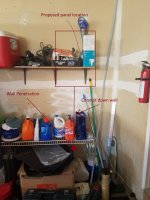
If you look at the attached, the first is a picture of where I want to put the panel in the garage. You can see the proposed panel location. The line coming out the bottom is where I propose using conduit (as sleeving for protection ONLY, I know it's not required). The hard to see circle at the bottom is where I propose punching through the wall.

The second picture is in the basement on the wall directly opposite the first picture. I have put a corresponding circle where I believe this wall penetration would fall, based on other penetrations into the garage. I believe this is referred to as a "rim joist" since it is sitting on the concrete foundation.

I omitted further pictures of the cable run because it is easy to get to the breaker box from there through the unfinished portion of the basement. Other than the connector I need to use to enter the main panel with the SER cable (if one is even required), I pretty much have no questions on that.

I hope this clears up any confusion.

I suppose I could enter the stud bay directly above the dot in the second photo. My two concerns are that (1) the stud bay is insulated and I'm not overly confident that I could fish the cable (advice?), and (2) because the stud bay is insulated, it's possible that I wouldn't qualify for the exemption under 310.15(A)(2), and would therefore be subject to using 60*C ampacity ratings for the SER.

And again, I could have SWORN I read somewhere that if going through a floor, you have to protect/sleeve the cable through the penetration. Entering the stud bay above the dot would require me doing just that. Not only would I have to drill through the floor, I'd also be drilling through the sole plate of that wall. And there is a guest bedroom on the other side of the ground level, so if I jack something up, it's gonna be very visible.

All this lead me to believe that running the cable on the exterior of the wall and protecting it from physical damage would be easier. Maybe that's wrong.

I would love to fish the cable through the wall, it would be cleaner and settle all the problems of LB size and yada yada. But if the centerline of the panel is say 48" off the floor, that means a minimum of 42" or so would be in insulation. That would be more than 10% in 310.15(A)(2), since there is no way it's 42 feet to the main panel.

As to flush vs. surface mounting the sub, I chose surface because EVERYTHING coming out of the sub will be in surface mounted EMT.
 

Attachments

  • Garage Labeled.jpg
    Garage Labeled.jpg
    137.9 KB · Views: 39
  • Basement Labeled.jpg
    Basement Labeled.jpg
    137 KB · Views: 38

ard

Well-known member
Joined
Feb 16, 2015
Messages
4,391
Location
Sierra Foothills... California
Drill a hole UP into the stud bay

Cut a 6x6 or 6x8 hole in the sheetrock

Use the space to run the wire, move insulation, whatever you need- plenty of access etc, etc

Patch the sheetrock, nothing pretty

Place the panel over the patch, running the SER into the back of the panel, connector I posted above.

Exiting into the space in front of the finished wall is simply not necessary, needlessly complicates the job.

(you could start with two small holes, see if you can fish it....if not expand the Sheetrock hole.)

Not sure why 310.15a2 is an issue...btw, that 10% math is wrong... 42"/10% is not 42 FEET.

And if you cannot drill the hole without 'jacking it up', hire someone.... ;)
 
OP
L

LipschitzWrath

Active member
Joined
Feb 10, 2014
Messages
29
Okay, allow me to clarify some things.

First of all, to help others that read this, I did find the passage about coming through the floor. It is 334.15(B).

2014 NEC 334.15(B) said:
Protection from Physical Damage. Cable shall be protected from physical damage where necessary by rigid metal conduit, intermediate metal conduit, electrical metallic tubing, Schedule 80 PVC conduit, Type RTRC marked with the suffix -XW, or other approved means. Where passing through a floor, the cable shall be enclosed in rigid metal conduit, intermediate metal conduit, electrical metallic tubing, Schedule 80 PVC conduit, Type RTRC marked with the suffix -XW, or other approved means extending at least 150 mm (6 in.) above the floor.

The part I missed is that all of 334.15 is for "Exposed Work". By penetrating the stud bay and entering the wall from underneath, it's not exposed and that code passage doesn't apply.

Good call on that.

Now, as to the other issue. I do feel that the exception in 310.15(A)(2) is germane to the conversation. Again from the code:

2014 NEC 310.15(A)(2) said:
Selection of Ampacity. Where more than one ampacity applies for a given circuit length, the lowest value shall be used.

Exception: Where two different ampacities apply to adjacent portions of a circuit, the higher ampacity shall be permitted to be used beyond the point of transition, a distance equal to 3.0 m (10 ft) or 10 percent of the circuit length figured at the higher ampacity, whichever is less.

Now, right off the bat, you're right. I had a brain fart on the math. 42" would be 35 feet, not 42. But 35 is still much longer than my run will be. This run is probably more like max of 25 feet.

Besides that, the way I read the code, technically you have to subtract the circuit length after the point of transition to lower ampacity.

Let's just say the run is 25 feet with 4 feet of that is in the insulated wall.

I can use the 75*C ampacity for SER cable (65 amps), except where it is in thermal insulation. 338.10(B)(4)(a) says that portion of the circuit must use the 60*C ampacity (55 amps). Right?

So my 25 foot run consists of 21 feet at the higher ampacity and 4 feet at the lower ampacity. The exception quoted above says you use 10 ft OR 10% of 21 feet (2.1 ft), whichever is less.

I would have more like 4 or 5 feet in insulation, so I can't use the 75*C rating for SER cable because the length of the circuit installed in thermal insulation exceeds 10%.

Bottom line: The way I read it, for this installation, I must use the 60*C column, so 55 amps. Now I understand that I can still use a 60A breaker since 55 isn't a standard size, but isn't the caveat there that your calculated load must be less than 55A? I have no such calculations.

And if I'm limited to the 60*C column, why even bother with SER cable? Save the money and use 6/3 romex, right?

As usual, I am probably over thinking this. But am I wrong?

Other question - if I cut a 6" x 6" hole in the sheetrock on the garage side of the wall, aren't I breaching a fire barrier? Do I just repair the hole with fire rock and all is well? I have zero experience there.
 
Last edited:

ard

Well-known member
Joined
Feb 16, 2015
Messages
4,391
Location
Sierra Foothills... California
As usual, I am probably over thinking this. But am I wrong?

Other question - if I cut a 6" x 6" hole in the sheetrock on the garage side of the wall, aren't I breaching a fire barrier? Do I just repair the hole with fire rock and all is well? I have zero experience there.

Probably...


Only if you leave the hole open. Patch it using whatever rock was used in the first place and the wall should retain whatever rating it had. Depending on how you make the patch it could exceed the original.

42" x10= 420 = 35 feet. Anyway to run the SE cable that takes 35 feet?
 
OP
L

LipschitzWrath

Active member
Joined
Feb 10, 2014
Messages
29
Anyway to run the SE cable that takes 35 feet?

Is coiling it up in the joists permitted? Joke (kinda), but that's the only way I could see the run getting to 35 feet.

The 42 inches was just a guess. We could roll with it for now, I'd probably have to come in through one of the lower knockouts on the back of the panel.

From my copper source (feel free to chime in if you know of a better source):

6-6-6-6 Copper SER = $3.69/ft x 35 feet = $129.15

For grins, I also checked:

4-4-4-6 Copper SER = $3.94/ft x 25 feet = $98.50

So I could run 4-4-4-6 for less overall cost, and even using the 60*C ampacity, have a sub panel capable of 70A.

That might be the way to go.
 
OP
L

LipschitzWrath

Active member
Joined
Feb 10, 2014
Messages
29
Why are you using copper?

Why not aluminum and save some dough?
Valid question. I guess I decided on copper a while ago because I was trying to keep wire diameter down to help resolve the conduit issue.

If I enter the stud bay, conduit is no longer a concern and it would make sense to save the money. All I need to do is use No-Alox and torque to recommended torque values, correct? Any other concerns?

Next question for a related project. Does aluminum wire/cable bend easier than copper for a given size, or is it about the same?

Sent from my SM-G935V using Tapatalk
 
OP
L

LipschitzWrath

Active member
Joined
Feb 10, 2014
Messages
29
Wow, 2-2-2-4 AL is only $1.37/ft with a 75A rating at 60*C. I think that's the way I might go. Punch up through the floor as ARD suggested.

Do you guys have any tips for snaking the cable between the insulation and garage-side sheet rock? It will be a pretty small hole I am working with on either side of the fishing run.
 

ard

Well-known member
Joined
Feb 16, 2015
Messages
4,391
Location
Sierra Foothills... California
1. Dont make it such a small hole

2. Have you ever handled 2224 AL SER cable? Its not 12/2 romex. Should push right up, no problem

Or- run a 42" piece of 1/4" rod, with a cord taped to the end. Run that down, then pull the cable up.
 
OP
L

LipschitzWrath

Active member
Joined
Feb 10, 2014
Messages
29
1. Dont make it such a small hole

Agreed. I won't skimp on the panel end of the fish run. I was referring to punching up into the stud bay from down below. Can only make the hole so big. I'm unsure if this is a 2x6 wall or 2x4. My guess would be 2x6 but won't know until I cut into the sheet rock.
 
To avoid these ads, REGISTER NOW!
Top Bottom