OP
LipschitzWrath
Active member
- Joined
- Feb 10, 2014
- Messages
- 29
Alright guys, I am resurrecting my own thread, lol. I am now planning on going with 6-6-6-6 copper and only running a 60A panel. I was able to power some other concerns I had differently, so I am now in full agreement that 60 amps in the garage will be more than enough. Funny how you more experienced guys tend to be right in the end, huh?
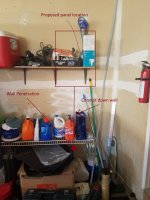
I was also able to find a location in the garage more suitable as the subpanel location, after I was educated on the 30" x 36" x 78" clear space requirements (plus the no "foreign systems" requirement floor-to-ceiling for the width of the panel). It was actually my lovely bride-to-be that pointed the new location out. It has so many more advantages that I can't believe how painfully obvious of a choice it should have been. Other big bonus - the cable pull from the main panel will be 10x easier access and half the length! Thank you Better Half!!!
With these two changes, I feel like I am now down to the finer details of the design, and about the only detail I haven't reconciled is (again) passing through the wall from the house into the garage.
I think it would be cleanest to punch a hole through the rim joist into the garage directly below the panel. Use an LB to 90 up directly into the bottom of the panel.
This brings me back to LB/conduit size. #6 SER is listed with an OD of 0.66 inches, so 5x that for pure code compliance would mean minimum bend radius of 3.3 inches. What size conduit and LB would be necessary to achieve that? I guess I was hoping for 1" EMT, but was curious what would be a) possible from a practical standpoint, and b) minimum to meet code?
While we are on the subject, is there some resource for figuring this bend radius stuff out? I can't seem to find any information on the net as far as what bending radii are possible in conduit bodies. Does anyone have a source for this type of info?
On the house side, once through the wall, I planned on installing a plastic snap bushing on the end of the EMT to satisfy 300.15(C), then run through the unfinished portion of the basement over to the main panel. Sound good?
What type of fitting (if any) do I need to use where the SER cable enters the main panel?
And above all else, THANK YOU guys for all your help with this. It has been enlightening and educational (and even a little fun, too)!
I was also able to find a location in the garage more suitable as the subpanel location, after I was educated on the 30" x 36" x 78" clear space requirements (plus the no "foreign systems" requirement floor-to-ceiling for the width of the panel). It was actually my lovely bride-to-be that pointed the new location out. It has so many more advantages that I can't believe how painfully obvious of a choice it should have been. Other big bonus - the cable pull from the main panel will be 10x easier access and half the length! Thank you Better Half!!!
With these two changes, I feel like I am now down to the finer details of the design, and about the only detail I haven't reconciled is (again) passing through the wall from the house into the garage.
I think it would be cleanest to punch a hole through the rim joist into the garage directly below the panel. Use an LB to 90 up directly into the bottom of the panel.
This brings me back to LB/conduit size. #6 SER is listed with an OD of 0.66 inches, so 5x that for pure code compliance would mean minimum bend radius of 3.3 inches. What size conduit and LB would be necessary to achieve that? I guess I was hoping for 1" EMT, but was curious what would be a) possible from a practical standpoint, and b) minimum to meet code?
While we are on the subject, is there some resource for figuring this bend radius stuff out? I can't seem to find any information on the net as far as what bending radii are possible in conduit bodies. Does anyone have a source for this type of info?
On the house side, once through the wall, I planned on installing a plastic snap bushing on the end of the EMT to satisfy 300.15(C), then run through the unfinished portion of the basement over to the main panel. Sound good?
What type of fitting (if any) do I need to use where the SER cable enters the main panel?
And above all else, THANK YOU guys for all your help with this. It has been enlightening and educational (and even a little fun, too)!