To avoid these ads, REGISTER NOW!

Suggestions for running low voltage from inside/out

TT_Vert

Well-known member
Joined
Mar 9, 2018
Messages
1,436
Location
Wauconda, IL.
I have an indoor LV transformer that will power some outside lights. Rather than put an AC box outside as well as the transformer I am going to put them in my garage. The transformer is indoor rated. I want to have the wire exit as low as I can as possible in the exterior wall and down into the ground but I also want it to look nice. Anyone have any suggestions how to trim the inside/outside to conceal the wiring?

Perhaps an LB like this into 1/2" conduit that'll go into the ground and be backfilled. Just not sure if there is some weatherproof box I could use that i could screw the LB into or if there is another aesthetically pleasing way to get the LV wire from it's exit hole down into the ground. I "could" use a feed through bushing but then I have the wire exposed which I won't like the look of. I also could use a wire guard there but that would look unfinished to me IMO. Perhaps i could 3D print a cap on it and paint both the same color as the wood siding.

On the inside I will probably install an old work bracket and probably banana jacks. I'll then put banana plugs on a whip that will feed into the transformer to make the inside look nice.

Dave
 
Last edited:
To avoid these ads, REGISTER NOW!
OP
T

TT_Vert

Well-known member
Joined
Mar 9, 2018
Messages
1,436
Location
Wauconda, IL.
Any suggestions? I did see we use NEC NFPA 2011 edition codes. I went looking a bit and after reading NEC-70 article 411 as well as chapter 3. I'm a bit confused as looking in NEC chapter 3 as directed below it doesn't state anything about LV cable, does that mean LV must be protected and exit like any HV cable would be? I cannot see that being the case but maybe I'm wrong.

These indoor units are manufactured with secondary input connections that are compatible with wiring methods from NEC chapter 3, such as those that include ½ inch knockouts or NM cable clamp, permitting compliance with 411.4. Section 411.4 states that low-voltage lighting systems must not be concealed or the wiring must not extend through a building wall, unless using a wiring method specified in chapter 3.

From chapter 3 (This seems to mean I MUST use an enclosed raceway or conduit, not the wire guard I had linked, opinions?)
Emerging from Grade. Direct-buried cables or conductors
that emerge from grade must be installed in an enclosure or
raceway to protect against physical damage. Protection isn’t
required to extend more than 18 in. below grade, and protection
above ground must extend to a height not less than 8 ft.


I'm unsure what "protected" means here exactly

Conductors Entering Buildings. Conductors that enter a
building must be protected to the point of entrance.


Dave
 
Last edited:

Git

Well-known member
Joined
May 18, 2008
Messages
6,895
Location
S Cal
If you want a clean install, I would probably cut a small hole in the drywall where you are going to mount the transformer. Feed the wires down inside the wall. Use gry pvc conduit with a LB and a short stub to go into the wall, and another piece to go down into the ground.
 

ddawg16

Well-known member
Joined
Jul 11, 2008
Messages
21,005
Location
S. California
Don't worry about the NEC.....think of it in terms of what could go wrong?

I think you're headed in the right direction. You want to protect the wires.

I like LB's. It's a good way to join your inside wiring to what ever you are using outside.

Just be aware, with DC, voltage drop is more of an issue. Hence, don't hesitate to upsize the wire. I personally would put all of it in conduit if it's going underground. It will make it a lot easier to replace should there be an issue.
 

checkthisout

Well-known member
Joined
Sep 5, 2008
Messages
5,232
In conduit is fine.

How high is the foundation wall where you want the wire to exit the structure?
 
OP
T

TT_Vert

Well-known member
Joined
Mar 9, 2018
Messages
1,436
Location
Wauconda, IL.
If I do this I'll use 14AWG. I don't know the resistance of the wire per foot but given the wattage of all of the bulbs I had planned to use I'm going to be fine. I can't see the voltage drop being enough to cause an issue (hopefully) Put in a few spots today and didn't like the way they illuminated my pine trees given how close they are to the base so I may not even do this. Definitely not going to the effort to run conduit over the entire run (It's quite long and convoluted)

Dave
 

Git

Well-known member
Joined
May 18, 2008
Messages
6,895
Location
S Cal
Your overthinking it. It's 12v low voltage wire

What kind of lights are you using - hopefully, led? Otherwise you need to add up the wattage of the lights, how long the run is etc, how many watts the transformer puts out, etc.

Around here, the wire is just buried several inches underground. Usually the lights are placed along the edge of a sidewalk, patio, etc and the wire is pretty much protected next to the edge of the concrete unless you go digging around

Here is a calculator for an example:
https://www.vistapro.com/calc_volt_drop.aspx
 
OP
T

TT_Vert

Well-known member
Joined
Mar 9, 2018
Messages
1,436
Location
Wauconda, IL.
I'm not worried about my safety or power consumption, I'm more worried about code and aesthetics. Using LEDS which draw a max of 3W each. SO ~250 mA.
 

alfredeneuman

Well-known member
Joined
Mar 3, 2011
Messages
4,596
Location
Fullerton, CA
Yes it's a problem, but not so much as DC.
The whole reason why we use Westinghouse's AC instead of Edison's DC system on our electrical services is it is able to transmit over much longer distances.
 

ard

Well-known member
Joined
Feb 16, 2015
Messages
4,391
Location
Sierra Foothills... California
I run low voltage exterior just like I am running 120VAC: PVC conduit, boxes and flex. When a wire needs to leave this 'system' and attach to something (ie like lawn sprinkler valves) it will leave via a downward facing opening OR a rubber compression fitting to seal the cable. Sometimes I will use spiral wrap or split-corrugated for wire bundles around valves, etc. Same for temp and solar sensors out at arrays; same for cable to satellite dishes; telephone cabling to the pool and decks.

Personally I dont like 'bare' wires strung around, conduit and boxes seem nice, neat, robust.
 

ard

Well-known member
Joined
Feb 16, 2015
Messages
4,391
Location
Sierra Foothills... California
curious what rubber compression fittings you use?

Dave

https://www.grainger.com/product/2H...kwcid=AL!2966!3!281698275252!!!g!470952775171!


2HXZ9_AS01

for example. never buy **** at grainger tho...
 
Last edited:

75gmck25

Well-known member
Joined
Jul 21, 2014
Messages
1,349
Location
Alexandria, VA
Since its LV cable, I believe you are really overthinking it. AFAIK, the rules in the NEC do not really address LV cable requirements, so I don't think the references are applicable. They are okay to use as guidelines, but inspectors don't get concerned about compliance for LV wiring.

You might also want to visit a dealer for in-ground lawn sprinkler supplies, since they often do a lot of LV wiring to the valves, and are mostly concerned with damage protection.

Bruce
 
To avoid these ads, REGISTER NOW!
OP
T

TT_Vert

Well-known member
Joined
Mar 9, 2018
Messages
1,436
Location
Wauconda, IL.
Since its LV cable, I believe you are really overthinking it. AFAIK, the rules in the NEC do not really address LV cable requirements, so I don't think the references are applicable. They are okay to use as guidelines, but inspectors don't get concerned about compliance for LV wiring.

You might also want to visit a dealer for in-ground lawn sprinkler supplies, since they often do a lot of LV wiring to the valves, and are mostly concerned with damage protection.

Bruce


On the contrary, it is directly defined and regulated now.

Dave
 
Last edited:

Innovate1

Well-known member
Joined
Jul 28, 2014
Messages
4,324
Location
Illinois near St. Louis, Missouri
Yes it's a problem, but not so much as DC.
The whole reason why we use Westinghouse's AC instead of Edison's DC system on our electrical services is it is able to transmit over much longer distances.

And the reason it can go over long distances is AC can easily be stepped up to higher voltages so the current and voltage drop is less. 12VAC or 12VDC for the same power level the voltage drop issue is EXACTLY the same.

The reason voltage drop is more of an issue with low voltage systems (AC or DC) is that for a given power the current is higher. 120W at 120V is 1A. 120W at 12V is 10A.
 
Last edited:

Git

Well-known member
Joined
May 18, 2008
Messages
6,895
Location
S Cal
On the contrary, it is directly defined and regulated now.

Dave

I can see protecting the wire INSIDE of your house. I guess if something shorted out there is a potential for a fire...

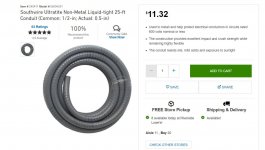
Luckily my two 900 watt transformers are mounted outside. If I was in your shoes under the new rules, I think I would just use a piece of 'liquid tite' from the transformer down inside the wall and come out the side into a LB. From there it shouldn't matter. Personally, I would not use conduit for landscape lights in the ground, that defeats the purpose of the direct burial wire, but different strokes for different strokes

https://www.lowes.com/pd/Southwire-...onduit-Common-1-2-in-Actual-0-5-in/1000239881
 

Attachments

  • GR8II-225.jpg
    GR8II-225.jpg
    88.5 KB · Views: 29

ard

Well-known member
Joined
Feb 16, 2015
Messages
4,391
Location
Sierra Foothills... California
I can see protecting the wire INSIDE of your house. I guess if something shorted out there is a potential for a fire...

Luckily my two 900 watt transformers are mounted outside. If I was in your shoes under the new rules, I think I would just use a piece of 'liquid tite' from the transformer down inside the wall and come out the side into a LB. From there it shouldn't matter. Personally, I would not use conduit for landscape lights in the ground, that defeats the purpose of the direct burial wire, but different strokes for different strokes

https://www.lowes.com/pd/Southwire-...onduit-Common-1-2-in-Actual-0-5-in/1000239881

Actually that 'all plastic' liquidtite is what I use to go from rigid over to whatever I am serving (valves, sensors, etc)

I dont have any low voltage lighting outside. All of it 120V, conduit in the ground. Screw transformers and direct burial cables and connectors. I like an install to work 10-15-20 years down the road. :thumbup: A couple of my circuits are well over 200 ft, w 10-12 bollards or fixtures- crossing driveways, walkaways, concrete. The low voltage stuff just seems less robust.

So my comments about low voltage stuff is not for lighting, just fyi.

Edit: Also like to be able to program different light dimmer levels with zwave controllers...so a path light migth be bright for some scenes, but dimmed down for mood lighting in other scenes.... I dont think you can do this with LED low voltage landscape lights. Maybe proprietary controllers? Anyway...
 
Last edited:

Git

Well-known member
Joined
May 18, 2008
Messages
6,895
Location
S Cal
I hear what you're saying. I have couple of dedicated circuits to the far corner of the yard that are 120v and run in pvc conduit. I have about 40 different low voltage landscape lights between the front and back yard. Direct burial wire has been in the ground for about 15 years now and never had a problem with it. A couple of years back I switched out the actual light element to LEDs which drastically cut the wattage - I only need to use the one transformer now
 
OP
T

TT_Vert

Well-known member
Joined
Mar 9, 2018
Messages
1,436
Location
Wauconda, IL.
Thanks for the input guys. The cleanest way I could think of was an LB and 1/2" PVC conduit into a box in the garage and into the ground. Took about an hour including having to fix some splintered wood while drilling, painting the repair and caulking. I contemplated using duct seal but I decided to just keep my tolerances into the siding tight and just use a bunch of clear caulk where the LB entered the siding. I then caulked the perimeter of the LB where it contacts the siding. Looks pretty good for someone who has never drilled a hole through a house before :D. The PVC doesn't contrast much from the siding color too so I may not even paint this.

Dave
 

Attachments

  • 2019-09-26 10.26.03.jpg
    2019-09-26 10.26.03.jpg
    79.2 KB · Views: 41
  • 2019-09-26 10.43.54.jpg
    2019-09-26 10.43.54.jpg
    81.4 KB · Views: 43
Last edited:
OP
T

TT_Vert

Well-known member
Joined
Mar 9, 2018
Messages
1,436
Location
Wauconda, IL.
Edit: Also like to be able to program different light dimmer levels with zwave controllers...so a path light migth be bright for some scenes, but dimmed down for mood lighting in other scenes.... I dont think you can do this with LED low voltage landscape lights. Maybe proprietary controllers? Anyway...

You can actually do this (at least w/ spots) and I plan to. I'm using 12V AC/DC bulbs that are controlled by smart things and google assistant . These are RGBs which I can control color temp, intensity, hue, saturation, set timers, themes, etc. on each. I'm going to have a bunch of fun w/ those. These are for my spots, i may look into some LED bulbs for the walkways.

Dave
 

Innovate1

Well-known member
Joined
Jul 28, 2014
Messages
4,324
Location
Illinois near St. Louis, Missouri
Concerning code and low voltage, it is quite possible the transformer is only rated for outside use. Pretty sure ones I have are. So if you are trying to meet code you may have more issues than how the wire is run.
 

wyliesdiesels

Well-known member
Joined
Aug 14, 2012
Messages
20,241
Location
Modesto, CA
Don't worry about the NEC.....think of it in terms of what could go wrong?

I think you're headed in the right direction. You want to protect the wires.

I like LB's. It's a good way to join your inside wiring to what ever you are using outside.

Just be aware, with DC, voltage drop is more of an issue. Hence, don't hesitate to upsize the wire. I personally would put all of it in conduit if it's going underground. It will make it a lot easier to replace should there be an issue.

Dont worry about the NEC?

Think of it as what could go wrong?

Umm where does the NEC list what could go wrong?

Your understanding and knowledge of the NEC is wuite interesting... :headscrat
 
OP
T

TT_Vert

Well-known member
Joined
Mar 9, 2018
Messages
1,436
Location
Wauconda, IL.
This one is an indoor/outdoor "rated" transformer but it's from amazon and made in China I'm sure so who knows..

PRODUCT FEATURES
5 modes: On, Off, Timer, Dusk-to-Dawn, Astronomical Timer.
For low-voltage lighting fixtures of 12V to 15V.
Turns on your lighting system at dusk and off at dawn automatically.
For indoor and outdoor use.
UL Certified. (Certificate No.1838 by UL, 25 Jan 2016)
Dave
 

DaFaDa

New member
Joined
Aug 25, 2021
Messages
2
TT_Vert:

I know this is an older post, and you may never see this, but I am just at the point with my project of LV wiring for lighting as you are. I took the same path by installing the 600 watt transformer inside and then couldn't figure out the best way to transfer from inside to outside.

This conversation and your photos have proven to be VERY HELPFULL!!

Looking at the verbage above, my knowledge of electricity is probably lass than all of you, but I am confident now that my plan, using this as a guideline, will work fine.

The only question I have is:

My thought was to run the wires from the transformer (Inside the garage to the two exit, entrance points on each side of the garage door) and then "Terminate" them there in the box on the inside of the garage. Then, continue the runs similar to how you did it from the outside with the wires connecting to the inside box/wires from there. (My Entrance/exit comment is simply that my transformer is 600 watts, divided into two 300 watt connectors. So, I am connecting to each circuit, looping around the house where my lighting will go -two lines- and then entering the garage again and reconnecting, creating two loops rather than two terminating lines.)

My thinking was, that if anything ever did go wrong with either end of the system, I would have a built in break point so I would not have to reinvent the whole system...

Thanks!!
 

DaFaDa

New member
Joined
Aug 25, 2021
Messages
2
Well even the ‘better’ brand name outdoor LV lighting is made in China.
Unfortunately, there is very little in the way of electronics actually "made" in this country... And this is not some anti-American slam... Just an unfortunate truth.
 
To avoid these ads, REGISTER NOW!
Top Bottom