To avoid these ads, REGISTER NOW!

Super deal on test lead kit

wrnchmonkey

Well-known member
Joined
Jul 20, 2011
Messages
125
Location
Hartland, WI
Btw if anyone wants to know. The Blue lead and Black lead on the variable resistor are the variable part. When the red and black are used it is a static 5k ohms.
 
To avoid these ads, REGISTER NOW!

ericg

Well-known member
Joined
Nov 14, 2009
Messages
881
I believe they have 2 different color LED's to indicate polarity. Try reversing the connection and see if the LED color changes.

I guess my question is, can the LED's be used on 12v without fear of blowing them out? In what part of diagnostics would they be used?
 

pi_guy

Well-known member
Joined
Jul 27, 2014
Messages
2,816
Location
N/A
My use for them would be presence of trigger voltage to coil or injector voltage.
The other thought would be for supply voltage to wheelspeed sensors.

My second set showed up today.
 

K-Dog

Well-known member
Joined
Mar 15, 2014
Messages
2,523
Location
Millersville Maryland
Used mine for the first time Friday.
Just two leads but two leads that I needed but didnt have.

I am still well pleased with the purchase.
 

GTA Matt

Well-known member
Joined
Aug 30, 2010
Messages
3,148
Location
Zebulon, NC
I've used mine a fair amount. I love how the extension leads plug right into the powerprobe. They also plug right into the adapters in my other test kit. My injector piggyback adapter is the same connector as the vanos solenoid in a 740i and the leads saved me some headache when actuating it with the PP. The backprobes are great and pin fit is excellent with the spade terminal adapters.
 

ricleh

Well-known member
Joined
Nov 2, 2007
Messages
1,447
Location
Sacramento, CA
I guess my question is, can the LED's be used on 12v without fear of blowing them out? In what part of diagnostics would they be used?

I think they are fine for 12V. What if you have a window that goes up but not down or a power antenna or sunroof with similar problem. You can verify the switch is reversing voltage to eliminate one possible fault.
 

Danglerb

Well-known member
Joined
Sep 6, 2007
Messages
9,736
Location
SoCal
Got my set, first impression, wow, bigger than expected. I haven't decided what all to try stuffing in with the cord extensions, maybe a HF meter?
 

T_Roze

Well-known member
Joined
Nov 5, 2013
Messages
481
Location
Edmonton Alberta
Fantastic kit. Used it good on Friday, testing a camshaft sync sensor for an intermittent signal on a Ford 3.0 liter. Loved the insulated connectors, no worries of a short to ground running the wires all the way up into the car to the Vantage. Thanks again OP, great find!
 

robalmal

Well-known member
Joined
Feb 3, 2011
Messages
362
Location
Triabunna Tasmania Australia
I guess my question is, can the LED's be used on 12v without fear of blowing them out? In what part of diagnostics would they be used?

I tried mine across a battery. Didn't blow out, just changes colour as you reverse the polarity. You can use them just like any LED test light that will light to indicate a current without drawing the amps that a normal test light would.
One example of use would be if you disconnected a the lead from an injector and plugged in the LED . With the engine cranking or running,you should see the light flashing. It should also increase in frequency as you rev it up.
 

ericg

Well-known member
Joined
Nov 14, 2009
Messages
881
I tried mine across a battery. Didn't blow out, just changes colour as you reverse the polarity. You can use them just like any LED test light that will light to indicate a current without drawing the amps that a normal test light would.
One example of use would be if you disconnected a the lead from an injector and plugged in the LED . With the engine cranking or running,you should see the light flashing. It should also increase in frequency as you rev it up.

Thank you. That is the answer I was looking for.
 

Deadhead

Well-known member
Joined
Nov 8, 2011
Messages
435
Location
Northeast Arkansas
Btw if anyone wants to know. The Blue lead and Black lead on the variable resistor are the variable part. When the red and black are used it is a static 5k ohms.


I think red and blue are your variables. Black is ground.
I've used mine twice this way.

The variable resistor help me isolate a bad auxiliary hydraulic filter blockage pressure switch a few days ago and saved me from draining and removing a fuel tank to change out something else. Used it today on a hydraulic kick out switch that was faulty. Another tech diagnosed problem as a bad computer and I was asked to verify his findings. New switch 142 bucks. New computer was 3800.
 

Jacobson

Well-known member
Joined
Jan 11, 2014
Messages
1,482
Can someone explain how to use the various parts in this kit?
I have almost no electrical experience.
All I can do it use a multi-meter to test for current and continuity.

1) Do these serve as the red and black test leads for your multimeter ?
Since they connect directly to various connectors and prongs, these act like alligator clips?
2qlz9rt.jpg


2) These are just test lead extension cords, right?
29v1lcm.jpg


3) What is this for? It looks like a splitter.
Why would you want to split one of your test leads?
5plb0x.jpg


4) How does this one work? There is a test light on one end.
Would you plug those 2 prongs into test leads, so you can then test a circuit?
Like if you connected each prong to (+) and (-) on your car battery, you'd get a light?
2d95y6h.jpg


5) There seems to be a rotating dial at one end.
Again, how would you use this?
Where do the other 3 prong plug into?
2rmuqg1.jpg
 
Last edited:
OP
S

signcrafter

Well-known member
Joined
May 9, 2012
Messages
12,338
Can someone explain how to use the various parts in this kit?

1) Do these serve as the red and black test leads for your multimeter ?
Since they connect directly to various connectors and prongs, these replace alligator clips, right?

2) These are just test lead extension cords, right?

3) What is this for? It looks like a splitter.
Why would you want to split one of your test leads?

4) How does this one work? There is a test light on one end.
Where would you plug those 2 other ends? Into your multimeter?
Wait, that makes no sense.

5) There seems to be a rotating dial at one end.
Again, how would you use this?
Where do the other 3 prong plug into?

I think I already answered most of these in previous posts in this thread but I'll do it again.

1) They can. They are used to get into connectors for testing without cutting wires. You can hook them into the + and - pins of the connector and then use the lead extensions to hook them up to your DMM and read voltage. They come in handy so you have a good connection instead of holding your meter leads on the pins or using alligator clips. I think I already posted this but I used this set for testing a power window that kept blowing fuses. I took the door panel off and unhooked the connector to the window motor. I plugged two of the adapters into the connector coming from the car. Plugged the adapters into my DMM using the extensions. Then hit the window switch to activate the window and read the voltage on my meter. It was nice to know it was a good solid connection and I didn't have to hold my meter leads. I had power there so then I used the opposite adapter on the connector on the window motor. Then used the extension plugged into my power probe and I was able to send power to the window motor and it wouldn't go. Using the adapters was really nice and I didn't have to hold anything on the pins of the connector to test like you normally have to do without these adapters.

2) Ya they are just "leads" to plug everything together. Can use them with you DMM or even to make your own combinations of the pieces in the kit. I used one the other day and put an alligator clip on one end and a spade adapter on the other to send power to something right from the battery.

3) I haven't really figured these out yet. There are two different ones I think, one that is just 2 male pins and one that is 2 male pins and a female slot on top. The one with 2 male pins is basically the same thing as using the lead extension cord, just doesn't have the 2-3' of wire the extension do. The one with the female port on top I think you could use to hook your meter up "inline". Using the window motor example you could unplug the connector and hook up the right male and female adapters into both sides of the connectors and then use the Y splitter to hook them back together so it's still a complete circuit. Then use the extensions to hook from the splitter to your meter so you can monitor the circuit while it's being used, kind of real life. But you can do the same thing with the backprobes so not really sure.

4) You can use it as a test light. Using the window motor again I could have used two adapters plugged into the + and - of the connector coming from the vehicle and then plugged the test light into them and see if it lights when I press the window switch. Basically just a test light that has the same connections as the other pieces in the kit. So you don't have to balance the tip of your normal test light on a connector to test it. You can plug this one in and use your hands for something else. I probably won't use mine that often but it may come in handy for something.

5) These are POTS. You can use them to test sensors and other things. To be honest I'm not real familiar with using these. I think one lead is a ground, the other is positive and the 3rd goes to the sensor or whatever you're testing. Then you turn the knob and it varies the resistance. Kind of like a dimmer for a light bulb.

Are there any electrical issues you've had in the past that you have troubleshooted? If you give me some example I can try and explain how I would use the pieces in the kit to troubleshoot the problem. I think you just need to use it when you run into an electrical problem and you will see all the great options you can put together with this kit. Are you a mechanic or just work on your own vehicles?
 
Last edited:

unslow1

Well-known member
Joined
Mar 3, 2012
Messages
7,880
Location
Illinois
If you Google the Pots use potentiometer. I always explain them as a dimmer switch. I've used them to test gas gauge problems on older cars.
 

gungatim

Well-known member
Joined
Jan 8, 2013
Messages
8,101
Location
west mich
in for 1, been eyeing these on my local auction site for several months, they sell 2 or 3 every week but they go for around $45-60 + tax/fees, and gas to go pick it up. $65 delivered is a deal...
 

Jacobson

Well-known member
Joined
Jan 11, 2014
Messages
1,482
4) Ok, so for the test light, instead of the multimeter being in the circuit with the switch and showing voltage, you replace the multimeter with the test light. That way, when the circuit is closed, the light will go on. Right?
 

Jacobson

Well-known member
Joined
Jan 11, 2014
Messages
1,482
If you Google the Pots use potentiometer. I always explain them as a dimmer switch. I've used them to test gas gauge problems on older cars.

How would you use the POTS dimmer to test a fuel gauge?
The fuel gauge is measuring resistance, right?
The POT has 3 leads.
What would you connect the blue, black, and red to?
What connectors would the gas gauge have?
 
To avoid these ads, REGISTER NOW!

gsea

Well-known member
Joined
Nov 29, 2011
Messages
198
I remember why I continually ban myself from this site. In for a set, been wanting something like this for a while...
 

pi_guy

Well-known member
Joined
Jul 27, 2014
Messages
2,816
Location
N/A
How would you use the POTS dimmer to test a fuel gauge?
The fuel gauge is measuring resistance, right?
The POT has 3 leads.
What would you connect the blue, black, and red to?
What connectors would the gas gauge have?

Use two leads hook up a ohm meter to two of the leads and if the ohm meter shows change when you move pot those are the two leads you use. The kit has most of the connector types so you should be able to plug it in to the connector and then move pot to see if gas gauge moves. You can use the led test light to determine that supply voltage is getting to gas tank sensor.
 
OP
S

signcrafter

Well-known member
Joined
May 9, 2012
Messages
12,338
4) Ok, so for the test light, instead of the multimeter being in the circuit with the switch and showing voltage, you replace the multimeter with the test light. That way, when the circuit is closed, the light will go on. Right?

Pretty much. Say you want to test for power at a fuel pump. Unhook the connector at the fuel pump and use the right adapters to hook up to the + and - at the connector. Then plug in your test light and turn the key to ON and see if the light comes on. This can be applied for pretty much any part on the car that uses + and - to run, from fuel pump to window motor to headlamp to tail light. I doubt I will use mine often but they are just another tool in the box to help diagnose. Can never have enough options when troubleshooting electrical issues.

Another great "tool" are wiring diagrams to find out what wires are what in a connector. If you don't have access to them then you can use BBBind.com and get free wiring diagrams online from them.
 

unslow1

Well-known member
Joined
Mar 3, 2012
Messages
7,880
Location
Illinois
Amen to the wiring diagrams. It's possible to troubleshoot without them but it is much easier with. On a gas gauge on an older car generally an open circuit will cause the needle to peg past full. A short to ground of the sender to gauge wire will usually cause a pegged empty. P I Guy explained how to use an ohmmeter to test which lead are which on a POT. The sender is a variable resistor to ground the gauge. You have to make sure tank/sender is well grounded. You should be able to take a sender out of the tank and by moving back and forth change the reading on the gauge. If you can't the POT can test the gauge. Then use an ohmmeter to test the sender. Resistance should change by moving sender float.

Sender click to enlarge brings up a nice pic.
http://www.summitracing.com/parts/rsd-esu7002?seid=srese1&gclid=CL6x8fLD_sICFWaCMgodBA0AnQ
 
Last edited:

Jacobson

Well-known member
Joined
Jan 11, 2014
Messages
1,482
xpov9z.jpg


I used the kit for the first time to test an auto relay.
I liked how the leads connected to the relay prongs 85 & 86.

Am I using it correctly?
Is there a better way to connect the other end to a power source?
I'd think this kit would come with a male/male coupler?
I used the extension cords, even though I didn't need more length.
It also would been nice to have alligator clips to connect to the battery source.
 
Last edited:

gungatim

Well-known member
Joined
Jan 8, 2013
Messages
8,101
Location
west mich
in for 1, been eyeing these on my local auction site for several months, they sell 2 or 3 every week but they go for around $45-60 + tax/fees, and gas to go pick it up. $65 delivered is a deal...

got them yesterday, 3 days flat! wahoo, very impressed. Thanks OP!!

Used them to diagnose no heat on my jeep. burned choke in the blower motor was a quick fix and still made it to work on time.. Glad I bought these.
 
OP
S

signcrafter

Well-known member
Joined
May 9, 2012
Messages
12,338
xpov9z.jpg


I used the kit for the first time to test an auto relay.
I liked how the leads connected to the relay prongs 85 & 86.

Am I using it correctly?
Is there a better way to connect the other end to a power source?
I'd think this kit would come with a male/male coupler?
I used the extension cords, even though I didn't need more length.
It also would been nice to have alligator clips to connect to the battery source.

Yep that's how it works. The kit does have two alligator clips but they are bigger so probably wouldn't have worked the best on the 9V batt. Ebay does have a selection of alligator clips with the 4mm connections on the other end, http://www.ebay.com/sch/i.html?_fro...gator+clips&_nkw=4mm+alligator+clips&_sacat=0.

Want to take it one step further? Put another adapter on pin 30. Now grab one of the yellow or black "splitters", the one with the female tap in the top. Plug both male pins of the splitter into the adapters on pins 30 and 85. And plug the positive wire coming from the battery into the female pin on that splitter. Now hook another adapter up to pin 87 on the relay. And hook that adapter up to the positive lead on the LED in the kit. Then hook the negative from the LED into the top of your negative jumper wire, "double stack" if you will. Now when you touch the battery the relay should activate and turn on the LED. A switch on either pin 85 or 86 to the relay would be nice but we don't have one to hook up. But basically you just created a full relay circuit and the LED can represent any component, a fuel pump, head light, etc.

I don't have my test leads with me right now and will be busy today but I will try to get some time and rig up what I just said. Can be a little confusing trying to explain it with just words so will try to get some pics. I agree a couple of male to male adapters would be nice but the test leads work alright for that. My powerprobe kit comes with both male to male and female to female adapters I think.

Any other electrical issues you have run into in the past that you had to troubleshoot? I can try to say how I would have used the test lead kit to troubleshoot the problem.
 

Jacobson

Well-known member
Joined
Jan 11, 2014
Messages
1,482
signcrafter,

Thanks for taking the time to teach me.
I totally understand your scenario.

We are simultaneously powering both circuits in the relay.
When I power the 85/86 circuit,
the inline LED (or device) on the 30/87 circuit will light.

So the coil circuit goes: (+) -> 86 -> 85 -> (-)
The main circuit goes: (+) -> 30 -> 87 -> LED -> (-)

I have my original adapters on 85 and 86 to close the coil circuit via battery.

I added a 3rd adapter to 30, and now have the (+) battery connected to 30 and 85 via a black splitter.

I need a 4th adapter to hook to 87, but the kit only has 3.
So, I used the large alligator clip, which goes to LED to (-)

Right?

So, when I test it,
the relay clicks, but the LED only flicks on for a moment when power is applied,
but then immediately goes out.

Why is that?
Maybe b/c the relay is bad?
 
Last edited:
OP
S

signcrafter

Well-known member
Joined
May 9, 2012
Messages
12,338
I'm not sure. Do you have a pic to show everything hooked up? Is your battery have enough power? Maybe the 9V is almost dead and only has enough power to light up the LED for a second?

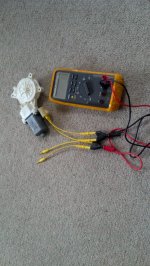
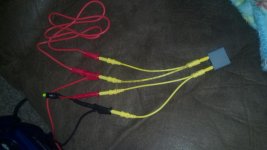
I got my kit out today and hooked up a 4 pin relay, think it's a GM relay. In the first picture the red and black wires on the left are hooked up to my jump pack giving the 12V power. For grounds the LED is plugged directly into the ground wire. And pin 85 is also hooked up to the ground. For the POS wire I have it hooked up to pin 30 on the relay. Pin 87 on the relay goes to the POS of the LED. Then off the POS I have another extension that I'm using as a "switch". I touch this to my yellow adapter on the relay pin 86 to energize the coil and activate the circuit to power the LED. In the second picture you can see the "switch" is connected and the LED is powered on. My LED stayed on as long as the "switch" was on. So not sure why yours didn't.

IMG_20150113_113309_633.jpg

IMG_20150113_113331_241.jpg
 
OP
S

signcrafter

Well-known member
Joined
May 9, 2012
Messages
12,338
Joined
Nov 15, 2014
Messages
17
Sorry about the confusion, guys.

Long story short, I had to change the listing. A few people were really agitating me. So I changed it.

Anyways, if you'd be interested in a set, PM me.

Cheers Gents
 

Jacobson

Well-known member
Joined
Jan 11, 2014
Messages
1,482
Signcrafter,

I got it to work with a new relay.
So, I guess the old relay was bad

Yellow is 85/86
Blue is 30/87

So the coil circuit goes: (+) -> 85 -> 86 -> (-)
The main circuit goes: (+) -> 30 -> 87 -> LED (-) -> LED (+) -> (-)

2czrrdy.jpg
 
Last edited:

Scotland

Well-known member
Joined
Jan 16, 2015
Messages
88
Location
Greenville, SC
Just PM ArchiesToolShop and order a set if you have a Paypal account. They are honoring the old price. I ordered earlier this week and received my kit today. This is a nice test lead kit and shipping was quick.
 
OP
S

signcrafter

Well-known member
Joined
May 9, 2012
Messages
12,338
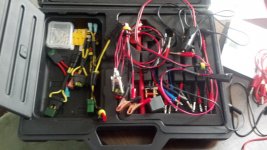
For Jacobson or anybody else interested I finally changed my bad window motor today and took some pictures of how you can use this kit. First I tested the new motor. It's an OE ACDelco part so normally I wouldn't bother testing it before installing it like I would an aftermarket **** part. But since I had the test lead kit I figured why not.

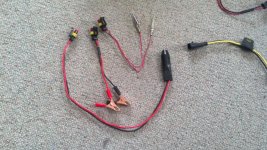
I've added some homemade adapters that I have made over the years to my kit. A while back I bought some weatherpack type connectors and "standardized" my homemade adapters so everything is plug and play. Here's my thread on that, http://www.garagejournal.com/forum/showthread.php?t=242545&highlight=sunday. I love the connectors. Means I can pretty much grab whatever pieces I need and plug them together to make whatever setup I need to test whatever I'm working on. Like today for example I could just grab a lighter plug, fuse holder, and an adapter to connect to the right 4mm banana jacks in the test lead kit. Also in the picture is my homemade fuse adapters for the common fuses to hook up a circuit breaker in place of a fuse to act as a "fuse saver" setup. I built this when the power window kept blowing fuse. It worked great and allowed me to do my testing without going through a million fuses. Here's the thread on that, http://www.garagejournal.com/forum/showthread.php?t=265319&highlight=connector. You could also use your power probe plugged into a jump box and plug the adapters into the PP to power up the device.
IMG_20150128_120615_909.jpg

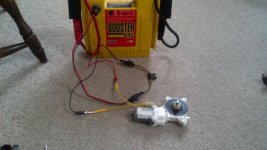
Here's the lighter plug, fuse holder, banana adapter and the two test lead adapters hooked up to the new window motor.
IMG_20150128_120242_971.jpg

Hooked into a jump pack to test the new motor.
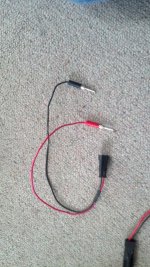
IMG_20150128_120506_783.jpg


The banana to weatherpack adapter I made.
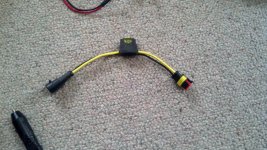
IMG_20150128_120317_395.jpg

The fuse holder I made.
IMG_20150128_120357_879.jpg

Lighter plug, small alligator clips, medium alligator clips that allow me to get power which ever way works the best.
IMG_20150128_120405_842.jpg
 
Last edited:
OP
S

signcrafter

Well-known member
Joined
May 9, 2012
Messages
12,338
So now that the motor is tested it's time to tear the door apart again and replace it with the burnt out one. I didn't do any real testing this time since I already did it a while ago but I did take some pictures of how you can use the kit to test an issue like this.


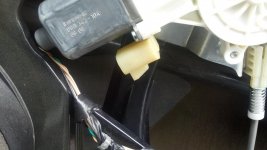
As you can see in this picture the connector for the motor is in an odd place and with the metal door panel that close to it it is really hard to get a normal set of multimeter leads to contact the pins. Also have to stick both the positive and negative test leads into the connector and not accidentally touch them together.
IMG_20150128_131757_527.jpg

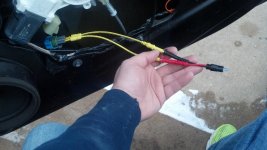
Here I used a couple of the adapters to go into the connector coming from the car and plugged the LED test light into it. So when you press the window button the test light should light up. Keep in mind that LEDs have to have the correct polarity and since window switches reverse polarity to make the window go up and down the LED should only light up for UP or DOWN, not both. I didn't test this out since I was in a hurry and it was cold out but that's how it should work.
IMG_20150128_134740_303.jpg

A close up of the test lead adapters in the vehicle side connector.
IMG_20150128_134747_824.jpg

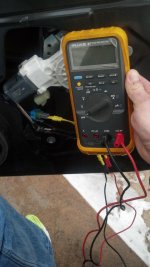
Multimeter hooked up to vehicle side connector so you can see the voltage when you press the switch.
IMG_20150128_134839_749.jpg

Here I hooked up the right adapters to the window motor and hooked them into my PPIII which also uses the 4mm banana jacks so the adapters plug right in. This allows you to apply power to activate the motor.
IMG_20150128_134936_497.jpg

We were talking about the "3 way" adapters in the kit. This was an after thought so I didn't do it in the vehicle but I have adapters hooked into the old motor and into the 3way. Then the male version of the adapters out of the 3way. These would get plugged into the vehicle side connector. Then I plugged the multimeter leads into the 3way. So you can monitor voltage in line while the window motor is being used.
IMG_20150128_140215_268.jpg
 
Last edited:
To avoid these ads, REGISTER NOW!
Top Bottom