Cyanoacrylate
http://en.wikipedia.org/wiki/Cyanoacrylate
I found this interesting. Some information below from Wikipedia. All the usual disclaimers.
-------------------------------------------------------------------
2-octyl cyanoacrylate (used in medical, veterinary and first aid applications). Octyl cyanoacrylate was developed to address toxicity concerns and to reduce skin irritation and allergic response.
-------------------------------------------------------------------
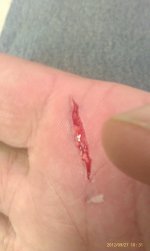
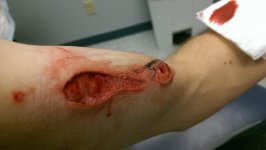
CA glue was in veterinary use for mending bone, hide, and tortoise shell by the early 1970s or before. Harry Coover said in 1966 that a CA spray was used in the Vietnam War to retard bleeding in wounded soldiers until they could be brought to a hospital. Butyl cyanoacrylate has been used medically since the 1970s. In the US, due to its potential to irritate the skin, the U.S. Food and Drug Administration did not approve its use as a medical adhesive until 1998 with Dermabond.[9] Research has demonstrated the use of cyanoacrylate in wound closure as being safer and more functional than traditional suturing (stitches).[10] The adhesive has demonstrated superior performance in the time required to close a wound, incidence of infection (suture canals through the skin's epidermal, dermal, and subcutaneous fat layers introduce extra routes of contamination),[10] and final cosmetic appearance.[11][12]
Some rock climbers use cyanoacrylate to repair damage to the skin on their fingertips.[13][14] Similarly, stringed-instrument players can form protective finger caps (in addition to calluses) with cyanoacrylates.
While standard "superglue" is 100% ethyl cyanoacrylate, many custom formulations (e.g.,, 91% ECA, 9% poly(methyl methacrylate), <0.5% hydroquinone, and a small amount of organic sulfonic acid[15] and variations on the compound N-butyl-cyanoacrylate's for medical applications[10]) have come to be used for specific applications.
-------------------------------------------------------------------
The United States National Toxicology Program and the United Kingdom Health and Safety Executive have concluded that the use of ethyl cyanoacrylate is safe and that additional study is unnecessary.[19] 2-octyl cyanoacrylate degrades much more slowly due to its longer organic backbone that slows the degradation of the adhesive enough to remain below the threshold of tissue toxicity. Due to the toxicity issues of ethyl cyanoacrylate, the use of 2-octyl cyanoacrylate for sutures is preferred.