It seems that if you are using the correct sized tap, it would work.
Normal taps are "cutting" taps. They work by removing material. Cutting taps are sized by having the hole drilled to the minor diameter of the resulting thread. In other words, the choice of drill size determines the "peak" of the treads in the hole. There is considerable wiggle room. Depending on the material, more or less thread engagement may be needed. Look at the "perfect" range in this pic:
For thin/stamped metal, the engagement might be as high as 85% (imagine closer to "too small"), while for deep threads in cast steel it may be approach 50%, or well into "too big". Lower thread engagement is desirable because the more the drill removes (i.e. the bigger the hole) the less the tap has to cut away, prolonging tap life, etc.
The problem is that it doesn't always leave you much to work with. Imagine a cross threaded bolt essentially squeezing the 'peak' of the thread (metal between "too big" and "stripped") into the neighboring 'valleys'. You've effectively enlarged the minor diameter, or in other words it's like you started with too big of a drill bit. If you pass a regular tap through, you'll cut away the material that was squeezed into the 'valley', but it won't leave you with much of anything for a peak!
So will it work? Yes, maybe, maybe not? I've made the mistake of using a tap where I didn't have another option, only to end up with useless threads.
For example, upsizing from a slightly stripped M12x1.25 drain plug to 1/2-20 should work perfectly in theory. (***Ignore boring math - 1/2 is 12.7mm and 1.25 metric threads equate to 20.32 thread per inch. Over the 1/4 inch of the oil pan material, 5 metric thread should equal 5.08 standard fine threads.***) But the reality is that even if the thread is the EXACT same size as the 'proper' plus size M12x1.25 plug, because it cuts material away, the result is different. Those nasty plus-sized plugs work exactly like a thread restorer, or any other self tapping fasteners for that matter.
Instead of cutting away the 'valley' they push it back to the peak - sort of at least. The main point is that even those these two taps below are designed to make the same sized threads, to work properly they must start with holes of a different size. Depending on how bad things are it can make a real difference.
Do the thread restorers have dulled cutting edges or something that just follows along the thread root and sort of forces the steel back into its original shape? Or, are they just like regular taps but undersized slightly so they won't actually cut anything but the distorted parts of the thread?
Pretty much what you were thinking in the bolded portion!
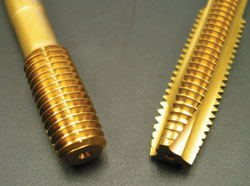
A thread restorer is much more like a forming tap (left above) than a cutting tap. The second video
in this link does an excellent job explaining how a forming tap works.
Here's their summary - note #3 - and this is regarding CNC production, us humans are even more prone to screwing up!:
In short, you're
meant to start with a bigger hole, and the machine cold forming process actually results in
stronger threads than those made with a cutting tap. This image is from a self-tapping fastener, but the idea is the same: only instead of 'creating' thread engagement, it 'restores' it.
Full fledged forming taps require tremendous force to work properly, and can't really be used by hand. But thread restorers are still much closer to a forming tap than a cutting tap.
Here is a pic of a thread restorer - the gap there is more to allow **** to accumulate and not get in the way than to act as a cutting/chipping edge.
By contrast, here are the profiles of a few cutting taps:
On the left is a negative rake, which requires more force to be effective but is also more durable for harder materials. On the right is a positive rake, which cuts/chips like mad and is much easier to use. But in either case, you can see that the design of a cutting tap is all about maximizing cutting efficiency. It doesn't restore what gets in its way, it eliminates it. Yet in so many cases, too much has already been eliminated or compromised.
Thread restorers don't really have a cutting edge at all. There's no flute to speak of and the profile is more about slicing the 'valley' to push it back to the 'peak' than cutting it off. Some forming taps also look an awful lot like cutting taps, but if you look closely they don't actually do any cutting. Here is another brand of forming tap for reference - much closer to the thread restorer than the cutting taps.
Now, I'm not saying these thread restorers are going to solve every problem. The majority of mistakes I've seen and made have come well before you reach for either a tap or thread restorer. And just recently I had to use a tap to repair the thread on an almost new BMW's hardened hub flange. It was easy work with an HSS tap, but even if I had the correct thread restorer size I think it would have struggled and it would have been the wrong tool for the job. The hardened wheel lug had completely given way to the deformed threads.


 ), if you asked about forming taps/thread restorers.


 ). Obviously the OP ask for a tap and die set, so I may have set this off on a tangent.

 The old-timer suggested that the relief could also help pick up some swarf from damaged threads that break off instead of submitting to the will of the tap. This in turn would help prevent them from mucking up the threads that can be saved.