To avoid these ads, REGISTER NOW!

Tap and die set?

To avoid these ads, REGISTER NOW!
OP
S

SuzukiGS750EZ

Well-known member
Joined
Apr 26, 2012
Messages
3,273
I don't really know what I need lol. I use them at work but the sizes are usually all over the place. When I buy tools I try and buy complete large sets so I can cover all my bases in one purchase.
 

Hiball

Well-known member
Joined
Apr 30, 2009
Messages
14,027
Location
Missery
I don't really know what I need lol. I use them at work but the sizes are usually all over the place. When I buy tools I try and buy complete large sets so I can cover all my bases in one purchase.

This set should cover most of your needs, I didn't do any price checking, but tooltopia is normally on top of things. If your luck is anything like mine, regardless of what set you buy, the first one you need will be a oddball.
 
Last edited:

fordbroncodave

Well-known member
Joined
Sep 15, 2009
Messages
4,555
I have had good luck with the dayton sets. I just got a brand new 40 piece metric set for $40 for USA made. I already had the SAE set I got at a pawn shop for $15 for 40 pieces
 

beatcad

Well-known member
Joined
Sep 15, 2013
Messages
4,520
Location
NOVA
yer budget is $200?
I bought a basic craftsman 'merican fine/course set years ago. I used it earlier today.
I've been wanting to buy a bigger set for some time now.
I can get one off the tool trucks for a little over $200. but how often do I need metric?
if you work in a shop that may need both I think the tool truck may be the way to go.
it's been a few months, but I believe I looked at sears a couple months ago and a complete kit(SAE & metric) was just under 100.
 

Sonorous

Well-known member
Joined
Aug 10, 2013
Messages
102
Location
Ottawa/Outaouais/MTL Canada
I don't really know what I need lol. I use them at work but the sizes are usually all over the place. When I buy tools I try and buy complete large sets so I can cover all my bases in one purchase.

I'd probably get a thread restorer kit first. Taps are often used incorrectly as the first choice, and are more likely to permanently compromise whatever your cutting more metal away from.This one by Kastar is apparently identical to the sets sold by Sears and Snap-On too, though Sears appears to be cheapest right now. Shop around!

After that, the Irwin sets are pretty good value for taps/dies. IIRC they end up costing something like $2 a piece. Not too shabby. But if you're really finding yourself cutting fresh threads on a regular basis, you might prefer better quality HSS taps. At that point you should stop buying taps from big box stores and seek out the better stuff from an industrial supply store or similar.

Beyond that, my main issue with the sets is that they aren't really ever complete. I have an overflowing machinist's box of taps and still come up empty handed sometimes. If I was starting from scratch for automotive work, I'd want a more complete metric tap set before any dies. But the whole tidy and integrated 'set' is out the window once you start adding to the collection, and big case full of seldom used pieces just becomes a pain to deal with. I've noticed some sets come as several smaller sets (i.e. metric taps get their own small case), which makes a lot more sense to me.
 

Alienbaby17

Well-known member
Joined
Jan 27, 2014
Messages
338
Location
Minnesota
I have an older Mac branded version of the 117 piece kit. I have had it for probably 15 years and have used it several times a week since. Over the course of that time I have broken 3 or 4 pieces but they were all easily sourced and not expensive to replace. I've found it to be an excellent investment.
 

Engine

Well-known member
Joined
Jan 9, 2014
Messages
646
Location
Kentucky
I'd probably get a thread restorer kit first. Taps are often used incorrectly as the first choice, and are more likely to permanently compromise whatever your cutting more metal away ...

I've heard several times that the regular taps should not be used to restore threads, but I still don't understand why. It seems that if you are using the correct sized tap, it would work. Do the thread restorers have dulled cutting edges or something that just follows along the thread root and sort of forces the steel back into its original shape? Or, are they just like regular taps but undersized slightly so they won't actually cut anything but the distorted parts of the thread?

Other than simply being curious, I'm trying to decide whether it would be necessary to buy a restorer set in addition to a tap & die set, or if the t&d set would be sufficient. As you can tell, I don't use either very often, but I would like to get a set.
 

Makapuu

Well-known member
Joined
Dec 10, 2013
Messages
253
Location
South Bay, CA
I've heard several times that the regular taps should not be used to restore threads, but I still don't understand why. It seems that if you are using the correct sized tap, it would work. Do the thread restorers have dulled cutting edges or something that just follows along the thread root and sort of forces the steel back into its original shape? Or, are they just like regular taps but undersized slightly so they won't actually cut anything but the distorted parts of the thread?

Other than simply being curious, I'm trying to decide whether it would be necessary to buy a restorer set in addition to a tap & die set, or if the t&d set would be sufficient. As you can tell, I don't use either very often, but I would like to get a set.

I am wondering along the same lines where you draw the line between using a thread restorer or a tap and die set.
 
Last edited:
To avoid these ads, REGISTER NOW!

Fretters

Well-known member
Joined
Jan 25, 2014
Messages
4,217
Location
South Yorkshire, England
I've heard several times that the regular taps should not be used to restore threads, but I still don't understand why. It seems that if you are using the correct sized tap, it would work.

This is one of those things you'll get no end of opinions on. Ask it in any non US forum, and the answer will likely be to just use taps. In all these years, from what I've noted, it's only across the pond where the thread restorers seem to have such a cult following. Forming taps are used elsewhere, but you rarely tend to see them suggested. Ask on a UK forum, for example, and you'd likely get a gormless look, (or a mental image of a how a gormless look would look, just from interpreting written text on a screen :D), if you asked about forming taps/thread restorers.

As you surmise, using a correctly sized tap won't have any detrimental effect. If there is distorted metal in there, forcing it back into position is having no useful effect. It has been weakened somewhat when it was deformed, IMHO. it's better to cut the **** out rather tha leaving it to gum the works up later on, or to just damage the bolt thread when it possibly distorts again. I'll sit back and wait for the inevitable earche over my opinion now though. :D


Other than simply being curious, I'm trying to decide whether it would be necessary to buy a restorer set in addition to a tap & die set, or if the t&d set would be sufficient. As you can tell, I don't use either very often, but I would like to get a set.

I personally wouldn't. I'd stick with the taps and dies alone. The only time I've ever heard of a situation where their use sounded feasible was on the slim welded retention nuts in vehicles. The ones where they are so thin that removing any damaged thread would likely leave them practically threadless, so trying to bullhorn any remaining thread back into line is preferable, even though the thread may not be as strong as originally. Either that else it's a case of replacing the nut, which is a far more involved process.
 

Sonorous

Well-known member
Joined
Aug 10, 2013
Messages
102
Location
Ottawa/Outaouais/MTL Canada
It seems that if you are using the correct sized tap, it would work.

Normal taps are "cutting" taps. They work by removing material. Cutting taps are sized by having the hole drilled to the minor diameter of the resulting thread. In other words, the choice of drill size determines the "peak" of the treads in the hole. There is considerable wiggle room. Depending on the material, more or less thread engagement may be needed. Look at the "perfect" range in this pic:

UNthreadform_zps19cf8529.jpg


For thin/stamped metal, the engagement might be as high as 85% (imagine closer to "too small"), while for deep threads in cast steel it may be approach 50%, or well into "too big". Lower thread engagement is desirable because the more the drill removes (i.e. the bigger the hole) the less the tap has to cut away, prolonging tap life, etc.

The problem is that it doesn't always leave you much to work with. Imagine a cross threaded bolt essentially squeezing the 'peak' of the thread (metal between "too big" and "stripped") into the neighboring 'valleys'. You've effectively enlarged the minor diameter, or in other words it's like you started with too big of a drill bit. If you pass a regular tap through, you'll cut away the material that was squeezed into the 'valley', but it won't leave you with much of anything for a peak!

So will it work? Yes, maybe, maybe not? I've made the mistake of using a tap where I didn't have another option, only to end up with useless threads.

For example, upsizing from a slightly stripped M12x1.25 drain plug to 1/2-20 should work perfectly in theory. (***Ignore boring math - 1/2 is 12.7mm and 1.25 metric threads equate to 20.32 thread per inch. Over the 1/4 inch of the oil pan material, 5 metric thread should equal 5.08 standard fine threads.***) But the reality is that even if the thread is the EXACT same size as the 'proper' plus size M12x1.25 plug, because it cuts material away, the result is different. Those nasty plus-sized plugs work exactly like a thread restorer, or any other self tapping fasteners for that matter.

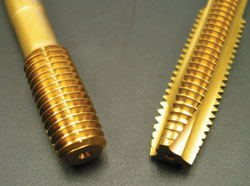
Instead of cutting away the 'valley' they push it back to the peak - sort of at least. The main point is that even those these two taps below are designed to make the same sized threads, to work properly they must start with holes of a different size. Depending on how bad things are it can make a real difference.

Roll-Forming-Taps-Vs.-Cutting-Thread-Taps-On-A-CNC-Mill.jpg


Do the thread restorers have dulled cutting edges or something that just follows along the thread root and sort of forces the steel back into its original shape? Or, are they just like regular taps but undersized slightly so they won't actually cut anything but the distorted parts of the thread?

Pretty much what you were thinking in the bolded portion!

A thread restorer is much more like a forming tap (left above) than a cutting tap. The second video in this link does an excellent job explaining how a forming tap works.

Here's their summary - note #3 - and this is regarding CNC production, us humans are even more prone to screwing up!:

FormingTap_zps5932d610.png


In short, you're meant to start with a bigger hole, and the machine cold forming process actually results in stronger threads than those made with a cutting tap. This image is from a self-tapping fastener, but the idea is the same: only instead of 'creating' thread engagement, it 'restores' it.

TapFlex-small_xenproduct_product_view2.jpg


Full fledged forming taps require tremendous force to work properly, and can't really be used by hand. But thread restorers are still much closer to a forming tap than a cutting tap.

Here is a pic of a thread restorer - the gap there is more to allow **** to accumulate and not get in the way than to act as a cutting/chipping edge.
P1020248.jpg


By contrast, here are the profiles of a few cutting taps:

3rakes_opt.jpeg


On the left is a negative rake, which requires more force to be effective but is also more durable for harder materials. On the right is a positive rake, which cuts/chips like mad and is much easier to use. But in either case, you can see that the design of a cutting tap is all about maximizing cutting efficiency. It doesn't restore what gets in its way, it eliminates it. Yet in so many cases, too much has already been eliminated or compromised.

Thread restorers don't really have a cutting edge at all. There's no flute to speak of and the profile is more about slicing the 'valley' to push it back to the 'peak' than cutting it off. Some forming taps also look an awful lot like cutting taps, but if you look closely they don't actually do any cutting. Here is another brand of forming tap for reference - much closer to the thread restorer than the cutting taps.

30cbbc06-30e1-412c-b150-43ddd59b0c6e_zps4059aa8d.png


Now, I'm not saying these thread restorers are going to solve every problem. The majority of mistakes I've seen and made have come well before you reach for either a tap or thread restorer. And just recently I had to use a tap to repair the thread on an almost new BMW's hardened hub flange. It was easy work with an HSS tap, but even if I had the correct thread restorer size I think it would have struggled and it would have been the wrong tool for the job. The hardened wheel lug had completely given way to the deformed threads.
 

Sonorous

Well-known member
Joined
Aug 10, 2013
Messages
102
Location
Ottawa/Outaouais/MTL Canada
I'll sit back and wait for the inevitable earche over my opinion now though. :D

Of course there's more than one right way to do most things (however, there's only one right side of the road:lol_hitti). Obviously the OP ask for a tap and die set, so I may have set this off on a tangent.

I've seen some unfortunate damage from taps, but in general I agree with you that properly used, taps are able to do the job in the majority of circumstances. The problem in automotive work is that you're usually working with limited access and under the pressure of time. Combine that with a cheaper tap handle and some contaminants in the internal thread, and you've got a recipe for over-sized threads.

And with no disrespect to those who use them routinely - let's face it, those who are always patient and take all precautions to do the best job possible are not usually the ones that will routinely need a tap to extricate themselves from whatever mess they've made. Just think of how often the job shop machinist thinks to himself, "if only they'd brought this too me before they tried XY or Z".

Anyways... A nice little trick if you don't have thread restorers is just cutting a couple slits/flutes/reliefs into a hardened bolt. This is especially good for removing crud/rust/fragments when the thread is relatively easy to salvage but you don't want to risk making a mess of things with a tap.

3d13c8cc-6d98-4a3e-8774-a396b70d386d_zps78b446ce.jpg
 

wafrederick

Well-known member
Joined
Jul 3, 2010
Messages
6,045
Location
Holton,Mi
Matco warranties their taps and dies if you break or dull them.I have both at work,a rethreading set and a regular tap and die set.The rethreading set comes in handy cleaning out dirt and crud out threads in engine blocks including paint.Have used them in new water pumps,the threads were not done right at the factory and the bolts went in hard at first.
 

Engine

Well-known member
Joined
Jan 9, 2014
Messages
646
Location
Kentucky
Thanks, Sonorous. What you are describing makes a lot of sense. I can see that both the thread restorers and the t&d sets have their own separate uses depending on the circumstances.

The Balax videos you posted make a good case for the advantages of the "thread former" cold forming taps over the standard cutting taps, especially in the production environment where multiple holes must be tapped with the greatest efficiency. It would be great to be able to use these in hand-powered applications, but like you mentioned, the torque required to turn them would be too much for most folks to manage. However, if someone is running a production shop it might be worth considering the benefits.

It looks like my best option is to buy a regular cutting t&d set as well as the thread restorer for regular maintenance/repair work.

I hope the OP gets some useful info from all this to help make the decision on what kind of t&d set to buy, even though it's a little off the topic.
 

Sonorous

Well-known member
Joined
Aug 10, 2013
Messages
102
Location
Ottawa/Outaouais/MTL Canada
I discussed this with someone wiser than me about these things. The relief in the former taps is usually to allow lubrication to flow and to prevent hydro-locking of cutting fluid/lubricant in blind holes. Makes sense if you think about it.:beer: The old-timer suggested that the relief could also help pick up some swarf from damaged threads that break off instead of submitting to the will of the tap. This in turn would help prevent them from mucking up the threads that can be saved.
If there is distorted metal in there, forcing it back into position is having no useful effect. It has been weakened somewhat when it was deformed, IMHO. it's better to cut the **** out rather tha leaving it to gum the works up later on, or to just damage the bolt thread when it possibly distorts again.

This is a valid point. Forming taps need the material to be somewhat malleable (as a pre-condition) to work, and also rely on 'work hardening' of the material to achieve the result of stronger threads than are possible with cutting taps in those malleable materials. In other words, even if the material is otherwise malleable to start, it will be somewhat less malleable after the cold forming process is complete. This is good in that it is ultimately stronger, but bad in that it is less able to sustain subsequent deformations.

Huh? I'm not an engineer, but I'll take a crack at making sense of this...

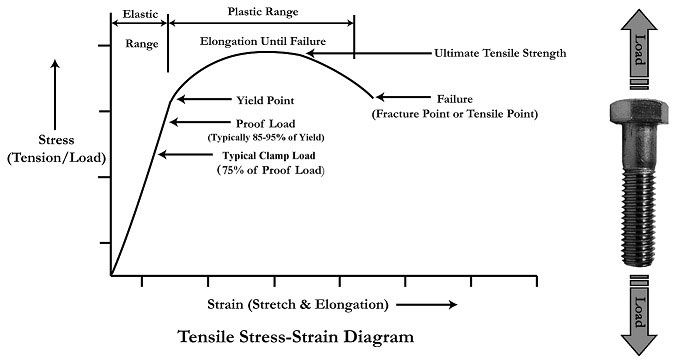
Think about torque to yield bolts. As they are stretched beyond elasticity, the plastic deformation at first actually hardens the bolt and makes it stronger. The 'necking' on those bolts is a good thing! But beyond the ultimate strength point, it gets weaker.

tensile-diagram.jpg


This work hardening phenomenon is also true of cross threaded thread. If some knuckle head fires a crooked grade 8 fastener into mild steel with an impact wrench, the deformation of the threads would be accompanied by increased hardness but decreased possibility for further/subsequent deformation. In other words it'll be harder to restore the threads and that process may push the material to failure.

On the other hand, it may actually further harden the material and be extremely durable. Guessing which will occur is more like blackjack than roulette! Different materials obviously have different characteristics, and malleability does not always correspond with ductility.

ToughnesCurves.jpg


It would be great to be able to use these in hand-powered applications, but like you mentioned, the torque required to turn them would be too much for most folks to manage.

I wouldn't give up so easily. Hand torque would be sufficient for smaller sizes, and there are numerous ways supplement that where needed. The best thing is where you can get a proper tap guide in place. For critical jobs, I've clamped a hand drill "drill press" adapter with an improvised tap guide and ratcheting handle to ensure proper alignment. Done properly the forces on the guide are minimal, but not having to worry so much about alignment you can really put some torque down.

Beyond this, forming taps actually self-align better than cutting taps IMO. A taper tap is easy to get in straight, but once you start cutting, the cutting action isn't usually uniform around the entire tap (i.e. one edge 'bites'). Those uneven forces can push the tap out of alignment, especially when done carelessly.

Given this discussion I may do some experimentation next time I have an uh-oh moment in the garage. Hopefully not in the near future though. :thumbup:
 

IFMJohn

Well-known member
Joined
Jun 6, 2014
Messages
990
Location
Tacoma, WA
If anyone is looking for a tap and die set, I have my snap-on 76 pcs. brand new set on CL for $225. I'd be willing to cut a deal for a GJ member.
 

Sonorous

Well-known member
Joined
Aug 10, 2013
Messages
102
Location
Ottawa/Outaouais/MTL Canada
It looks like my best option is to buy a regular cutting t&d set as well as the thread restorer for regular maintenance/repair work.

+1. Beyond all this hocus-pocus, wannabe metallurgy, this is GJ - the more tools the merrier. Moreover, the restorer kit is often available for about $50 at Sears. That's a lot of value compared to just about anything for $50 off the tool truck.:evil:
 

Gingger22pm

Active member
Joined
Oct 29, 2013
Messages
38
Sorry Fretters but I'm up in Bonnie Scotland and love my kit of restorers, use them every week. Used one this afternoon in fact. My mate put me on to them, he's a fan too. Usually use them for cleaning **** out of the threads or corrosion. Wish I could get a BSF set!
 
OP
S

SuzukiGS750EZ

Well-known member
Joined
Apr 26, 2012
Messages
3,273
I want both something to clean threads as well as say cross threading something and cleaning it. Would both situations be able to use one kit?
 

e30bradley

Well-known member
Joined
Aug 3, 2011
Messages
2,725
Location
Don’t have a garage in Arizona USA
taps do wear out right? I have used my m8x1.25 at least a dozen times and it works great but if I where to invest in a full set should I get the snap on kit because they replace them if they wear out? over my lifetime will it pay off or should I just get the irwin set and replace as needed?
 
To avoid these ads, REGISTER NOW!
Top Bottom