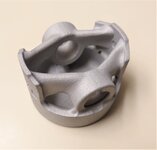
-Not sure where to begin after reading the posts and watching the video. The tolerance(s) required aren't posted, nor is the equipment/machinery involved. I can say that if all you have is a caliper, a worn out lathe (per the video description), and no other measuring equipment then your tolerances better be wide and your expectations low as there's plenty of reasons to expect a seized piston after low running hours.
However, if this is just an experimentation and/or a learning experience then by all means have a go at it. Whether holding a reamer by one hand or two there's multiple reasons to get the axis of the reamer out of alignment with the axis of the holes. Cutting tools need to be rigidly fixed in location to the machine. A chuck in the tailstock of the lathe is no guarantee of alignment either. The leading hole will also likely be larger than the trailing hole as a result. Axis of said holes will likely NOT be perpendicular to axis of piston body. Machining afterwards by using the holes as a reference? Without accurate fixtures (like a good V-block), a surface plate, and indicators it's not likely you'll produce good results to know where and how much to machine off the piston body.
I don't want to discourage you or piss in your corn flakes but you have too many variables, too little equipment, not enough (by your admission) skills, and no previous attempts to form a baseline of info. You may succeed at achieving poor-to-mediocre results. If you're prepared for this and still wish to push on then record EVERYTHING you do to analyze areas for improvement the next attempt.
Good luck and report back if you want further assistance. Ganbatte.
This piston is really just for demonstration/experimentation purposes, so as long as the wrist pin bores are nearly perpendicular to the piston OD, that should allow it to function "long enough"...
I do have a small lathe and micrometers, small bore gauges...but I am no machinist, but patient and meticulous enough to creep up on dimensions.
Now I see that the hand reamer doesn't even fit into these very oblong holes, so that bad idea is scrapped. I'll have to start them with an endmill or boring bar to ensure they're not led off center.
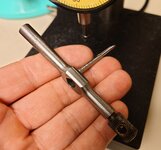
My plan is to bore the wrist pins open to size, then indicate on the wrist pin to align it to the lathe cross slide. Then take a skim cut on the bottom of the piston skirt so it serves as a datum for the next fixture.
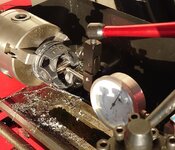
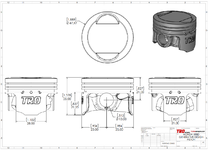
Then mount the piston into this fixture and cut the OD of the piston (oversized by 0.5 mm) and cut the ring grooves. For these purposes, the typical elliptical and tapered piston won't be necessary.

I'm also considering boring the wrist pin holes as seen in this video by chucking it up on one side. I'd just turn down some stock until is just barely fits into the oblong bores and do one side at a time.